
Value-based pricing is a strategy that anchors your product's price to the tangible, economic value it delivers to the customer. Instead of focusing inward on your production costs or sideways at competitors, this approach shifts the focus outward to a critical question: "What problem are we solving, and what is that solution worth to our customer's business?"
This model directly links your pricing to the measurable benefits and financial impact your solution provides. It's about capturing a fair share of the value you create, moving the conversation from your costs to your customer's outcomes.
Rethinking Price Beyond Cost
Many B2B companies default to two pricing models: cost-plus or competitor-based. While simple, these strategies often leave significant revenue on the table and can push brands into a race to the bottom on price. They ignore the primary driver of any purchase decision: the value delivered to the customer.
Cost-plus pricing calculates price by adding a standard margin to the cost of goods sold. It’s predictable but completely disconnected from market demand or the unique advantages of your product.
Competitor-based pricing sets prices based on what rivals are charging. This reactive approach frequently leads to price wars, eroding margins across the industry and commoditizing your product.

Shifting Focus to Customer Outcomes
Value-based pricing flips the script. The core question becomes, "How much is this solution worth to our customer?" This moves the conversation from internal spreadsheets to the real-world operational and financial challenges your customers face.
For example, a company selling industrial automation hardware using a cost-plus model would price it based on components, labor, and a markup.
With a value-based model, the price is anchored to the economic benefit it generates. You justify the price by quantifying the labor hours it saves a factory, the measurable reduction in safety incidents, or the direct increase in production throughput. The price reflects the outcome, not the inputs.
The Commercial Impact of Value Alignment
This strategic pivot directly impacts the bottom line. Companies that commit to value-based strategies often realize significant financial returns. Research shows that a successful implementation can boost a company's return on sales by an average of 5 to 10 percent.
In a real-world example, a network equipment manufacturer facing an industry downturn shifted its focus to the superior value its product delivered. By quantifying this value, the company successfully increased its price by over 24%. You can learn more about the financial benefits of value-driven models and how it works in practice.
Value-based pricing is a strategy to align price with the economic benefit the customer receives. The focus shifts from 'What did this cost to make?' to 'What is this worth to my customer?'.
To clarify the differences, here is a comparison of the three main pricing approaches.
Comparing the Three Core Pricing Strategies
| Strategy | Pricing Focus | Primary Advantage | Key Disadvantage |
|---|---|---|---|
| Value-Based | Customer's perceived value and ROI | Maximizes profitability and reinforces brand value | Requires deep customer and market research |
| Cost-Plus | Internal production and operational costs | Simple to calculate and ensures a consistent margin | Ignores customer value and competitive dynamics |
| Competitor-Based | What rivals are charging for similar products | Easy to implement and keeps you in the market ballpark | Leads to price wars and commoditization |
While cost-plus and competitor-based strategies are easier to implement, they leave businesses vulnerable. Value-based pricing is the only approach that builds a sustainable, profitable advantage. By adopting this mindset, B2B leaders can achieve several critical business goals:
- Defend and Increase Margins: Get paid for the unique value you create, not just the sum of your parts.
- Justify a Premium Position: Build a clear, data-backed narrative for why your product is worth more than the competition.
- Build a Sustainable Advantage: Force your organization to deeply understand your customers, which fuels innovation that solves their most critical problems.
This shift requires a sophisticated understanding of both customers and the competitive landscape. Quantifying your unique value is essential, and this is where automated competitor tracking becomes a critical tool. For instance, a platform like Market Edge can deliver the SKU-level intelligence needed to pinpoint feature gaps and build an undeniable, data-driven case for your price.
When to Use Value-Based Pricing (And When Not To)
Value-based pricing is a powerful strategy, but it’s not a universal solution. The core principle is to shift the conversation from what your product is to what your product does for the customer's business. If your product is easily substituted with nearly identical competitors, simpler models like cost-plus or competitor-based pricing may be more practical.
However, if you have true innovation, sticking to those models means leaving money on the table. You're allowing your R&D and unique market position to be undervalued.
Scenarios Where Value-Based Pricing Shines
This approach is most effective under specific conditions. If these points describe your business, you are likely in a prime position to implement value-based pricing.
- You've Built Something Truly Innovative: When your product has unique technology or features that competitors cannot match, its price should reflect the new efficiencies, cost savings, or revenue streams it creates for customers.
- You're Solving a Nasty Problem for a Niche Market: If you are the go-to solution for a specific, high-cost problem within a defined customer segment, those customers will often pay a premium for a perfect fix. The greater the pain point, the more they value the solution.
- Your Brand is Your Strongest Asset: In industries like specialized medical parts or critical enterprise software, reputation is a key value driver. Customers aren't just buying a product; they're buying reliability and peace of mind. That certainty is worth a premium.
Use Case: A manufacturer of specialized medical components can command a premium price by proving its parts lead to lower device failure rates. For a hospital, this translates to a lower total cost of ownership and better patient outcomes—a value proposition that extends far beyond the component's manufacturing cost.
When to Stick with Simpler Pricing Models
Conversely, applying value-based pricing in a commoditized market is often ineffective. If you sell standard-issue industrial fasteners, customers primarily care about price and availability. In that environment, cost-plus pricing and diligent competitor tracking are the most practical strategies.
Knowing the difference is crucial. Value-based pricing is a proven strategy in tech-heavy sectors like SaaS and AI, where delivered value can be exponentially higher than production costs. Research confirms it works best when customers perceive real differences in quality or benefits, but it falls flat in price-sensitive, commoditized markets. B2B distributors must pinpoint their differentiators, and competitive intelligence is the key. You can read more about the challenges and rewards of putting this strategy into practice.
To make the right decision, you need an unfiltered view of your product's standing in the market. This requires more than just tracking competitor prices; it demands SKU-level data. This is where a tool like Market Edge becomes useful, providing the hard evidence to see exactly where your product outperforms the competition and enabling you to build a value-based price you can confidently defend.
A Step-By-Step Implementation Framework
Switching to value-based pricing requires a methodical, data-backed plan. You're not just picking a number; you're building a business case for your price based on the real economic impact you deliver.
This five-step framework provides a roadmap for putting this theory into practice.
The core idea is simple: find your niche, create a superior solution, and then price it based on that unique advantage.
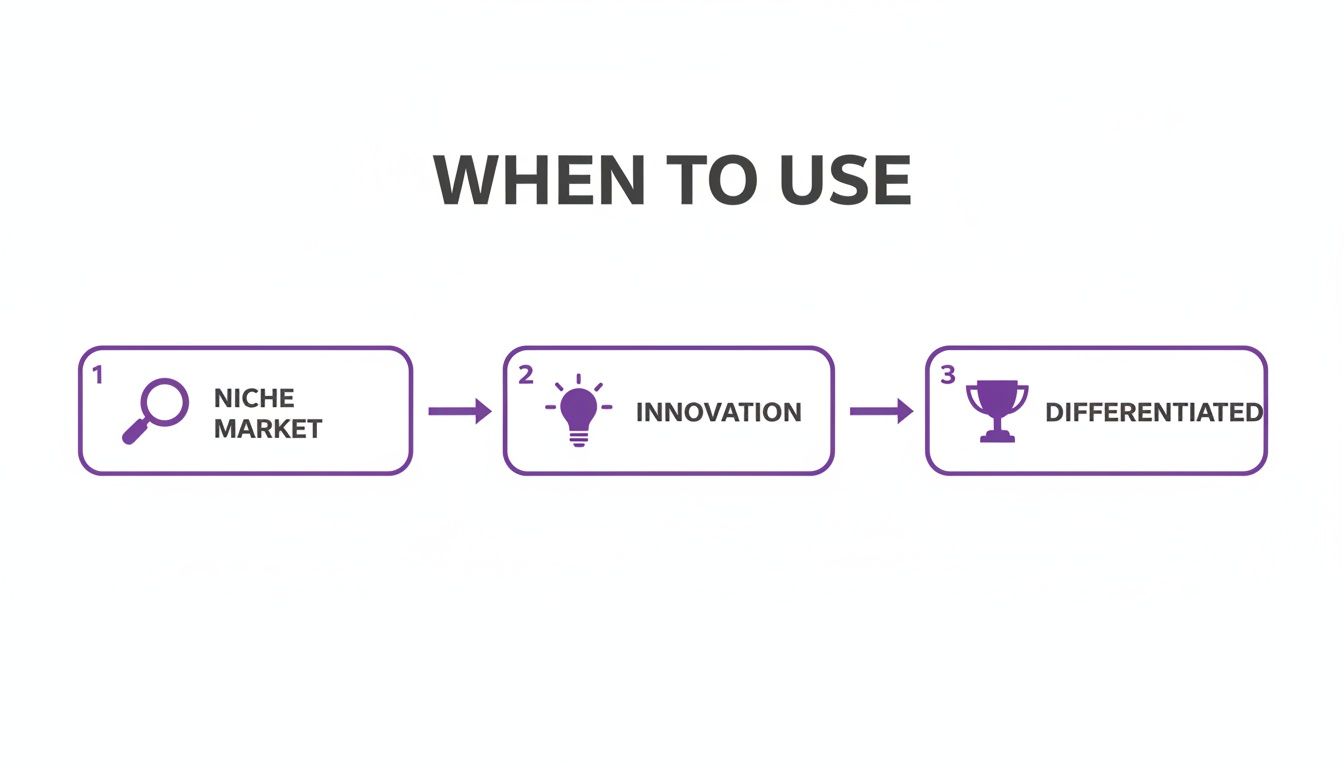
Remember, value is not one-size-fits-all. It is defined by how well your product solves a specific problem for a specific customer segment.
Step 1: Identify and Segment Your High-Value Customers
Not all customers derive the same value from your product. The first step is to identify which customer segments gain the most measurable benefit. A single price point fails to capture the reality that your solution might be a minor convenience for one company but a transformative investment for another.
Start by analyzing your current customer base. Look for patterns among your best accounts. What industries are they in? What is their company size? What specific problems do they consistently say you solve for them? This goes beyond demographics to build detailed personas of your ideal buyers.
Once you have defined these segments, you can tailor your value proposition and pricing accordingly. Accurate segmentation is foundational, as the value calculated in the next step will differ for each group.
Step 2: Quantify the Economic Value Your Product Delivers
This is the most critical and data-intensive step. You must move beyond vague claims like “we boost efficiency” and put hard numbers behind your value proposition. This is often referred to as calculating the Economic Value to the Customer (EVC).
EVC represents the total financial gain a customer receives from your product, minus the costs to acquire and use it. Your task is to build a clear, defensible equation around this.
- Value Drivers: What specific outcomes does your product drive?
- Increased Revenue: Does it help them win more business or enter new markets?
- Reduced Costs: Does it decrease labor, material waste, or maintenance expenses?
- Mitigated Risk: Does it prevent costly downtime, compliance penalties, or safety incidents?
You need data to substantiate every claim. If you state that you reduce maintenance time, you must know the average hourly rate for a technician and the precise number of hours your product saves. This is where deep competitive intelligence is essential. For a primer on the basics, see our guide on how to determine product price.
You must also prove your value against the next best alternative. By analyzing SKU-level competitor data, you can isolate the unique features and benefits that your rivals cannot offer. A price monitoring tool, like Market Edge, can provide the granular data needed to find these differentiators and build an evidence-backed case for a premium price.
Step 3: Select Your Value Metric and Pricing Structure
Once you have quantified the value, you need to decide how to charge for it. The value metric is the unit you base your price on—for example, "per user," "per gigabyte," or "per transaction." The key is to choose a metric that scales as the customer derives more value.
A SaaS company might charge per seat if value is tied directly to the number of users. However, if the primary value is in data processing, a metric based on data volume would be more appropriate. Research indicates that buyers prefer outcome-based metrics, such as paying per "successful resolution" for a support tool, as it aligns payment with results.
Your pricing structure builds on that metric. Common approaches include:
- Tiered Pricing: Offering different packages (e.g., Basic, Pro, Enterprise) with escalating features and value.
- Usage-Based Pricing: Customers pay for what they consume, ideal for accounts with variable usage.
- Flat-Rate Pricing: A single price for a defined set of features, valued for its simplicity and predictability.
Step 4: Arm Your Sales Team to Communicate Value
A well-calculated price is ineffective if your sales team cannot articulate its value. Shifting to value-based pricing requires a significant change in the sales conversation—from features and price to business impact and return on investment.
Your team needs the right tools and training:
- Value Calculators: Simple tools, such as a spreadsheet, that allow reps to input a prospect's numbers to demonstrate potential savings or revenue gains.
- Case Studies: Real-world examples from existing customers in similar industries who have achieved measurable results.
- Battle Cards: Quick-reference guides detailing the value proposition against key competitors, supported by the data gathered in Step 2.
The objective is to empower your sales team to transform price objections into value-focused conversations.
Step 5: Monitor, Test, and Refine Your Pricing
Value-based pricing is not a "set it and forget it" exercise. Customer needs evolve, competitors launch new products, and market conditions shift. You must continuously monitor the landscape and adapt your strategy.
Key Takeaway: Pricing is a process, not a one-time project. The most successful companies treat pricing as an ongoing discipline, constantly gathering data and refining their approach to stay aligned with the market and customer value.
Establish a dashboard with key performance indicators (KPIs) like win/loss rates, average discount levels, and customer lifetime value (CLV) for each segment. Use this intelligence to conduct small pricing experiments, such as testing a new price point or bundle for a specific audience. This constant feedback loop is essential for maintaining a sharp, profitable, and defensible pricing strategy.
Value-Based Pricing Implementation Checklist
This checklist breaks down the implementation framework into actionable tasks. Use it to guide your process and ensure you have the right data to avoid common missteps.
| Step | Key Action | Data Needed | Common Pitfall |
|---|---|---|---|
| 1. Segment Customers | Identify customer groups with the highest perceived value. | Customer interviews, sales data, usage analytics. | Using broad demographic data instead of behavior and needs. |
| 2. Quantify Value | Calculate the EVC for each segment using hard data. | Competitor pricing, industry benchmarks, customer operational data. | Relying on vague claims like "improves productivity" without numbers. |
| 3. Choose Metric | Select a pricing metric that aligns with value delivery. | Customer feedback on fairness, usage patterns. | Picking a metric that punishes customers for growth (e.g., per user). |
| 4. Train Sales | Equip the sales team with tools to sell on ROI, not features. | Value calculators, case studies, competitive battle cards. | Assuming salespeople can make the switch without new training and tools. |
| 5. Monitor & Refine | Track pricing KPIs and run experiments to optimize. | Win/loss rates, discount trends, churn rates by segment. | Treating pricing as a one-and-done project instead of a continuous process. |
By systematically working through these steps, you can build a pricing strategy that not only reflects your true value but also becomes a powerful competitive advantage.
Using Competitive Intelligence to Define Value
Value is never defined in a vacuum. A product's worth is always relative to the customer's next best alternative, which almost always means a direct competitor. This is where the theory of value-based pricing meets the practical work of competitive intelligence. You cannot set a confident value-based price without a deep, evidence-backed understanding of the competitive field.
This goes beyond simple price checks. Modern competitive intelligence digs into the why behind a competitor's move and, more importantly, identifies the unique advantages you hold that make a price match unnecessary.

From Price Alerts to Value Quantification
Traditional price monitoring tells you what your competitors charge. True competitive intelligence provides the context needed to quantify your unique value. It is the raw material for building a robust business case for your price.
This deeper intelligence uncovers data that translates directly into financial terms for your customer.
- Feature Gaps: Does your industrial pump have a self-cleaning feature that competitors lack? Quantify that value. If it saves a customer 10 hours of maintenance a month and their technician costs $75/hour, you have identified $750 in monthly value exclusive to your product.
- Stock Availability: Is your top competitor consistently out of stock on a critical component? Your reliable inventory is not just a logistical advantage; it is risk mitigation for your customer, preventing costly production downtime. This reliability has a tangible monetary value.
- Service and Warranty Differences: If your product includes a two-year warranty while competitors offer one year, you are saving the customer the cost and disruption of potential repairs or a replacement in that second year.
This is how you shift from making vague marketing claims to presenting a defensible, data-driven value statement. This process is central to effective competitive intelligence gathering, turning raw market data into powerful pricing insights.
Defending Your Price with SKU-Level Data
When a customer pushes back on price, a generic response like "we offer better quality" is insufficient. A value-based pricing strategy demands a sharper, data-driven answer.
This is where SKU-level intelligence becomes a powerful tool. By monitoring specific products—both yours and your competitors'—you can build a detailed, feature-by-feature comparison. This arms your pricing and sales teams with the precise reasons for a price premium.
A pricing manager, armed with SKU-level data, can inform the sales team: "Competitor X is cheaper, but their model lacks the reinforced steel housing our unit has, which extends its operational life by an average of three years under heavy use. For the customer, our price premium is an investment that avoids a full replacement cost down the line."
This level of granular detail reframes the conversation from price to total cost of ownership (TCO) and long-term ROI.
Enforcing MAP and Responding Strategically
Competitive intelligence is also a critical tool for brand and pricing governance. For manufacturers with a Minimum Advertised Price (MAP) or Recommended Retail Price (RRP) policy, automated monitoring is the only practical way to ensure compliance across a broad network of resellers and marketplaces.
When a reseller breaks MAP, it not only squeezes margins but also devalues the product in the eyes of all customers, making it harder for other partners to sell based on its true worth. Swift detection and enforcement are essential.
Continuous market monitoring also enables strategic responses to market changes. When a rival adds a new feature or adjusts their service terms, you are immediately aware. This allows your team to proactively update your value proposition and messaging, ensuring your pricing always reflects your true market position. This is where automated price monitoring tools like Market Edge become useful.
Watch Out for These Common Pitfalls
Switching to value-based pricing can significantly improve profitability, but the path has potential missteps that can derail the entire effort. Success requires knowing what not to do.
A common blunder is pricing based on internal perceptions of value instead of what customers actually value. It is easy to brainstorm a price in a conference room; it is much harder, yet essential, to validate those assumptions with customer research. Skipping this step results in a price that is disconnected from market reality.
Another classic mistake is simply providing the sales team with a new price list and expecting them to succeed. Without the right training and messaging to sell value, they will revert to selling features. At the first sign of a price objection, they will offer discounts, and the entire strategy will crumble.
Forgetting to Keep an Eye on the Market
Many companies treat pricing as a one-time project. You cannot set your price and walk away. Markets are dynamic: competitors add features, customer needs shift, and economic conditions change. The value you offered six months ago may not be the same today.
Value isn't a static number you calculate once. It's a moving target that you have to constantly track against what everyone else is doing. If you're not watching the market, you're pricing with old news.
When you stop monitoring, you create risks:
- Losing deals because a competitor launched a key feature you didn't see coming.
- Leaving money on the table because you didn't realize your product's value had increased relative to others.
- Eroding margins through defensive discounting because you lack the data to prove your premium is justified.
Dropping the Ball on Execution
Even a brilliant pricing strategy is worthless without proper execution. There is often a significant gap between the list price and the price a customer actually pays. A 2023 analysis revealed that companies realized only 48% of their planned price increases after all discounts and promotions were accounted for.
This represents a massive execution failure. Conversely, when a global IT services provider equipped its sales team with a structured pricing toolkit, it boosted earnings by around 5 percent. This demonstrates that with the right support, the gap can be closed. You can learn more about how value-based pricing boosts revenue growth when implemented correctly.
Treating All Customers the Same
Finally, a one-size-fits-all price is a fatal flaw in B2B. The value your product delivers to a small startup is completely different from the value it provides to a large enterprise. Grouping them together prevents you from capturing the maximum value from your most important accounts.
Proper segmentation is the foundation of a solid value-based strategy. It allows you to fine-tune not just your price but your entire message to address the specific problems and goals of each customer group.
Avoiding these pitfalls comes down to a commitment to data. Continuous competitor and price monitoring is necessary to keep your value proposition sharp and your pricing optimized. This is where automated tools like Market Edge become essential, providing the real-time intelligence to navigate these challenges and protect your profitability.
Your Action Plan for Smarter Pricing
Making the leap to value-based pricing is a fundamental shift in how your organization operates. It is a commitment to understanding, measuring, and communicating the real-world economic impact you deliver. This approach is the most effective way to defend margins, command a premium, and build a foundation for long-term growth.
Success depends on two key elements: deep customer insight and robust market intelligence. You cannot quantify value without intimately understanding a customer's pain points and business goals. And without a real-time view of your competitors' actions, your value proposition lacks the context needed to win a sale. The framework we’ve discussed provides the map, but consistent, reliable data is the fuel.
Final Checklist for Leaders
As you prepare to implement this strategy, review this checklist with your team to focus your efforts and ensure alignment toward a more profitable pricing model.
- Audit Your Data: Is your competitive intelligence sharp enough to pinpoint your unique advantages at the SKU level?
- Segment Your Customers: Have you identified which customer groups derive the most measurable, bottom-line value from your products?
- Equip Your Sales Team: Are your reps comfortable selling ROI and total cost of ownership, or are they still focused on features?
- Establish Pricing KPIs: Do you have a system in place to track metrics like win/loss rates and discount patterns to continuously refine your approach?
Quantifying your unique value proposition begins with a clear picture of the market. The detailed insights required are available through specialized pricing analytic software that automates the heavy lifting of data collection.
This is where automated tools like Market Edge become indispensable, giving you the foundation to build and maintain a pricing strategy that’s truly driven by data.
Frequently Asked Questions
Even with a solid plan, switching to value-based pricing can seem daunting. Here are answers to common questions from B2B leaders considering this move.
How Do I Start with a Large Product Catalog?
For businesses with thousands of SKUs, a comprehensive rollout is impractical. Start small with a pilot program.
Focus on a single, high-impact product line or a category where your value proposition is clear and defensible. These are products with measurable advantages or those critical to your most valuable customer segments. Use this pilot to refine your process, train a small sales team, and track the impact on margins and win rates.
The lessons and data from this focused test will provide a proven playbook for a broader rollout across your portfolio.
Is This Just an Excuse to Charge More?
No. Value-based pricing is not about arbitrarily increasing prices; it is about aligning price with the real economic value a customer receives. If your solution saves them more money, increases their revenue, or reduces their risk compared to any alternative, it is, by definition, more valuable. The price should reflect that.
The question changes from, "What did this cost us to make?" to "What is this solution actually worth to our customer's business?"
When implemented correctly, both parties benefit. The customer receives a solution with a clear ROI, and you are compensated fairly for the superior value you deliver.
What Is the Sales Team's Role in This Strategy?
Your sales team is critical to the success of this strategy. They must transition from being product pitchers to value consultants who can speak the language of business outcomes.
This requires arming them with the training and data to confidently explain the "why" behind your price. They need to become adept at diagnosing a customer's financial pain points, calculating the ROI your product will deliver for them, and reframing the conversation from price to total cost of ownership.
Without a sales team capable of executing this on the front lines, even the best value-based pricing strategy will fail.
Successfully implementing this strategy requires continuous, granular insight into the competitive landscape. Market Edge provides the SKU-level data needed to quantify your unique advantages and defend your price with confidence. Learn more at https://marketedgemonitoring.com.