
Pricing analytic software is a critical tool for B2B decision-makers. It automates the collection and analysis of pricing data from competitors, marketplaces like Amazon, and your own resellers. Instead of being overwhelmed by raw numbers, you get clear, actionable insights to make proactive, data-driven decisions that protect margins and uncover growth opportunities.
This guide explains how this software works, its direct commercial impact, and how to implement it effectively.
Why Manual Price Tracking Is a Losing Strategy
In today's fast-moving market, using spreadsheets for price tracking is a direct path to margin erosion. Manually checking competitor sites is slow, prone to human error, and cannot keep pace with real-time market changes. By the time your team compiles the data, it's already outdated. This leaves you reacting to old information—either overpriced on key products or, more commonly, leaving money on the table.
This reactive approach creates significant business risk. Without a live view of the market, you cannot effectively enforce Minimum Advertised Price (MAP) policies, which damages brand equity and creates channel conflict with distribution partners. You also miss strategic opportunities to adjust pricing based on competitor stockouts or emerging market trends.
The Shift to Automated Intelligence
This is where pricing analytic software provides a decisive advantage. It acts as a 24/7 market intelligence team, automating the entire data collection process and delivering a continuous stream of accurate information. This frees your team from low-value data entry.
The software systematically tracks product prices across any website or marketplace you designate. More importantly, it organizes that data to provide immediate answers to crucial business questions:
- Who is selling my products below MAP?
- Which competitors just dropped prices on a key product line?
- Are we priced competitively on our most important SKUs?
- Which resellers are consistently out of stock?
By automating this work, companies reverse the typical resource allocation. Instead of spending 80% of their time collecting data and only 20% analyzing it, they flip that ratio. This allows key personnel to focus on strategic decisions that defend margins and drive growth. This is the core function of automated tools like Market Edge.
What This Software Actually Does to Drive Profit
The commercial value of pricing analytics software comes from its core functions, which directly protect margins, grow market share, and uphold brand reputation. For business leaders, understanding these features clarifies how the technology translates into measurable financial results.
The software is built on four key pillars. Each one solves a specific, recurring business problem, turning market noise into a competitive advantage.
Automated Price Monitoring
A solid pricing strategy requires a complete, real-time view of the market. Automated price monitoring delivers this without manual effort. The software continuously scans competitor websites, marketplaces, and reseller channels to track prices, promotions, and stock levels.
This means you get an instant alert when a competitor slashes prices, allowing you to make an informed decision before losing sales.
Real-World Example: An industrial parts distributor uses automated monitoring to track hundreds of online resellers. The platform flags a key competitor consistently undercutting the market by 3-5% on high-volume items. Instead of entering a price war, the distributor uses this intelligence to renegotiate better terms with their supplier, protecting their margin while remaining competitive. This is a classic use case we explore further in our guide to competitor price monitoring software.
Competitive Intelligence
While price monitoring tells you what's happening, competitive intelligence helps you understand why it matters. The software aggregates historical data to reveal patterns, trends, and the strategic moves of your rivals.
It helps answer key strategic questions:
- Market Position: Are you perceived as the premium, budget, or mid-market option? The data provides the answer.
- Promotional Cadence: How often do your competitors run promotions? Which product lines do they discount most heavily?
- Product Assortment Gaps: Are there popular products your competitors carry that you don't?
This analysis enables more effective benchmarking and informs decisions on product assortment and promotional strategy.
MAP and RRP Enforcement
For manufacturers and brand owners, maintaining price integrity is essential for protecting brand value and retailer relationships. However, Minimum Advertised Price (MAP) and Recommended Retail Price (RRP) policies are only effective if they are enforced. Policing thousands of online sellers manually is impossible.
Pricing analytics software automates the entire enforcement workflow. The system instantly flags any seller violating pricing rules and provides documented proof—including screenshots and timestamps—to enable immediate action.
This is not just about penalizing rule-breakers. It is about protecting the perceived value of your brand and ensuring a level playing field for authorized retailers who adhere to your policies. Consistent enforcement prevents price erosion and maintains a healthy distribution channel.
Real-World Example: A premium consumer electronics brand uses MAP monitoring to protect its brand image. The software identifies an unauthorized seller on a third-party marketplace listing a new product 20% below MAP. The brand manager receives an automated alert with a screenshot, URL, and timestamp. A takedown notice is issued within minutes, preventing a domino effect of price drops among legitimate retail partners.
Dynamic Price Optimization
This is where all the data converges to enable faster, more profitable decisions. Dynamic price optimization uses business rules or AI to recommend or automatically execute price changes based on real-time market conditions. This is where pricing analytic software unlocks its full potential.
These optimization engines can process multiple variables simultaneously:
- Competitor price changes
- Current inventory levels
- Historical sales trends
- Pre-set profit margin floors
This allows you to capitalize on opportunities instantly. For example, the software can automatically increase a price when a key competitor goes out of stock or lower it to match a new market price—all within your predefined rules. Platforms like Market Edge provide the clean, real-time data feeds required to power these advanced strategies.
How Pricing Analytics Works Under the Hood
To trust the insights from pricing software, it's useful to understand the process. The system operates on three core steps: data collection, product matching, and data cleansing. This automated workflow operates at a scale and accuracy that no manual effort can replicate.
Data collection functions like a fleet of digital shoppers. These web crawlers constantly visit competitor websites, marketplaces, and reseller pages, recording prices, stock levels, shipping costs, and promotional details. This creates a live feed of market data.
This flowchart illustrates the loop that transforms raw data into profitable action.
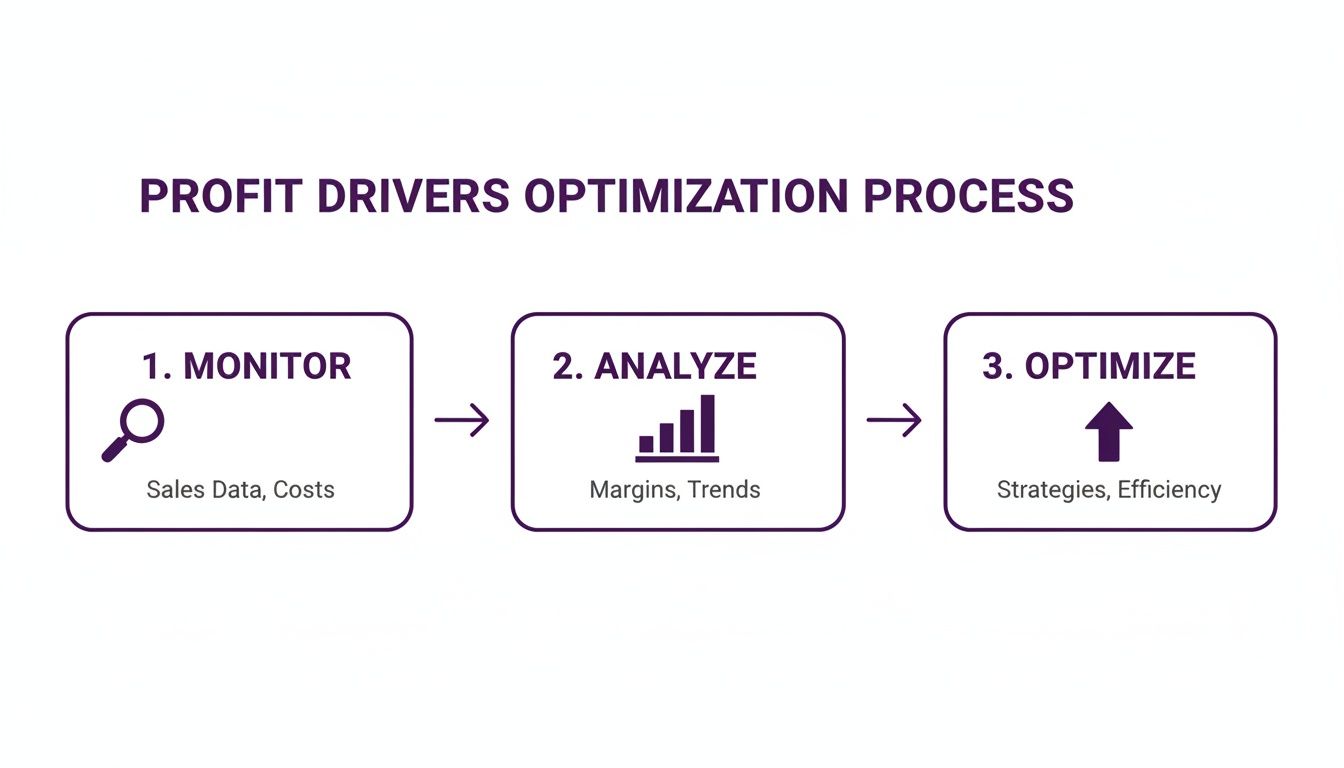
This monitor-analyze-optimize cycle is the engine of a data-driven pricing strategy, enabling businesses to respond to market shifts intelligently.
AI-Powered Product Matching
Once data is collected, it must be matched to your specific products. A competitor might list the "A-500 Pro Series Blender," while you call it the "Pro Blender A500." Matching these variations across thousands of SKUs and dozens of websites is an impossible manual task.
This is where AI-powered product matching is essential. The software uses algorithms to analyze product titles, descriptions, images, model numbers, and UPCs/EANs. It intelligently connects your SKUs to the correct competitor listings, even when naming conventions differ.
This AI-driven step makes competitive data truly actionable. Without it, you are comparing dissimilar items, which leads to poor pricing decisions. The best platforms, like Market Edge, use these advanced matching techniques to ensure the data is directly relevant to your product catalog.
The Critical Role of Data Cleansing
The final step is data cleansing and normalization. Raw data from the web is inherently messy, containing different currencies, misplaced decimals, or temporary placeholder prices. "Dirty" data leads to costly mistakes.
A pricing decision is only as good as the data it's based on. Data cleansing is the non-negotiable process that transforms messy, raw information into a trustworthy asset ready for strategic action. It filters out the noise, corrects errors, and structures the data for consistency.
Effective pricing analytics software includes a rigorous cleansing phase:
- Standardizes formats: Converts all prices to a single currency and ensures consistent formatting for metrics like stock levels.
- Identifies outliers: Flags obviously incorrect prices (e.g., a $50 item listed for $9,999) to prevent them from skewing analysis.
- Structures the data: Organizes everything into a clean database for easy interpretation in dashboards and reports.
This quality control ensures that when you receive an alert or view a report, the information is reliable and you can act on it with confidence. It’s this demand for clean, real-time data that is projected to drive the global Price Optimization and Management Software market to USD 1,824.5 million in 2025. You can learn more about the growth of price management tools in this detailed market report.
Practical Use Cases For Your Business Type
Pricing analytics software is not a one-size-fits-all solution. Its power lies in how different businesses apply it to solve their specific commercial challenges. A manufacturer uses it for brand protection, while an online retailer uses it to win the buy box on a competitive marketplace.
Here are three real-world examples of how different businesses use this software to achieve tangible results.
Use Case For Manufacturers
The Problem: A high-end power tool manufacturer was losing control of its brand due to widespread MAP (Minimum Advertised Price) violations. Unauthorized resellers were consistently undercutting authorized dealers, damaging the brand's premium reputation and straining relationships with key retail partners. Manual tracking was ineffective.
The Solution: They implemented a pricing analytics platform to automate MAP enforcement. They loaded their top 100 SKUs and 50 key online retailers into the system, which then continuously scanned for prices below their MAP policy. When a violation was detected, the software automatically captured a time-stamped screenshot for proof and sent an alert to the brand protection team.
The Measurable Result: Within three months, they achieved a 95% reduction in MAP violations. This stabilized channel pricing, rebuilt trust with authorized retailers, and stopped the brand erosion.
Use Case For Distributors and Importers
The Problem: A regional distributor of electronic components operated on thin margins. They needed to balance competitive pricing with profitability, monitoring their own reseller network while also tracking competitor distributors to protect market share without initiating a price war.
The Solution: The distributor used pricing analytics for a 360-degree market view. They monitored their key resellers to identify partners who were discounting too aggressively, providing data for constructive conversations about protecting value. Simultaneously, they tracked the prices of direct competitors on identical product lines to see where they were over- or under-priced.
This intelligence is critical. The Pricing Software Market, valued at USD 1.15 billion in 2025, is projected to hit USD 1.78 billion by 2029. The manufacturing sector, comprising 23.6% of this market, increasingly relies on these platforms to benchmark costs and protect slim margins. This is where a tool like Market Edge helps spot margin leakage. You can find more data on the growing pricing software market on ResearchAndMarkets.com.
The Measurable Result: They discovered they were 10% overpriced on a major product category. After adjusting their price to align with the market, they saw a 15% increase in sales volume for that category in the following quarter, delivering a significant revenue boost without sacrificing overall margin.
Use Case For Online Retailers
The Problem: An e-commerce retailer selling on Amazon and their own website was constantly losing the Amazon Buy Box on their most popular items due to rapid competitor price changes. Each loss was a direct hit to sales and visibility.
The Solution: They implemented pricing analytic software with competitive intelligence and automated repricing capabilities. They configured the tool to monitor their top five competitors for their 500 best-selling products, with data refreshed every 15 minutes. The software sent instant alerts for competitor price changes or stockouts. Using this live data, they established a rule-based repricing strategy. For example, if a key competitor sold out, their price would automatically increase slightly. If a competitor dropped their price, their system would match it down to a pre-set floor. You can learn more about these tactics by exploring these examples of dynamic pricing.
The Measurable Result: The retailer increased their Amazon Buy Box ownership by 40% for target products. This translated directly into a 22% increase in sales from Amazon within 60 days, demonstrating the clear link between real-time data and e-commerce performance.
Pricing Analytics Use Cases by Business Type
| Business Type | Primary Objective | Key Features Used | Commercial Outcome |
|---|---|---|---|
| Manufacturer | Protect brand value and enforce channel pricing policies | MAP Monitoring, Automated Violation Alerts, Price Change History | 95% reduction in MAP violations, stronger retailer relationships |
| Distributor | Balance competitive positioning with margin protection | Competitor Price Tracking, Reseller Monitoring, Benchmarking | 15% sales volume increase by correcting overpricing |
| Online Retailer | Win the buy box and react instantly to market changes | Competitive Intelligence, Automated Repricing Rules, Stock Monitoring | 40% increase in Buy Box ownership, 22% sales growth |
The software's core functions are consistent, but the strategic application is tailored to solve distinct business problems, leading to powerful, measurable results across different sectors.
How to Choose the Right Pricing Analytics Software
Selecting the right pricing analytics software is a strategic decision. The platform you choose will be the engine for your entire pricing strategy, influencing daily reactions and long-term margin protection.
The goal is to find a tool that delivers reliable, actionable intelligence tailored to your business. The right choice provides a foundation for growth; the wrong one can lead to costly mistakes based on bad data.
Data Accuracy and Refresh Rate
Data quality is paramount. A pricing decision is only as sound as the information behind it. Outdated or inaccurate data is worse than no data at all, as it provides a false sense of security.
Ask any potential vendor two direct questions:
- How often is the data refreshed? In e-commerce, data needs to be updated multiple times a day, if not hourly. A weekly data scrape is insufficient.
- How do you cleanse and validate your data? A robust platform must have automated systems to filter out anomalies like placeholder prices ($9999.99) or temporary out-of-stock errors that can distort your analysis.
This focus on data quality is non-negotiable. Clean, near real-time information allows you to act with confidence.
Scalability and Product Matching
Your pricing software must be able to scale with your business as you add product lines, track more competitors, or enter new markets. Ensure the platform can handle an increasing number of SKUs and competitor sites without performance degradation.
A critical component of scalability is automated product matching. Manually linking your products to every competitor's listing is logistically unsustainable. The software must use AI to accurately match products based on model numbers, descriptions, and images, especially when product names differ. This is what transforms raw data into usable competitive intelligence. It’s where tools like Market Edge excel, using sophisticated AI to manage complex catalogs without manual intervention.
Key Evaluation Checklist
Use this checklist to structure your evaluation process and ensure you select the right solution.
- Data Quality: Is the data accurate and how frequently is it updated?
- Scalability: Can the platform grow with your product catalog and list of competitors?
- Product Matching: Does it use AI to automatically and accurately match your SKUs to competitor listings?
- Key Integrations: Can it connect to your ERP, e-commerce platform, or BI tools via an API to streamline workflows?
- User Interface and Reporting: Is the dashboard intuitive? Can your team build reports and find insights without extensive training? For more on this, check out our guide on the key capabilities of price optimization software.
- Transparent Pricing Model: Is the pricing model clear and predictable? A per-URL or usage-based model is often more transparent than a vague enterprise contract.
The demand for these tools is driving significant market growth. Projections show the Price Optimization Software market is set to grow from USD 1.68 billion in 2025 to USD 3.59 billion by 2030. This expansion is fueled by businesses needing AI-powered, real-time pricing to remain competitive. You can get a closer look at this trend in the full market report.
Your Implementation Action Plan
Selecting a pricing analytics tool is the first step. Effective implementation is what delivers results. Simply purchasing the software will not automatically protect your margins or enforce MAP policies; a structured rollout plan is required.
Treat this as a business initiative, not just a software installation. Start by defining specific, measurable goals. Vague objectives like "improve pricing" are insufficient.
Translate broad ambitions into quantitative targets. For example, aim to "reduce unauthorized MAP violations by 40% in six months" or "increase gross margin on our top product category by 3% this quarter." Concrete goals provide a clear benchmark for success.
Your Go-Live Checklist
Before a full rollout, conduct a focused pilot program to prove the tool's value on a small scale, identify any issues, and build internal momentum. This minimizes risk and confirms the solution is the right fit.
Use this step-by-step checklist to guide your pilot:
- Define a Pilot Scope: Start with a manageable segment of your business, such as your top 20-50 SKUs and a handful of key competitors or marketplaces.
- Establish Actionable Workflows: Define roles and responsibilities. When a MAP violation alert is received, who is responsible for the initial contact? What is the escalation process? A clear workflow translates data into action.
- Run the Trial: Thoroughly test the platform. Evaluate the data's accuracy and the user-friendliness of the interface. Does it provide the necessary insights without creating additional work?
- Measure Pre- and Post-Implementation ROI: Establish baseline metrics before you begin. After the pilot, compare the results. Did MAP violations decrease? Did you identify opportunities for profitable repricing?
This is where an automated platform like Market Edge provides significant value. It is designed to make this setup and measurement process straightforward, allowing you to see the impact quickly.
Frequently Asked Questions
Here are answers to common questions business leaders have when evaluating pricing analytics software.
How Long Does Implementation Take?
Modern SaaS platforms can be implemented quickly. The days of lengthy, multi-month IT projects are over.
You can begin tracking your first set of products and competitors within hours. Setup typically involves providing a list of your product URLs and identifying the competitors you want to monitor. Tools like Market Edge are designed for rapid deployment, enabling you to see a return on investment almost immediately.
Is This Technology Affordable For SMBs?
Yes. The shift to flexible SaaS subscription models has made this technology accessible to small and mid-sized businesses.
Most platforms offer "pay-as-you-grow" pricing. You can start with a smaller plan covering a limited number of products and competitors, then scale up as your needs expand and you see value. This aligns the cost directly with the results.
How Accurate Is The Collected Data?
Data accuracy is a core function of leading software. Top-tier platforms deliver a level of precision that manual tracking cannot achieve, as human-led efforts are susceptible to typos, missed updates, and errors.
Leading platforms use sophisticated AI for product matching and run continuous validation checks to eliminate errors and data anomalies. The objective is to provide a clean, reliable feed of market intelligence you can trust for critical business decisions.
This automated process ensures that all insights, from competitor stock levels to MAP violations, are based on verified information, providing a solid foundation for your pricing strategy.
This is where automated price monitoring tools like Market Edge become so valuable.