
Competitive intelligence isn't about corporate espionage. It's the disciplined, ethical process of gathering and analyzing public information about your market, customers, and competitors. For B2B decision-makers in manufacturing, distribution, or ecommerce, this means turning raw data—like competitor pricing, stock levels, and promotions—into actionable insights that protect revenue and drive strategic growth.
Why Competitive Intelligence is a Commercial Necessity

In today's digital markets, operating without clear market visibility is a direct threat to your bottom line. Relying on outdated assumptions about competitors is no longer a viable strategy. Competitive intelligence (CI) has moved from a quarterly boardroom review to an operational necessity for making daily decisions on pricing, sourcing, and brand protection.
The critical shift has been from slow, manual spot-checks to automated, near real-time data feeds. This constant flow of information allows you to react instantly to market shifts, defend margins, enforce MAP policies, and identify opportunities before your competitors do.
From Niche Tactic to Core Business Function
What was once a niche practice has grown into a multibillion-dollar global industry, fueled by the transparency of ecommerce. The CI industry was valued at roughly $8.2 billion in 2023 and is projected to reach $16.8 billion by 2030.
This means your competitors are likely making decisions based on live data, not guesswork. When a seller on Amazon adjusts a price, that move is often detected and met with an automated response within hours. You can explore the competitive intelligence industry landscape to understand its scale.
A structured CI program is no longer optional. Here’s why it matters commercially:
- Protect Margins: Without clear visibility, you are either pricing too low and leaving money on the table or pricing too high and losing sales. Real-time data enables precise, margin-aware price adjustments.
- Enforce MAP/RRP: For brands and manufacturers, automated monitoring is the only scalable way to identify and address unauthorized resellers who violate pricing policies and devalue your brand.
- Optimize Sourcing: Distributors can use competitor stock data to identify supply chain gaps, informing better purchasing decisions and inventory management.
- Capture Market Share: Knowing a rival's pricing and stock levels allows you to strategically target their vulnerabilities and win more business.
The Bottom Line: Modern competitive intelligence isn't about simply observing competitors. It’s about using that knowledge to make faster, more profitable decisions—from setting the right price on a key product to enforcing brand policies across your reseller network.
Ultimately, a robust competitive intelligence program shifts your business from reactive to proactive. It provides the data-driven foundation to anticipate market shifts, counter threats, and seize opportunities. This is where automated competitor tracking solutions, such as Market Edge, become an indispensable part of your operational toolkit.
Step 1: Set Clear Goals for Your CI Program
Before discussing data or tools, you must define your goals. This is the most critical step and where most competitive intelligence (CI) programs fail.
Many companies invest heavily in data collection only to end up with information they cannot use. The mistake is asking "what data can we get?" instead of "what business decisions do we need to make?"
A successful CI program answers specific, commercially-focused questions. Moving from a vague goal like "we need to monitor our competitors" to a sharp, actionable question like "which resellers are breaking MAP on our top 20 SKUs?" transforms a research project into a strategic tool.
Translating Business Goals into CI Questions
Effective CI questions originate from the practical needs of your team. Brand managers, sales leaders, and sourcing experts are all solving different commercial problems, and a solid CI program must serve them all.
Here’s how this looks in practice for different roles:
- For Brand & Pricing Managers: They focus on protecting brand equity and profit margins. They need to know precisely which resellers are violating pricing policies and how their prices compare to key competitors.
- For Sales & Ecommerce Leaders: They need to win sales and grow market share. A timely alert about a competitor's price drop or stockout is an immediate opportunity to act and win business.
- For Sourcing & Operations Managers: They focus on supply chain logistics and cost control. They need to know if they can find better sourcing deals or anticipate a supply disruption by seeing which competitors are out of stock.
Key Takeaway: Do not let your CI program become an academic exercise. Start by identifying the most pressing business challenges and decisions. Your data collection strategy should flow directly from those priorities.
A Framework for Turning Goals into Action
To make this process concrete, build a simple framework that connects high-level goals to specific questions your CI program can answer. Everyone involved should understand the commercial objective.
For instance, a distributor might be losing market share on key products, while a brand manager’s priority is shutting down unauthorized sellers. Each requires different intelligence.
Use this practical table to map this out for your business.
| Business Goal | Key Stakeholder | Specific CI Question to Answer |
|---|---|---|
| Protect Brand Value & Margins | Brand Manager | Which unauthorized resellers are selling our products below MAP? |
| Increase Market Share | Ecommerce Manager | Which competitors are consistently out of stock on our best-sellers? |
| Win More Profitable Deals | Sales Leader | Are we losing deals because our price is >5% higher than Rival X? |
| Optimize Sourcing Costs | Purchasing Manager | Which suppliers are also used by our main competitors? |
By starting with a clear question—the "end in mind"—you ensure every subsequent step is focused and efficient. This is the point where automated price monitoring platforms like Market Edge become invaluable. They are designed to deliver the precise, SKU-level data needed to answer these kinds of critical business questions, turning your goals into tangible results.
Step 2: Implement a Scalable Data Collection Strategy
A competitive intelligence program is only as good as its data. Flawed data leads to flawed insights and poor business decisions. Success requires a scalable, reliable data collection engine that delivers clean, accurate, and timely information.

For most B2B and ecommerce businesses, data sources fall into two main categories: direct competitor websites and online marketplaces. Each requires a specific approach to extract the necessary information effectively.
Define Your Scope and Data Sources
To avoid being overwhelmed by irrelevant data, you must be disciplined in defining your collection scope. Start by answering three foundational questions:
- Who are we tracking? List your top 5-10 direct competitors, including established players and emerging threats. Also include key resellers or distributors who significantly influence market pricing.
- What are we tracking? Focus on the products that directly impact your bottom line. This could be your top 50 best-sellers, a new product line, or a category with intense price competition.
- How often will we check? The required frequency depends on market velocity. Consumer electronics may require daily or even hourly price checks, while more stable B2B industrial parts might only need weekly updates.
This deliberate approach focuses your resources on intelligence that answers the business questions you defined earlier, preventing "data hoarding" and ensuring valuable insights are not lost in noise.
The Technical Challenge of Product Matching
Once you know which products to track, the next major technical hurdle is product matching. A competitor may sell the exact same item but list it with a different product title, use a manufacturer part number (MPN) instead of a SKU, or have a slightly different description. Manually reconciling these discrepancies across thousands of products is not feasible.
This is where AI-powered matching is essential. Modern CI systems analyze multiple attributes—images, descriptions, MPNs, specifications—to accurately link identical products across different websites, enabling true apples-to-apples comparisons.
Real-World Example: A distributor of industrial components needs to benchmark its pricing. One rival uses internal part numbers, another uses manufacturer SKUs, and a third uses descriptive titles. An AI matching engine can determine that "1/2in Steel Hex Bolt - 100 Pack," "MFG# HBS-050-100," and "SKU 987654" are all the same product.
Without intelligent matching, your competitive intelligence will be fragmented, leading to flawed analysis and poor decisions.
Why Automation is Non-Negotiable
Manually checking competitor websites is not a viable strategy. It is slow, prone to human error, and cannot keep pace with modern ecommerce. Automated web crawlers are the backbone of any serious CI program.
These crawlers are programmed to visit target URLs on a set schedule, extracting key data points like price, stock status, and promotions. The market has embraced this shift toward automation, with a clear preference for cloud-based solutions that do not require a massive internal IT effort.
This is precisely where automated competitor price monitoring software becomes an essential part of your toolkit. A dedicated platform handles the entire data pipeline—crawling, extraction, cleaning, and AI-powered matching—freeing up your team to focus on analysis rather than data acquisition.
Step 3: Turn Raw Data Into Actionable Insights
Collecting data is only the first step. A spreadsheet of raw numbers provides no value until it is translated into business decisions. The analysis phase is where you uncover the patterns, threats, and opportunities hidden within the data.
This process is about moving from seeing what is happening to understanding why it is happening and determining the correct response. To do this effectively, you need a solid analytical framework.
Establish Your Key Analytical Metrics
To avoid analysis paralysis, first decide which metrics matter most to your commercial goals. For most B2B and ecommerce businesses, analysis centers on a few key pillars:
- Price Position: For any given product, are you the lowest-priced, in the middle, or the highest-priced? Tracking your price position over time reveals how your strategy compares to your main rivals.
- Competitor Stock Availability: A competitor who is frequently out of stock on a key product presents a clear opportunity. This data point can inform your pricing, trigger a targeted marketing campaign, or signal a potential supply chain issue.
- MAP/RRP Compliance: For manufacturers and brands, this is a critical metric. What percentage of your resellers adhere to your pricing policies? Who are the repeat offenders? This metric is the foundation of any brand protection strategy.
Monitoring these indicators helps you establish a baseline of normal market behavior, making it easier to spot anomalies—like a sudden price war or a widespread stockout—and react before they impact your business.
Create Stakeholder-Specific Reports and Alerts
Not everyone in your organization needs the same level of detail. A pricing manager requires SKU-level data, while a sales leader needs high-level summaries and immediate alerts for critical events. Customizing reports and alerts ensures the right information reaches the right person in a usable format.
An essential part of turning data into action is setting up automated alerts for specific events. This transforms competitive intelligence from a passive reporting function into an active, real-time operational tool.
A robust CI system should be able to segment and deliver data to different teams automatically. For example:
- For the Sales Team: An instant email or Slack alert when a key reseller violates MAP on a best-selling product. The alert should include the product, reseller, incorrect price, and a link for immediate action.
- For Category Managers: A weekly pricing benchmark report showing their price position for every product in their category against the top three competitors, highlighting areas where they are overpriced or underpriced.
- For the Executive Team: A monthly dashboard summarizing high-level metrics like overall MAP compliance rates and competitor stock levels on strategic product lines.
This targeted approach ensures your insights drive action. This is what platforms like Market Edge are designed for, allowing you to create custom reports and trigger-based alerts that align with your team's workflows.
Mini Use Case: Spotting Opportunity from Competitor Stock Data
Imagine you are a distributor of specialized electronic components. Using an automated tracking tool, your purchasing manager notices that your largest competitor has been out of stock on a critical, high-margin part for over a week across several major marketplaces.
This is not just a data point; it is a strategic opportunity. You can take several immediate actions:
- Adjust Pricing: Cautiously increase your price by 3-5%, knowing buyers have fewer options.
- Launch a Campaign: The marketing team can create a targeted ad campaign on Google or LinkedIn, highlighting your in-stock availability for that specific part number.
- Inform Sales: The sales team can proactively contact their largest customers to inform them of your reliable, ready-to-ship supply.
This example illustrates how effective competitive intelligence leads directly to measurable, profitable outcomes. The related field of content intelligence, which analyzes digital content and customer behavior, was valued at $2.04 billion in 2024 and is expected to grow to $28.86 billion by 2034. For a pricing manager, this trend means decisions are no longer just about price but also incorporate signals like competitor stock and product features. You can read more about the growth of content intelligence on Precedence Research.
Analyzing competitive data requires both the right tools and the right mindset. To learn more about available solutions, see our guide on pricing analytic software.
Step 4: Turn Insights into Action with Repeatable Playbooks
Data is useless if it remains in a report. To realize its value, competitive intelligence must become part of your team's daily operations. This is achieved by turning insights into standardized, repeatable processes—or playbooks.
Playbooks are your team's "if-this-then-that" guide for responding to market events. Instead of reacting ad hoc every time a competitor makes a move, your team follows a clear, pre-approved set of actions. This removes guesswork and ensures consistent, strategic, and rapid responses.
This is how you transform competitive intelligence from a passive analysis tool into an active operational engine.
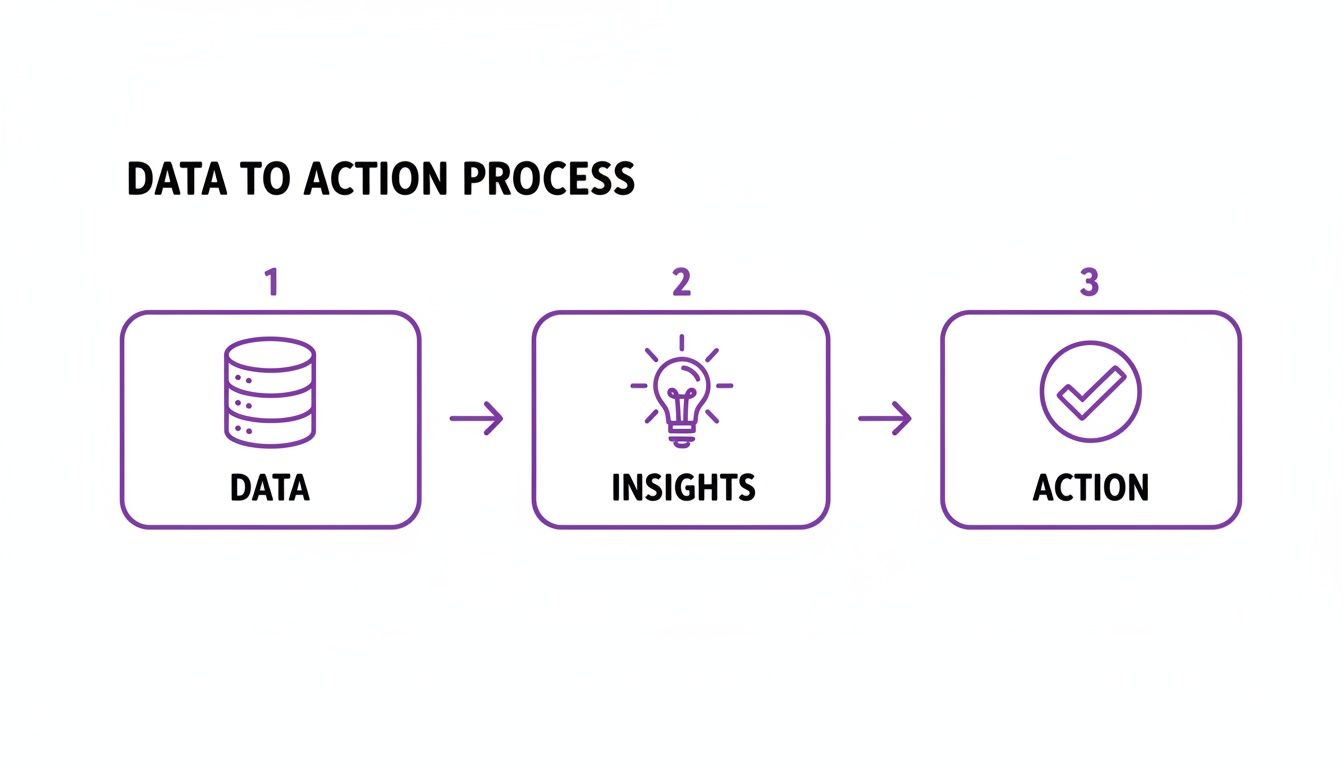
This simple flow is the core of an effective CI program: raw data becomes a meaningful insight, which then triggers a specific, profitable action.
The MAP Violation Enforcement Playbook
For any brand with a MAP policy, consistent enforcement is essential. A playbook ensures every violation is handled with fairness, consistency, and speed.
A practical MAP violation playbook includes these steps:
- Trigger: An automated alert is generated the moment a reseller's advertised price drops below your MAP.
- Verification: The system automatically captures a timestamped screenshot as evidence. A team member quickly verifies it is not a data error.
- First Contact: A pre-written, standardized email is sent to the reseller. It is professional, non-confrontational, and clearly states the product, violation, and required action, referencing your policy terms.
- Monitoring & Escalation: The system continues to monitor the listing. If the price is not corrected within 24 hours, a second, firmer email is automatically sent.
- Consequences: If the violation persists, the playbook dictates the next step, such as a temporary hold on shipments or a formal review of their reseller status. This step demonstrates that you take your policy seriously.
This structured process removes emotion and ensures every violator is treated identically.
The Dynamic Pricing Adjustment Playbook
For distributors and online retailers, the ability to react to competitor price changes directly impacts revenue and margin. A dynamic pricing playbook establishes rules of engagement for making data-driven adjustments without starting a race to the bottom.
This is not about mindlessly matching the lowest price; it is about setting intelligent rules based on market conditions and business goals.
Practical Advice: Your pricing playbook must be built around your specific business goals. Whether you are trying to maximize margin, gain market share, or clear old inventory, the triggers and actions will differ accordingly.
Here’s a structure for a pricing adjustment playbook:
1. Define the Trigger Event:
- Example: A key competitor reduces their price on a top-seller by more than 5%.
- Example: You are identified as the most expensive seller for a specific SKU.
- Example: A competitor goes out of stock on a high-demand product.
2. Set Your Pricing Rules:
- If Competitor X drops their price: Match them, but only down to a floor that protects a 15% gross margin.
- If we become the highest price: Adjust our price to be 1% above the market average, but never below our margin floor.
- If a competitor stocks out: Increase our price by 3% for the next 72 hours.
3. Schedule a Review: A quarterly review is a good cadence to ensure your strategy still aligns with your business goals. Strong supplier relationships are also crucial; knowing how to negotiate with suppliers can provide the flexibility needed for these dynamic strategies to be profitable.
Integrate CI Data Directly into Your Business Systems
The most mature competitive intelligence programs are highly automated. True efficiency comes from connecting CI data directly to the systems that run your business, such as your pricing engine, ERP, or ecommerce platform.
This is where a platform like Market Edge becomes more than a monitoring dashboard. By using an API to feed clean, structured data into your other systems, you can automate the actions in your playbooks. For example, a MAP violation alert can automatically trigger an email from your CRM, or a competitor price drop can instruct your pricing engine to recalculate and push a new price to your website—all without manual intervention.
This level of integration allows your team to stop analyzing the past and start actively shaping your market position in real time.
Answering Key Questions About Competitive Intelligence
Even with a well-defined plan, stakeholders will have questions. Gaining buy-in for a competitive intelligence program requires being prepared to address their concerns, particularly from leadership.
Here are common questions and practical answers.
Is Competitive Intelligence Gathering Legal and Ethical?
This is a critical question. The answer is yes, provided it is done correctly.
Ethical competitive intelligence involves gathering information that is publicly available. This includes data from competitor websites, online marketplaces, press releases, and other public sources. It does not involve hacking, stealing proprietary data, or other illegal activities. That is corporate espionage, not intelligence.
A professionally run CI program is the digital equivalent of walking into a competitor's store to check their prices—it is simply done more efficiently and at a larger scale.
The golden rule of ethical CI is to only use methods and data that are publicly and openly accessible. The goal is to see the market as any customer would.
As long as you adhere to public data sources, your program is on solid legal and ethical ground.
How Can We Start Small and Scale Up?
You do not need to implement a full-scale program from day one. The most effective approach is to start with a focused pilot, prove its value, and then expand.
Here is a simple framework for a pilot program:
- Pick one specific problem. Don't try to track everything. Focus on a single, high-impact area, such as enforcing your MAP policy on your top 10 products or monitoring your 3 biggest competitors in one key category.
- Define success. Establish a clear, measurable goal. For example, reduce MAP violations by 50% in the first three months or ensure your price on key items is never more than 5% higher than your top rival's.
- Use a specialized tool. Avoid building a complex system in-house initially. A dedicated platform provides clean, reliable data quickly without a massive technical lift.
Once you can demonstrate positive results in that one area, you will have a compelling success story to justify expanding the program.
What is the ROI of a CI Program?
You must be able to demonstrate how competitive intelligence directly impacts the bottom line. It is not just about collecting interesting data; it is about connecting that data to financial outcomes.
Here are straightforward ways to measure ROI:
- Margin Protection: Calculate the savings from avoiding knee-jerk price cuts. Track the additional revenue gained from identifying opportunities to safely raise prices. If your data helps you increase a product’s price by $2 and you sell 1,000 units a month, that is $2,000 in additional gross profit.
- MAP Enforcement Value: Quantify the impact of a cleaner market. Reducing policy violations protects your brand's value and your partners' margins. This can be tied directly to preserved revenue and stronger reseller relationships.
- Competitive Wins: When your sales team closes a deal because they had better, faster information on a competitor's pricing or stock levels, that is a direct win for your CI program. Track these wins.
By focusing on these metrics, you can prove that competitive intelligence is not an expense but an investment that drives measurable growth.
This is where automated price monitoring tools like Market Edge become useful. They handle the heavy lifting of data collection and structuring, providing the reliable intelligence needed to build a program that delivers a clear return on investment. Find out more at the Market Edge Monitoring website.