
Pricing optimization software is a business intelligence tool that uses data—not guesswork—to determine the most effective price points for your products. Instead of relying on manual spreadsheet analysis, this software evaluates market trends, competitor actions, customer demand, and inventory levels to recommend prices that maximize revenue and protect profit margins. The core function is to shift a business from reactive price adjustments to a proactive, data-informed strategy.
Beyond Spreadsheets: The Commercial Impact of Pricing Software
For many B2B companies, pricing strategy still lives in a labyrinth of complex spreadsheets. This manual method isn't just time-consuming; it's a critical business risk, prone to human error and based on outdated information. It’s like navigating a logistics network with a paper map printed last year—you might eventually reach your destination, but you’ll miss the real-time traffic jams, detours, and faster routes a modern GPS would provide instantly.
Pricing optimization software is that GPS for your commercial strategy. It automates the heavy lifting of market data collection and analysis, transforming a rigid, manual task into a dynamic, intelligent system. This shift frees up ecommerce managers, pricing analysts, and sales leaders to move beyond simple price setting and begin strategically managing profitability.
Transforming Pricing From a Cost Center to a Profit Driver
Manual pricing methodologies almost always leave money on the table. A business might be underpriced on its most popular items, sacrificing revenue, or overpriced on others, killing sales volume. The commercial purpose of pricing optimization software is to identify the optimal price for every product based on what is happening in the market right now.
This technology achieves this through several critical functions:
- Automated Data Collection: The software continuously monitors competitor prices, stock levels, and marketplace shifts, eliminating the need for manual research.
- Data-Driven Recommendations: It uses algorithms or AI to suggest price points aligned with specific business goals, whether capturing market share or increasing gross margin.
- Strategic Agility: It enables immediate reactions to market changes, keeping prices competitive and profitable 24/7.
This represents a fundamental operational shift. The market reflects this—the global pricing optimization software market was valued at USD 2.09 billion in 2026 and is projected to reach USD 7.56 billion by 2035. A significant portion of this growth, approximately 55%, is driven by companies adopting AI-powered strategies, according to Business Research Insights.
Pricing software moves a team from spending hours on data entry to minutes on strategic analysis. The focus shifts from "What are our competitors' prices?" to "What is our most profitable response to the market?"
Let's examine how this plays out in practice.
Manual Pricing vs Optimized Pricing
The table below breaks down the fundamental differences between relying on spreadsheets and adopting a modern, software-driven approach.
| Aspect | Manual Pricing Approach | Optimized Pricing Approach |
|---|---|---|
| Data Source | Static spreadsheets, manual research | Real-time market & competitor data |
| Decision Speed | Slow, reactive (weekly/monthly) | Instant, proactive (daily/hourly) |
| Accuracy | Prone to human error, outdated info | High, based on current data models |
| Scalability | Limited; unmanageable for large catalogs | Highly scalable; manages thousands of SKUs |
| Focus | Cost-plus or gut-feel | Value-based, demand-driven |
| Business Outcome | Margin erosion, missed opportunities | Increased revenue & profit margins |
The difference is stark. One method keeps a business reacting to past events, while the other puts it in control of its market position.
Ultimately, these platforms deliver the intelligence needed to make smarter, faster, and more profitable pricing decisions. For a deeper dive into the mechanics, explore our complete guide on pricing analytic software. This is where automated price monitoring tools like Market Edge become useful.
What Can Pricing Software Actually Do? A Look at its Core Capabilities
Effective pricing optimization software is more than a dashboard; it is the engine that powers a smarter, more profitable pricing strategy. It is built on a handful of core features that work together to gather data, provide intelligent recommendations, and enable your team to make faster, better-informed decisions. For a decision-maker evaluating these tools, understanding these functions is critical.
A manual pricing strategy is like navigating with a paper map. Pricing software is a real-time GPS that not only shows you where you are but also reroutes you instantly based on changing market conditions.
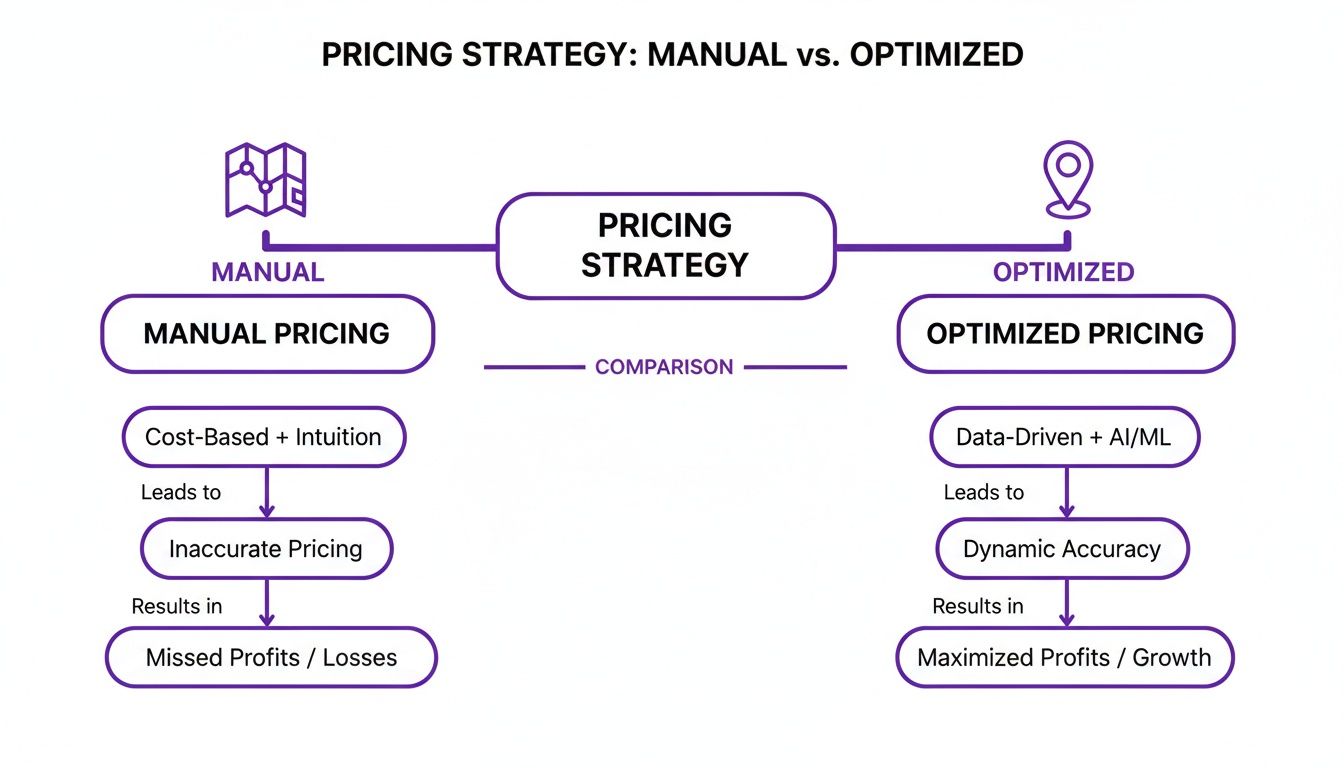
As the chart illustrates, the traditional approach is often a static, cost-based calculation that leaves profit on the table. A data-driven approach, by contrast, continuously adapts to the market to maximize profit potential.
Automated Competitor Price Monitoring
Market awareness is the foundation of any effective pricing strategy. Automated competitor price monitoring provides this critical visibility without the labor-intensive task of manually checking dozens of competitor websites and marketplaces.
These tools use sophisticated web crawlers to systematically extract price and stock information for specific products from any competitor you choose to track. The primary value lies in its accuracy and scale—it can monitor thousands of SKUs daily, providing a clear and current picture of the competitive landscape.
This is not just about identifying who is cheaper. It's about understanding the velocity of price changes in your market, identifying which competitors are aggressive on which products, and recognizing opportunities to capitalize on a competitor's stockout.
Use Case: A distributor of industrial parts can use a monitoring tool to benchmark its top 100 SKUs against three major online rivals. The software would instantly flag whenever a competitor’s price drops below a set threshold, giving the pricing manager the actionable intelligence to make a quick adjustment and protect market share on key items. This is why a strong foundation of competitive price monitoring software is non-negotiable.
Dynamic Pricing Engines
Once you have market data, you must act on it. A dynamic pricing engine is the operational "brain" of the system, using a set of rules or algorithms to adjust your prices automatically based on predefined triggers. These engines can range from simple rule-based systems to advanced AI models.
A typical rules-based engine operates on "if-then" logic:
- "If Competitor X is out of stock, increase my price by 5%."
- "Always remain $0.50 below the market's lowest price, but never drop below my 15% floor margin."
- "When inventory for SKU-123 is below 10 units, increase the price by 10% to capture scarcity-driven demand."
These rules automate decision-making, ensuring your strategy is applied consistently across thousands of products—a scale no human team can match. More advanced AI-driven systems go further, identifying hidden patterns in large datasets to recommend an optimal price without requiring a rule for every scenario.
Price Elasticity Modeling
If you decrease a product's price by 5%, how much will sales volume increase? If you raise it by 10%, will sales decline sharply or will customers absorb the change? Price elasticity modeling answers these critical commercial questions. It analyzes historical sales data to determine how sensitive customer demand is to price changes.
This feature allows you to forecast how potential price adjustments will impact both revenue and bottom-line profit. For an ecommerce manager planning a promotion, this is invaluable. Instead of guessing discount levels, they can model different scenarios to find the optimal point that drives the most total profit, not just the highest sales volume.
Understanding elasticity allows you to confidently raise prices on inelastic products (where demand is stable) and apply surgical discounts to elastic ones to trigger a significant increase in sales.
MAP and RRP Enforcement
For manufacturers and brands, protecting brand value and maintaining channel harmony is paramount. A Minimum Advertised Price (MAP) or Recommended Retail Price (RRP) enforcement module is a specialized tool designed to automate this critical process.
This feature acts as a 24/7 watchdog, scanning the web to ensure all authorized and unauthorized resellers are adhering to your pricing policies. When it identifies a violation, the software can:
- Automatically capture a timestamped screenshot as evidence.
- Log all violation details: the seller, the product, and the offending price.
- Trigger an automated alert to your team or even send a pre-written notification directly to the violator.
Use Case: A brand manager for a consumer electronics company needs to monitor 500+ online sellers. Instead of an employee spending their week manually checking websites, the software instantly pinpoints the 3% of sellers breaking MAP policy. This allows the team to shift from policing to targeted enforcement.
How Pricing Software Fuels Your Business Strategy
Pricing software is less of a technical tool and more of a strategic asset. It is the engine that converts raw market data into measurable commercial growth. The objective is to shift pricing from a reactive, administrative task to a proactive, profit-generating function.
Whether you are a distributor managing thousands of SKUs, a brand owner protecting your reputation, or an online retailer competing for every sale, this software provides the intelligence to make smarter, faster decisions that directly impact the bottom line.
For Distributors and Wholesalers
For a distributor, business profitability is determined by margins. You operate in a high-volume, tight-spread environment where small pricing errors can have a massive financial impact. The primary challenge is to remain competitive without eroding profits across a vast product catalog.
Pricing optimization software provides a real-time, SKU-level view of the entire market, allowing you to instantly identify where you are priced too high or—more importantly—too low.
Mini Use Case: Protecting Margins An electronics distributor with over 10,000 SKUs cannot track competitor prices manually. By implementing pricing software, they can automatically monitor their top 500 products against their three largest competitors. The system reveals they are 15% cheaper on a popular line of cables but 10% more expensive on a high-volume power adapter. With this insight, they can make surgical adjustments: increasing the cable price to improve margin without losing sales, while slightly lowering the adapter price to regain volume. This process plugs margin leaks and captures previously unrealized profit.
For Manufacturers and Brands
For manufacturers, the primary pricing challenge is protecting brand value and maintaining channel harmony. Your reputation depends on consistent pricing, but when a reseller violates your Minimum Advertised Price (MAP) policy, it devalues your product and creates friction with compliant partners.
Pricing software automates MAP/RRP enforcement, transforming a frustrating, time-consuming task into a manageable process.
For a brand, uncontrolled online pricing is a direct threat to brand equity. Automated monitoring shifts the dynamic from chasing violations to preventing them, preserving relationships with valuable retail partners.
Mini Use Case: Enforcing MAP Compliance A premium consumer goods brand sells through over 200 online retailers and has a strict MAP policy. A few rogue sellers consistently undercut it, causing complaints from compliant partners. Using software with MAP monitoring, the brand’s leadership receives a daily automated report flagging every violation, complete with screenshots. This evidence-based approach enables decisive action. Within 60 days, MAP compliance increases from 75% to 98%, stabilizing the brand’s market value and rebuilding trust with key retailers. This is the kind of actionable intelligence that vendor-neutral tools like Market Edge are built to provide.
For Online Retailers and Ecommerce Stores
In the competitive world of ecommerce, the digital shelf is the entire battlefield. Online retailers must fight for visibility, win the Buy Box, and react to competitor moves in minutes, not days. The biggest challenges are speed, accuracy, and understanding non-price signals, like a competitor's low stock levels.
Pricing software provides the agility retailers need to compete effectively. It goes beyond simple price tracking to offer crucial context, such as competitor stock levels, which can be a significant leading indicator.
Key Plays for Retailers
- Win the Buy Box: Automatically adjust prices to meet marketplace criteria without sacrificing unnecessary margin.
- Execute Smarter Promotions: Use real-time competitor data to launch sales that are compelling, not just needlessly cheap.
- Capitalize on Stockouts: Receive alerts when a key competitor runs out of a popular item, providing an opportunity to strategically raise your price and capture higher-margin sales.
This is where a powerful automated price monitoring tool can provide a significant competitive advantage.
How to Choose the Right Pricing Optimization Software
Selecting the right pricing optimization software is not about finding the longest feature list. It’s about matching the right tool to your specific business needs. A few key criteria separate platforms that genuinely drive commercial results from those that are just another dashboard to manage.
This decision is more critical than ever. The industry is rapidly shifting to the cloud, with cloud-based solutions now commanding over 61% of the market. This segment is expected to grow at a 18.43% CAGR through 2030, outpacing legacy on-premise systems. While large enterprises have led adoption, small and medium-sized businesses are now growing at an 18.89% CAGR as they adopt affordable subscription models that deliver a fast ROI. You can explore these trends in market data from 360iResearch.
Here is a practical framework for evaluation.
Data Quality and Accuracy
Your pricing software is only as good as the data it runs on. Inaccurate data leads to flawed strategies, margin erosion, and a loss of trust in the tool itself.
Your evaluation must begin here. A top-tier platform requires a robust data collection engine with sophisticated web crawlers that can navigate complex ecommerce sites without being blocked. It also needs AI-driven product matching to correctly identify your products on a competitor's site, even when SKUs or product names differ.
Scalability and Performance
Your business is growing, and your software must be able to keep up. A platform that works for 500 SKUs might fail when asked to handle 50,000. Ask potential vendors how their systems manage large catalogs and frequent data refreshes.
Can it monitor thousands of competitor products daily? Can it apply new pricing rules in minutes, not hours? A truly scalable solution ensures that as your business expands, your pricing intelligence does not become an operational bottleneck.
Integration Capabilities
Pricing software cannot operate in a silo. It must integrate with your existing tech stack—your ERP, CRM, and e-commerce platform—to create a unified system. Without smooth integrations, you will be stuck with manual data exports, defeating the purpose of automation.
Look for tools with well-documented APIs or pre-built connectors for platforms like Shopify, Magento, or BigCommerce. This allows for a bidirectional flow of information, so you can push price updates to your website and pull in inventory data to inform your pricing models.
A platform's true power is unlocked when it integrates deeply into your existing workflows. The goal is to make data-driven pricing an organic part of your operations, not a separate, siloed task.
Ease of Use and Support
The most powerful tool is useless if your team cannot use it effectively. The user interface must be intuitive, translating complex data into clear, actionable insights. Your pricing managers should be able to set rules, identify trends, and run reports without requiring a data science degree.
Do not overlook the vendor’s support model. Do they offer hands-on onboarding and training? Is there a dedicated support contact? A flexible payment model is also a positive indicator. For instance, a usage-based structure, like the one offered by solutions such as Market Edge, allows you to start small, prove the tool’s value on a limited product set, and scale your investment based on demonstrated ROI.
Pricing Software Evaluation Checklist
- Data Accuracy: Does the vendor guarantee a high product matching accuracy rate and provide evidence?
- Data Freshness: How often is competitor data refreshed—hourly, daily, or weekly?
- Scalability: Can the system handle your entire catalog and all key competitors without performance degradation?
- Integrations: Does it offer APIs or pre-built connectors for your existing systems (ERP, ecommerce platform)?
- User Interface: Is the dashboard intuitive and usable for non-technical team members?
- Rule Engine: Can you build and manage the specific pricing rules your business requires?
- Support & Onboarding: What level of training and ongoing support is provided?
- Commercial Model: Is the pricing transparent and flexible enough to grow with your business?
Focusing on these core pillars will help you choose a partner that becomes a true driver of your business strategy. For a more detailed breakdown, check out our guide on the best price monitoring software.
Bringing Your Pricing Strategy to Life and Measuring the Payoff
Acquiring pricing optimization software is the first step. The real value is realized through effective implementation and, critically, measuring its impact. A successful rollout is a deliberate process that connects the tool's capabilities to clear, tangible business goals.

Before implementation, you must define what success looks like. Vague goals like “improve pricing” are not actionable. You need specific, time-bound objectives.
For example, a strong initial goal is to increase gross margin by 2% on a specific product line within the next quarter. Another could be to achieve 95% MAP compliance across all key online channels within 60 days. These concrete targets provide a clear yardstick for measuring progress.
A Phased Rollout That Actually Works
Applying new pricing rules across your entire catalog at once is a recipe for chaos. A focused pilot program is the more prudent approach. This allows your team to learn the software, test your strategy on a manageable scale, and achieve early wins to build momentum and prove the concept internally.
A typical implementation follows these steps:
- Define the Pilot: Select a small, strategic group of products. Good candidates include high-volume SKUs, a highly competitive category, or products where you suspect margin leakage.
- Configure Rules: Translate your business goals into automated logic. This may involve setting margin floors, creating rules for competitive price matching, or establishing automated alerts for MAP violations.
- Integrate and Test: Connect the pricing software to your ERP or ecommerce platform. Run tests to ensure price changes are pushed correctly and that all data flows smoothly.
- Train Personnel: Your pricing managers, sales teams, and ecommerce staff must understand how to use the system and interpret its data. This step is critical for adoption.
- Launch and Monitor: Go live with the pilot group and closely track your defined KPIs. Are you meeting your targets?
A pilot isn't just about testing software—it’s about proving a business case. A successful pilot delivers undeniable ROI, simplifying the approval process for a company-wide deployment.
Measuring What Really Matters
To prove the investment in pricing software was worthwhile, you must track the right Key Performance Indicators (KPIs). These metrics shift the conversation from what the software does to the commercial impact it has. While every business has unique metrics, a few are universally essential for demonstrating a clear return.
Key Metrics for Proving ROI:
- Gross Margin Return on Investment (GMROI): This is the ultimate measure of profitability, answering the question: "For every dollar invested in inventory, how much gross profit are we generating?" An increasing GMROI is a powerful indicator of a successful pricing strategy.
- Price Realization: This metric compares the average actual selling price against your list or target price. It reveals how much value you are capturing versus conceding through unplanned discounts.
- Sales Velocity: This measures how quickly products are sold. An effective pricing strategy not only protects margins but can also accelerate sales on competitively priced items.
- Quote-to-Close Ratio (for B2B): For businesses that issue quotes, tracking the percentage of quotes that convert to sales is crucial. Optimized pricing should directly lead to a higher win rate without sacrificing margins.
By monitoring these metrics, pricing managers can build a compelling, data-driven case that proves the software's value. This is where automated tools like Market Edge can become an invaluable part of your operational toolkit.
Common Questions About Pricing Optimization Software
Even after understanding the potential, practical questions often arise before making an investment in pricing optimization software. Here are answers to the most common inquiries from business leaders.
How Quickly Can We Actually See Results?
The answer has two parts: immediate tactical wins and longer-term strategic gains.
-
Quick Wins (Weeks to Months): The most immediate impact typically comes from gaining visibility into your competitive landscape. Simply identifying and correcting pricing errors—or automatically catching MAP violations—can plug margin leaks almost instantly. Fixing instances where you are significantly underpriced can deliver a revenue lift in the first few weeks.
-
Strategic Gains (Months to Quarters): The most significant, lasting value comes from dynamic pricing and elasticity modeling. As the software accumulates more sales and market data over several months, its recommendations become more precise. Optimizing prices across an entire catalog to achieve a specific gross margin or sales velocity target is a process that builds on itself, creating substantial value over one to two quarters.
The quick wins are like patching a leaky pipe; the strategic gains are like upgrading the entire plumbing system for long-term efficiency and performance.
Is This Software Only for Huge Companies?
This is a common misconception. While pricing optimization tools were once exclusive to large enterprises, that is no longer the case.
Today's leading platforms are cloud-based and designed to be scalable. With subscription or usage-based pricing models, they are accessible to small and medium-sized businesses. An online retailer can begin by tracking a few dozen key products against a handful of competitors and expand their usage as they grow.
The key is agility, not size. A smaller, more nimble business can often implement a data-driven pricing strategy faster than a large enterprise, leveraging speed as a competitive advantage.
Modern tools are designed to serve a range of users, from a founder managing a growing e-commerce store to a pricing manager at a global distributor.
How Does It Handle a Giant, Messy Product Catalog?
This is precisely the problem this software is built to solve. Managing pricing for tens of thousands of SKUs manually is operationally infeasible. The software automates this task, primarily through AI-based product matching.
Here is a simplified explanation of the process:
- Data Collection: The software's crawlers systematically scan competitor websites, marketplaces, and other online channels.
- Attribute Analysis: AI algorithms analyze product details—model numbers, UPCs, descriptions, images, and specifications.
- Accurate Matching: The system intelligently matches your products to identical items on other sites, even if they use different product names or SKUs.
This automation eliminates manual work and the associated human error, ensuring that the price comparisons feeding your dynamic rules are accurate. This allows you to confidently manage your strategy at scale. Solutions such as Market Edge, for example, specialize in providing this clean, reliable data feed for even the most complex product catalogs.
Can It Connect with Our Existing Systems?
Yes, and this is a critical requirement. A modern pricing platform should not operate in isolation. Its value increases exponentially when it is integrated with the other systems you rely on daily, such as your e-commerce platform, ERP, or CRM.
Integration is typically achieved in one of two ways:
- APIs (Application Programming Interfaces): A well-documented API allows your developers to build custom connections between the pricing software and your internal systems. This provides the flexibility to create automated workflows, such as pushing new prices directly to your product pages.
- Pre-built Connectors: Many platforms offer ready-made integrations for popular systems like Shopify, Magento (Adobe Commerce), or BigCommerce. These connectors act as plug-and-play adapters, accelerating and simplifying the setup process.
Before selecting a solution, ensure you understand its integration capabilities. A seamless flow of data is what transforms pricing insights into automated actions that drive business growth.
This is where automated price monitoring tools like Market Edge become useful. To see how real-time competitive intelligence can protect your margins and grow your revenue, you can learn more about Market Edge.