
Competitive price monitoring software provides an automated, real-time view of competitor pricing, stock levels, and promotions. It replaces manual, time-consuming website checks with a centralized intelligence platform. This allows businesses to shift from reactive pricing adjustments to a proactive, data-driven strategy.
What Is Competitive Price Monitoring and Why It Matters Commercially
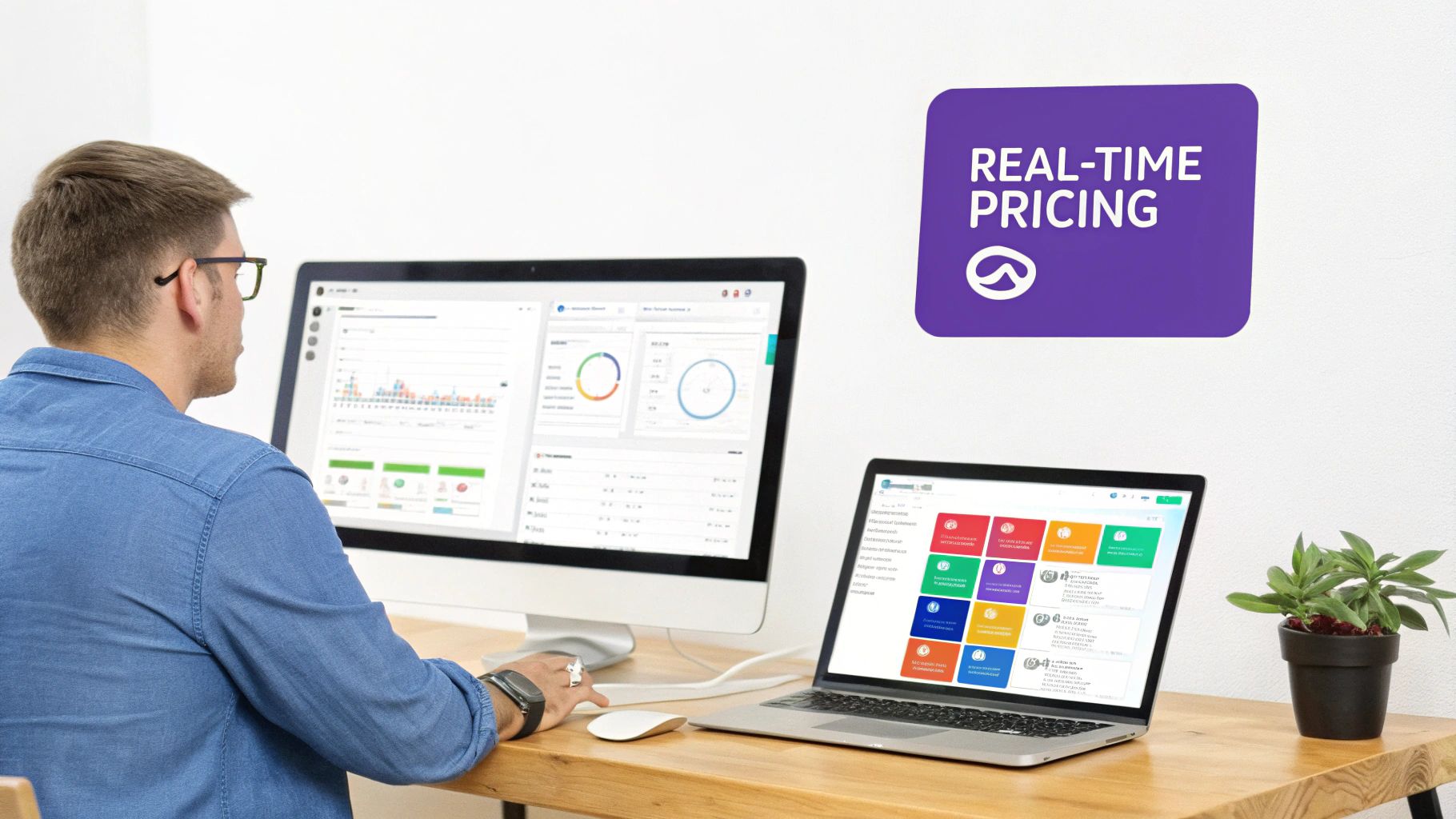
Attempting to track competitor prices manually is inefficient and prone to error. By the time a team populates a spreadsheet with pricing data, the market has likely changed—a competitor may have launched a flash sale, a popular product sold out, or a marketplace seller adjusted their price to win the buy box. Decisions based on such outdated information lead directly to lost sales and compressed profit margins.
Competitive price monitoring software automates this entire process, delivering a continuous stream of market intelligence. It functions like a live GPS with real-time traffic updates, constantly scanning competitor websites, marketplaces, and online stores to provide accurate, up-to-the-minute data on the products critical to your business.
The Commercial Importance of Market Visibility
This is not merely a data-gathering tool; it is a strategic asset for commercial growth. The primary function is to convert raw market data into actionable insights that inform better business decisions. This intelligence is critical for several key reasons:
- Margin Protection: It helps avoid unnecessary price reductions while identifying opportunities to increase prices without impacting sales volume.
- Strategic Brand Positioning: By showing how your prices compare to the competition, it enables you to decide whether to defend a premium position or compete more aggressively on price.
- Opportunity Capture: When a competitor goes out of stock on a high-demand item, you receive an alert. This allows you to immediately adjust your pricing or promotions to capture the resulting shift in demand.
At its core, price monitoring enables confident decision-making. It provides the empirical evidence needed to validate your pricing strategy and respond to market dynamics with precision rather than speculation.
From Data Collection to Strategic Action
The value of this software lies in its ability to connect market events to your specific business objectives. For instance, a brand owner can use it to enforce Minimum Advertised Price (MAP) policies. Instead of relying on inconsistent manual checks, the software automatically flags unauthorized discounts, allowing the brand to protect its value and maintain stable retailer relationships.
An ecommerce manager could analyze historical pricing data to identify seasonal trends, which then informs the promotional calendar for the next quarter. This represents a significant shift from the reactive, problem-solving mode that many businesses operate in without reliable data. To build a robust plan, you can learn more about crafting a competitive pricing strategy in our detailed guide.
Ultimately, the software provides the market context necessary to compete effectively. It helps businesses avoid damaging price wars, identify profitable market gaps, and strengthen their overall competitive position. This is where automated tools like Market Edge prove their value.
How Competitive Price Monitoring Software Works
Think of competitive pricing software as a dedicated intelligence team operating 24/7 to convert market noise into clear, actionable data. It automates the tedious and error-prone task of manual competitor site checks, replacing it with a reliable, systematic process.
The process operates in three distinct stages behind the scenes.
Stage 1: Data Collection
First, the software collects raw data using automated tools known as web crawlers or "scrapers." These are programmed to visit specified websites—such as competitor domains, marketplaces like Amazon, or comparison shopping engines—on a defined schedule.
Instead of an employee manually navigating to a product page, the crawler directly accesses the target URLs. It systematically extracts publicly available information, including:
- The product's current price
- Stock availability (in stock, out of stock)
- Promotional details, special offers, or sale prices
- Shipping costs and estimated delivery times
Because crawlers can be scheduled to run multiple times per day, you receive a near-continuous feed of market data, enabling you to identify a competitor’s flash sale as it happens, not hours later.
Stage 2: AI-Powered Product Matching
Once the raw data is collected, the software performs its most critical function: product matching.
Knowing a competitor is selling a "Blue Polo Shirt" for $45 is useless if you cannot confirm it is the exact same product you sell. Modern AI and machine learning algorithms are essential here. The system intelligently analyzes the collected data to match identical products, even when product names, images, or descriptions vary slightly.
How a match is confirmed: The software identifies common identifiers across different websites. The most reliable are:
- UPC/EAN/GTIN: These universal product codes provide the highest-confidence match.
- SKU/MPN: A manufacturer's part number is another strong identifier.
- Product Titles: AI can determine that "Men's Classic Fit Polo - Navy" is likely the same as "Navy Blue Classic Polo Shirt for Men."
- Brand & Images: Visual recognition technology can help confirm a match when text-based data is ambiguous.
Accurate matching is fundamental. A single poor match could lead you to reduce your price to compete with a different, lower-quality item, unnecessarily eroding your profit margin.
Stage 3: Data Delivery and Visualization
The final stage involves transforming millions of collected data points into a usable format for a pricing manager or business leader. Raw web data is unstructured and contains irrelevant information.
The software cleanses, standardizes, and organizes this data. It then presents the refined information in intuitive dashboards, scheduled reports, and automated email alerts. This is where raw data becomes commercial insight. The leading tools on the market are built to deliver this, offering real-time competitor tracking and AI-powered matching to ensure data is decision-ready. You can explore the price monitoring software market landscape to see how vendors approach this.
For example, a user can log in to a dashboard and immediately see where they are priced higher or lower than their top three competitors for a key product line. This type of clear, immediate insight enables faster, more informed pricing decisions.
Core Features That Drive Business Value
When evaluating competitive price monitoring tools, it is easy to become overwhelmed by feature lists. For a decision-maker, the critical question is: how does this feature help protect margins, increase sales, and strengthen our brand? Not all features deliver equal value; some are ancillary, while others are essential for achieving tangible business outcomes.
The entire price intelligence process can be simplified into a three-step workflow: collecting raw data, accurately matching it to your products, and delivering it as actionable insights.
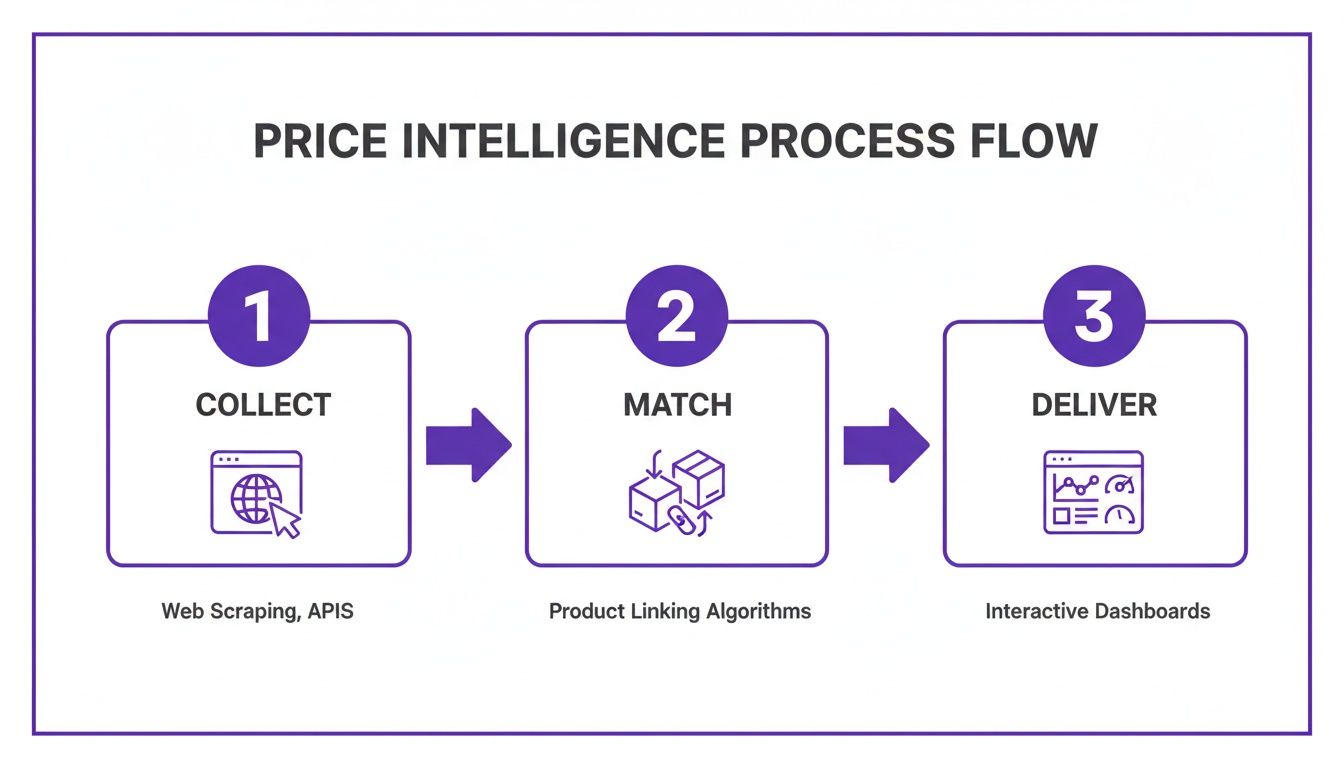
This Collect, Match, Deliver flow is the engine that powers every informed pricing decision, transforming scattered market information into a sustainable competitive advantage.
Real-Time Data and High-Accuracy Matching
A credible pricing strategy must be built on trustworthy data. Real-time data updates ensure that decisions are based on current market conditions, not historical ones. For fast-moving categories like electronics or seasonal goods, a delay of even a few hours can mean missing a competitor's brief promotional window.
Equally critical is high-accuracy product matching. If the software mistakenly compares your premium product to a competitor's entry-level model, you might receive an alert suggesting a price drop, leading to a direct and unnecessary hit to your profit margin. The best systems use a combination of UPCs, SKUs, and AI-powered analysis to ensure you are always comparing identical items. This is a foundational component of any reliable software for price comparison.
Historical Pricing and Stock Availability Tracking
While real-time data informs tactical responses, historical pricing data shapes long-term strategy. By analyzing pricing trends over weeks and months, you can identify seasonal patterns, understand a competitor's discounting habits, and forecast market shifts more accurately. This allows you to set strategy proactively rather than just reacting to market events.
Use Case: An ecommerce manager reviews historical data for a line of hiking boots. They discover a pattern: their primary competitor consistently discounts prices by 15% during the final week of each quarter. Armed with this insight, they schedule a promotion to launch two days earlier, capturing customer demand before the competitor's sale begins.
Furthermore, stock availability tracking is a powerful strategic tool. When a competitor sells out of a popular item, a market opportunity is created. An automated alert notifying you of the stockout serves as a trigger to act—perhaps by slightly increasing your price or by launching a targeted ad campaign for your in-stock alternative.
Customizable Alerts and Analytics
Data is only useful if it can be interpreted. Customizable alerts and a clear analytics dashboard are therefore essential. You need a system that automatically flags the most important market changes, eliminating the need to manually search for them.
A robust platform allows you to set rules-based alerts for events that matter to your business:
- Price Change Alerts: Notify me when a key competitor changes the price on one of my top 10 products.
- MAP Violation Alerts: Send an immediate email if any retailer advertises a product below our Minimum Advertised Price.
- Stock Alerts: I need to know the moment a specific competitor’s product changes from "In Stock" to "Out of Stock."
These alerts cut through market noise, allowing your team to focus on decision-making rather than data discovery. The final component is a comprehensive analytics dashboard that provides a clear, visual summary of your market position, opportunities, and competitive landscape.
Here is a summary of the most essential features and their direct business impact.
Essential Features of Price Monitoring Software
| Feature | Description | Business Impact |
|---|---|---|
| Real-Time Data Collection | Continuously scans competitor websites for up-to-the-minute price and stock information. | Enables immediate reactions to market changes, preventing lost sales from being out-priced. |
| High-Accuracy Matching | Uses AI, UPCs, and SKUs to ensure your products are correctly matched with competitor equivalents. | Prevents margin erosion from unnecessary price drops based on mismatched, lower-quality products. |
| Historical Price Tracking | Stores and visualizes pricing data over time, revealing trends, seasonality, and competitor strategies. | Informs proactive, long-term pricing strategies and helps predict future market movements. |
| Stock Availability Alerts | Notifies you instantly when a competitor's product goes out of stock. | Creates opportunities to capture market share and adjust pricing to meet increased demand. |
| Customizable Alerts | Allows users to set specific rules to trigger notifications (e.g., MAP violations, price drops). | Focuses team attention on high-priority events, saving time and enabling rapid responses. |
| Analytics & Reporting | Provides visual dashboards and reports to understand market position and pricing opportunities. | Translates raw data into actionable business intelligence for strategic decision-making. |
These are the features that transform a monitoring tool into a strategic asset. Solutions like Market Edge are designed to turn complex market data into clear, actionable steps.
How Brands and Retailers Use Price Monitoring Data

Understanding the features of price monitoring software is one thing; seeing how it generates tangible business results is another. The technology's true value becomes apparent when it is applied to solve specific commercial challenges. From product manufacturers to direct-to-consumer retailers, businesses use this intelligence in distinct ways to protect revenue, build brand value, and maintain a competitive edge.
The shift toward data-driven pricing is not a temporary trend. Research indicates that rising consumer expectations for competitive prices have driven a majority of businesses to adopt such software. Market visibility is no longer a luxury—it is a core operational requirement. You can discover more insights about these market trends for a broader perspective.
Here are three real-world applications for different business types.
For Manufacturers and Brands
For a manufacturer, maintaining price integrity across a large network of third-party sellers is a persistent challenge. When unauthorized sellers implement deep discounts, it can erode brand perception, damage relationships with authorized retail partners, and condition consumers to expect lower prices. Price monitoring software serves as the first line of defense against this.
Primary Use Case: MAP Policy Enforcement
A brand’s Minimum Advertised Price (MAP) policy defines the lowest price at which a retailer can publicly advertise a product. Manually policing these agreements across thousands of websites is an unsustainable task.
- The Challenge: A premium electronics brand discovers that several online sellers are advertising its new flagship headphones at 20% below MAP. This immediately undercuts authorized dealers and devalues the product's premium positioning.
- The Software Solution: The brand implements monitoring software to automatically scan all known sellers for its SKUs. The system is configured to trigger an instant alert whenever a price falls below the MAP threshold.
- The ROI: The enforcement team receives real-time, screenshot-verified evidence of each violation. This enables them to contact the non-compliant seller with definitive proof, resulting in a 90% reduction in MAP violations within three months. This outcome protects brand equity and strengthens relationships with loyal retail partners. You can explore this topic further in our guide on selecting MAP policy monitoring software.
For Distributors and Wholesalers
Distributors operate on thin margins, where profitability depends on a careful balance between sourcing costs and selling prices. They must price their products competitively to secure business from retailers without sacrificing their own margin. This requires continuous monitoring of the market landscape.
Primary Use Case: Competitive Benchmarking and Sourcing
A distributor must ensure the prices offered to its customers are aligned with what its competitors are charging for the same products.
- The Challenge: A regional auto parts distributor is consistently losing bids to a larger national competitor. They suspect their pricing is misaligned on key product lines but lack the data to confirm it.
- The Software Solution: They deploy a price monitoring tool to track the online catalogs of their main rivals. The platform's dashboard provides a clear breakdown of which product categories—and specific SKUs—are priced above the market average.
- The ROI: The data reveals they are 15% overpriced on a popular brand of brake pads but are underpriced on air filters. They immediately adjust their strategy, lowering brake pad prices to become more competitive while slightly increasing air filter prices to improve margins. This targeted adjustment increases their overall sales volume by 10% without negatively impacting profitability.
For Online Retailers
For online retailers, the digital shelf is a competitive environment. Pricing must be highly agile to respond to competitor promotions, stock fluctuations, and shifts in consumer demand. Here, the software becomes the engine for dynamic pricing and optimized promotions.
Primary Use Case: Dynamic Pricing and Promotional Optimization
An online retailer's objective is to win sales without defaulting to the lowest price, which is a quick path to margin erosion.
A strategic takeaway: The goal is not simply to match the lowest price but to identify the optimal price. This involves finding opportunities to maintain a premium or capitalize on a competitor's weakness, such as an out-of-stock event.
- The Challenge: An ecommerce store selling home goods observes a sudden drop in sales for a popular coffee machine. Manually checking dozens of competitor websites to diagnose the cause is too slow.
- The Software Solution: An automated alert from their pricing software notifies them that their main competitor has just launched a "20% off plus free shipping" flash sale on that exact model. A second alert indicates that another key competitor is now out of stock.
- The ROI: Armed with this intelligence, the retailer avoids a price war. Instead of matching the deep discount, they launch a targeted ad campaign emphasizing their immediate availability and fast shipping. They successfully capture customers who prioritize quick delivery, salvaging sales for the day without entering a race to the bottom on price.
This is where automated price monitoring tools like Market Edge become useful.
Choosing and Implementing the Right Solution
Selecting the right competitive price monitoring software is a significant strategic decision that goes beyond comparing feature lists. The optimal platform is not merely the one with the most functions; it is the one that integrates seamlessly into your team's workflow and can scale with your business. You are selecting a technology partner, not just a tool.
A feature specification sheet can easily obscure what truly matters: the operational details that impact daily use. Key considerations include data accuracy guarantees, the platform's ability to handle a growing product catalog, and the availability of timely support.
Key Evaluation Criteria Beyond the Feature List
When comparing vendors, it is essential to look beyond marketing claims and focus on factors that directly affect the reliability and utility of the intelligence you receive. A platform that excels in these fundamental areas will deliver a superior return on investment.
Here are the critical factors to discuss with potential vendors:
- Data Accuracy and Freshness: Ask for their guaranteed data accuracy rate. How frequently is the data refreshed? For dynamic markets, anything less than multiple updates per day is insufficient.
- Scalability: Can the platform accommodate your growth? Inquire how it handles a significant increase in SKUs or competitors without performance degradation or prohibitive cost increases.
- Integration Capabilities: A standalone tool creates data silos. Confirm that the software can integrate with your existing systems, such as your ERP, ecommerce platform like Shopify or BigCommerce, and business intelligence tools. This ensures pricing data is accessible where it is needed most.
- Quality of Support: Consider a scenario where a critical pricing alert fails or a data feed breaks before a major sale. How quickly can you access expert support? Look for vendors that provide dedicated account managers and clear service-level agreements (SLAs).
The selection process should be as rigorous as hiring a key employee. You are entrusting a core business function—your pricing intelligence—to an external system. Thorough due diligence is non-negotiable.
Simultaneously, increasing consumer demand for price transparency, particularly in retail, travel, and hospitality, has accelerated the adoption of these tools. Businesses recognize that clear, fair pricing builds customer loyalty. You can read the full research about pricing software market drivers to understand this market shift. Choosing a platform that delivers trustworthy data is the first step toward building that trust.
A Practical Vendor Evaluation Checklist
To maintain objectivity during the procurement process, use a structured checklist. This helps you compare vendors systematically, focusing on what is most important for your business.
| Evaluation Area | Question to Ask | Vendor A Notes | Vendor B Notes |
|---|---|---|---|
| Data Quality | What is your guaranteed data accuracy? Can you prove it during a trial? | ||
| Scalability | How does your pricing model support adding 10x more SKUs? | ||
| Integration | Do you offer a native integration for our ERP/ecommerce system? | ||
| Support | What are your standard support hours and response time SLAs? | ||
| Onboarding | What does your implementation and training process look like? |
Best Practices for a Smooth Implementation
Once a vendor is selected, the implementation phase determines how quickly you realize a return on your investment. A poorly planned rollout can result in a tool that is underutilized and data that is not trusted.
Follow these steps for a successful launch:
- Start with a Pilot Project: Do not attempt to monitor your entire product catalog from the outset. Begin with a single, high-impact product line or one key competitor. This allows you to validate the data and refine your internal processes in a controlled environment.
- Define Clear KPIs from Day One: Establish what success looks like before you begin. Set measurable goals, such as "reduce MAP violations by 50% in Q1" or "improve margin on our top 20 SKUs by 3%."
- Train Your Team to Act on Insights: The software provides the intelligence; your team must act on it. Provide clear training on how to interpret the data and what specific actions to take in response to alerts, such as a competitor price drop or stockout.
A structured approach ensures you not only select the right tool but also integrate it effectively into your company’s commercial strategy. This is where automated tools like Market Edge can be beneficial, as many offer free trials to validate both the data and the platform's suitability before a full commitment.
How to Measure the ROI of Price Monitoring
Competitive price monitoring software should not be viewed as a cost center, but as a strategic investment designed to directly enhance profitability. To secure buy-in from leadership and your team, you must demonstrate its value in clear financial terms. Measuring the return on investment (ROI) involves connecting the software's data to tangible business outcomes.
A robust ROI framework positions the platform as a profit driver, clearly illustrating how the insights gained lead to improved financial performance, whether through increased revenue, expanded margins, or both. This process begins by defining key performance indicators (KPIs) before implementation to track progress effectively.
Identifying Your Core KPIs
First, establish a baseline. Before activating any new software, capture a snapshot of your current performance. This "before" state will serve as the benchmark against which all future results are measured.
Focus on metrics directly linked to your pricing strategy and market position:
- Gross Margin by Product Line: How profitable are your core categories? The objective is to increase these margins by identifying opportunities for price optimization and reducing unnecessary promotions.
- Sales Velocity for Key SKUs: How quickly are your most important products selling? Correcting previously misaligned prices should accelerate sales for items that were overpriced.
- MAP Violation Rate: For brands, this is a critical metric. Calculate the percentage of resellers advertising below your Minimum Advertised Price (MAP). A primary goal is to drive this rate toward zero.
- Manual Labor Hours: Quantify the number of hours your team currently spends on manual competitor research. Automating this work frees them to focus on high-value strategic tasks.
Tracking these specific KPIs reframes the internal conversation from "How much does this cost?" to "How much additional profit is this generating?" The software transitions from a budget line item to a documented growth engine.
Calculating Tangible and Intangible Returns
After several months of use, you will have the necessary data to calculate a clear ROI. The tangible returns are the most straightforward to measure. For example, if the software identifies five products where you can safely increase the price by $2 without impacting demand, and you sell 500 of those items per month, that represents an additional $1,000 in monthly margin directly attributable to the platform.
For brands, the ROI is equally clear. A company that reduces its MAP violation rate from 15% to 2% can demonstrate the concrete value of protecting its brand equity and strengthening its retail partnerships.
However, do not overlook the intangible benefits. While more difficult to quantify, the strategic advantage gained from market agility is significant. The ability to react instantly when a competitor goes out of stock or launches an unexpected promotion can secure sales that would otherwise be lost. This speed and the confidence to make data-backed decisions are core components of the software’s true value.
This is where automated price monitoring tools like Market Edge demonstrate their worth.
Frequently Asked Questions
When considering the adoption of a new business tool, several key questions typically arise. Here are answers to the most common inquiries regarding competitive price monitoring.
How Often Is The Pricing Data Updated?
Data freshness is non-negotiable in ecommerce, where market conditions can change within hours. Most reputable platforms refresh pricing and stock data multiple times per day.
For highly dynamic categories, such as consumer electronics or popular marketplace items, the update frequency can often be increased. Some tools allow you to monitor critical competitor products as frequently as every 15-30 minutes, ensuring you can capture price changes or stockouts almost in real-time.
How Does The Software Handle Product Variations?
This is a critical function. A sophisticated competitive price monitoring tool is designed to manage product variations—such as different colors, sizes, or pack quantities—seamlessly.
The system uses multiple methods for accurate matching. It begins with universal identifiers like UPCs and EANs for a precise match. When these are unavailable, its AI analyzes product titles, descriptions, and other attributes to correctly associate your blue, size-large shirt with the identical product on a competitor’s site. This intelligent matching is essential to prevent poor decisions based on flawed data.
What Is a Typical Implementation Timeline?
Implementation is often faster than anticipated, particularly with cloud-based software. For a standard setup—such as tracking a few dozen products against a handful of key competitors—a business can be operational in under an hour.
For larger-scale projects involving thousands of SKUs and custom API integrations, the process is more involved and may take several weeks to fully configure and validate. A platform like Market Edge provides structured onboarding to ensure a smooth and efficient implementation from day one.
Ready to turn market data into a competitive advantage? Market Edge delivers the real-time pricing intelligence required to protect margins, enforce MAP policies, and act with confidence. Start your free trial to see it in action.