
For B2B decision-makers, pricing analysis software is mission control for competitive intelligence. It automates the grueling, error-prone task of tracking competitor prices, stock levels, and promotions, turning raw market data into a clear strategic advantage.
From Spreadsheets to Strategy
Trying to track the market with spreadsheets is like navigating with an old paper map—it's outdated the moment it's printed. Pricing analysis software is the upgrade to a live, real-time GPS.
This isn't just about avoiding a wrong turn; it’s about seeing the entire traffic pattern of your market. It helps you dodge margin-killing price wars, spot clear routes to profitability, and navigate sudden market shifts with confidence.
Essentially, this software is non-negotiable for any business serious about competing online. It filters the chaotic noise of market data into clean, actionable signals. The commercial goal is simple: stop guessing and start making data-driven pricing decisions.
Who Benefits the Most?
The impact of this technology is not theoretical. It delivers a direct commercial advantage for key B2B roles:
- Manufacturers and Brands: Enforce MAP/RRP policies consistently to protect brand value and maintain healthy reseller relationships.
- Distributors and Importers: Gain a panoramic view of market pricing to protect margins, identify smart sourcing opportunities, and avoid costly overstocks.
- E-commerce Retailers: Use competitor benchmarks to position products intelligently, run effective promotions, and capture market share without sacrificing profit.
The demand for these tools is expanding rapidly. The global Pricing Software Market was valued at USD 8 billion in 2024 and is projected to reach USD 19.5 billion by 2033, growing at a 10.5% CAGR. This is no longer a niche tool; it's fundamental to modern commerce. You can explore more data on this market trend.
In short, pricing analysis software answers critical commercial questions with hard data: Are we priced competitively right now? Are our channel partners adhering to our pricing policies? When is the optimal moment to adjust a price?
A robust platform provides the data backbone for a proactive and resilient commercial strategy. For instance, a solution like Market Edge automates the intelligence gathering, freeing up your team to focus on strategic decisions, not manual data entry.
Core Capabilities of a Modern Pricing Platform
Effective pricing analysis software is more than a simple data scraper; it’s a complete system built on essential pillars. For a pricing manager or sales leader, understanding these core capabilities is crucial for selecting a platform that drives tangible results. These aren't just features on a checklist; they are the engine that turns raw data into a profitable strategy.
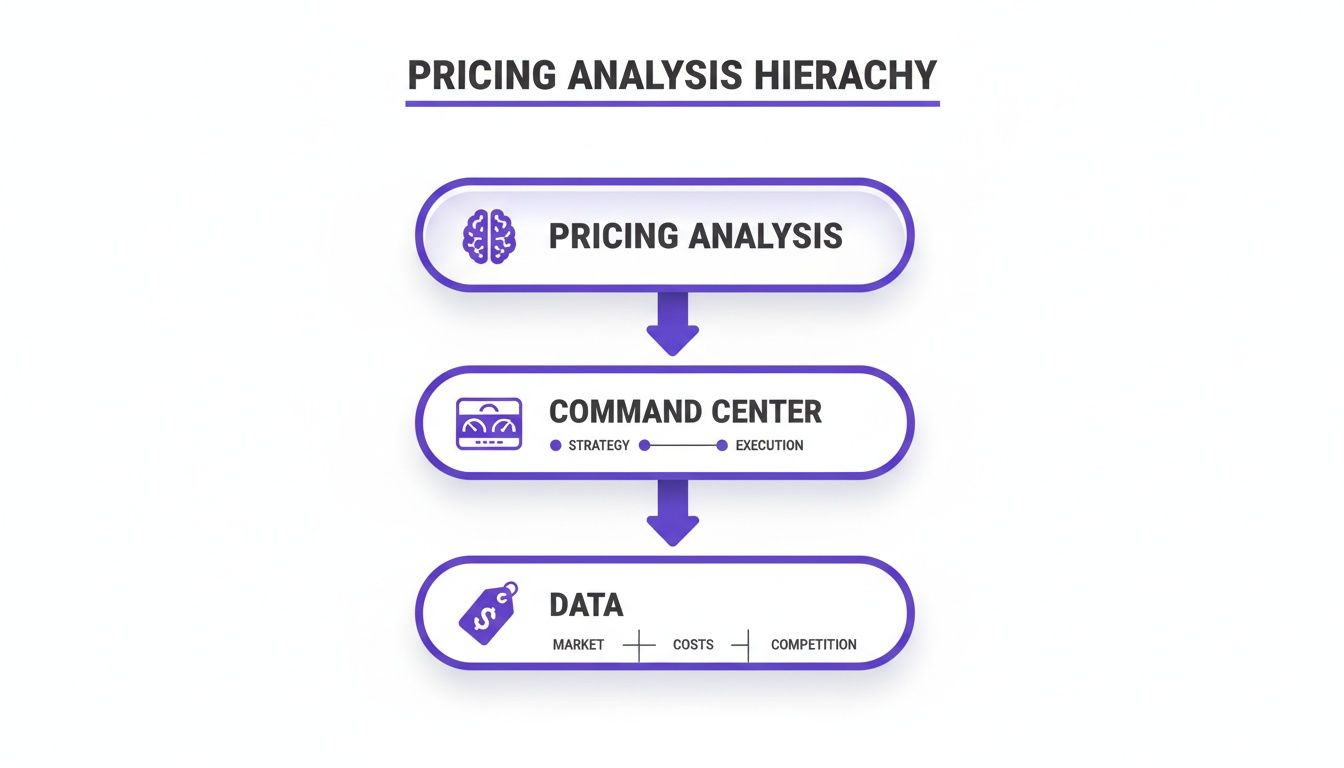
A modern platform acts as a command center for your pricing operations, automating tedious tasks, highlighting critical threats and opportunities, and ensuring the information you act on is both accurate and immediate.
This diagram illustrates how these components work together, from foundational data collection to a central command center where strategic decisions are made.
Your high-level analysis is only as good as the data and tools that support it. Let’s break down the components that make it work.
Automated Price Monitoring
The foundation of any pricing platform is automated price monitoring. This function systematically collects pricing data from competitor websites, marketplaces like Amazon, and authorized reseller pages. It eliminates the slow, error-prone process of manually checking websites and updating spreadsheets.
This constant data flow ensures you are always working with the freshest information. In e-commerce, a price that was competitive yesterday could be losing you money today. Automation delivers a near real-time feed of market shifts directly to your dashboard.
Competitor and Reseller Tracking
It’s not enough to see market-wide prices; a powerful platform lets you isolate and track specific competitors and authorized resellers. This is critical for strategic positioning and channel management. You can benchmark your prices against top rivals or monitor your entire reseller network for compliance.
For manufacturers, this is the backbone of MAP (Minimum Advertised Price) enforcement. The system acts as a digital watchdog, instantly flagging any seller who lists your products below the agreed-upon price. This provides the timestamped proof needed to address violations and protect your brand’s market value.
AI-Powered Product Matching
This is perhaps the most critical component. Competitors and resellers rarely use the same SKU, product title, or part number for an identical item. AI-powered product matching uses intelligent algorithms to correctly identify and link identical products across different websites.
A reliable system analyzes multiple attributes to confirm a match:
- Identifiers: It checks for common codes like UPCs, EANs, and MPNs.
- Text Analysis: It compares product titles, descriptions, and specifications.
- Image Recognition: Advanced systems can even compare product photos for a visual match.
Without accurate matching, all other data is useless. A 99%+ accuracy rate, which platforms like Market Edge aim for, ensures you are comparing apples to apples. It prevents disastrous pricing decisions based on mismatched data. To go a bit deeper, you can learn more about the crucial role of data in our article on price optimization software.
Accurate product matching is the difference between genuine market intelligence and a collection of misleading numbers. It ensures every pricing alert is based on a true competitive comparison, giving you the confidence to act decisively.
Customizable Alerts and Reporting
Finally, the platform must convert its massive data sets into actionable insights. This is where customizable alerts and reporting are essential. A constant stream of raw data is just noise; value comes from being notified about specific events that impact your business.
A pricing manager can create rules that trigger instant notifications. For example, receive an alert via email or Slack when:
- A key competitor drops their price on a bestseller.
- An authorized reseller violates your MAP policy.
- A rival goes out of stock, creating an opportunity to capture high-margin sales.
- Your price is no longer the lowest on the market for a key product.
These alerts enable immediate, targeted action, shifting pricing from a reactive chore to a proactive, strategic operation that directly protects revenue and margins.
How Pricing Analysis Drives Profitability
It's one thing to discuss features; it's another to connect them to your P&L statement. For business leaders, that's the only metric that matters. This isn't about collecting data for its own sake—it's about turning market intelligence into a sharp commercial edge.
The core principle is using precise data to make smarter, faster, and more profitable decisions. A manufacturer might use it to defend brand integrity, while a distributor uses it to protect thin margins. Let's look at how this plays out in real-world business scenarios.
MAP and RRP Enforcement for Brand Protection
For a brand owner, brand integrity is paramount. When a reseller violates your Minimum Advertised Price (MAP) or Recommended Retail Price (RRP), it triggers a dangerous chain reaction. Your product's perceived value drops, compliant partners become frustrated, and your brand equity erodes.
Pricing analysis software automates enforcement. Forget manual spot-checks or relying on anecdotal reports. The platform acts as your 24/7 watchdog.
- Constant Monitoring: The software continuously scans reseller websites and marketplaces.
- Instant Alerts: The moment a price drops below policy, the system flags it and notifies you.
- Irrefutable Proof: It captures timestamped screenshots and data, providing the hard evidence needed to take corrective action.
Use Case: A premium electronics brand tracks its top 50 online resellers. Over a weekend, the software flags a major retailer for dropping a flagship sound system’s price by 15% below MAP. An alert is sent to the channel manager, who forwards the documented proof to the retailer. The price is corrected before it can trigger a market-wide race to the bottom.
Margin Protection for Distributors and Wholesalers
Distributors operate on thin margins where every basis point counts. The pressure to remain competitive can lead to a downward spiral of price cuts that erodes profitability for everyone. Pricing analysis software provides the market visibility needed to price with intelligence, not just aggression.
By seeing competitor prices in real-time, you can identify products where you are priced too low and have room to increase your margin. Conversely, it shows where you are too expensive and risk losing sales.
The goal isn't always to be the cheapest; it's to be the smartest. Full market visibility allows a distributor to protect margins by knowing when to hold a price, when to raise it, and when a strategic discount is necessary to win a key deal.
This data-driven confidence replaces gut-feel pricing, ensuring decisions are based on actual market conditions.
Sourcing and Procurement Optimization for Importers
For businesses like importers with long supply chains, when you buy is as critical as your selling price. Poor timing can lead to a warehouse full of dead stock or missed sales during a demand spike. Pricing analysis software offers a view into market-wide stock levels.
By monitoring competitor inventory, an importer can make strategic procurement moves:
- Spot Scarcity: If a popular product is disappearing from competitors' shelves, it’s a signal to stock up and potentially command a higher price.
- Anticipate a Glut: If the market is flooded with an item, it's a cue to delay a large purchase order and avoid being stuck with inventory that must be sold at a loss.
This transforms procurement from a reactive task into a strategic function that maximizes the return on inventory investment.
Strategic Competitive Benchmarking for Ecommerce
In e-commerce, you must clearly define your market position. Are you the price leader? The premium service provider? The best overall value? Pricing analysis software provides the hard data to define and execute your strategy day in and day out.
This is no longer a niche tactic. The market for these tools is expected to hit USD 1.68 billion in 2025 and grow to USD 3.59 billion by 2030, at a 16.40% CAGR. This demand is driven by brands that require this data to compete effectively. With cloud-based systems comprising 61.43% of the revenue in 2024, access to real-time intelligence is more accessible than ever. You can read the full research about price optimization trends.
This is where automated tools like Market Edge provide the continuous data stream needed to support critical commercial decisions.
Putting AI to Work in Your Pricing Strategy
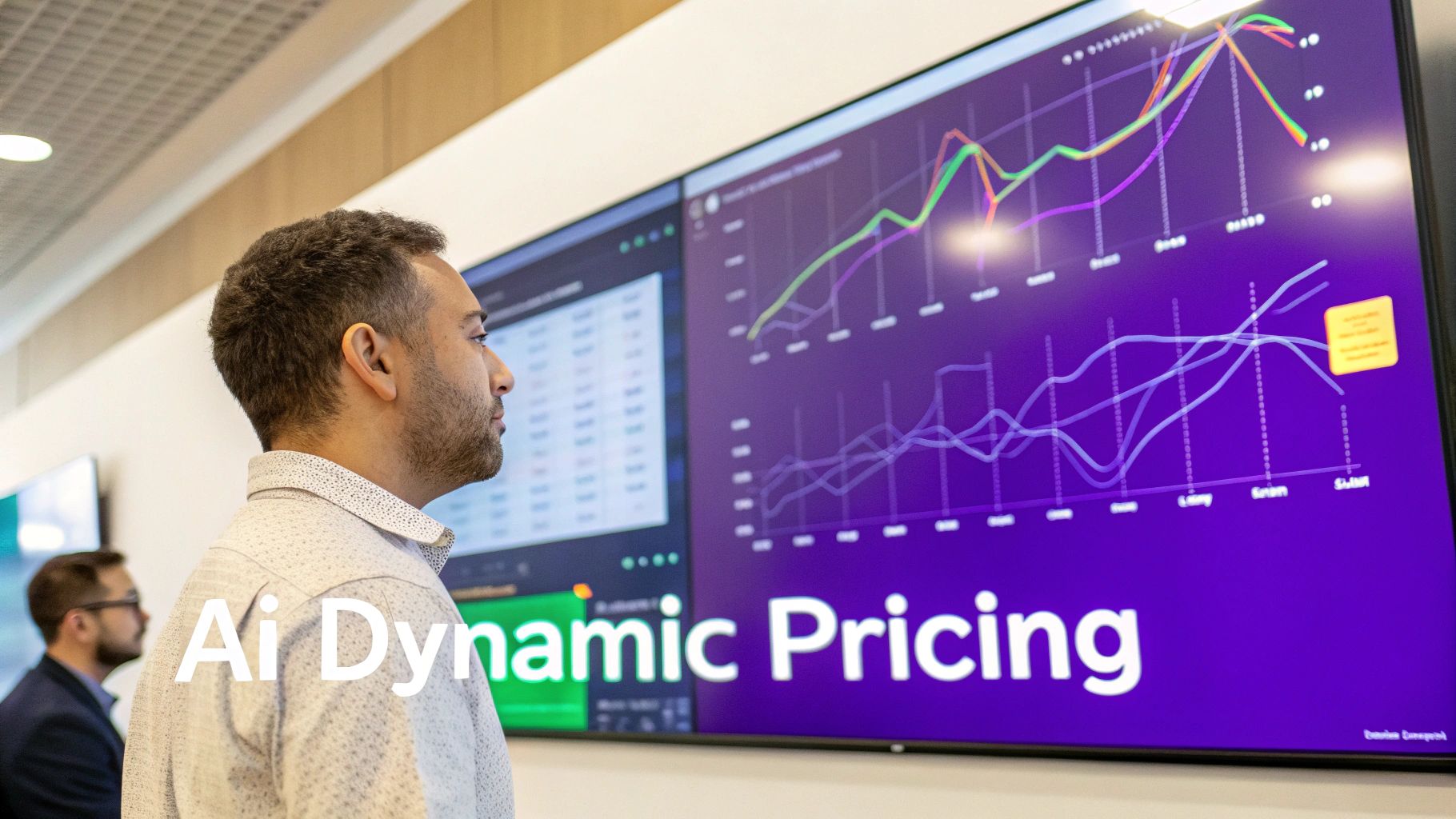
Standard price monitoring shows you what competitors did yesterday. AI-powered pricing analysis recommends what you should do right now. This is the core of a dynamic pricing strategy—shifting from a defensive, reactive posture to an offensive, predictive one.
For a B2B distributor or e-commerce brand, dynamic pricing involves automatically adjusting prices based on real-time market signals. It enables you to capitalize on small windows of opportunity that a human team could never spot or act on quickly enough.
AI and machine learning algorithms analyze millions of data points—historical sales, competitor stock levels, demand spikes—to identify the optimal price for a product at any given moment.
How AI Finds Hidden Pricing Opportunities
The strategic value of AI in pricing is its ability to identify and quantify opportunities at scale. It connects seemingly random market events to specific pricing actions, turning data into an immediate competitive edge.
Consider these real-world examples:
- Competitor Stockouts: The software detects that your top competitor is out of stock on a key item. The AI instantly recommends a temporary 5% price increase on your equivalent product, allowing you to capture higher-margin sales while demand is high.
- Demand Surges: The platform notices a sudden increase in traffic and searches for a specific product line. It might suggest a modest price increase to capitalize on the heightened interest before competitors react.
- Time-Based Adjustments: If certain products sell better during business hours, the system can learn this pattern, suggesting small price increases during peak times and slight discounts during lulls to maximize total daily revenue.
This automation transforms pricing from a quarterly review into a continuous optimization process.
With AI, pricing decisions are no longer based on last quarter’s reports or a manager's intuition. They become calculated, data-driven moves made in response to live market conditions, executed with speed and precision.
The adoption of these technologies is growing. The dynamic pricing software market is expected to reach USD 6.9 billion by 2030, with a 14.6% CAGR. This growth is fueled by companies, particularly distributors and importers, who recognize the potential to increase revenue by as much as 12%. You can discover more about the global impact of dynamic pricing to see how it's reshaping industries.
Getting Started With a Dynamic Pricing Framework
Implementing AI in your pricing strategy does not mean relinquishing control. It's about setting smart business rules and guardrails that guide the AI’s recommendations, ensuring every automated adjustment aligns with your overarching goals.
For a deeper dive, you can read our complete guide to dynamic pricing in retail.
A typical implementation follows these steps:
- Define Business Rules: Set your boundaries. For example, establish rules that prevent prices from increasing by more than 10% or dropping below a specific gross margin floor.
- Select Pilot Products: You don't have to start with your entire catalog. Begin with a single product category or a handful of fast-moving SKUs to test and refine the approach.
- Monitor and Analyze: A tool like Market Edge runs in the background, analyzing the market and flagging opportunities that fit your predefined rules.
- Execute and Measure: Your team can review and approve the AI's suggestions, or configure the system to make certain changes automatically. Then, track the direct impact on sales and profit.
This capability fundamentally changes how you compete. Instead of reacting to yesterday’s market, you are actively capitalizing on today's opportunities.
How to Choose the Right Pricing Analysis Software
Selecting the right pricing analysis software isn't about finding the longest feature list. It’s about matching the platform to your specific business objectives. To make a smart investment, focus on four critical areas that determine whether a tool will be a genuine asset or just another subscription fee.
A clear checklist helps you compare solutions effectively and ensures the platform you choose becomes a powerful partner for your team.
Is the Data Accurate?
The entire value of a pricing platform depends on the quality of its data. Inaccurate or outdated information is worse than no information at all—it leads to poor decisions that can damage margins. Your first step should be to investigate how a provider collects and verifies its data.
Ask these critical questions:
- How fresh is the data? In e-commerce, you need data that's updated multiple times a day. Anything less is a snapshot of a market that no longer exists.
- How accurate is the product matching? Ask for their stated accuracy rate for matching identical products across different websites. If it's below 98%, you will encounter significant errors in your analysis.
- How is the data cleaned? What processes are in place to filter out website errors, typos, and other anomalies?
If the data isn't trustworthy, any strategy built upon it is flawed from the start.
Can It Scale With Your Business?
A tool that works for 50 SKUs on one marketplace may fail when you need to monitor 5,000 products across dozens of websites. You need a platform that can scale with your business.
Consider scalability from two perspectives:
- Catalog Depth: Can the platform handle your entire product catalog now and in the future? Watch for limits on the number of SKUs or competitors you can track.
- Market Breadth: Does the tool cover all the channels where your products are sold? This includes major marketplaces, direct competitor sites, and specialized B2B portals.
A platform with broad coverage provides a complete view of your competitive landscape, closing blind spots. For a deeper look at what top platforms offer, check out our guide on the best price monitoring software.
Is It Easy to Use and Integrate?
The most powerful software is worthless if your team finds it too complex to use. An intuitive interface and a logical workflow are essential for daily adoption. The platform should empower your team, not create a technical bottleneck.
Beyond the dashboard, evaluate how well the tool integrates with your existing systems. Can it connect to your ERP, e-commerce platform, or business intelligence tools via an API? Seamless integration transforms the software from a data source into a core part of your commercial operations, automating workflows and saving significant time.
The right tool should feel like a natural extension of your team. If it requires extensive training or constant IT support, it will hinder your ability to act quickly on market intelligence.
Does the Pricing Model Make Sense?
Finally, examine the cost. Opaque pricing and hidden fees can turn a smart investment into a costly mistake. Look for transparency and flexibility.
A modern, usage-based model is often ideal. For example, some platforms like Market Edge use a simple per-tracked-URL pricing structure. This approach allows you to start with a focused, low-cost pilot project to prove the tool’s value. As you see a clear return, you can scale your monitoring without being locked into rigid subscription tiers.
The right pricing analysis software should be a profit center, not a cost center. Its ROI should be measurable in protected margins, new revenue opportunities, and operational efficiency.
Getting the Most Out of Your Pricing Software

A successful implementation of pricing analysis software starts with a focused pilot project. Avoid trying to monitor your entire catalog from day one. This approach minimizes initial risk and helps build confidence and momentum across your team.
Begin by selecting a small, manageable group of your most important SKUs, such as best-sellers or products with the largest impact on your bottom line. Track these against a handful of your primary competitors.
This initial test accomplishes two things: it validates the tool's data accuracy and allows your team to establish a practical workflow for acting on the insights.
Once you achieve clear wins from the pilot, you can methodically expand your efforts by adding more products, competitors, and sales channels. This phased rollout ensures your team can manage the new information flow effectively.
Defining and Measuring Success
To ensure you are getting a return on your investment, you must set clear Key Performance Indicators (KPIs) from the outset. Your software should provide the data to track these metrics, translating business goals into measurable outcomes.
A successful implementation turns data into performance metrics. Every alert and report should tie back to a specific business objective, whether it's enforcing a pricing policy or capitalizing on an opportunity to improve margins.
Here is a practical checklist of KPIs to track as you implement your new system:
- Reduction in MAP Violations: For brands, this is mission-critical. A realistic goal is to achieve a 90% reduction in MAP policy violations within the first three months of active enforcement.
- Gross Margin Improvement: Monitor the margin for tracked products versus untracked ones. A target of a 2% lift in gross margin on monitored SKUs is achievable by identifying and acting on opportunities to optimize prices.
- Increased Sales Velocity: If you were overpriced on certain products, use the software to become more competitive. Track the subsequent increase in sales volume and velocity as a direct measure of the tool's impact.
Continuous monitoring is a core business function, not a one-time project. This is where automated tools like Market Edge become useful, delivering the steady stream of data you need to keep your KPIs moving in the right direction.
Frequently Asked Questions About Pricing Analysis Software
Here are answers to some of the most common questions from business leaders evaluating pricing analysis software.
How Long Does It Take to See Results?
Initial setup is fast. You can typically configure your products and key competitors in a few hours, with actionable data available within the first 24 hours.
In practice, this means you can identify critical pricing gaps or find MAP violations within the first week. The tangible business impact—measured in improved margins or policy compliance—usually becomes evident within the first 30-60 days as your team begins to act on the insights consistently.
Is This Software Only for Large Enterprises?
Not anymore. While this technology was once limited to large corporations, modern cloud-based tools have made it accessible to businesses of all sizes.
Flexible, usage-based pricing models allow small and mid-market retailers, distributors, and brands to adopt this technology without a massive upfront investment. You can start small, prove the ROI, and scale as you grow.
How Does the Software Match Products?
Effective product matching is a sophisticated process. A reliable pricing analysis tool uses a combination of AI, machine learning, and rule-based logic to ensure it is comparing identical products.
It analyzes several key attributes to confirm a match across different websites:
- Unique Identifiers: Codes like EANs, UPCs, and Manufacturer Part Numbers (MPNs) are the most reliable matching points.
- Textual Data: The system compares product titles, technical specifications, and detailed descriptions.
- Visual Cues: Advanced systems use image recognition to compare product photos, adding another layer of validation.
Top-tier tools achieve accuracy rates above 95%. This precision is critical; making strategic decisions based on mismatched products can be extremely costly. This level of accuracy ensures you are making moves based on a true competitive picture.
This is where automated price monitoring tools like Market Edge become useful. They deliver the clean, accurately matched data required to make confident, data-driven decisions.
Ready to see how real-time pricing intelligence can protect your margins and grow your business? Get a free trial of Market Edge to start tracking your competitors today.