
Dynamic pricing isn't a "set it and forget it" tactic. It is a commercial strategy where product prices are adjusted in near real-time based on current market conditions. Instead of a fixed price tag, this approach uses live data on competitor pricing, inventory levels, and customer demand to find the optimal price point at any given moment. This allows retail businesses to react instantly to market shifts, protecting margins and capturing sales opportunities that would otherwise be missed.
Why Dynamic Pricing Is a Commercial Imperative

In today's fast-paced retail environment, a static pricing model is a direct path to lost revenue. Manual price updates are too slow to keep pace with online marketplaces and aggressive competitors, leading to missed opportunities. Dynamic pricing addresses this by transforming your pricing strategy from a fixed variable into an active, responsive component of your commercial operations.
It functions like a smart thermostat for your revenue. A thermostat doesn’t just maintain a single temperature; it constantly reads the room and makes small adjustments to maintain an optimal environment. Similarly, dynamic pricing makes frequent, data-driven adjustments to preserve the balance between sales velocity and profit margins.
The Shift from Reaction to Proaction
Traditional pricing is inherently reactive. A pricing manager identifies a competitor's price drop, analyzes the potential impact, and eventually implements a manual price change. By the time this process is complete, the market has often moved on.
A dynamic approach, powered by automated competitor tracking, flips this model. It enables businesses to set predefined pricing rules that act on their behalf, moving from a reactive stance to a proactive one. This shift is critical for several commercial reasons:
- Margin Protection: Automatically increase prices when a key competitor goes out of stock or when market demand surges.
- Competitive Positioning: Strategically lower prices just enough to win the sale without initiating a price war that erodes profitability.
- Brand Value Enforcement: For manufacturers, automated monitoring ensures resellers adhere to Minimum Advertised Price (MAP) or Recommended Retail Price (RRP) policies, preventing unauthorized discounting from damaging brand equity.
For a busy ecommerce manager or pricing leader, this means replacing cumbersome spreadsheets and gut-feel decisions with an intelligent, automated system. You can define pricing rules that execute your strategy, freeing up your team to focus on higher-level planning.
For example, a distributor can implement a rule to maintain a 5% price advantage over its top three competitors for a specific product line. A crucial part of this rule would be a price floor, ensuring the price never drops below a predefined profit margin. This keeps them competitive without sacrificing profitability.
This is where automated competitor price monitoring tools come into play. A platform like Market Edge delivers the clean, real-time data needed to power these pricing decisions, tracking competitor prices and stock levels across any website or marketplace.
Choosing Your Dynamic Pricing Strategy
Effective dynamic pricing is not about flipping a switch; it's about selecting a strategy that aligns with specific business objectives. A model designed to clear excess inventory will differ significantly from one built to protect a premium brand's market position.
The goal is to choose an approach that fits your market, product catalog, and commercial goals. Here are three of the most effective strategies used in retail today.
Time-Based Pricing
Time-based pricing adjusts prices based on predictable demand fluctuations, such as time of day, day of the week, or seasonal events. It is a practical way to capitalize on the natural rhythm of consumer behavior.
For example, an online retailer could automatically lower prices on specific items during late-night hours to target bargain-seeking shoppers. Conversely, they might slightly increase prices during a pre-holiday rush when demand is highest, maximizing profit when purchasing intent is strong.
Use Case Example: An electronics retailer aims to win the Amazon Buy Box during peak business hours. Their pricing system is configured to automatically set their product price $0.01 below the nearest competitor between 9 AM and 5 PM. Outside of these hours, the price reverts to a higher, margin-focused level.
Segmented Pricing
Segmented pricing involves offering different prices to distinct customer groups for the same product. This is based on objective data such as a customer's location, purchase history, or loyalty program status.
The underlying principle is that not all customers have the same price sensitivity. A first-time visitor might see the standard price, while a long-term, high-volume customer could be offered a preferential rate to encourage retention and repeat business.
Competitor-Based Pricing
This is one of the most powerful and widely used dynamic pricing strategies in retail. It uses real-time intelligence on competitors' pricing and stock availability to inform your own pricing decisions. This data-driven approach removes guesswork and enables strategic, market-aware adjustments.
You can establish rules that directly support your market position. For example, a retailer can set a rule to always be priced 3% below its top five competitors for a specific product category, while also implementing a price floor to guarantee it never sells at a loss. If you want to understand the mechanics, our guide explains how to monitor competitor prices in greater detail.
Use Case Example: A premium tool brand uses competitor monitoring to enforce its MAP (Minimum Advertised Price) policy. An automated system scans reseller websites continuously. If a retailer's price falls below the MAP threshold, an alert is instantly sent to both the brand's compliance team and the reseller, enabling swift remediation.
The right strategy depends on your business objective. Each model offers distinct advantages. The following table provides a clear comparison.
Comparison of Dynamic Pricing Models
This table compares the primary dynamic pricing strategies, outlining the best use case, primary data required, and potential business impact for each.
| Strategy Type | Best For | Data Required | Potential Business Impact |
|---|---|---|---|
| Time-Based | Capitalizing on predictable demand peaks and troughs, such as holidays or flash sales. | Historical sales data, website traffic analytics, and event calendars. | Increased sales velocity during key periods and improved conversion rates. |
| Segmented | Businesses with distinct customer groups and varying price sensitivities, like B2B vs. B2C. | Customer purchase history, location data, and loyalty program status. | Higher customer lifetime value and improved loyalty from targeted offers. |
| Competitor-Based | Highly competitive markets where price is a key decision factor, like electronics or CPG. | Real-time competitor pricing, stock availability, and MAP/RRP data. | Maintained market share, protected profit margins, and stronger brand positioning. |
Ultimately, a clear goal is the first step. Whether you're aiming to drive volume, reward loyalty, or just stay competitive, there's a dynamic pricing model that can get you there. And with tools like Market Edge providing the competitor data you need, you have the foundation to execute these strategies with confidence.
Balancing the Rewards and Risks
Adopting a dynamic pricing strategy can drive significant growth, but it requires careful management. For any business leader, it is essential to weigh the commercial benefits against the potential risks to customer perception and brand trust.
The rewards are tangible and directly impact the bottom line. The risks, however, are centered on customer perception. Poorly managed dynamic pricing can appear arbitrary or unfair to consumers, leading to frustration and eroding trust. Frequent, drastic price fluctuations can cause customers to question the fundamental value of your brand.
The Tangible Commercial Benefits
The primary appeal of dynamic pricing is its immediate impact on key financial metrics. When implemented correctly, the benefits extend beyond simple price adjustments.
- Boost Revenue and Profit Margins: By automatically identifying opportunities to increase prices—even incrementally—when demand rises or a competitor is out of stock, you capture revenue that would otherwise be lost. This can lift profits by 2-5% within months.
- Improve Inventory Velocity: Dynamic pricing can automatically apply targeted discounts to slow-moving products. This liquidates capital tied up in stagnant inventory, reduces holding costs, and creates space for higher-demand items.
- Sharpen Your Competitive Edge: Real-time market data enables faster, more informed decisions. It allows you to be aggressive enough to secure sales without triggering a race-to-the-bottom price war that destroys industry-wide margins.
Mini Use Case: A distributor manages thousands of SKUs. They implement a simple rule: if their primary competitor for a top-selling product goes out of stock, their system automatically increases the price by 3%. This single, automated rule can add thousands in pure profit each quarter with zero manual intervention.
Mitigating the Potential Downsides
The benefits are compelling, but managing the risks is what separates successful implementation from a cautionary tale. The primary danger is alienating customers, which can cause long-term brand damage.
The most common pitfall is the race to the bottom, where automated, competitor-driven rules create a vicious cycle of price reductions. This is why intelligent guardrails are non-negotiable.
Here is a practical framework for risk mitigation:
- Set Hard Price Floors: Before activating any rule, define a non-negotiable minimum price for every product based on costs, target margin, and any MAP/RRP policies. The system must never be allowed to price below this floor.
- Define Clear Price Ceilings: Equally important is setting a maximum price. This prevents the system from appearing to price-gouge during supply shortages or demand surges, which is a reliable way to damage customer trust and attract negative attention.
- Ensure Rule Transparency: Your pricing team must understand why the system made a price adjustment. Avoid "black box" algorithms. The logic behind every price change should be traceable and clear.
This is where price monitoring platforms like Market Edge provide significant value. They deliver the clean, real-time competitor and market data needed to set these rules intelligently, ensuring your dynamic pricing strategy is both profitable and sustainable.
How AI and Data Power Modern Pricing Decisions
Dynamic pricing is a data-driven process, not a "black box" solution. The pricing algorithm is the engine, but it is useless without high-quality fuel in the form of clean, real-time data. Without a constant stream of reliable market intelligence, even the most advanced AI is simply making educated guesses.
To make intelligent, automated decisions, pricing systems must integrate a wide range of internal and external data. This creates a comprehensive, 360-degree view of the market, allowing the system to identify opportunities and threats that a human team using spreadsheets would likely miss.
The Essential Data Inputs
A robust dynamic pricing model is built on several key data streams. Each provides a different piece of the market puzzle.
- Competitor Price Data: This is the foundation. It is essential to know what competitors are charging, including their promotional offers and shipping fees. This requires continuous monitoring of their websites and marketplace listings.
- Inventory and Stock Levels: Knowing your own stock levels is standard. The strategic advantage comes from knowing your competitors' stock availability. When a rival sells out of a key item, a clear opportunity opens to adjust your price upward without losing sales momentum.
- Historical Sales Data: Your own transaction history offers valuable insights into seasonal demand patterns and the price elasticity of specific products.
- Shopper Behavior Data: Metrics like conversion rates, product page views, and cart abandonment rates serve as leading indicators of demand. A sudden increase in page views for a product often signals a coming surge in interest before sales materialize.
This data must be clean, structured, and available in near real-time. A data lag of even a few hours can mean the difference between capitalizing on a market shift and falling behind it.
How AI Finds Hidden Pricing Opportunities
Once the data is aggregated, AI and machine learning algorithms analyze these massive datasets to identify patterns that inform the next optimal price move.
It’s not just about reacting to a single competitor. For instance, instead of merely matching a competitor's 5% price drop, an AI model can analyze the broader market context. It might notice that while your largest rival lowered their price, three smaller competitors actually increased theirs, suggesting the market can support a higher price point than initially thought.
This is where the commercial value becomes clear. An algorithm might identify that a specific product's conversion rate doubles on weekends, even at a higher price. It can then be programmed to automatically increase the price by 2% every Friday evening and revert on Monday morning, capturing additional margin with no manual effort.
These systems operate within parameters you define. You set the guardrails, such as maintaining a minimum profit margin or never pricing above a key competitor, and the AI works within those boundaries to find the optimal price.
Vendor-neutral platforms that deliver accurate market intelligence are crucial to this process. Solutions like Market Edge are designed to provide the clean, structured competitor data that advanced pricing engines require to operate effectively. It allows your team to focus on high-level strategy instead of data collection. To see how this fits into your overall tech strategy, you can learn more about selecting the right price optimization software for your business.
Your Step-by-Step Implementation Framework
Transitioning to a dynamic pricing strategy can seem daunting. The key is to break the process down into manageable, logical steps. This is a deliberate process that must begin with business goals, not technology. A successful strategy is one that directly supports your commercial targets.
Phase 1: Define Your Business Goals
Before evaluating any technology, you must clearly define what you want to achieve. What does success look like? Your goals will guide every subsequent decision.
Avoid vague objectives like "increase sales." Instead, set specific, measurable targets. For example, a clear goal might be to increase the margin on your top 100 SKUs by 3% this quarter, or to reduce aging inventory by 50% before the end of the fiscal year.
Practical examples of goals include:
- For Manufacturers: Flag any reseller dropping below MAP within one hour of the violation.
- For Distributors: Secure a position as one of the top three lowest-priced options for a key product line, while never allowing gross margin to fall below 15%.
- For Ecommerce Retailers: Achieve 80% ownership of the Amazon Buy Box for hero products during peak shopping hours (9 AM - 5 PM).
Phase 2: Get Your Data in Order
With clear goals established, the next step is to gather the necessary data. The effectiveness of your dynamic pricing strategy depends entirely on the quality of the information you feed it. This involves consolidating all relevant internal and external data into a clean, accessible format.
Internal data provides insights into your own operations. External data offers a view of the broader market. Both are essential.
A common mistake is focusing solely on competitor prices. While critical, this is only one piece of the puzzle. The real power comes from combining data points. For example, combining a competitor's low-stock alert with your own high inventory levels for the same product is a perfect trigger for a targeted, timely promotion.
Phase 3: Choose a Strategy and Set Your Rules
Now, connect your goals and data to a specific strategy. Select the model—competitor-based, time-based, or segmented—that best aligns with your objectives. Then, define the rules that will govern your automated pricing. These rules are the guardrails that keep the automation aligned with your business logic.
Your rules engine should include:
- Triggers: The specific events that prompt a price change (e.g., a competitor's price drop, a change in stock levels, a specific date).
- Price Floors: An absolute minimum price based on your costs and required profit margin to prevent selling at a loss.
- Price Ceilings: The maximum price you are willing to charge, protecting your brand's reputation and preventing perceptions of price gouging.
Phase 4: Integrate the Tech and Monitor Performance
With your strategy defined, you can select and integrate the right technology. This typically involves a pricing engine or platform that can execute your rules automatically.
This is where automated price monitoring tools like Market Edge are essential. They provide the clean, real-time market data that powers your pricing rules, tracking competitor actions without manual effort from your team.
Launching the system is not the final step. You must continuously monitor your key performance indicators (KPIs). Are you hitting margin targets? Is inventory moving at the desired rate? Use this feedback loop to test, refine, and improve your strategy.
Implementation Checklist:
- Define Primary Goal: (e.g., Increase margin by X%, win Buy Box Y% of the time)
- Identify Key Data Sources: (Internal sales data, competitor prices, stock levels)
- Choose Pricing Strategy: (Competitor-Based, Time-Based, etc.)
- Set Price Floors & Ceilings: (For each key product or category)
- Define Price Change Triggers: (e.g., Competitor out-of-stock, demand surge)
- Select & Integrate Monitoring Tools: (Automate data collection)
- Establish KPIs for Monitoring: (e.g., Gross margin, sales velocity, market share)
- Launch Pilot Program: (Test with a limited set of SKUs)
- Review & Refine: (Analyze results weekly and adjust rules as needed)
Real-World Examples of Dynamic Pricing Success
Theory is useful, but practical examples demonstrate the real-world impact of dynamic pricing. These brief case studies show how manufacturers, distributors, and retailers use this strategy to solve commercial challenges and achieve measurable results.
Use Case 1: A Manufacturer Stops Brand Erosion
A leading power tool manufacturer was experiencing brand value erosion. Numerous authorized online sellers were violating their Minimum Advertised Price (MAP) policy, triggering price wars that devalued their premium products. Manually tracking every seller was inefficient and ineffective.
The Solution: They implemented an automated price monitoring system. The platform scanned reseller websites and online marketplaces 24/7, comparing advertised prices against the official MAP list. When a violation was detected, the system automatically sent a documented notification to the reseller, including a screenshot and a clear deadline for correction.
The Commercial Outcome: Within 90 days, the company achieved a 95% MAP compliance rate. This stabilized their market value, restored trust with compliant retail partners, and protected profit margins across their distribution network.
Use Case 2: A Distributor Finds Hidden Profit
A large electronics distributor with over 20,000 SKUs faced shrinking margins. Their pricing team was constantly reacting to competitor price cuts, participating in a race to the bottom that damaged profitability. They needed a more strategic approach to identify opportunities to raise prices without losing sales.
The Solution: They adopted a competitor-based dynamic pricing strategy powered by market intelligence. They created simple rules to monitor the stock levels of their top five competitors for their most popular products. The key rule was: if their main competitor ran out of stock on a high-demand item, their own price would automatically increase by 3%, while staying below a predefined price ceiling.
The Commercial Outcome: By capitalizing on competitor stockouts, the distributor increased their gross profit margin by an average of 1.5 percentage points in six months. This delivered a significant revenue increase with no additional marketing spend, turning a competitor's supply chain issue into their own financial gain.
Use Case 3: An Ecommerce Retailer Wins the Buy Box
An ecommerce retailer on Amazon was struggling to win the Amazon Buy Box, which accounts for over 80% of sales. Their manual price adjustments were too slow to compete with rivals using automated repricing tools.
The diagram below shows the basic framework behind implementing these kinds of smart pricing strategies.
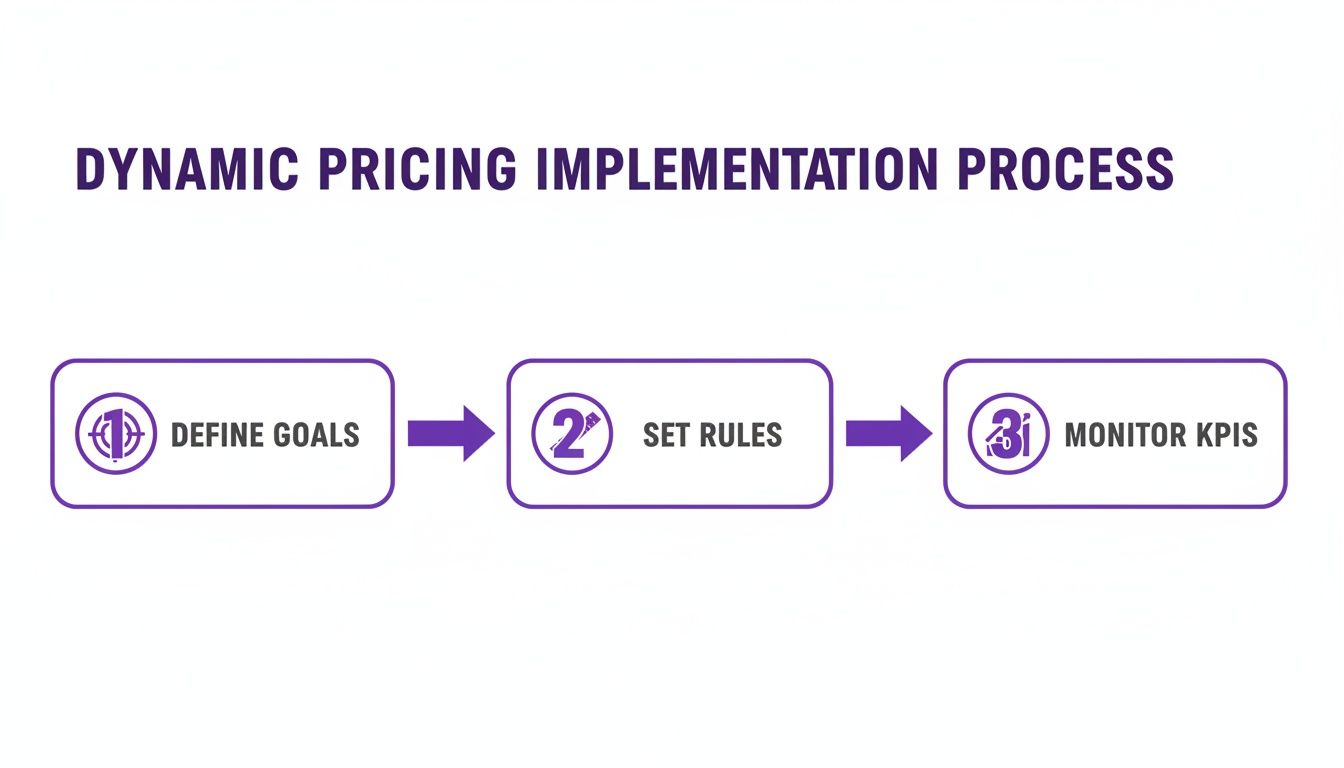
As you can see, it all starts with knowing what you want to achieve, creating smart rules to get there, and then keeping a close eye on your results.
The Solution: The retailer implemented an intelligent repricing tool capable of making real-time price changes. They configured it to automatically price their items slightly below the current Buy Box winner, but never below their minimum profit margin floor. The system operated 24/7, reacting instantly to competitor movements.
The Commercial Outcome: The retailer's Buy Box ownership for their top products increased from 30% to over 75% during peak hours. This drove a 40% increase in sales velocity for those products within the first month.
These examples show that with the right strategy and accurate data, the results are tangible. You can explore more examples of dynamic pricing to see how it applies across different sectors. This is where automated tools become useful, giving businesses the data they need to compete effectively.
Dynamic Pricing: Your Questions Answered
When business leaders consider dynamic pricing, several common questions arise. Here are direct answers to the most frequent inquiries.
How Often Should I Actually Change My Prices?
There is no universal answer. The optimal frequency depends on your market, products, and specific goals.
An aggressive ecommerce seller on a marketplace like Amazon might reprice key products every few minutes to compete for the Buy Box. In contrast, a B2B distributor may find that daily or weekly adjustments are sufficient to respond to competitor stockouts or cost changes.
The key is to tie price updates to meaningful market events. Arbitrary, frequent price changes can confuse and alienate customers. Instead, base adjustments on clear business triggers, such as a competitor's price change, a surge in demand, or a shift in your own inventory levels.
Will This Scare Away My Customers?
This is a valid concern, but the risk of customer backlash is entirely manageable with a transparent and logical approach.
Customers become frustrated by prices that feel arbitrary or unfair. It is crucial to understand that dynamic pricing should be based on market factors (like supply and demand), not personalized pricing aimed at an individual.
To maintain customer trust, adhere to these principles:
- Set Clear Guardrails: Establish firm price floors and ceilings to prevent extreme fluctuations that can be perceived as price gouging.
- Be Consistent: Your pricing logic should apply uniformly to all customers at any given moment.
- Communicate Value: The conversation should not be solely about price. Consistently reinforce your product quality, customer service, and other brand differentiators.
Isn't This Just Algorithmic Pricing?
The terms are related but distinct. It is helpful to think of them this way:
Dynamic pricing is the strategy—the "what" and "why." It is the overall approach of allowing prices to adjust to market conditions. Algorithmic pricing is the technology that enables the strategy—the "how." It is the software engine that executes your pricing rules.
So, your dynamic pricing strategy might be to "maintain a price position within 2% of our top three competitors." The algorithm is the software that processes the data and makes the automated price adjustments to achieve that strategic goal.
What's the Most Important Data I Need for This to Work?
While many data points can be used, a few are non-negotiable for success.
The most critical input is real-time competitor price and stock data. Operating without visibility into your competitors' actions is a significant disadvantage. Equally important is your own internal sales and inventory data, which reveals what is selling, at what velocity, and at what price point.
Combining these external and internal data streams provides the comprehensive market view required to make intelligent, automated pricing decisions.
This is where automated price monitoring tools like Market Edge become useful. They deliver the clean, reliable competitor data that fuels an effective and sustainable dynamic pricing strategy.