
Price optimization software is more than an advanced repricing tool. It's a sophisticated system that uses data and algorithms to identify the ideal price for a product—the point where sales velocity and profit margin are perfectly balanced. For B2B decision-makers, this technology turns pricing from a reactive task into a strategic, profit-driving function.
Why Legacy Pricing Strategies Underperform
Relying on spreadsheets and manual analysis to set prices is no longer viable in today's dynamic market. This approach is slow, prone to error, and cannot keep pace with real-time market shifts, leading to significant lost revenue. Price optimization software automates this complexity, using predictive models to transform pricing from guesswork into a data-driven science. It enables businesses to anticipate market trends rather than just react to them.
This strategic advantage is fueling rapid market growth. The global price optimization software market, currently valued at over USD 1.2 billion, is projected to reach USD 2.9 billion by 2033. Some forecasts are even more aggressive, predicting a market size of USD 3.59 billion by 2030, driven largely by AI. You can read more about the market's rapid expansion to understand the scale of this industry shift.
From Manual Guesswork to Data-Driven Decisions
Effective pricing is not about simply undercutting competitors. It requires a comprehensive understanding of costs, competitor positioning, and customer willingness to pay. Price optimization software excels by continuously ingesting and analyzing multiple data streams to inform its recommendations.
Key data inputs include:
- Competitor Prices: Real-time monitoring of what direct and indirect competitors charge for identical or similar products. This is critical for MAP/RRP enforcement and competitive positioning.
- Internal Sales History: Analysis of past transaction data to understand price elasticity and how price changes impact demand for specific SKUs.
- Inventory Levels: Tracking both internal stock and, crucially, competitor stock levels. When a competitor goes out of stock, it creates a clear opportunity to adjust pricing for a higher margin.
- Market Demand Signals: Factoring in external variables like seasonality, holidays, and promotional events that influence consumer purchasing behavior.
By processing this data, the software uncovers profit opportunities that a human analyst would likely miss.
Mini Use Case: Competitor Tracking An ecommerce manager for a consumer electronics brand notices a key competitor has sold out of a popular television model. The price optimization software, fed by a real-time competitor tracking feed, flags this event. The system automatically recommends a 4% price increase on the brand’s comparable model to capitalize on the temporary spike in demand, boosting gross margin without harming sales velocity. This is why high-quality competitive intelligence from a solution like Market Edge is essential; it provides the clean, reliable data these pricing engines require.
A pricing strategy without real-time data is like navigating without a map. Price optimization software provides that map, showing you the most profitable route based on current conditions, not just where you've been before.
This approach marks a definitive shift away from outdated "cost-plus" or simple competitor-matching tactics toward a dynamic, value-driven strategy. Every price becomes a calculated business decision, providing the confidence that it is backed by data and optimized for maximum returns.
Manual Pricing vs. Price Optimization Software
The difference between using spreadsheets and dedicated software is a fundamental shift in commercial capability. Here’s a practical comparison:
| Attribute | Manual Pricing (Spreadsheets) | Price Optimization Software |
|---|---|---|
| Speed & Agility | Slow, manual updates. Cannot react to market changes in real-time. | Instantaneous. Automatically adjusts to market shifts 24/7. |
| Data Scope | Limited to what a human can gather and input. Often outdated. | Ingests vast, real-time data (competitors, stock, demand). |
| Accuracy | Prone to human error, typos, and formula mistakes. | Highly accurate, rule-based calculations eliminate costly errors. |
| Strategy | Reactive. Often based on gut feel or simple cost-plus models. | Proactive & data-driven. Uses predictive analytics to find opportunities. |
| Scalability | Becomes unmanageable with thousands of SKUs or competitors. | Easily handles millions of data points across massive catalogs. |
| Profit Impact | Leaves significant margin on the table. Missed opportunities are common. | Actively works to maximize profit margins and sales velocity. |
While familiar, spreadsheets cannot compete with the strategic, profit-driving power of a dedicated price optimization platform. The software doesn't just manage prices; it actively finds and captures hidden revenue.
How the Pricing Engine Works
At its core, price optimization software operates on a continuous loop: ingest data, apply logic, and generate a strategic price. The true value lies in how the software executes these steps, graduating a business from manual processes to automated, intelligent decision-making.
The process can be broken down into three essential stages. High-quality data feeds the engine, which performs the analysis, resulting in profitable pricing actions.
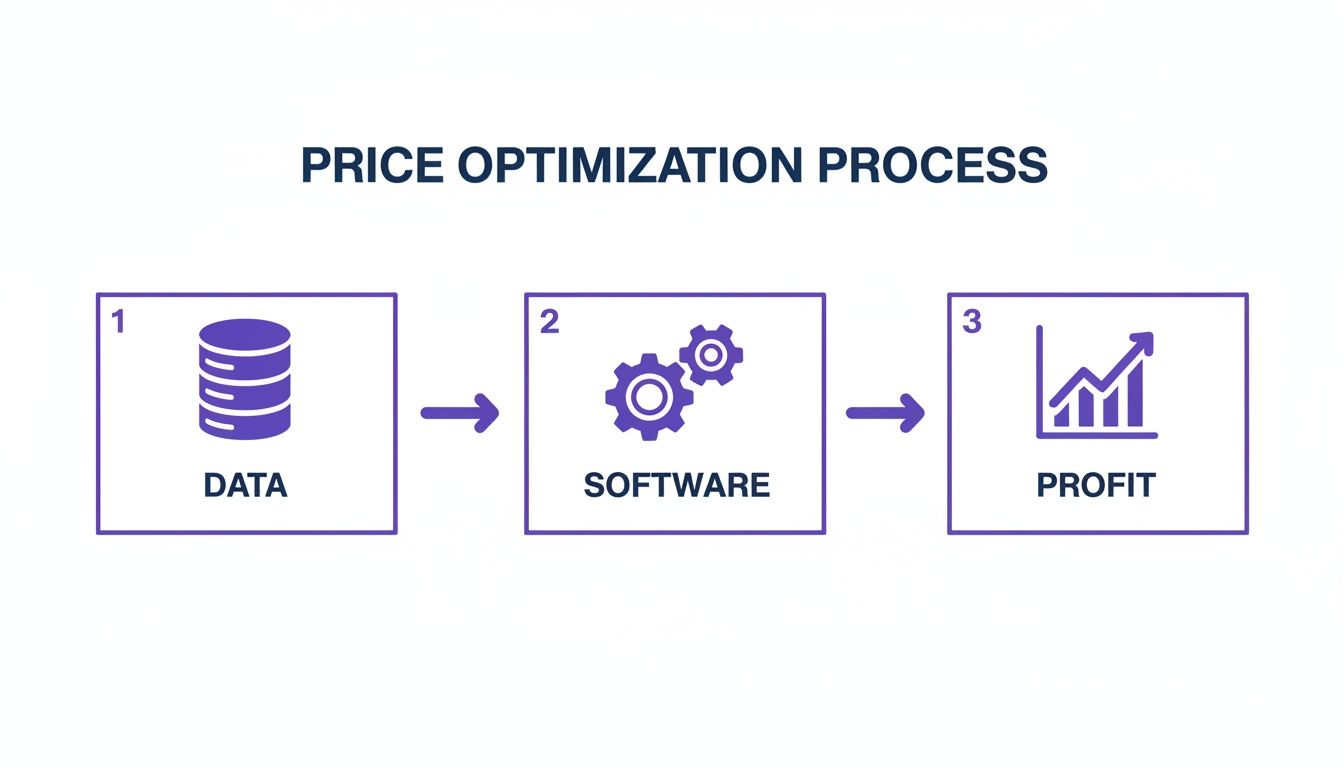
The quality of the output—the optimized price—is directly dependent on the quality of the input data. Let's examine each stage.
Stage 1: Data Ingestion
The process begins with data. The software requires a continuous stream of information from various sources to build a comprehensive, live view of the market.
Essential data points include:
- Competitor Pricing Data: The most critical external factor. Real-time pricing for identical or similar items is necessary for informed decisions.
- Internal Sales Data: Transactional history provides a rich source for understanding price elasticity and demand curves for every SKU.
- Inventory and Stock Levels: Knowing your own stock levels is standard; knowing your competitors' stock levels is a strategic advantage. An out-of-stock event at a competitor is a clear signal for a margin-enhancing price adjustment.
- Product Costs and Margins: The cost of goods sold (COGS) establishes the absolute price floor, ensuring every pricing decision remains profitable.
This constant flow of fresh data enables the software to react to market shifts in minutes, not days. Without a clean, reliable stream of competitive data, the system cannot operate effectively. To learn more about this foundational element, read our guide on competitor price monitoring software.
Stage 2: The Pricing Engine Logic
Once collected, the data is fed into the core pricing engine where the analysis occurs. These engines typically use one of two main approaches: rule-based logic or AI-driven models.
A rule-based system executes specific, pre-defined commands. These are straightforward "if-then" statements that give pricing managers direct control over the logic.
Examples of common rules:
- "Always price Product X $1.00 below Competitor A."
- "If our stock of Product Y drops below 10 units, increase the price by 5%."
- "Maintain a minimum gross margin of 30% on all products in the Z category."
This method provides high control and predictability, making it an excellent entry point for businesses new to dynamic pricing.
An AI-driven engine uses machine learning to analyze dozens of variables simultaneously, predicting how a price change will impact both sales and profit. It is designed to identify complex patterns that a human—or a simple rule—would miss.
Instead of just following a command, it addresses a broader strategic question: "Based on all available data—competitor prices, inventory, historical demand, seasonality—what is the optimal price for this product right now to maximize gross margin?"
Stage 3: Actionable Output
The final step is to translate analysis into action. The software delivers the new price in a format that integrates directly into your existing workflows.
Typically, this is managed via an API connection to an ERP, PIM, or ecommerce platform like Shopify or Magento. The optimized prices can be pushed live automatically or routed to a pricing manager for final approval. This seamless integration closes the loop, converting raw data into tangible profit.
This is where a vendor-neutral data feed, like the one provided by Market Edge, becomes crucial. It is designed to deliver high-quality, structured competitive data that sophisticated pricing engines need to function, ensuring every decision is based on an accurate reflection of the market.
Core Features That Drive Business Value
When evaluating price optimization software, it's essential to focus on the features that deliver a tangible commercial impact. For distributors, manufacturers, and retailers, the key is to identify capabilities that directly improve margins, strengthen brand equity, and increase market share.
These core features work in concert to transform raw market data into a cohesive and profitable pricing strategy.
Competitor Price Monitoring
This is the foundation of any intelligent pricing strategy. Without clean, accurate, and timely data on competitor pricing, all subsequent actions are based on assumptions. This feature automates the collection of prices and stock availability from competitor websites, marketplaces, and resellers.
The value extends beyond simple price tracking. A robust monitoring tool can identify when a competitor is out of stock, presenting an immediate opportunity to adjust your price upward for a better margin without sacrificing the sale. This is the raw intelligence that fuels all other strategic features.
Dynamic Pricing Rules Engine
The rules engine translates business objectives into automated actions. It allows you to move beyond reactive spreadsheet management into proactive, real-time price adjustments based on a set of "if-then" conditions.
This engine makes pricing manageable at scale. Instead of a person manually repricing thousands of SKUs, you can set rules that execute your strategy 24/7. To see practical applications, you can explore some examples of dynamic pricing across different industries.
Common rules include:
- Margin Protection: Establish a price floor to ensure you never sell below a target gross margin, regardless of competitor actions.
- Competitor Positioning: Automatically set your price relative to specific rivals (e.g., always 1% below Competitor A but 2% above Competitor B).
- Inventory-Based Adjustments: Increase prices when stock is low to maximize profit on remaining units, or apply discounts to clear slow-moving products.
A strong rules engine ensures your pricing strategy is executed consistently and immediately, capitalizing on market changes in minutes, not days. It’s the bridge between market intelligence and profitable action.
AI-Powered Price Recommendations
While a rules engine executes a known strategy, an AI recommendation engine helps discover new ones. It uses machine learning to analyze vast datasets—sales history, competitor behavior, market trends—to predict the optimal price for achieving a specific goal, such as maximizing revenue or gross profit.
This predictive capability offers a significant commercial advantage. For instance, an AI might identify a product with low price elasticity, indicating that a price increase is unlikely to cause a significant drop in sales volume. The market for this technology is expanding rapidly; the AI-driven price optimization market, valued at USD 2.98 billion, is expected to reach USD 11.74 billion by 2034. These systems consistently demonstrate the ability to boost profit margins by 5% to 10%. You can read more about this AI-driven market surge.
MAP Monitoring and Enforcement
For manufacturers and brand owners, protecting brand value and maintaining channel harmony is paramount. Minimum Advertised Price (MAP) or Recommended Retail Price (RRP) monitoring is an essential feature that automatically tracks reseller pricing to ensure compliance.
Mini Use Case: MAP/RRP Enforcement A brand manager for a premium tool company uses a price optimization platform with built-in MAP monitoring. The system detects that an unauthorized online seller has listed a flagship product 15% below the MAP policy. An alert is sent instantly with a timestamped screenshot as evidence. The brand's legal team can then issue a cease-and-desist notice within hours, preventing brand erosion and protecting its authorized retail partners.
These core features all rely on a continuous stream of high-quality, structured market intelligence. This is where automated data feeds, for instance from a provider like Market Edge, become indispensable. They supply the clean, reliable competitive data that pricing engines need to make smart, profitable decisions.
Measuring the Business Impact
Adopting price optimization software is about achieving measurable results that directly impact the bottom line. Business leaders need to know what tangible outcomes to expect. The impact is quantifiable across several key areas of the business.
This is not about abstract benefits. It's about direct improvements to financial statements and operational efficiency. Automating price adjustments based on real-time market conditions unlocks gains that are impossible to achieve with manual processes.
Increased Profit Margins
The most immediate benefit is margin expansion. Price optimization software excels at identifying products where you have a competitive advantage—such as better stock availability or temporary market exclusivity—and helps you capitalize on it. This involves making precise, surgical price adjustments on products where customers have a higher willingness to pay.
For example, a B2B distributor might discover it is underpriced on 500 different SKUs for no strategic reason. By adjusting those prices to be competitive, rather than simply the lowest, the business could realize a 1.5% increase in overall gross margin without a meaningful loss in sales volume.
Price optimization isn't about being the cheapest—it's about being the smartest. It’s about ensuring you capture the full value the market is willing to pay for every product, every day.
Improved Sales Velocity
Profitability is a function of both margin and the speed at which inventory is converted into cash. Products sitting in a warehouse represent tied-up capital. Price optimization software identifies the price point that increases sales velocity, ensuring products move at a healthy rate.
This is particularly valuable for seasonal goods or products with a limited shelf life. The software can execute a dynamic strategy that systematically lowers prices to clear stock before it becomes a liability, helping avoid large, profit-eroding clearance sales. This keeps inventory lean and cash flow strong.
Enhanced Market Agility
Today’s ecommerce market moves quickly. A competitor can change prices overnight and begin eroding your market share before your business day begins. Manual tracking cannot keep up.
Price optimization software provides the agility to react to market shifts in minutes:
- React to Competitors: A key rival runs out of stock? Your prices can automatically adjust upward to capture additional margin.
- Protect Your Brand: The system can instantly flag when a reseller violates a MAP or RRP policy, enabling swift enforcement to protect brand equity.
- Capitalize on Trends: It identifies surging demand for a product and can adjust prices to maximize revenue during peak opportunities.
This speed is a true competitive advantage, allowing you to consistently outmaneuver competitors still reliant on manual processes.
Key Performance Indicators for Price Optimization
To measure the impact accurately, you need to track the right metrics. Moving beyond top-line revenue provides a clearer picture of the software's contribution.
| Business Goal | Primary KPI | Secondary KPI |
|---|---|---|
| Increase Profitability | Gross Margin Return on Investment (GMROI) | Average Unit Margin |
| Boost Sales Efficiency | Sales Velocity / Inventory Turnover | Sales Conversion Rate |
| Gain Market Share | Competitor Price Parity | Number of Price Adjustments per Week |
Monitoring these KPIs provides the hard data needed to prove the return on your investment. Improving any of these metrics begins with high-quality market data. This is why a powerful price monitoring tool, like the one offered by Market Edge, is so critical. It provides the clean, reliable competitive intelligence an optimization engine needs to perform effectively.
Implementation Roadmap and Pitfalls to Avoid
Implementing price optimization software is a strategic business initiative, not just a technology upgrade. A well-defined plan is crucial for a smooth rollout and avoiding costly errors. This roadmap helps align teams, prepare data, and establish measurable success criteria.

This technology is no longer exclusive to large enterprises. While market leaders have traditionally captured 55.64% of the market, small and mid-sized businesses are growing their adoption at an impressive 18.89% rate. The entire market, valued at USD 5.73 billion, is projected to nearly double, signaling that companies of all sizes need scalable pricing solutions. You can explore more data on the growth of the pricing management market for a complete overview.
Step-by-Step Implementation Checklist
A successful launch requires careful planning. This five-step checklist provides a practical framework.
- Define Business Goals: Clearly articulate what success looks like. Is the primary objective to increase gross margin, gain market share, or liquidate aging inventory? Your goal will inform every subsequent decision.
- Ensure Data Integrity: This is the most critical step. The pricing engine relies on clean, accurate data—your product catalog, costs, sales history, and competitor prices. Incomplete or messy data will produce flawed recommendations. Clean data is non-negotiable.
- Integrate with Core Systems: The software must communicate with your existing technology stack. Plan for integrations with your ERP (for cost and inventory data), PIM (for product attributes), and ecommerce platform (like Shopify or BigCommerce) to push prices live.
- Launch a Pilot Program: Start with a limited scope. Select a single product category or brand to test the system. Implement a few simple, high-impact pricing rules. This allows your team to learn the software and validate its effectiveness before a full-scale rollout.
- Monitor, Refine, and Expand: Pricing is an iterative process. Continuously monitor the performance of your pricing rules against your KPIs. Use these insights to refine your strategy and gradually expand the software's application across your entire catalog.
Common Pitfalls and How to Avoid Them
Knowing what not to do is as important as having a solid plan. Many implementations falter due to a few common, avoidable mistakes.
The goal of price optimization is not simply to be the cheapest; it's to be the smartest. An overly aggressive strategy focused solely on undercutting competitors is a fast track to margin erosion for everyone in the market.
Three major traps to watch out for:
- Using Unreliable Competitor Data: Basing your strategy on inaccurate, outdated, or poorly matched competitor data is a recipe for failure. It leads to poor pricing decisions that either cost you sales or destroy your margins.
- Creating a "Race to the Bottom": A simple rule like "always be 1% cheaper than Competitor X" can trigger a price war that eliminates profit from the market. A better approach is to build rules that incorporate your costs, inventory, and brand value, ensuring you never sell below a profitable floor.
- Ignoring Cross-Functional Alignment: Pricing does not exist in a vacuum. A pricing strategy must align with inventory, marketing, and sales functions. Aggressively pricing a product that is about to go out of stock, for example, only creates customer frustration. Ensure open communication across departments.
A successful implementation depends on a solid data foundation. This is where automated price monitoring tools prove their worth, providing the clean, accurate competitive intelligence needed to power a sophisticated pricing engine.
Your Path to a Smarter Pricing Strategy
Transitioning from manual spreadsheet management to automated price optimization software is a fundamental business transformation. It is no longer a niche tool for large corporations but a core competency for any serious distributor, manufacturer, or online retailer focused on sustainable growth.
The paradigm has shifted from reactive price matching to proactively engineering profitability with data-driven insights.
This transition allows you to move from guesswork to calculated financial success. Instead of scrambling to react to a competitor's price drop, you can make a strategic decision based on a complete market view—your costs, your inventory, and your brand's true value. This is the difference between surviving on thin margins and thriving. To learn more about building this type of resilience, review our guide on what is a competitive pricing strategy.
From Data to Decisions
Ultimately, any pricing engine—whether rule-based or AI-driven—is only as effective as the data it consumes. Incomplete or inaccurate information will inevitably lead to poor pricing decisions that can damage margins from the outset.
Clean, reliable, and comprehensive market data is the bedrock of any successful pricing initiative. Without it, even the most powerful software is flying blind.
The objective is not just to change prices faster, but to make smarter pricing decisions with confidence. By leveraging a clear view of the competitive landscape, every price adjustment becomes a calculated move that directly contributes to your bottom line.
This is why automated tools that deliver high-fidelity competitive intelligence are so crucial for fueling any effective pricing engine.
Answering Your Top Questions
Here are answers to common questions from business leaders exploring price optimization software.
How Is Price Optimization Different From Price Monitoring?
Think of it this way: price monitoring is the reconnaissance report. It tells you where your competitors are positioned in the market—their current prices and stock levels. It is essential information, but it is passive.
Price optimization, in contrast, is the command center. It takes that reconnaissance report, combines it with your internal intelligence—costs, inventory, and sales data—and then executes a strategic decision. It determines the optimal price to achieve a specific business objective, whether that is maximizing profit, liquidating inventory, or gaining market share.
Monitoring provides the data. Optimization turns that data into action. A tool like Market Edge provides the clean, reliable data that a powerful optimization engine needs to function.
How Long Does It Take to Implement This Software?
Implementation timelines vary based on complexity. For a business with clean product data on a standard ecommerce platform like Shopify or BigCommerce, a go-live is possible within a few weeks.
For larger organizations with custom ERP systems, complex integrations, and product catalogs requiring significant data cleansing, a more realistic timeline is two to four months.
The single biggest variable is data readiness. Messy or incomplete data will delay the project and compromise the quality of the outcomes. Starting with accurate, well-matched competitor price data is the most effective way to accelerate the timeline and ensure the pricing recommendations are sound.
Implementation success hinges on data quality. Feeding an advanced algorithm bad information—like mismatched products or inaccurate competitor prices—will only generate flawed recommendations and lead to lost revenue.
Can This Software Cause a Race to the Bottom?
This is a valid concern. The software will only do what you instruct it to do. If your sole strategy is "always be the cheapest," then yes, it can trigger a price war that erodes margins for the entire market.
However, a well-designed price optimization system is built to prevent this. It allows you to set firm price floors based on your costs and minimum acceptable profit margins, ensuring you never sell below a profitable threshold.
More importantly, its true power lies in identifying opportunities to increase prices. The software can detect where you have a competitive advantage—such as superior stock availability, faster shipping, or market exclusivity. These are the moments to intelligently raise your price and enhance your profit, not just cut it. The goal is smarter pricing, which often means being more expensive, not just cheaper.
This is where automated price monitoring tools like Market Edge become useful. They provide the rock-solid competitive intelligence that forms the foundation of any smart pricing engine. You can see how it works by starting a free trial at marketedgemonitoring.com.