
Ecommerce pricing intelligence is the systematic process of collecting, analyzing, and acting on market data—primarily competitor prices, promotions, and stock availability. This isn't about guesswork; it's a strategic shift from reactive price changes to a proactive methodology that grows your bottom line and solidifies market position.
For B2B decision-makers, including founders, ecommerce managers, and sales leaders, this process is fundamental. It provides the data-driven clarity needed to navigate competitive markets, protect brand value, and optimize profitability.
What Ecommerce Pricing intelligence Actually Delivers
Operating without pricing intelligence is like navigating a competitive landscape blindfolded. You might make a sale, but you won't know if you could have earned a higher margin or if you're consistently being undercut. You're effectively guessing at one of the most critical levers of your business.
True pricing intelligence provides a live, dynamic view of the market, allowing you to make strategic decisions based on real-time conditions. It moves beyond simply checking a competitor's price on a single product to building a comprehensive market view.
The Key Ingredients of Pricing Intelligence
An effective pricing intelligence strategy is built on several core data pillars. Combining them creates a clear and actionable picture of your market position.
- Competitor Price Monitoring: The foundation. This means tracking the exact price of your products on every relevant competitor site and marketplace.
- Stock Availability: A critical signal. Knowing when a competitor is out-of-stock on a popular item creates an immediate opportunity to capture their sales, often at a higher margin.
- Promotional Tracking: Are competitors offering a 10% discount, a "buy one, get one" deal, or free shipping? These promotions directly impact a product's true cost and must be monitored to understand your competitive standing.
- Historical Price Trends: Analyzing how prices fluctuate over weeks, months, or years reveals patterns. You can identify seasonal strategies and anticipate a competitor's next move.
When these elements are combined, you are no longer just reacting to numbers. You are interpreting the market's narrative. This forms the bedrock of more sophisticated strategies, a topic you can dive into by reading about the essentials of competitive intelligence gathering.
Why Spreadsheets Are a Liability
Not long ago, an ecommerce manager might have attempted to track key competitors with a spreadsheet. This manual process is now a recipe for failure.
Today's digital marketplace is defined by constant change. Prices fluctuate by the hour, sometimes by the minute, particularly on large platforms like Amazon. Manually keeping pace is impossible for any business managing more than a handful of products.
Let's compare the manual approach to modern, automated systems.
Manual Tracking vs. Automated Intelligence
| Attribute | Manual Price Tracking | Automated Pricing Intelligence |
|---|---|---|
| Speed | Slow and delayed; data is often outdated by the time it is recorded. | Real-time or near-real-time data collection, operating 24/7. |
| Scale | Limited to a handful of products and competitors; cannot scale effectively. | Monitors thousands of SKUs across countless competitors simultaneously. |
| Accuracy | Prone to human error, typos, and missed updates. | Delivers highly accurate and consistent data, free from manual mistakes. |
| Data Depth | Typically captures only the list price. | Gathers prices, stock levels, promotions, shipping costs, and historical trends. |
| Strategic Value | Provides a limited, reactive snapshot. | Enables proactive, data-driven strategies and predictive analysis. |
Relying on manual tracking today is a significant competitive disadvantage.
An automated ecommerce pricing intelligence system is a fundamental tool for survival and growth. It provides the speed, scale, and accuracy required to compete effectively.
Ultimately, pricing intelligence is an offensive playbook that helps you identify hidden revenue opportunities, protect your brand's value, and drive profitability with confidence. This is where automated platforms like Market Edge become invaluable, turning massive amounts of data into a distinct competitive advantage.
How Pricing Intelligence Data Is Collected and Matched
If you intend to base high-stakes commercial decisions on data, you must be able to trust its source. Robust ecommerce pricing intelligence is the result of a systematic process that transforms raw web data into a strategic asset. The quality of your pricing strategy is a direct reflection of the quality of your data collection.
The process begins with sophisticated web crawlers. These are automated bots that continuously scan competitor websites, marketplaces, and product pages. They are programmed to extract key details—prices, stock levels, shipping fees, and active promotions—around the clock. This ensures the information is current, reflecting the market as it is right now.
The Real Challenge: Product Matching
Collecting prices is the easy part. The most critical and difficult step is product matching—the process of connecting your SKU to the identical product sold by a competitor. This is where simple tools and manual spreadsheets fail, because sellers rarely use the same product names or identifiers.
For example, a manufacturer might call their product "Model X-100 Professional Blender, Black." A retailer lists it as "X100 Pro Series Blender," while a marketplace seller calls it "Black Blender X-100." A basic script would see three different items. Modern platforms solve this with a multi-layered approach using AI and machine learning.
Advanced product matching technology cross-references multiple data points to confirm a match with high confidence:
- Unique Identifiers: The first check is for universal codes like UPCs, EANs, or GTINs. When available, these provide a near-perfect match.
- SKUs and MPNs: Manufacturer Part Numbers (MPNs) and model numbers are the next-best identifiers, offering a strong signal across different storefronts.
- Image Recognition: AI can visually compare product photos, identifying matches even when text descriptions differ significantly.
- Textual Analysis: Advanced algorithms parse product titles, specifications, and descriptions to find functionally identical items, even if named differently.
This multi-faceted approach ensures you are comparing apples to apples. Without it, you risk making costly decisions based on mismatched data. To better understand the software that enables this, explore our guide to the best ecommerce price monitoring tools.
The visual below illustrates how these components fit together.
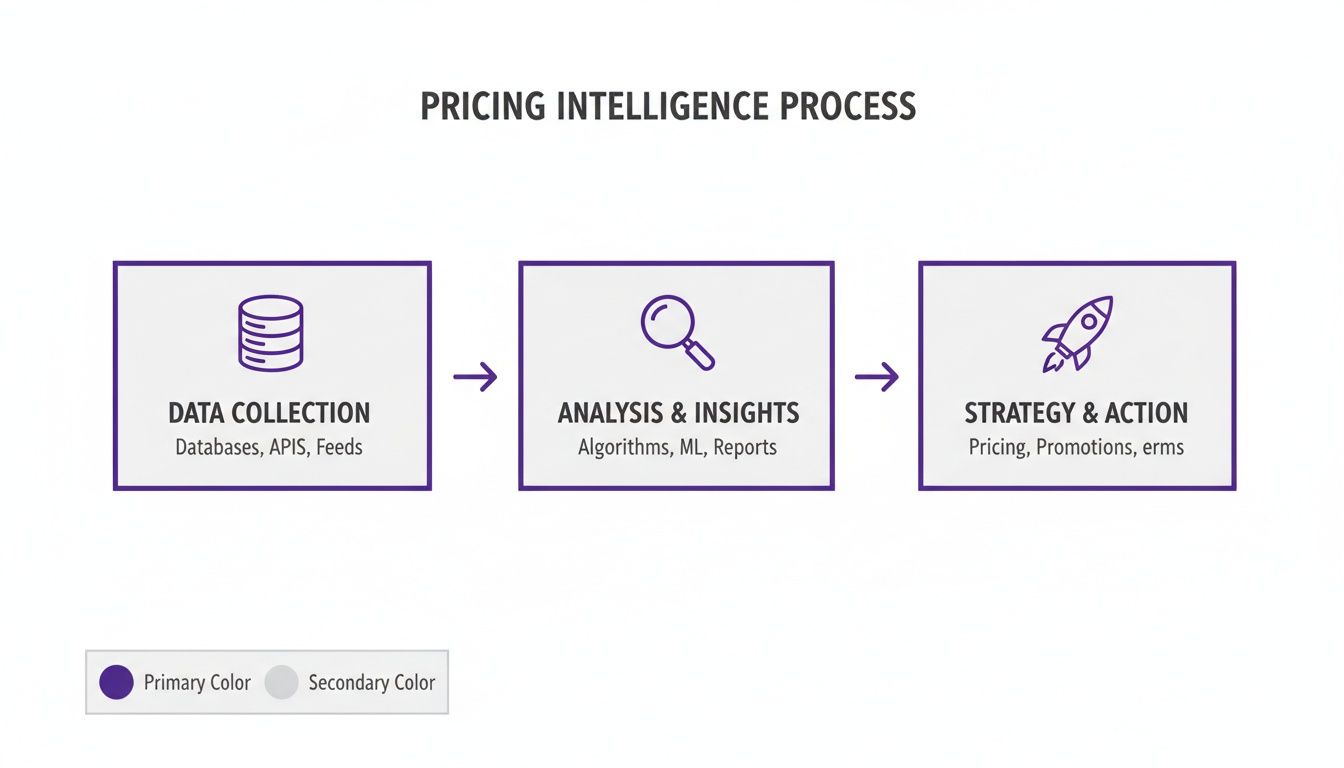
This journey is clear: gather raw materials, analyze them to understand the market narrative, and then take decisive action.
From Raw Data to Actionable Insight
Once collected and matched, raw data is not yet ready for strategic use. It must be cleaned and structured. This involves removing duplicates, correcting errors (like a typo listing a price as $9,999.99), and standardizing different formats into a single, coherent system.
The goal is to transform a chaotic flood of web information into a clean, reliable, and organized data feed. This is the foundation of every successful pricing strategy.
Only after these rigorous steps—collection, matching, and cleansing—can you trust the insights. This is the heavy lifting that platforms such as Market Edge perform behind the scenes. We manage the complex data engineering so that pricing managers and sales leaders receive clean, verified intelligence, freeing them to focus on strategy.
Putting Pricing Intelligence Into Action
Data has no commercial value until it is used to solve real business problems. This is where pricing intelligence moves from a background process to a driver of strategy and profit. For B2B and B2C leaders, this means turning numbers into measurable commercial wins.
Let's examine three common scenarios where an intelligence-driven pricing strategy delivers tangible results.
Use Case 1: Winning the Buy Box with Dynamic Pricing
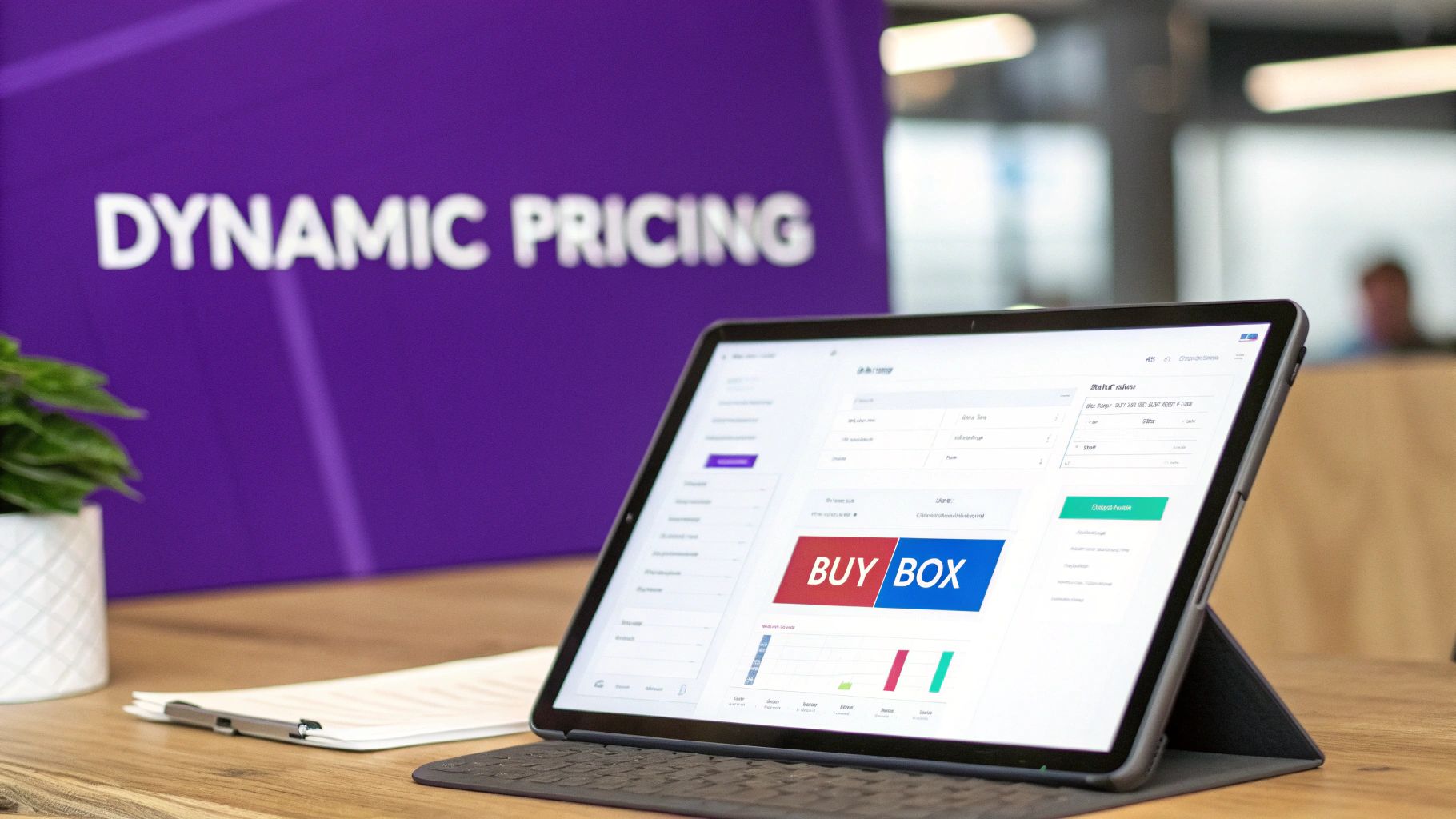
The Problem: An online electronics retailer struggles on a major marketplace. Their prices appear competitive, but they consistently lose the "Buy Box" to rivals who react to market shifts in minutes. Manually adjusting prices across hundreds of products is inefficient and results in lost revenue.
The Solution: The retailer implements a dynamic pricing strategy powered by real-time competitor data. They establish automated rules that go beyond "be the lowest price," incorporating competitor stock levels and their own profit margin floors.
- Rule Example 1: If the primary competitor for a top-selling camera goes out of stock, automatically increase our price by 3%, while remaining below the next-closest seller.
- Rule Example 2: To capture the Buy Box, automatically price $0.01 below the lowest FBA (Fulfilled by Amazon) seller, but never fall below a 15% gross margin.
The Commercial Benefit: The retailer begins winning the Buy Box more frequently without engaging in a race to the bottom. They also capture sales from out-of-stock competitors at higher margins. Pricing becomes a proactive, profit-generating function. You can explore how to build your own dynamic price strategy and achieve similar results.
Use Case 2: Protecting Brand Value with MAP Enforcement
The Problem: A manufacturer of high-end power tools sells through a network of authorized online resellers. However, several unauthorized sellers are listing products below the brand's Minimum Advertised Price (MAP), eroding the brand's premium image and frustrating compliant retail partners.
The Solution: The manufacturer deploys an automated MAP monitoring system. The tool continuously scans the web to identify every seller listing their products. The moment a price drops below the MAP policy, an alert is triggered.
The system documents each violation with timestamped screenshots and direct links. This provides the brand protection team with irrefutable evidence, enabling them to issue warnings and takedown notices systematically and efficiently.
The Commercial Benefit: Consistent monitoring and enforcement eliminate unauthorized discounting. The brand's value is restored, and loyal retail partners regain confidence, leading to stronger channel relationships and more predictable sales.
Use Case 3: Strategic Benchmarking for B2B Distributors
The Problem: A B2B distributor with a catalog of over 20,000 SKUs lacks visibility into their market pricing position. The sales team frequently hears "your competitor is cheaper" but cannot determine if this is a valid claim or a negotiation tactic. This leads to lost deals or unnecessary margin concessions.
The Solution: The distributor uses a pricing intelligence platform to benchmark its entire catalog against three key competitors. The objective is to identify where they are priced too high (losing sales) and where they are priced too low (leaving money on the table).
They segment their product catalog to focus the initial analysis on high-volume and strategic product lines for maximum impact.
The resulting intelligence is a game-changer. For items priced far below the market average, they confidently adjust prices upward without losing their competitive edge. For high-margin products, the data helps them resist discounting pressure, protecting profitability.
The Commercial Benefit: The sales team enters negotiations armed with objective market data. They know when to hold firm on price and when a surgical adjustment will close a deal. This data-first approach leads to higher win rates and an average margin increase of 5% across benchmarked categories. This is where a vendor-neutral tool like Market Edge excels, delivering the clean, large-scale data required for such analysis.
Implementing Your Pricing Intelligence Strategy
Transitioning from theory to action requires a methodical plan that connects data collection directly to business goals. This framework turns a sea of abstract data into a reliable, profit-driving engine.
The process starts with strategy, not technology. Before monitoring a single competitor, you must define what a successful outcome looks like for your business. Rushing this step results in a mountain of data that creates noise instead of a clear signal.
Step 1: Define Your Business Goals
What, specifically, are you trying to accomplish? Your answer will shape every subsequent decision. A vague goal like "be more competitive" is insufficient.
Establish specific, measurable targets. For example:
- Margin Improvement: Identify products priced below the market and safely raise prices by 5% without impacting sales volume.
- MAP Compliance: Achieve 95% MAP policy compliance across your reseller network this quarter by systematically addressing violations.
- Revenue Growth: Increase market share in a key category by ensuring your price is consistently in the top three against primary rivals.
- Operational Efficiency: Reduce the time your team spends on manual price checks by 80%, reallocating their focus to strategic analysis.
Step 2: Identify Critical Products and Competitors
You cannot—and should not—monitor everything. The most effective strategies focus resources where they will have the greatest impact. Start by segmenting your products based on their strategic importance.
A logical starting point is your Key Value Items (KVIs)—the high-visibility products that drive customer perception of your brand's value. Similarly, focus on your true, direct competitors rather than attempting to monitor the entire market. This targeted approach ensures you are investing resources in the battles that matter most.
Step 3: Configure Your Monitoring and Rules
With goals and targets defined, you can configure the technical mechanics. This involves selecting the channels to monitor (e.g., specific competitor sites, Amazon, eBay) and establishing the rules that will automate your strategy.
Translate your business objectives into automated triggers. For MAP enforcement, create a rule that sends an alert with a screenshot the moment a reseller's price on a specific SKU falls below your policy. For dynamic pricing, a rule might automatically adjust your price to be $0.01 below a key competitor, but only if your margin remains above 20%.
The image below outlines the core components of a basic implementation plan.

This plan serves as your roadmap, ensuring every action is directly tied to achieving your primary objectives.
Step 4: Integrate and Act on the Data
The final step is to ensure your pricing intelligence is integrated into your team's daily workflow. Data sitting in a dashboard has no value. It must be actionable. This could mean sending alerts directly to a Slack channel, feeding price change recommendations into your ecommerce platform, or generating a concise weekly report for leadership.
The goal is to make acting on the information seamless. An alert about a competitor's stockout is only useful if the category manager sees it in time to adjust pricing. A purpose-built platform like Market Edge facilitates this by delivering clean, timely data in a format your team can use without friction.
Your Implementation Checklist
- Define Goals: What are the top 1-3 measurable outcomes you need to achieve?
- Select Products: Identify the top 20% of SKUs that drive 80% of your revenue or strategic value.
- Choose Competitors: List your 3-5 most direct and impactful competitors to monitor first.
- Set Rules: Create specific, condition-based rules for alerts (e.g., price drops, stockouts, MAP violations).
- Integrate Workflow: How will your team receive and act on insights daily or weekly?
- Review and Refine: Schedule a monthly check-in to see how you're tracking against your goals and tweak your strategy.
The Rise of the AI Shopper
The ecommerce landscape is undergoing a fundamental shift. For years, the challenge was to out-price human competitors. Now, a new player has entered the field: artificial intelligence. The objective is no longer just winning over people; it’s about remaining visible and relevant to the AI systems that are beginning to make purchasing decisions on their behalf.
This is not a fleeting trend. We are witnessing the emergence of AI-powered shopping agents—autonomous algorithms designed to find the best overall value for a shopper by evaluating multiple factors simultaneously.
As a result, having the lowest price will no longer guarantee a sale. These AI agents are programmed to assess the bigger picture.
Why the Lowest Price Is Losing Its Power
The new competitive battleground is about being priced for selection by algorithms. When an AI agent is tasked with purchasing a product, it evaluates a complex checklist to find the best possible deal for its user—a checklist that extends far beyond price.
Your offer is now graded on a scorecard that includes:
- Price: Still a critical factor, but only one piece of the puzzle.
- Stock Availability: Can the customer receive it now? An algorithm will nearly always choose an in-stock item over a slightly cheaper one on backorder.
- Shipping Speed and Cost: How quickly and affordably can the product be delivered? Prime-style shipping is a major variable.
- Seller Reputation: What do ratings and recent reviews indicate? Trust is a quantifiable data point for an AI.
You could offer a product at a rock-bottom price, but if your shipping is slow or your inventory is inconsistent, an AI agent will simply bypass your offer in favor of a competitor who provides a better overall experience.
Getting Your Business Ready for AI
This represents a fundamental change in how products will be discovered and purchased, rewriting the rules of pricing strategy. Projections indicate that AI-driven ecommerce will grow significantly, expected to clear $144 billion by 2029. That’s nearly 8.8% of all online retail sales. You can get more details about this growing trend on emarketer.com.
For pricing teams, the old playbook is becoming obsolete. In this new environment, real-time ecommerce pricing intelligence is not just a competitive edge; it's a prerequisite for survival. It provides the data needed to see how you stack up on all the metrics that these new AI gatekeepers prioritize.
You cannot optimize what you cannot see. Without a clear, live view of your competitors' prices, stock levels, and shipping offers, you are invisible to the algorithms that will soon control a significant portion of online sales.
This is how you stay ahead of the curve. The goal is no longer just to monitor prices. It's about building a complete, 360-degree view of the market to ensure your products are consistently chosen as the best option—by both human shoppers and their AI agents.
This is where automated price monitoring tools like Market Edge become useful.
How to Measure the ROI of Your Pricing Strategy
Investing in pricing intelligence is a critical first step, but executive leadership will inevitably ask, "What is the return on this investment?" Proving that your pricing strategy is delivering tangible value is essential for securing budget and demonstrating strategic competence.
The key is to move beyond vague terms like "better insights" and focus on hard financial metrics. When you connect your pricing strategy directly to revenue and profit, you build a solid business case. This can be broken down into three core areas of financial impact.
Calculating Margin Improvement
One of the first discoveries from effective pricing intelligence is often identifying where you are leaving money on the table. It is common for businesses to unknowingly price certain products well below the market average.
This is a straightforward win to measure. Focus on products where you have identified an opportunity to increase your price without negatively impacting sales volume. The calculation is simple:
Margin Gain = (New Price - Old Price) x Units Sold
For example, if you discover a popular product is priced $10 below the market average and you sell 500 units per month, a conservative $5 price increase translates to an additional $2,500 in gross profit monthly from a single SKU.
Measuring Revenue Growth from Competitive Wins
The second area is winning more sales by being priced competitively. This is especially critical in crowded marketplaces where a small price difference can determine which seller gets the click. The goal is to measure the increase in sales volume attributable to smarter pricing.
Track unit sales for key products before and after implementing your new strategy. A simple way to measure the impact is:
Revenue Growth = (Units Sold After - Units Sold Before) x Average Selling Price
This formula clearly demonstrates how market alignment can drive top-line growth. For instance, if a 2% price reduction on a key item to match the market leader results in a 15% increase in monthly sales, you can directly attribute that revenue boost to your pricing action.
Quantifying Operational Efficiency
Finally, do not overlook the "soft" savings from automating manual processes. Manually checking competitor websites is a time-consuming, error-prone task that occupies skilled employees who could be focused on higher-value strategic work.
Calculate the hours your team previously spent on manual price checks.
Efficiency Savings = (Hours Saved per Month) x (Average Employee Hourly Cost)
If a pricing analyst earning $40/hour saves 20 hours of manual work in a month, that equates to $800 in operational savings. This is time and capital that can be reinvested into strategic initiatives. It proves that pricing intelligence is a force multiplier for your team's productivity.
By combining gains from healthier margins, new revenue, and a more efficient team, you can demonstrate the full financial impact of your pricing strategy. This is where automated tools like Market Edge come in—they provide the clean data needed to track these metrics and prove ROI.
Frequently Asked Questions
Here are practical answers to common questions business leaders have when considering a pricing intelligence solution.
How Long Does It Take to Implement a Pricing System?
This is a primary concern, and the timeline has improved significantly. We are no longer in the era of large-scale enterprise software projects that required six months to implement. Modern SaaS platforms have streamlined the process.
For most companies, implementation can be completed in a few days. The initial setup involves defining your key products and competitors, configuring tracking rules, and integrating the data feed into your team's daily workflow. A dedicated platform enables a rapid transition from zero to actionable data.
Is This Technology Only for Large Enterprises?
This is a common misconception. While large corporations were early adopters, ecommerce pricing intelligence is now accessible to small and medium-sized businesses. The shift to flexible, usage-based pricing models has been a key enabler.
Instead of a large upfront investment, you pay for what you use, such as the number of products you monitor. This model allows a growing brand to start small, track a core set of SKUs to prove the value, and scale their monitoring as the business expands.
How Do We Track Competitors with Thousands of SKUs?
Monitoring a competitor's massive catalog can seem daunting, but this is a challenge solved by technology and strategy. You do not need to track every item they sell.
First, leading platforms use AI-powered product matching to automatically link your products to equivalent items on competitor sites, even with different names or descriptions. This automation eliminates hours of manual work.
Second, start strategically. Focus on the products that have the greatest business impact—the 20% of your SKUs that generate 80% of your revenue. By concentrating on these critical items first, you achieve the largest impact quickly. This is where automated price monitoring tools like Market Edge become useful, turning a complex data problem into a focused, strategic advantage.
Ready to turn competitive data into your strategic advantage? With Market Edge, you can automate price and stock monitoring to protect your margins, enforce your MAP policy, and make smarter decisions faster. Find out how our platform can give you the clarity you need to win in your market by visiting marketedgemonitoring.com.