
Ecommerce price monitoring tools are specialized software platforms that automate the tracking of competitor prices, stock levels, and product availability across the digital shelf.
These systems eliminate the labor-intensive, error-prone process of manual price checks. Instead, they provide a live, automated view of market dynamics, enabling ecommerce managers and brand leaders to make informed pricing decisions that protect profit margins and drive growth.
Why Price Monitoring Is No Longer Optional
In a market where prices can change multiple times a day, manual tracking is not just inefficient—it's a direct business risk. For any ecommerce leader, relying on spreadsheets and occasional spot-checks leads to margin erosion, lost sales, and a damaged brand reputation. Without a clear, real-time view of the competitive landscape, you are pricing blind.
Price monitoring tools are strategic intelligence systems. They empower manufacturers, distributors, and online retailers to move from reactive guesswork to proactive, data-driven decisions that safeguard profitability and solidify market position.
The Commercial Impact of Pricing Blind Spots
Ignoring competitor pricing is an active choice with tangible consequences. Businesses without automated monitoring inevitably fall into common traps that erode their bottom line.
Key commercial risks include:
- Margin Erosion: Without knowing the market's floor price, brands can be dragged into price wars, sacrificing profit on every sale.
- Lost Sales Opportunities: Pricing products even slightly higher than key competitors means customers will simply buy elsewhere.
- Damaged Brand Perception: Inconsistent pricing across channels or unauthorized discounts from third-party sellers devalues a brand in the eyes of consumers.
These platforms transform unstructured web data into a clean, actionable business asset. It is like having a dedicated analyst for every product you sell, working 24/7 to report on every market shift.
From Manual Effort to Strategic Advantage
Making the switch to automation is critical for survival and growth. As online sales expand, so does the competition. By automating the foundational work of data collection, these tools free up your team to focus on high-value strategic analysis. You can stop asking, "What are our competitors' prices today?" and start asking, "Why are their prices changing, and what is our most profitable response?"
This shifts the focus from simple data collection to true competitive intelligence gathering. This is where automated price monitoring tools like Market Edge become useful.
How Price Monitoring Technology Works
To make sound pricing decisions, you need clean, reliable data. An ecommerce price monitoring tool functions as a sophisticated data pipeline, converting the chaotic information scattered across the internet into structured, actionable intelligence.
The process involves three core stages that work in concert to provide a clear view of the market, allowing your team to focus on strategy instead of manual data gathering.
Stage 1: Automated Data Collection
The process begins with collecting raw data using automated programs known as web crawlers or spiders. These bots systematically browse specified competitor websites, marketplaces like Amazon, and direct-to-consumer (DTC) stores.
They are programmed to extract specific information from each product page, gathering crucial context beyond just the price:
- Stock Availability: Is a competitor's product in stock, low stock, or sold out?
- Shipping Costs and Times: What is the total landed cost for the customer?
- Promotions and Discounts: Are there any active sales, coupon codes, or special offers?
- Seller Information: On marketplaces, this is essential for identifying specific third-party sellers.
This initial sweep gathers thousands of data points that would be impossible to collect manually, forming the foundation for market intelligence.
Stage 2: AI-Powered Product Matching
With the raw data collected, the next challenge is ensuring accurate comparisons. A competitor might list the same product with a slightly different name or a missing product code. This is where AI-driven product matching is essential.
Advanced algorithms analyze multiple product attributes to link your products to identical ones sold by competitors. The system cross-references key identifiers such as:
- SKUs (Stock Keeping Units)
- UPCs (Universal Product Codes)
- EANs (European Article Numbers)
- MPNs (Manufacturer Part Numbers)
When these codes are missing or inconsistent, the AI uses image recognition and natural language processing (NLP) to compare product titles, descriptions, specifications, and images. This ensures high match accuracy, preventing poor decisions based on flawed comparisons.
Stage 3: Data Structuring and Analysis
Raw web data is inherently messy. The final stage cleans and organizes this information, transforming it into a usable format by removing duplicates, correcting errors, and standardizing data points. For example, it converts different currencies or units of measurement into a consistent format for direct comparison.
This is the point where raw data becomes true business intelligence. Without a clear, structured view, a business remains exposed to significant risks.
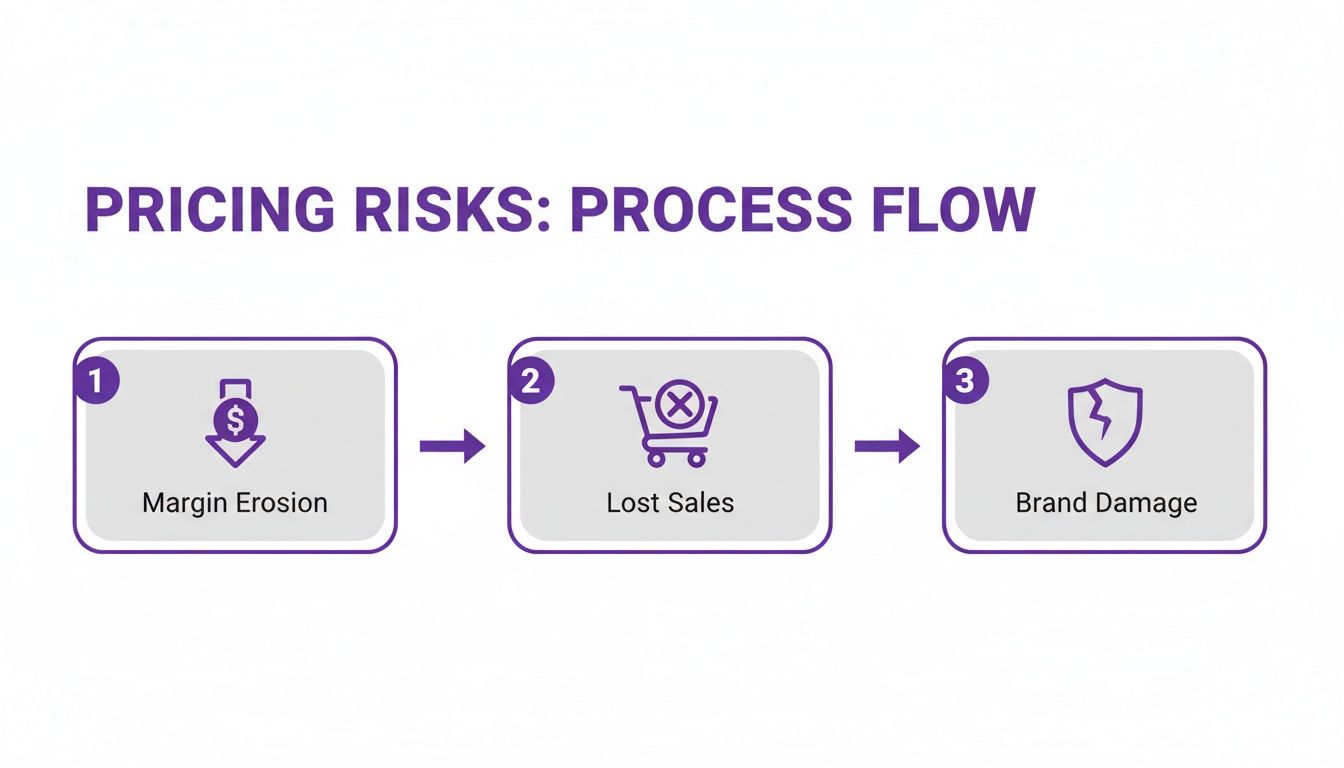
As shown, a reactive or uninformed pricing strategy leads directly to margin erosion, lost sales, and long-term brand damage. This is precisely the challenge that a robust price monitoring tool, such as Market Edge, is designed to solve.
Key Applications for Modern Ecommerce
The value of price monitoring technology lies in its practical application. When clean data is translated into strategic action, it becomes a powerful driver of business outcomes. For manufacturers, distributors, and online retailers, these tools are essential for executing strategies that protect margins, enforce brand policies, and capture market share.
Here are the primary commercial use cases for these tools.
MAP and RRP Enforcement for Manufacturers
For manufacturers, brand equity is a core asset. When a reseller violates a Minimum Advertised Price (MAP) or Recommended Retail Price (RRP) policy, it can trigger a price war that devalues the product and damages relationships with compliant retail partners.
Automated price monitoring is the most effective defense. A monitoring tool scans all online channels 24/7, eliminating the need for manual spot-checks.
- How It Works: The brand's official MAP/RRP list is loaded into the system. The tool then continuously crawls the web, comparing every advertised price against the policy.
- The Outcome: The moment a violation occurs, an instant alert is generated, complete with a timestamped screenshot as evidence. This allows the brand protection team to address the issue immediately, contact the seller, and enforce the policy efficiently.
A real-world example: A premium electronics brand uses a monitoring tool to scan over 500 authorized and unauthorized online sellers daily. When a new marketplace seller lists their flagship headphones 15% below MAP, an alert is triggered. Within an hour, the brand's legal team has sent a formal notice to the seller, who corrects the price by the end of the day, preventing further brand erosion.
Competitive Benchmarking for Distributors
Distributors operate on narrow margins where small pricing errors have a significant impact. To remain profitable, they must know their competitive positioning at all times. Price monitoring tools provide this critical intelligence.
A distributor can leverage this data to:
- Strengthen Supplier Negotiations: Armed with hard data on market pricing for specific products, distributors can negotiate better terms and volume discounts from suppliers.
- Identify Market Gaps: Noticing a competitor is consistently out of stock on a popular item presents an opportunity to increase inventory and capture unmet demand.
- Optimize Product Mix: Data reveals which product categories are oversaturated and hyper-competitive versus those with fewer sellers and healthier margins, informing smarter inventory decisions.
This steady flow of market intelligence turns pricing from a reactive headache into a strategic advantage. You start anticipating market shifts instead of just getting hit by them, which gives you a serious leg up.
Dynamic Pricing for Online Retailers
For online retailers, particularly on competitive marketplaces like Amazon, pricing is never static. To win the Buy Box and maximize profitability, a pricing strategy must be agile. This is the core function of dynamic pricing.
This strategy uses automated, rule-based algorithms to adjust prices in response to real-time market conditions. A common rule is to automatically price a product $0.01 below the lowest competitor, while ensuring it never falls below a predefined minimum profit margin. You can see how this works in practice by looking at some real-world examples of dynamic pricing.
Price monitoring software is the engine behind this approach, providing clear dashboards that consolidate price changes, stock levels, and market trends. This is precisely where automated tools like Market Edge prove their worth.
Price Monitoring Applications by Business Type
While the core technology is the same, its application varies by business model. The table below outlines common use cases and their direct commercial benefits.
| Business Type | Primary Use Case | Key Benefit |
|---|---|---|
| Manufacturer | MAP/RRP Policy Enforcement | Protects brand equity and prevents price erosion. |
| Distributor | Competitive Price Benchmarking | Informs negotiations and identifies market opportunities. |
| Importer | Margin Protection | Ensures pricing aligns with landed costs and market demand. |
| Online Retailer | Dynamic Pricing & Repricing | Maximizes sales and profits on competitive marketplaces. |
Ultimately, whether you're protecting a brand, managing a supply chain, or competing for the next sale, the goal is the same: to use accurate, timely data to make smarter decisions that boost your bottom line.
What to Look For in a Price Monitoring Tool
When evaluating price monitoring tools, focus on the capabilities that directly support your business objectives. A brand enforcing its MAP policy has different requirements than a retailer focused on dynamic pricing.
However, a few core features are non-negotiable. These fundamentals distinguish a truly useful platform from a simple data scraper.
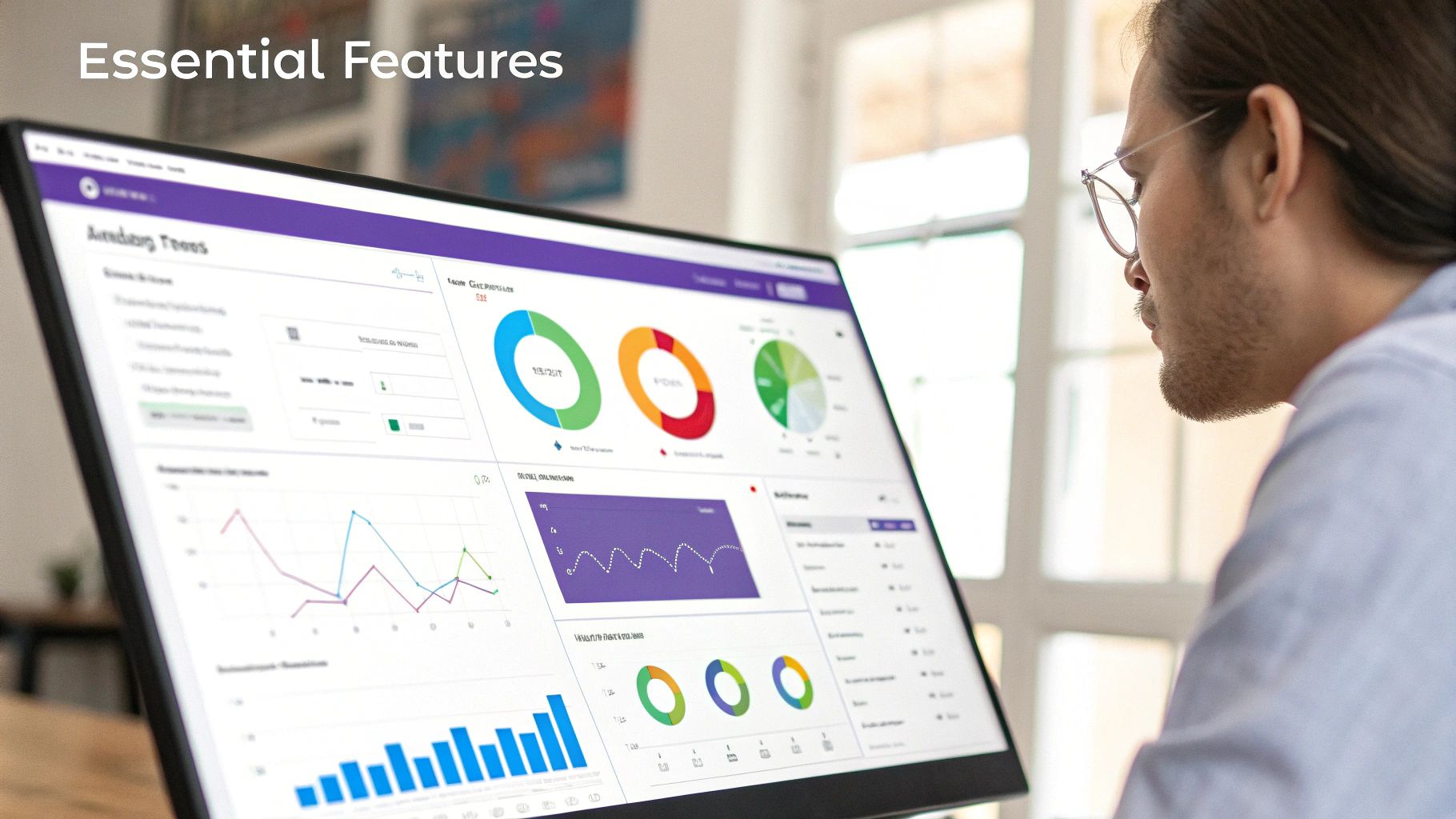
Think of it as hiring a market analyst who works around the clock. They must be accurate, fast, and able to surface what truly matters.
Data Accuracy and Refresh Rate
A price monitoring tool is worthless if its data is inaccurate or outdated. Making decisions on bad information is often worse than making no decision at all. Two elements are critical:
- AI-Powered Product Matching: The tool must accurately link your products to the same items on competitor sites, even with variations in names, SKUs, or UPCs. This ensures you are comparing apples to apples.
- Data Refresh Frequency: The required data update frequency depends on your market's velocity. For industrial goods, a daily refresh may suffice. For fast-moving consumer electronics, updates every few hours or even in near real-time are necessary.
Without clean, reliable data, pricing strategy is just guesswork.
Competitor Coverage and Scalability
The tool must be able to monitor all channels where your products are sold, including direct competitor websites, major marketplaces, and comparison shopping engines. Confirm the platform can cover the domains most important to your business.
Scalability is equally important. As your product catalog and list of competitors grow, the tool must be able to handle the increased load without performance degradation or excessive cost increases.
Customizable Alerting and Reporting
Raw data is interesting, but automated alerts drive action and revenue. A strong tool allows you to create custom "if this, then that" rules to flag events that require immediate attention.
For instance, a pricing manager for a consumer brand can set an alert to be triggered the moment an unauthorized seller lists a flagship product below its MAP. This enables the team to address the violation in hours, not weeks.
Effective alerts can be configured for scenarios such as:
- MAP/RRP Violations: Instant notification when a seller breaks policy.
- Significant Price Drops: Awareness when a key competitor makes an aggressive price move.
- Competitor Stockouts: An opportunity to capture market share when a competitor cannot meet demand.
- New Competitors: An alert when a new seller enters the market for one of your core products.
This transforms the tool from a defensive reporting mechanism into a proactive system that identifies commercial opportunities.
How to Implement a Pricing Strategy
Acquiring a powerful ecommerce price monitoring tool is the first step. The real value is unlocked when you use it to execute a deliberate pricing strategy. Without a clear plan, data collection can lead to analysis paralysis rather than confident, profitable decisions.
A structured implementation plan transforms raw market data into a reliable engine for growth. The goal is to shift from a reactive posture—constantly responding to competitor price drops—to a proactive one, where you anticipate market shifts and use them to your advantage.
Step 1: Define Your Business Objectives
Before tracking a single product, define what success looks like for your business. Your commercial goals will shape the entire implementation, from software configuration to the KPIs you monitor. Are you protecting a premium brand image, maximizing profit on bestsellers, or competing for market share?
Your objectives must be specific and measurable.
- For Manufacturers: Reduce MAP violations by 90% within Q3.
- For Distributors: Increase gross margin by 2% on the top 100 SKUs by identifying underpriced products.
- For Online Retailers: Increase the Amazon Buy Box win rate by 15% for a key product category.
Clear targets link your price monitoring efforts directly to business results.
Step 2: Identify Key Products and Competitors
It is impractical and inefficient to monitor everything. Focus on the products that have the most significant impact on your business—your Key Value Items (KVIs)—and the competitors who are most relevant for those items.
KVIs are typically your best-selling products or those that most heavily influence customer perception of your brand's pricing.
Next, identify your direct competitors for these specific products on the channels where you compete. This is not an exhaustive list of every company in your industry but a focused group of sellers targeting the same customers. Configure your tool to monitor this group closely.
Step 3: Configure Your Alerting Rules
This is where you automate the monitoring process. Based on the objectives from Step 1, create custom alerts that notify you the moment a critical market event occurs. These rules act as an early-warning system.
For instance, a pricing manager can set up a rule to get an instant email whenever a key competitor’s stock on a KVI drops to a critically low level. This isn't just data; it's a golden opportunity to capture their customers, maybe even while nudging your own price up slightly.
Effective alerts could be triggered by:
- A price change exceeding a certain threshold (e.g., a drop of more than 10%).
- A competitor’s price falling below your cost or a predetermined profit floor.
- A new, unauthorized seller appearing on a listing for a flagship product.
Step 4: Establish a Baseline and Test Your Rules
After configuring the tool, resist the urge to make immediate, sweeping changes. Allow the data to accumulate for one to two weeks to establish a baseline. This initial period provides a clear snapshot of your current market position and highlights the most pressing pricing gaps.
With a baseline established, begin testing your pricing rules on a small, controlled set of products. For example, if your strategy is to be the lowest-priced option, apply that rule to a handful of non-critical items. Monitor the impact on both sales volume and profit margin.
This "test and learn" methodology minimizes risk and allows you to refine your strategy before a full-scale rollout. This is where automated tools like Market Edge provide significant value, offering the clean historical data and flexible rule-building capabilities needed to test and validate your approach with confidence.
Your Questions, Answered
When considering a price monitoring tool, several key questions consistently arise regarding data integrity, legality, and cost. Here are direct answers to help you make an informed decision.
How Accurate Is The Data, Really?
This is the most critical question. The entire value of the tool depends on the quality of its data.
Leading tools achieve data accuracy rates between 95% and 99%. This precision is the result of sophisticated, AI-driven product matching that goes beyond simple code comparisons. These systems cross-reference SKUs, UPCs, and other identifiers to ensure correct matches.
When codes are missing or mismatched, advanced systems use image recognition and analyze product attributes—such as color, size, and brand—to confirm an identical match. This prevents strategic errors based on flawed data.
How Often Does The Data Get Updated?
In ecommerce, data from yesterday can be obsolete. The appropriate update frequency, or refresh rate, depends on the velocity of your market.
- Daily Refreshes: Sufficient for categories with stable pricing, such as industrial parts or specialized B2B equipment.
- Intra-day (Multiple times per day): Necessary for faster-moving sectors like consumer electronics or apparel, where prices can shift throughout the day.
- Near Real-time: Essential for highly competitive environments like Amazon, where algorithmic repricing occurs constantly to win the Buy Box. Updates are needed within minutes.
Choosing the right refresh rate ensures your strategy is based on current market conditions.
Is It Legal To Monitor Competitor Prices?
Yes, monitoring competitor prices is completely legal.
These tools only collect information that is publicly available on the internet. The process is analogous to a consumer browsing a competitor's website or a "mystery shopper" visiting a physical store. No private systems are accessed, and no confidential data is compromised.
What Should I Expect To Pay?
Pricing models for these platforms vary. Many vendors offer tiered subscriptions based on the number of products and competitors you track.
A more flexible and modern approach is a usage-based model. With this structure, you pay only for the data you consume—for example, by the number of specific product URLs monitored. This model scales efficiently with your business, allowing you to start with a focused scope and expand as your needs grow, without being locked into a rigid subscription tier. This is where automated price monitoring tools like Market Edge come in handy.
Gain a clear view of your market. Market Edge provides the accurate, real-time competitive intelligence you need to protect margins, enforce MAP, and make smarter pricing decisions. See how it works at https://marketedgemonitoring.com.