
A dynamic price strategy is not about randomly changing prices. It is a methodical approach to adjusting prices in response to real-time market conditions, competitor actions, and customer demand. Instead of setting a price and leaving it for months, this strategy turns pricing into a tool that actively protects margins, grows revenue, and captures market share.
For B2B decision-makers, implementing a dynamic price strategy is a direct path to a significant competitive advantage. It moves pricing from a static, reactive task to a proactive, strategic function.
Why a Dynamic Price Strategy Matters Now
In today’s ecommerce and B2B distribution markets, static, cost-plus pricing models are a commercial liability. They leave money on the table when demand is high and expose your business to margin erosion when competitors launch a price war. You become a sitting duck, unable to react to market volatility.
A dynamic strategy provides the agility to respond instantly.
- Mini Use Case: Competitor Price Drop: Imagine a key competitor cuts the price on a top-selling product. With static pricing, you might not notice for days, losing sales in the meantime. An automated dynamic system, fueled by competitor tracking, can detect this change and adjust your price according to predefined rules, keeping you competitive without manual intervention.
- Mini Use Case: Demand Spike: Conversely, if a competitor runs out of stock, your system can detect this and automatically increase your price to capture higher margins from the increased demand.
Static vs. Dynamic Pricing At a Glance
The core difference between static and dynamic pricing is the ability to capitalize on market opportunities and mitigate risks in real time. A static model is slow and unresponsive, while a dynamic approach is built for speed and precision.
| Attribute | Static Pricing | Dynamic Pricing |
|---|---|---|
| Responsiveness | Prices updated quarterly or annually, missing daily market shifts. | Prices adjust in near real-time based on live data feeds. |
| Market Awareness | Relies on slow, manual competitor checks that are often incomplete. | Uses automated competitor tracking for instant, accurate insights. |
| Margin Protection | Cannot adapt to sudden cost changes or price wars, putting profits at risk. | Automatically enforces price floors and protects margins with smart rules. |
| Goal Alignment | A blunt instrument that struggles to meet specific commercial goals. | Can be fine-tuned to achieve objectives like revenue growth or market share. |
Ultimately, a dynamic system ensures you make better, data-backed pricing decisions faster than your competitors.
A dynamic price strategy isn’t just about changing prices frequently; it’s about making smarter, data-driven pricing decisions faster than your competition. The goal is to ensure you are never priced too high to lose a sale or too low to sacrifice profit.
From Reactive to Proactive
Implementing a dynamic price strategy shifts your team's focus from tedious manual updates to strategic oversight. Pricing becomes an automated engine working 24/7 to achieve business goals.
Whether the priority is protecting brand value through MAP/RRP enforcement or aggressively pursuing market share, dynamic adjustments provide the necessary control and speed. This is where automated price monitoring tools like Market Edge become useful, handling the data collection and execution so your team can focus on strategy.
First Things First: What Are You Trying to Accomplish?
Before considering algorithms or software, you must define the business objective. A dynamic price strategy without a clear commercial goal is just random price changing. Your objective will dictate every rule you create and every data point you collect.
What is the primary driver? Are you trying to protect profit margins on high-value products? Or is the goal to capture market share from key rivals, even if it means a temporary hit to profitability?
Perhaps the objective is operational, such as liquidating excess seasonal inventory before it becomes a liability. For brands and manufacturers, the priority is often maintaining brand equity and ensuring channel partner compliance by enforcing Minimum Advertised Price (MAP) policies.
Connecting Your Goals to a Real-World Strategy
Each of these goals requires a distinct strategy that relies on different market signals. If maximizing profit is the objective, your cost of goods is a critical input. If market share is the game, competitor pricing becomes the central focus.
Here’s how these goals translate into practical strategies:
- Protecting Profits: This strategy is ideal for unique, high-demand products. The focus is on maintaining a healthy margin. When a competitor is out of stock or demand surges, prices automatically increase.
- Growing Market Share: Here, sales volume is the primary metric. Rules are set to aggressively match or slightly undercut key competitors on popular items to win customers and increase sales velocity.
- Clearing Out Old Inventory: For end-of-life products, the goal is simple: liquidate. Pricing rules are designed to systematically lower prices over time until the stock is cleared, avoiding costly write-offs.
- Enforcing MAP/RRP: For a brand, a dynamic strategy often means ensuring stability. It involves continuous monitoring of resellers to ensure they do not price below a set floor, with automated alerts for violations.
The Data That Powers Your Pricing Engine
Once the goal is set, you need to build the engine. The quality of a dynamic pricing engine is determined by the data it consumes. Inaccurate, incomplete, or latent data will lead to poor decisions that damage margins and erode customer trust.
Your pricing strategy can't be smarter than your data. High-quality, real-time data isn't a "nice-to-have"; it is the non-negotiable bedrock of any successful dynamic pricing implementation.
The required data falls into four main categories:
- Competitive Intelligence: This is your market visibility. You need real-time pricing and stock levels from key competitors, major marketplaces like Amazon, and other relevant channels. For example, an electronics distributor must gather comprehensive competitive data before building a single pricing rule.
- Internal Sales and Inventory Data: Your own historical sales data, conversion rates, and current inventory levels are crucial. High velocity and low stock signal an opportunity to raise prices; slow-moving inventory indicates a need to be more competitive.
- Market and Demand Signals: This involves understanding broader market trends. Seasonality, product category search volume, and even news events can signal shifts in demand. A surge in online searches for "office chairs" is a market signal that can inform pricing. For more on this, see how businesses are using big data in retail.
- Cost and Margin Data: You must know your absolute price floor. Your Cost of Goods Sold (COGS) and associated channel fees create the guardrails that prevent any automated price change from resulting in a loss.
Attempting to gather and normalize this data manually is operationally infeasible at scale. Automated platforms like Market Edge are designed to deliver the clean, structured, and near real-time data feeds required for confident pricing decisions.
Building Your Pricing Rules and Logic
With goals defined and data flowing, the next step is to translate strategy into automated rules that execute pricing decisions. This is where your dynamic pricing engine comes to life. Start with simple rules and add complexity over time.
A pricing rule is a simple "if-this-then-that" instruction. For example: "If Competitor X drops their price on SKU 123 below our floor, then send an alert." A more proactive rule might be: "If stock of Product Y exceeds 100 units and has an age of 90+ days, then reduce the price by 10%."
These rules are the living logic that executes your pricing strategy 24/7.
The process follows a logical flow: your goals determine the data you need, and that data fuels the rules you create.
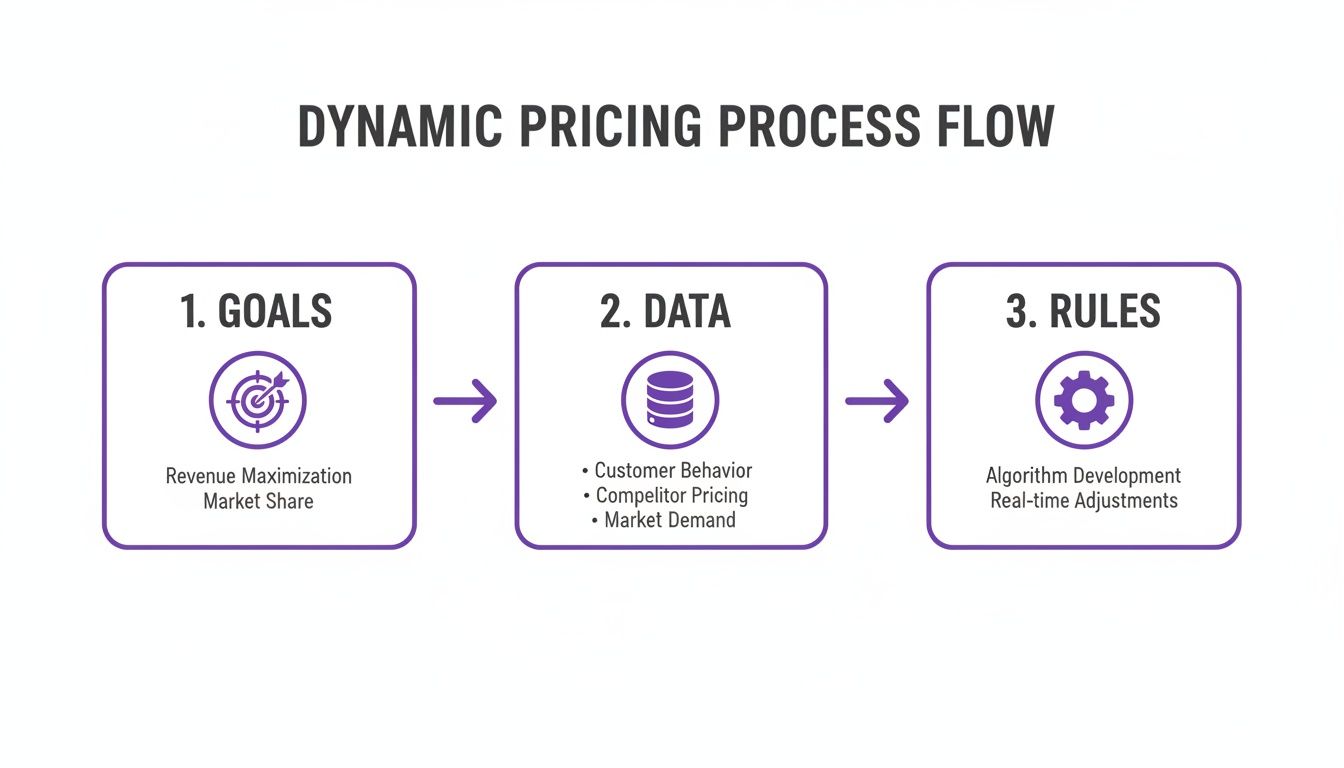
As the chart illustrates, without clear goals and clean data, your pricing rules are ineffective because they lack commercial context.
Implementing Rule-Based Approaches
A rule-based system is the most practical starting point. It offers control and transparency, avoiding the "black box" problem where the logic behind a price change is unclear. You define specific actions based on clear data triggers.
Here are several common rule-based scenarios:
- Competitive Positioning: "Always price Brand X products 2% below the market average." Or, "Match the top three competitors on our 'Best Sellers' category, but never drop below a 15% margin."
- Inventory and Velocity: "If a product's sales velocity drops 30% month-over-month, automatically apply a 5% discount." Or, "If stock for a high-demand item falls below 10 units, increase the price by 8%."
- MAP/RRP Enforcement: "Scan all authorized resellers for Brand Z every hour. If any price is more than 1% below RRP, flag the violation and capture a timestamped screenshot for our records."
The power of this approach lies in its precision, which depends entirely on accurate data. High-quality, AI-driven product matching is non-negotiable. A solution like Market Edge ensures that when your rule says "track Competitor X's widget," it is tracking the exact same product, preventing costly errors.
Segmenting Your Products and Customers
Applying a single set of rules to your entire product catalog is a strategic error. A high-margin, exclusive product requires a different pricing logic than a commoditized, low-margin accessory. Effective segmentation is critical.
Begin by grouping products into logical categories:
- By Margin: High-margin "hero" products vs. low-margin volume drivers.
- By Brand: Premium, in-demand brands vs. private-label or budget alternatives.
- By Lifecycle Stage: New arrivals, established best-sellers, and clearance items.
With these segments, you can apply tailored rule sets to each. Hero products might have rules designed to maximize profit, while clearance items need aggressive markdown rules to move inventory.
Your most valuable products deserve a different pricing strategy than your clearance items. Segmentation allows you to apply surgical precision, protecting margins where it matters most while aggressively driving volume elsewhere.
The scale of automation can be significant. Amazon’s dynamic pricing algorithms adjust millions of prices hourly. This strategy was a major factor in its 25% revenue growth between 2018 and 2023, contributing an estimated 1-8% in additional annual revenue. For B2B firms, the lesson is the same: robust competitor tracking delivers a direct ROI by enabling instant reactions to market shifts. You can read more about the findings from dynamic pricing studies to understand the commercial impact.
Testing and Rolling Out Your Strategy
Once pricing rules are defined, the temptation is to deploy them across the entire catalog. This is a high-risk approach that can lead to margin erosion or unintended price wars.
A methodical, controlled rollout is the professional standard. It minimizes risk and creates a feedback loop to refine your logic with real-world data before scaling. The objective is to prove the strategy works in a contained environment, build confidence, and then expand from a position of strength.
Starting Small with A/B Testing
Begin with a manageable segment of your product catalog, such as a specific category, a single brand, or a handful of high-volume SKUs. This creates an ideal environment for A/B testing.
For example, test two different pricing rules against each other on similar products to determine which one best achieves your goals.
- Test A: Price SKUs to match the lowest competitor.
- Test B: Price SKUs 1% below the market average, but never drop below a 20% gross margin.
Running these tests simultaneously provides a direct comparison. You might find that Test B generates slightly less revenue but delivers a significantly healthier profit margin, making it the superior strategy. This is an insight that can only be gained through live testing. Our guide on real-world dynamic pricing examples provides more scenarios for testing.
Tracking Key Performance Metrics
A test without measurement provides no actionable insight. As you launch initial tests, obsessively track the key performance indicators (KPIs) tied to your business goals. A performance dashboard is essential for monitoring progress.
Your dashboard should focus on a few core metrics:
- Profit Margin: Is the new logic protecting or improving margins?
- Sales Volume: How have unit sales changed compared to the baseline?
- Conversion Rate: Are more site visitors completing a purchase?
- Market Position: How has your price rank against key competitors changed?
This continuous feedback is what makes a pricing strategy truly dynamic. It allows your team to identify what works, what doesn't, and make iterative adjustments to optimize performance.
A phased rollout isn't about a lack of confidence; it's about disciplined execution. By testing your logic on a small scale, you can validate your strategy with real data, minimize financial risk, and build the internal trust needed for a full-scale deployment.
The airline industry pioneered this approach in the 1980s, using sophisticated systems to adjust fares based on real-time signals. This strategy now accounts for over 6% of global airline revenues and is estimated to boost annual revenues by 1-8% compared to fixed pricing.
Phased Rollout Checklist
Use this checklist to guide a structured rollout and ensure all bases are covered before a full-scale deployment.
- [ ] Select a Low-Risk Test Segment: Choose a product category with stable demand and a good data history. Avoid testing on your most critical products initially.
- [ ] Define Clear Success Metrics: Know what "success" looks like (e.g., a 5% margin increase, a 10% lift in conversion).
- [ ] Establish a Control Group: Keep a similar group of products on the old pricing model to serve as a baseline for comparison.
- [ ] Set Up Guardrails: Implement hard price floors (based on cost) and ceilings to prevent algorithm errors. This is your safety net.
- [ ] Run the Test for a Meaningful Period: Allow enough time (typically 2-4 weeks) to collect statistically significant data and smooth out daily fluctuations.
- [ ] Analyze and Refine: Review the results against your KPIs. Tweak rules based on what you learned and prepare for the next phase of the rollout.
This systematic process relies on automated tools like Market Edge to deliver the clean, reliable competitor data needed to fuel tests and accurately measure impact.
Integrating Tools and Enforcing MAP Compliance
A dynamic price strategy without automation is not scalable. Manually tracking competitors and adjusting prices is inefficient and prone to error. The right technology stack is what transforms your strategy into a revenue-generating operation.
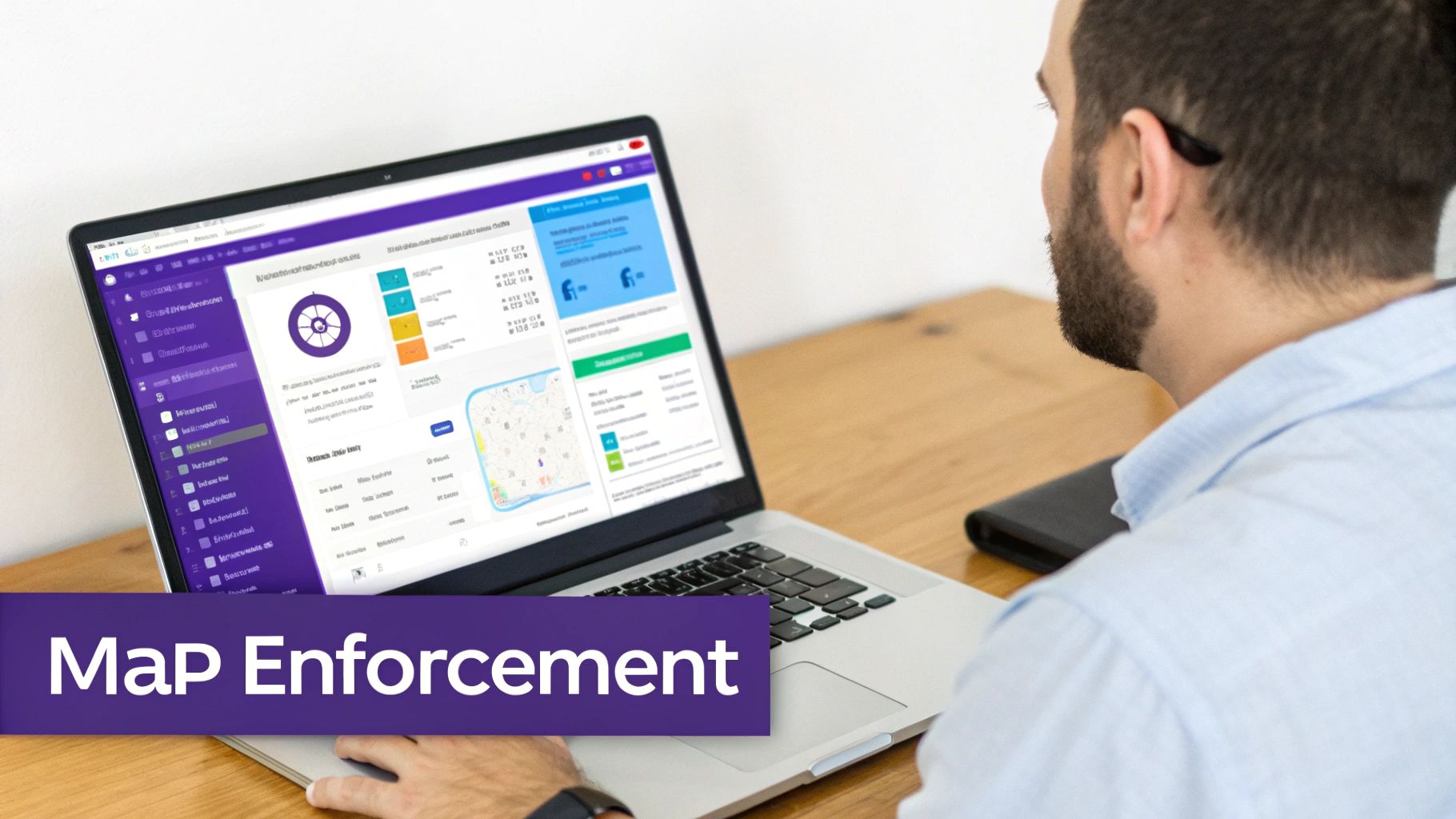
This requires integrating a specialized price monitoring platform with your core systems—your ERP, PIM, or ecommerce platform—to create a seamless flow from market data to price execution.
Automating the Data-to-Decision Workflow
The entire system depends on a reliable, automated data feed. The right platform acts as your market intelligence unit, continuously gathering data that is impossible to collect manually.
For example, a platform like Market Edge uses advanced web crawlers to extract near real-time data from thousands of competitor sites and online marketplaces. This raw data is cleaned, matched to your specific SKUs using AI, and delivered in a structured format that your systems can act on immediately.
The automated loop follows these steps:
- Data Collection: The tool continuously scans the web for prices, stock levels, and promotions for your products and competitors.
- Rule Application: This fresh data is evaluated against your predefined pricing rules (e.g., “Maintain a price 5% below Competitor X on this product line”).
- Price Execution: When a rule is triggered, the platform automatically pushes the new price to your ecommerce store or ERP via an API.
This closed-loop system ensures your pricing remains competitive and aligned with your goals 24/7.
Protecting Your Brand with MAP Enforcement
For manufacturers and brand owners, a dynamic price strategy is often focused on enforcing stability to protect brand value. Minimum Advertised Price (MAP) or Recommended Retail Price (RRP) policies are critical, but they are only effective if they are enforced.
Manual MAP monitoring is a losing battle. Resellers can change prices multiple times a day across numerous channels. Automation provides a significant ROI for brands by making enforcement scalable.
MAP enforcement isn't about punishing your partners. It's about protecting your brand's perceived value and guaranteeing a level playing field for every authorized reseller. Automation is the only way to do this at scale.
A dedicated monitoring tool transforms MAP enforcement from a reactive problem into a proactive, evidence-based process.
- Mini Use Case: Automated MAP Violation Detection: A brand manager for a high-end electronics company wants to ensure all 50 of their authorized online retailers adhere to their MAP policy. An automated MAP enforcement tool scans these retailers hourly. When a retailer drops the price of a flagship headphone model by $10 below MAP to win a "deal of the day" feature, the system instantly flags it. It captures a timestamped screenshot as evidence and sends an alert to the brand manager, who can then contact the retailer with indisputable proof of the violation that same day.
This capability is fundamental to building healthy channel relationships and is explored further in our guide on MAP policy monitoring software. The core logic is similar to that used by ride-sharing apps like Uber, whose surge pricing models analyze real-time signals to balance supply and demand. You can learn more about how historical pricing data powers these models and its importance.
Keeping Your Pricing Strategy on Track: Governance and Maintenance
A dynamic pricing strategy is not a "set-it-and-forget-it" project. It requires continuous attention, clear governance, and periodic refinement to remain effective. Without proper oversight, even a well-designed pricing engine can drift off course, eroding margins, damaging brand perception, or triggering an unwanted price war.
Long-term success depends on a disciplined process for monitoring, refining, and controlling your automated strategy.
Build Your Guardrails First
Before any algorithm adjusts your prices, you must establish guardrails. These are the hard boundaries that the system is never permitted to cross.
- Price Floor: This is your most critical guardrail. It is calculated based on your cost of goods, shipping, marketplace fees, and the minimum acceptable profit margin. It prevents an aggressive pricing rule from selling a product at a loss.
- Price Ceiling: This guardrail prevents the system from setting a price so high that it damages customer trust, even during a demand spike. While maximizing profit is the goal, price gouging can cause long-term harm to your brand.
Human Oversight is Non-Negotiable
Automation is for execution; humans are for strategy. An algorithm cannot understand your long-term business goals or the nuances of your channel partnerships. This is why clear human ownership is essential.
Establishing a small pricing committee is a proven approach. This group, typically comprising leaders from sales, marketing, finance, and operations, is not responsible for micromanaging individual price changes. Instead, they provide high-level oversight.
The committee's responsibilities include:
- Review Performance: Regularly assess KPIs to ensure the strategy is meeting its commercial objectives.
- Approve Rule Changes: Vet and approve any significant modifications to the pricing logic.
- Manage Overrides: Define the specific, rare circumstances in which a manual override is permitted and who has the authority to execute it.
Without this human oversight, your pricing engine becomes a "black box," making it impossible to adapt when market conditions change.
A dynamic pricing system without human governance is just an algorithm running wild. True strategic control comes from combining powerful automation with smart, consistent human oversight to ensure the machine always serves the business—not the other way around.
Dynamic Pricing Governance Checklist
Use this checklist to implement a repeatable process for governing your dynamic price strategy.
- [ ] Are our price floors and ceilings reviewed quarterly? Costs change, so your guardrails must be updated regularly to protect margins.
- [ ] Does every pricing rule have a clear owner? Accountability ensures that someone is responsible for the performance of each rule.
- [ ] Is there a formal process for changing rules? A documented change-management process prevents ad-hoc adjustments and ensures all changes are strategic.
- [ ] Do we have alerts for anomalous pricing activity? Configure notifications for unusual events, such as steep price drops, to quickly identify system errors or competitor actions.
- [ ] Is a KPI dashboard accessible to key stakeholders? Transparency ensures everyone can monitor performance at a glance.
- [ ] Is there a documented "kill switch" protocol? In case of a serious issue, you need a pre-approved plan to pause all automated price changes immediately.
This entire governance framework depends on a foundation of clean, timely market data. You cannot govern what you cannot see.
A robust governance process relies on constant, reliable market intelligence. This is where automated price monitoring tools like Market Edge become essential. To see how clean, real-time data can support your dynamic pricing governance, visit the Market Edge website.