
Manually checking competitor websites to track pricing is an inefficient and unreliable strategy. The process is slow, prone to human error, and the data is often outdated by the time it's compiled.
Competitor price tracking software automates this entire process, acting less like a static spreadsheet and more like a live market data feed for your specific product catalog. It continuously monitors what your rivals are charging, providing the real-time intelligence required to build a proactive pricing strategy.
Understanding Competitor Price tracking Software
In an environment where customers can compare prices across dozens of retailers in seconds, making pricing decisions in an information vacuum is a significant commercial risk. Automated price monitoring provides the data needed to move from reactive guesswork to strategic, evidence-based decisions.
This is not about blindly matching every price drop or engaging in a race to the bottom. It is about understanding your precise market position at all times. With accurate data, you can protect your brand's perceived value, identify opportunities to improve margins, and respond intelligently to market shifts.
Who Benefits from Price Tracking
This software provides a distinct commercial advantage to several key roles, each facing unique challenges:
- Manufacturers: Brands use this software to enforce Minimum Advertised Price (MAP) or Recommended Retail Price (RRP) policies. The system automatically flags any reseller pricing below the agreed-upon threshold, protecting brand equity and maintaining healthy channel relationships.
- Distributors: Operating on thin margins, distributors require a clear understanding of the market's price floor and ceiling. Price tracking identifies where they can adjust prices to improve profitability without sacrificing competitiveness.
- Online Retailers: For businesses competing for the Amazon Buy Box or seeking differentiation in crowded marketplaces, real-time data is critical. It powers dynamic repricing strategies designed to win sales without unnecessarily eroding profit margins.
The table below illustrates how these core functions align with tangible business objectives for different teams.
Core Functions of Price Tracking Software at a Glance
| Core Function | Primary Business Goal | Key Beneficiary |
|---|---|---|
| MAP/RRP Monitoring | Protect brand value and prevent channel conflict. | Manufacturers |
| Competitive Benchmarking | Set optimal prices to maximize profit margins. | Distributors |
| Dynamic Repricing | Win more sales on competitive online marketplaces. | Online Retailers |
Ultimately, each of these functions helps a business maintain market alignment, mitigating the dual risks of overpricing (lost sales) and underpricing (lost revenue).
Why It Matters Commercially
The fundamental business problem that competitor price tracking solves is the risk of market misalignment. Pricing too high leads to lost sales; pricing too low leaves revenue on the table.
Market data supports this view. The global Competitor Price Monitoring Software Market is projected to grow from $1,129.5 million in 2025 to $2,500 million by 2035. This growth is driven by a simple commercial reality: businesses recognize that a significant percentage of consumers will abandon a purchase if they find a better price elsewhere. You can explore more insights about the competitor price monitoring software market to understand the trend.
The goal is not just to see competitor prices; it's to understand the context behind them. Is a price drop a temporary promotion or a permanent strategic shift? Is a competitor out of stock, creating an opportunity to hold your price and capture demand? This is the intelligence that transforms raw data into a competitive advantage.
Ultimately, these platforms provide the data to shift from making reactive price adjustments to building a proactive, intelligent pricing strategy. This is where automated price monitoring tools like Market Edge become useful.
How Price Tracking Technology Works
The software follows a systematic, three-part process to convert unstructured information from across the web into a clean, actionable feed of competitive intelligence. This automated workflow delivers the speed and accuracy required to make pricing decisions with confidence.
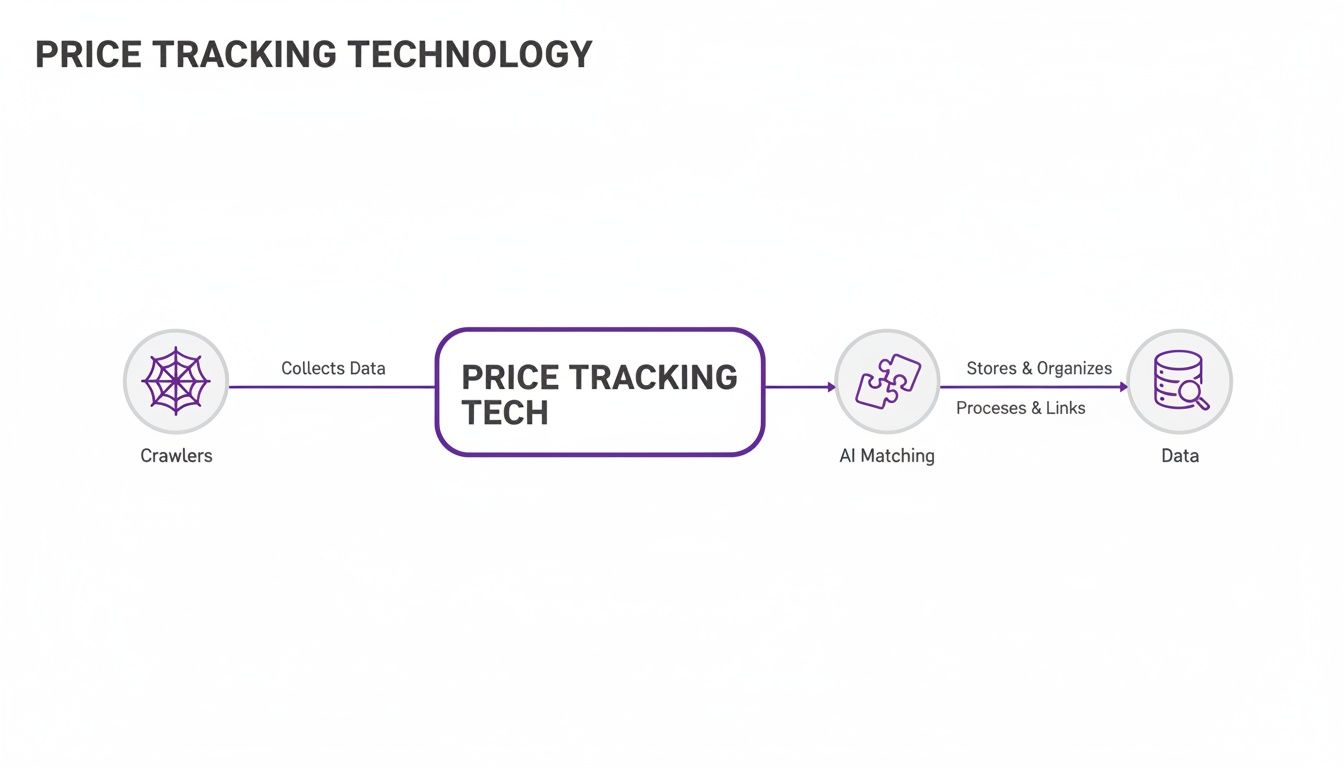
Let's examine each component of this process.
Step 1: Data Collection with Web Crawlers
The process begins with data acquisition. Specialized software bots, known as web crawlers or spiders, are deployed to systematically visit competitor websites and online marketplaces. These crawlers operate 24/7, navigating to specific product pages to extract key data points.
These bots are configured to capture more than just the advertised price. They also gather crucial context:
- Stock Availability: Is the competitor's product in stock, low on inventory, or sold out?
- Shipping Costs: The final price a customer pays includes shipping, making this essential for a true like-for-like comparison.
- Promotional Details: Any active sales, bundle deals, or coupon codes that affect the final price are captured.
This raw data is collected continuously, with crawl frequency customized to the velocity of the product category—from near real-time for electronics to daily for products with more stable pricing.
Step 2: AI-Powered Product Matching
Once collected, the data undergoes the most critical step: product matching. A competitor may list a product as "ProWidget Model X, Blue," while your internal system uses the identifier "PW-X-BL." Manually reconciling these discrepancies across thousands of products is not feasible.
This is where AI algorithms are essential. They analyze product attributes to identify and link identical items across different sellers, even with inconsistent naming conventions. The algorithms evaluate:
- SKUs, UPCs, and EANs
- Product titles and descriptions
- Brand and model numbers
- Product images and technical specifications
By matching products with high accuracy, the software ensures you compare the correct items, preventing strategic errors like dropping your price to compete with an older or different product version. This high-fidelity matching distinguishes professional-grade platforms from basic web scrapers. You can dive deeper into what to look for in our guide on software for price comparison.
The commercial impact of poor product matching cannot be overstated. A single mismatched SKU could trigger an automated repricing rule that unnecessarily drops your price, directly eroding your profit margin on every sale of that item until the error is caught.
Step 3: Data Structuring and Delivery
The final stage, data structuring, organizes the raw data into a clean, structured, and usable format. This process transforms millions of individual data points into a coherent database ready for analysis.
The output is a pristine dataset that powers intuitive dashboards, automated reports, and alert systems. A platform like Market Edge presents this information so you can immediately see your market position, track historical trends, and receive notifications for critical events, such as a MAP policy violation.
This three-step process—crawling, matching, and structuring—is how raw web data is converted into a powerful strategic asset.
Putting Price Tracking Data to Work
Acquiring clean, accurate data is the first step. The real value is realized when that data informs decisions that directly impact revenue and profitability. Competitor price tracking software is not merely a reporting tool; it is an engine for executing high-impact business objectives.
Protect Your Brand with MAP Enforcement
For manufacturers, maintaining brand integrity is paramount. A Minimum Advertised Price (MAP) policy helps preserve brand value and ensures a level playing field for retail partners. Manual enforcement, however, is resource-intensive and inefficient.
Automated competitor price tracking monitors reseller websites and marketplaces around the clock. The moment a price drops below the established MAP, an alert is triggered.
Use Case: A Consumer Electronics Brand
- Challenge: A premium headphone brand discovered unauthorized online sellers were heavily discounting their products, undercutting official retail partners and eroding the brand's premium image.
- Solution: They implemented a price monitoring tool to track 50 key SKUs across 200 reseller sites. A simple MAP rule was configured to flag any price below $299.
- Outcome: The system automatically generated violation reports with screenshot evidence. The brand's enforcement team used this documentation to reduce MAP violations by over 80% in three months, stabilizing their channel relationships.
Win More Sales with Dynamic Pricing for Online Retail
In hyper-competitive ecommerce environments like Amazon, prices can change multiple times per day. Dynamic pricing uses automated, rule-based logic to adjust prices in response to market conditions, maximizing sales opportunities.
Pricing engines can be configured with specific rules, such as:
- Price 1% below the key competitor, but maintain a minimum gross margin of 15%.
- Match the lowest market price, but only if the competitor has the item in stock.
- Increase the price by 5% when you are the only seller with available inventory.
These automated adjustments help retailers win the "Buy Box" more often and optimize revenue without sacrificing profit. For a much deeper look, check out our guide on how price optimization software can transform your strategy.
Safeguard Profits with Margin Protection for Distributors
Distributors often operate with narrow profit margins, where minor pricing errors can have a significant impact. Competitor price tracking provides a clear view of the market "floor" and "ceiling" for any given product, enabling pricing managers to protect and grow margins.
By knowing the lowest and highest prices in the market, distributors can avoid undercutting competitors for no reason. If everyone else is selling a widget between $50 and $55, pricing it at $45 is just leaving money on the table.
This data provides the confidence to hold firm on pricing or identify opportunities to increase prices on certain product lines without losing customers.
Make Smarter Buys with Optimized Sourcing for Importers
For businesses that source products from various suppliers, pricing intelligence offers a strategic advantage in procurement. By tracking a product's retail selling price, importers can assess its perceived market value and profit potential before committing to a large purchase order.
If a product consistently commands a premium online, it may justify a higher wholesale cost. Conversely, if a product is perpetually on sale, it could indicate oversupply or weak demand, helping buyers avoid poor inventory investments.
How to Choose the Right Price Tracking Software
Selecting the right competitor price tracking software is a critical decision. The market contains numerous options with varying capabilities. A successful evaluation focuses on specific business objectives rather than just technical features.
The Price Optimization Software Market is projected to grow from $1,776.67 million in 2026 to $11,063 million by 2035. This growth is fueled by the fact that 75% of retailers now rely on near real-time data to navigate price competition that can erode 10-15% of their profits annually. This is a core business decision, not just an IT purchase. You can dig deeper into these price optimization market findings to see the full picture.
Focus your evaluation on these four key areas.
Data Accuracy and Refresh Rate
The effectiveness of any pricing strategy depends entirely on the quality of its underlying data. Inaccurate or outdated information leads to flawed decisions.
When evaluating vendors, ask direct questions:
- What is your product matching accuracy? AI-powered matching is the industry standard, ensuring correct product identification even with inconsistent competitor data.
- How frequently is the data refreshed? Fast-moving markets require updates every few minutes or hours, while daily updates may suffice for other categories. The refresh rate should align with your industry's velocity.
The most reliable way to assess data quality is to test the software with your own products. A reputable vendor will offer a pilot or free trial, allowing you to validate their matching accuracy and data speed before making a commitment.
Scalability and Coverage
Your business will evolve, and your software must be able to scale accordingly. A solution should accommodate growth from tracking a few dozen core products to monitoring thousands of SKUs across numerous competitors and marketplaces.
Consider the platform's ability to scale:
- Can it handle an expanding product catalog without performance degradation?
- Does it cover all relevant sales channels, from competitor websites to marketplaces like Amazon and eBay?
- Are there hard limits on the number of competitors or products you can track?
A solution with a rigid structure that you will outgrow is not a long-term partner but a future bottleneck.
Ease of Use and Reporting
Powerful data is useless if it is inaccessible or difficult to interpret. A well-designed user interface should be intuitive, enabling pricing managers and business leaders to find the information they need without requiring technical support.
Key features to evaluate include:
- An intuitive dashboard: Can you get a clear, immediate snapshot of your market position?
- Customizable alerts: How easily can you configure notifications for events like MAP violations or competitor stock-outs?
- Actionable reports: Can you generate reports that clearly show pricing trends, identify opportunities, and highlight threats?
The objective is to spend less time managing the software and more time making strategic decisions.
Integration Capabilities
To maximize ROI, pricing data must integrate with your other core business systems. A well-documented API (Application Programming Interface) is non-negotiable for this. An API allows the software to communicate with your other tools, creating a seamless flow of information.
For example, data can be piped directly into your:
- ERP (Enterprise Resource Planning) System: To provide real-world context for financial reporting.
- PIM (Product Information Management) System: To centralize all product data.
- Dynamic Repricing Engine: To automate price adjustments based on live market conditions.
This level of automation is a core feature of platforms like Market Edge, which are designed for deep integration into a company's technology stack.
Vendor Selection Checklist
Use this structured checklist to guide your vendor conversations and compare potential partners based on criteria that directly impact business performance.
| Evaluation Criterion | What to Ask | Why It Matters |
|---|---|---|
| Data Accuracy | "What is your product matching accuracy rate? Can you prove it with my product list?" | Bad matches lead to bad decisions. You need to trust the data implicitly. |
| Data Freshness | "How frequently can data be refreshed? Is it configurable by product or competitor?" | Stale data means you're always one step behind the market. |
| Scalability | "What are the limits on SKUs and competitors? What is the cost to add more?" | You need a partner that can grow with you, not hold you back. |
| Channel Coverage | "Which marketplaces and websites can you track? What about international sites?" | Your coverage needs to match where your customers and competitors are. |
| Ease of Use | "Can we see a live demo of the dashboard? Can my team try it out?" | If your team can't use it easily, the tool's power is wasted. |
| Reporting & Alerts | "How customizable are the reports and alerts? Can they be sent to different teams?" | Generic reports aren't helpful. You need insights tailored to your strategy. |
| API & Integration | "Do you have a well-documented API? What systems have you integrated with before?" | Integration unlocks automation and makes the data 10x more valuable. |
| Support & Onboarding | "What does your onboarding process look like? What are your support SLAs?" | A great tool with poor support is a recipe for frustration. |
This framework helps you identify a strategic partner with the technology and support to help you achieve your commercial goals.
Measuring the ROI of Your Pricing Strategy
An investment in competitor price tracking software requires a clear business case. This means drawing a direct line from the platform's capabilities to tangible P&L results. The return on investment (ROI) is not about isolated price adjustments but about making consistently smarter decisions that drive profitability.
The cost of inaction—lost sales, brand erosion, and operational inefficiency—is often the greatest expense. By measuring performance with the right KPIs, you can transform your pricing strategy from a cost center into a profit driver.
KPIs for Online Retailers and Marketplaces
For ecommerce businesses, success depends on visibility, conversion, and profitability. The right pricing data fuels all three.
Key metrics to track include:
- Buy Box Win Rate: For marketplace sellers, this is a primary performance indicator. Calculated as (Number of Buy Box Wins / Total Product Views), a higher win rate directly translates to increased sales.
- Conversion Rate Lift: Compare the conversion rates on key product pages before and after implementing a dynamic pricing strategy. A small lift from 2% to 2.5%, for example, can significantly boost revenue with no additional marketing spend.
- Gross Margin Percentage: The objective is to win sales profitably. Closely monitor gross margin to ensure pricing rules are protecting your bottom line, not just chasing top-line revenue.
KPIs for Manufacturers and Brand Owners
For brands, price tracking is focused on protecting brand equity and maintaining healthy retail channels. The ROI is derived from creating a stable and fair market for your products.
Essential metrics include:
- Reduction in MAP Violations: Track the number of unauthorized discounts detected per month. A 75% reduction in violations within the first quarter is an achievable goal with automated monitoring.
- Reseller Compliance Rate: This is the percentage of authorized resellers adhering to your pricing policies. A high compliance rate indicates strong channel partnerships and effective brand governance.
The impact of MAP enforcement extends beyond price. It mitigates channel conflict, builds trust with key retail partners, and protects long-term brand perception—a critical, albeit difficult-to-quantify, asset.
KPIs for Distributors and Importers
Distributors and importers operate on thin margins where small price optimizations have a large impact on profitability. ROI is about identifying and acting on opportunities to improve margins on core product lines.
Focus on these KPIs:
- Price Index vs. Key Competitors: This metric benchmarks your pricing against your main rivals. An index of 105 indicates you are, on average, 5% more expensive. The goal is to manage this index intentionally, not necessarily to be the cheapest.
- Margin Uplift on Key Product Categories: When competitor stock-outs or market-wide price increases create an opportunity to raise your prices, track the resulting margin improvement. This provides a direct ROI calculation for your pricing actions.
Modern pricing analytics software is designed to provide the data needed to track these KPIs. Platforms like Market Edge help you build a solid business case demonstrating the financial return of your investment.
Getting Your Price Tracking System Up and Running

The most effective way to implement a competitor price tracking tool is to start with a focused pilot project. This approach allows you to demonstrate quick wins, build internal support, and refine your process before a full-scale rollout. Attempting to monitor every product against every competitor from day one often leads to information overload. A strategic, phased approach ensures your initial efforts deliver measurable results.
Step 1: Define Your Initial Scope
The first step is to prioritize. Focus on the areas that will have the greatest impact on your business.
To define your pilot group, answer these questions:
- Which 20 SKUs drive 80% of our revenue or profit? Begin with the products that matter most.
- Who are our top three to five direct competitors? Concentrate on the rivals who directly influence your sales.
- Which marketplace (e.g., Amazon) is most critical to our business? Pinpoint the single channel where pricing is most sensitive.
By narrowing your focus to this high-value segment, you can gather meaningful data quickly and build a strong case for future expansion.
Step 2: Configure and Launch Tracking
Once your scope is defined, the technical setup is typically straightforward. Provide your list of product identifiers—such as SKUs, UPCs, or product page URLs—and specify the competitor websites to monitor.
The system's web crawlers and AI-powered matching algorithms then take over, linking your products to their equivalents across the web. Your dashboard will begin to populate with data. Automated tools like Market Edge are built to facilitate this rapid onboarding.
Step 3: Set Up Alerts and Reports
With data flowing, the next step is to make it actionable. Configure automated notifications to transform the platform from a passive dashboard into an active monitoring system.
Establish rules for critical alerts, such as:
- MAP/RRP Violations: Receive an immediate notification when a reseller's price falls below your established threshold.
- Significant Price Drops: Be alerted when a key competitor makes a substantial price cut on a flagship product.
- Competitor Stock-Outs: Get notified when a competitor runs out of inventory for a key item, creating an opportunity to capture their sales.
Step 4: Integrate with Your Other Systems
To achieve maximum value, connect the pricing data to your other business systems. Most sophisticated platforms provide an API (Application Programming Interface) to enable this integration.
An API allows you to pipe near real-time pricing intelligence directly into your internal dashboards, ERP software, or a dynamic repricing engine. This final step automates workflows and ensures all teams—from marketing to sales—are operating with the same accurate, up-to-date market data.
Frequently Asked Questions
Here are direct answers to the most common questions about competitor price tracking software, designed to help you determine if this technology is right for your business.
How accurate is the data from price tracking software?
Data quality is directly tied to the underlying technology. Top-tier platforms that combine advanced web crawlers with AI-powered product matching can achieve accuracy rates exceeding 99%.
The AI-driven matching is the key differentiator. It can distinguish between product variations (e.g., colors, sizes, model years) even when retailers use different product titles and descriptions. This prevents costly errors, such as matching your premium product against a competitor's entry-level version.
The most reliable way to assess accuracy is to test it. A reputable provider will offer a free trial or pilot program, allowing you to validate their matching performance with your own product catalog before making a commitment.
Can this software track prices on marketplaces like Amazon?
Yes. Any professional-grade price tracking software is designed to monitor large marketplaces like Amazon, eBay, and Walmart in addition to individual ecommerce sites. This is a baseline requirement in today's retail landscape.
The software can differentiate between third-party sellers on a single product listing, reporting on individual prices, stock levels, and which seller currently holds the ‘Buy Box’. For businesses that rely on marketplaces, this level of granular detail is essential.
How difficult is it to set up and integrate this software?
Most modern platforms are cloud-based (SaaS) and designed for rapid implementation. Onboarding typically involves uploading a list of your products (using SKUs, UPCs, or URLs) and identifying the competitors you wish to track.
Day-to-day operations are managed through an intuitive web-based dashboard. For advanced automation, platforms offer a robust API (Application Programming Interface). This allows you to integrate pricing data directly with your ERP or ecommerce system to power functions like automated repricing. This is where automated price monitoring tools like Market Edge become invaluable.
Ready to turn competitive insights into a strategic advantage? Market Edge provides the near real-time data you need to protect your margins, enforce MAP policies, and make smarter pricing decisions. Validate our accuracy with a no-obligation free trial.