
For any business leader, a clear picture of the competitive landscape isn't just a nice-to-have—it's essential for survival. Software for price comparison provides that clarity by automating the manual, time-consuming work of market monitoring. It shifts your team from a reactive, guessing game to a proactive, strategic position armed with precise, continuously updated competitor data.
Why Price Comparison Software Matters Commercially
In a market that changes by the minute, manual price tracking is a significant competitive disadvantage. If your team spends hours checking a few competitor sites for a handful of products, you are operating on outdated, incomplete information. This method is slow, prone to human error, and fails to scale as your product catalog and competitor set grow.
The commercial purpose of this software is to deliver real-time market intelligence. It is the key to protecting profit margins, enforcing pricing policies like MAP or RRP, and capitalizing on market opportunities the moment they arise. It allows pricing managers and sales teams to focus on strategy instead of tedious data collection.
The Shift From Manual Guesswork to Automated Insight
Consider a common business scenario. An ecommerce manager spends several hours each week manually checking the top 20 SKUs against three key competitors. The result is a narrow, often outdated, snapshot of the market. Now, imagine that same manager using a dedicated software platform. They can now monitor 500 SKUs across 25 competitors automatically, receiving instant alerts when a price drops or a competitor's product goes out of stock.
This is the fundamental shift: moving from a reactive, limited view of the market to a proactive, comprehensive one. Businesses using this technology can reclaim market share, identify profitable pricing gaps, and protect their brand's value with a fraction of the manual effort.
This is not a niche tool; it is becoming a standard component of the modern commercial tech stack. The global price comparison software market is expected to grow from $2.5 billion in 2026 to over $4 billion by 2033. This growth reflects a market reality: distributors, manufacturers, and online retailers require this capability to compete effectively. You can analyze the data behind this trend at Verified Market Reports.
Let's break down the operational difference.
Manual vs. Automated Price Comparison At a Glance
The table below highlights the contrast between legacy methods and modern, automated solutions. It shows how software doesn't just accelerate a process—it fundamentally changes what is possible.
| Attribute | Manual Price Checking | Automated Price Comparison Software |
|---|---|---|
| Data Scope | Very limited; a few products on a few sites. | Comprehensive; thousands of SKUs across the entire market. |
| Frequency | Infrequent; weekly or monthly snapshots. | Continuous; real-time data, 24/7. |
| Accuracy | Prone to human error, typos, and missed data. | Highly accurate with sophisticated data matching. |
| Scalability | Impossible to scale without massive headcount. | Easily scales as your catalog and competitors grow. |
| Actionability | Delivers old data, leading to reactive decisions. | Provides instant alerts for proactive, strategic moves. |
| Time Investment | Extremely time-consuming; hours of manual labor. | Minimal; frees up teams for high-value strategic work. |
As you can see, the switch to automation isn't just about efficiency—it's about gaining a strategic edge that's simply out of reach with manual methods.
Key Commercial Benefits
Automating price comparison delivers direct, bottom-line advantages that manual checks cannot. You move beyond simply knowing a competitor's price to having actionable intelligence.
- Protect Your Margins: Instantly identify where you are underpriced and can safely increase prices without impacting sales volume. This is about capturing revenue you are currently leaving on the table.
- Enforce MAP/RRP: For brands and manufacturers, the software acts as a watchdog. It automatically flags retailers who violate pricing policies, helping you prevent price erosion and protect brand equity.
- Stay Agile: Receive real-time alerts on competitor price changes, promotions, or stockouts. A competitor running out of a popular item is an opportunity to capture their customers—but only if you know about it immediately.
Price comparison software is a commercial tool, not just a data source. Automated platforms, such as Market Edge, consolidate this intelligence into a single view, turning raw numbers into profitable business decisions.
Core Features Every Decision-Maker Should Demand
When evaluating software for price comparison, it's easy to get lost in feature lists. The real value lies in capabilities that directly protect margins, save team hours, and strengthen retailer partnerships. For any B2B decision-maker, these are the non-negotiable features that convert raw data into a strategic advantage.
The shift from a manual, spreadsheet-driven process to a fully automated one is a game-changer. It’s the difference between guessing and knowing.
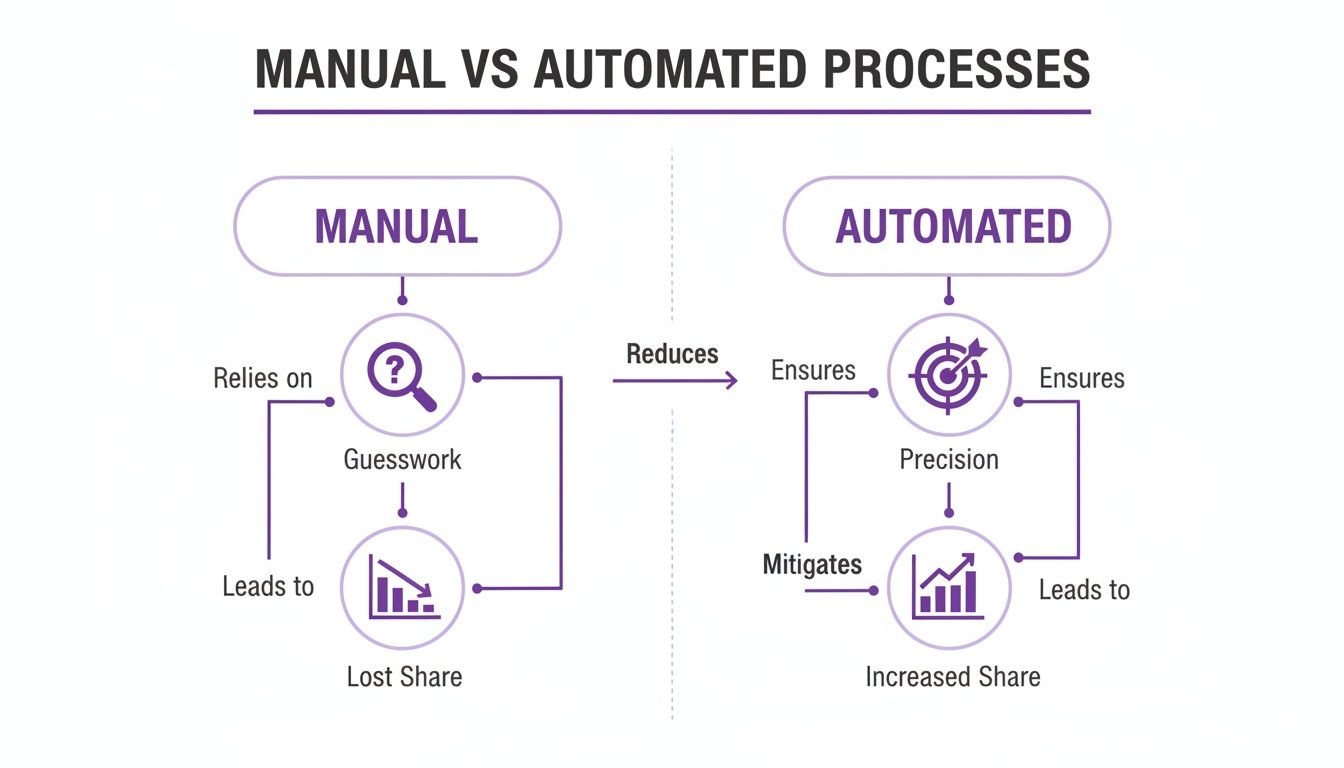
As the infographic shows, relying on manual checks means you’re always a step behind, missing opportunities and losing ground. A dedicated software platform provides the clarity to make confident, profitable decisions every time.
Automated Web Crawling and Data Collection
The foundation of any price comparison tool is its ability to gather data accurately and relentlessly. Automated web crawling is the process where the software systematically browses and extracts pricing information from competitor websites, marketplaces, and direct seller portals. This eliminates the error-prone task of manual data entry.
This is about the scale and quality of intelligence. An automated system can monitor thousands of SKUs across hundreds of websites multiple times a day—a task impossible for any human team. This continuous data flow ensures pricing decisions are based on what the market is doing right now, not last week.
AI-Powered Product Matching
A primary challenge in competitive analysis is ensuring an "apples-to-apples" comparison. Sellers often use different product names, SKUs, or bundle items. This is where AI-powered product matching is mission-critical.
Instead of relying on a product title, advanced algorithms analyze dozens of data points—model numbers, technical specifications, and even images—to identify true "like-for-like" products. Without this capability, you risk dropping your price to match a competitor's refurbished item or a product missing a key accessory, unnecessarily eroding your margin.
Mini Use Case: A manufacturer can use this to spot an unauthorized product bundle on a marketplace. Even if a seller uses a custom title and different photos, a smart system can identify the core components and flag the listing as a potential channel violation. This protects both brand integrity and official retail partners.
Real-Time Monitoring and Alerts
The digital marketplace operates 24/7. A competitor can slash prices at 2 AM, run a flash sale, or run out of a key product on a holiday weekend. Real-time monitoring and alerts act as your watchtower, notifying you of critical market moves the moment they happen.
Imagine receiving an instant notification when a competitor makes an aggressive price drop. Instead of discovering this days later after losing sales, you can make a strategic decision immediately: match the price, hold firm, or launch a counter-promotion. These alerts can be configured for specific events:
- Price change alerts: Get an email or notification the second a competitor's price for a specific SKU moves.
- Stock status alerts: Be the first to know when a key competitor runs out of a popular item—an opportunity to capture their customers.
- New product alerts: Discover when a rival introduces a new product in one of your most important categories.
This capability moves your pricing team from a reactive to a proactive posture.
MAP Compliance Monitoring
For brands and manufacturers, protecting brand value and maintaining healthy retail partnerships is paramount. Minimum Advertised Price (MAP) compliance monitoring automates the process of enforcing your pricing policies. The software scans your entire seller network, flagging any products advertised below your set MAP.
If you’re looking for a deeper dive, this guide on how to choose the right competitor price monitoring software offers some great insights.
When a violation is found, the system can automatically capture a timestamped screenshot, log the details, and even initiate a pre-written email to the seller. This automates a historically manual process, ensures consistent policy enforcement, and protects your brand’s premium positioning. It keeps authorized retail channels stable and profitable. This is where a tool like Market Edge becomes useful.
How to Choose the Right Price Comparison Software
Selecting the right software for price comparison is a critical business decision, not just a technical task. The platform you choose will directly impact your ability to protect margins, enforce pricing policies, and adapt to market shifts. A structured evaluation helps you invest in a tool that solves your specific commercial problems.
The most important step occurs before you view a single demo: define your internal needs. Are you an online retailer monitoring a few key competitors, or a large manufacturer monitoring hundreds of SKUs across marketplaces like Amazon and eBay? The answer dictates the type of solution you require.
Define Your Core Requirements
Before evaluating software features, document your business objectives. What outcomes are you trying to achieve? A simple framework can bring your priorities into focus.
- Scope of Monitoring: How many products do you need to track? How many competitors or marketplaces are on your radar? Be realistic, but also consider your growth plans for the next 1-2 years.
- Key Use Cases: What is your most pressing commercial challenge? Is it rampant MAP policy violations, a need for better competitive benchmarking, or gaining control over supplier pricing?
- Team Workflow: Who will use this data? A dedicated pricing analyst needs granular detail, while a sales director may only require a high-level dashboard summary.
- Existing Tech Stack: Where does this tool need to integrate? Consider your ERP, PIM, or ecommerce platform. A tool that does not integrate easily creates more work.
This initial homework prevents you from being swayed by impressive but ultimately irrelevant features and keeps the evaluation grounded in business needs.
Key Evaluation Criteria for Vendors
With your requirements defined, you can now evaluate vendors against a consistent standard. Look past the sales pitch and examine the fundamentals.
1. Data Accuracy and Refresh Rate Your pricing decisions are only as good as the underlying data. Ask vendors direct questions: How often is the data refreshed? For fast-moving categories, daily updates may be insufficient; you may need near real-time intelligence. Press them on product matching accuracy. A tool that mistakenly matches your premium product against a competitor's budget alternative can lead to disastrous pricing errors.
2. Scalability and Performance Your business will grow, and your software must scale with it. Can the platform handle an increase from 1,000 SKUs to 100,000 without performance degradation? Can it easily expand to new countries or marketplaces? A scalable solution avoids a painful migration process later.
3. Integration and Reporting Capabilities A tool that silos its data has limited value. The best price comparison software integrates into your existing workflows. Evaluate its API capabilities and pre-built connectors. Can you feed its data directly into your dynamic pricing engine or BI tools? Reporting should also be flexible, allowing you to build custom dashboards that highlight the metrics most important to your team. Our guide on pricing analytic software dives deeper into this topic.
The ultimate test of any platform is the quality of its data. Before signing a long-term contract, insist on a trial or pilot program. This is where a solution like Market Edge can prove its value, letting you validate data quality and platform fit with your own products and competitors.
It’s worth noting that the market for related tools is booming. Price optimization software, which uses this very same competitive data to power dynamic pricing, is projected to grow from $1.68 billion in 2025 to $3.59 billion by 2030. This rapid growth, fueled by intense competition and the push for AI-driven insights, just underscores how essential foundational price comparison data has become. Discover more insights about price optimization software on Mordor Intelligence.
Getting Started: How to Roll Out Your Price Comparison Software for Maximum ROI
Acquiring a powerful price comparison tool is the first step. The actual return on investment is unlocked through a structured implementation plan. A thoughtful rollout turns a mountain of data into profitable decisions from day one.

Without a clear plan, even the most advanced software can become an underutilized tool. The goal is to integrate competitive intelligence directly into your company's decision-making processes. The best approach is to start with a focused pilot and build from there.
Start with a Focused Pilot Program
Instead of attempting a company-wide deployment, begin with a focused pilot program. This simplifies the initial phase and allows your team to achieve quick wins, building momentum for a broader rollout.
Choose a small, manageable set of high-priority products for this first phase. Good candidates include:
- Your Bestsellers: These products have the largest impact on revenue, so small pricing adjustments can yield significant gains.
- Highly Competitive Categories: Focus on product lines where price competition is constant and real-time data is essential.
- Products with Known MAP Issues: Use the pilot to test the software's MAP enforcement features and its ability to document violations.
A controlled launch helps confirm data accuracy and allows you to refine internal workflows without overwhelming your team.
Set Up Your Pricing Rules and Alerts
Once your pilot is running, translate your business strategy into automated rules. This is where the software begins to perform the heavy lifting, actively scanning the market and flagging events that require your attention.
Define specific triggers based on your objectives. For example, an ecommerce manager might set an alert for when a key competitor on a top-selling item drops their price by more than 5%. A brand manufacturer would want an instant notification the moment a reseller lists a product below its MAP price. These alerts convert raw data into a clear signal for action.
This highlights the close relationship between price comparison and price optimization. The price optimization software market is projected to grow from $1.23 billion in 2024 to $1.4 billion in 2025. This growth is driven by businesses using the continuous data stream from monitoring tools to not only track the market but also to power dynamic pricing and enforce MAP. You can read the full research on this expanding market at The Business Research Company.
This checklist provides a step-by-step guide for a successful implementation.
Actionable Checklist for Software Implementation
This checklist provides a clear, phase-by-phase guide to help you move from initial setup to ongoing optimization, ensuring you get the most out of your new tool.
| Phase | Key Action | Success Metric |
|---|---|---|
| 1. Setup & Onboarding | Work with the vendor to configure initial settings and train key team members. | Team completes training; 100% of pilot SKUs are loaded and tracking correctly. |
| 2. Pilot Launch | Run the software on a small set of high-priority products for 2-4 weeks. | Identified at least 3-5 actionable pricing opportunities or MAP violations. |
| 3. Rule Configuration | Define and implement automated alerts for price drops, MAP violations, and stock changes. | Alerts are triggered accurately, reducing manual monitoring time by 50%. |
| 4. Workflow Integration | Establish a weekly review meeting to discuss insights and decide on actions. | Pricing data is a standard agenda item in commercial meetings. |
| 5. Performance Review | After 90 days, analyze KPIs like margin uplift and sales volume for the pilot group. | Pilot products show a measurable improvement in margin or sales velocity. |
| 6. Scale & Optimize | Based on pilot success, roll out the software to additional product lines and refine rules. | Software is deployed across all key categories; ROI is positive. |
Following these steps creates a structured process that ensures the software becomes a core part of your strategy.
Weave the Data into Your Daily Workflow
To achieve a true return on investment, insights from your price comparison software must become part of your team's daily routine. Data sitting in a dashboard is inert; it only becomes valuable when acted upon.
This means incorporating pricing data into weekly sales meetings, category reviews, and discussions with suppliers. For advanced teams, this could involve feeding the data via API directly into an automated repricing engine or your primary ERP system.
Mini Use Case: A B2B distributor ran a pilot on one of its most important product categories. Within two weeks, the data revealed they were consistently 15% more expensive than their three main rivals. After adjusting prices, they saw a 35% increase in sales volume for that category in the following quarter, making the decision to roll out the software company-wide straightforward.
Measure, Adjust, and Expand
A successful implementation is not a one-time project; it's a continuous cycle of learning and refinement. Closely monitor key performance indicators (KPIs) to understand what is working.
Track metrics that matter to the business, such as:
- Margin improvement on products with adjusted prices.
- Sales velocity and win rate on competitive quotes.
- The number of MAP violations identified and resolved across your reseller network.
Use these insights to tweak your pricing rules, adjust alert settings, and gradually expand the program to cover more products and competitors. This cycle of measuring, adjusting, and scaling ensures your strategy remains effective as market conditions change. This is where automated tools like Market Edge prove their long-term value.
Advanced Strategies Beyond Simple Price Checking
Knowing competitor pricing is the baseline benefit of any price comparison tool. The strategic advantage emerges when you analyze the data more deeply, using the software not just as a defensive shield but as a proactive tool for growth.
When you combine pricing intelligence with stock levels and product assortment data, you unlock powerful insights for teams across the business—from brand management to procurement.
For Manufacturers Protecting Brand Equity
For a manufacturer, brand reputation is a primary asset. When unauthorized third-party sellers slash prices online, they don't just steal sales; they erode the perceived value of your entire product line. This creates a race to the bottom that damages relationships with loyal retail partners.
Price comparison software functions as a brand protection tool. It continuously scans marketplaces and retailer sites, acting as your eyes and ears online. By automating MAP (Minimum Advertised Price) monitoring, it instantly flags sellers who violate your policies and provides the timestamped evidence needed for consistent enforcement.
Mini Use Case: A Medical Device Manufacturer A company making premium medical devices was facing significant price erosion from rogue sellers on Amazon. This undercutting cheapened the brand's image and strained relationships with their official distributors. They implemented a monitoring solution with alerts for any listing below their MAP. In the first month, they identified 12 repeat offenders. Armed with evidence like screenshots and pricing history, their legal team issued notices and had the non-compliant listings removed. This restored pricing integrity and rebuilt trust with their distribution channel.
For Distributors Optimizing Procurement
A distributor's profitability is heavily influenced by procurement efficiency. You manage a network of suppliers with prices and stock levels that can change daily. The right software can cut through this complexity and turn procurement into a competitive advantage.
Instead of only tracking retail competitors, distributors can use the software to monitor their own suppliers. This creates a unified view of which supplier has what inventory, and at what price. This allows them to:
- Identify the best pricing by comparing supplier costs on the same SKUs in near real-time.
- Negotiate from a position of strength, using hard data to demonstrate market pricing.
- Avoid stockouts by receiving alerts when a key supplier is running low, providing time to secure an alternative source.
This data-driven approach ensures distributors are consistently sourcing inventory at the lowest possible cost, directly increasing gross margins.
For Retailers Identifying Market Gaps
An online retailer wins by being quicker and smarter than the competition. Competitor stock status is one of the most valuable—and often overlooked—data points provided by price comparison software. When a rival runs out of a popular item, it creates a significant market opportunity.
By setting up "out-of-stock" alerts, a retailer can immediately identify a gap in the market. This creates a window to capture sales from motivated buyers whose first choice is suddenly unavailable.
This is the ideal moment for a tactical price adjustment. If you want to see this in action, our article on examples of dynamic pricing breaks down several real-world scenarios. With a key competitor temporarily out of the market, you can often increase your price to improve margin without losing the sale.
Mini Use Case: An Electronics Retailer An online electronics store configured stock alerts on the top 50 products sold by its main competitor. During the holiday season, an alert indicated the competitor was sold out of a popular gaming headset. Their pricing team confirmed they had ample stock and increased their price by 7%. Over the next 48 hours, they sold nearly their entire inventory of that headset at a higher margin, capturing sales that would have gone to their largest rival.
This is how to move beyond simple price matching. This intelligence empowers teams to make data-driven decisions that directly boost revenue and profit. This is where automated monitoring tools like Market Edge prove their worth.
Your Next Step Toward Intelligent Pricing
We've covered the core functions and strategic applications of automated price comparison. The key takeaway is this: in today's market, manual price tracking is no longer a viable competitive strategy. Automating data collection frees your team to focus on strategic analysis and business growth.
The immediate next step is to analyze your current process. Quantify the hidden costs of manual methods, including not just team hours but also missed sales opportunities from stale data.
Think about the last time a competitor's price drop caught you by surprise, costing you sales or forcing you to slash your margins. The goal here is to stop relying on gut feelings and start building a solid, data-driven case for a smarter approach.
Once you establish that baseline, the path forward becomes clear. If you are ready to move beyond spreadsheets and guesswork, it is time to evaluate a dedicated platform. This is where a tool like Market Edge comes in, providing a central hub for competitive intelligence that helps turn reactive fire-fighting into a proactive growth strategy.
Frequently Asked Questions
When considering new business technology, you need straightforward answers. Here are responses to the most common questions we hear from decision-makers about software for price comparison.
How Does The Software Handle Different Product Variations?
This is a key differentiator for advanced platforms. It is simple to match identical UPC codes, but a competitor might list the same product with a different title, SKU, or as part of a bundle.
Advanced platforms use sophisticated AI to analyze a range of attributes—model numbers, technical specs, colors, sizes—to ensure a true "apples-to-apples" comparison. This prevents an ecommerce manager from mistakenly dropping the price of a premium model to match a competitor's entry-level version. It ensures the insights are reliable enough for decision-making.
Is This Software Only Useful for E-commerce Companies?
No. While online retailers are a primary user base, they are not the only one.
Manufacturers and brand owners use this technology for MAP policy enforcement. They use it to monitor their entire distribution network and automatically flag any retailer selling products below the agreed-upon minimum price. This is not about policing partners; it's about protecting brand value and ensuring a level playing field for authorized distributors who adhere to policy. It is a core function for brand protection and a key reason clients turn to a solution like Market Edge.
How Quickly Can We Expect to See a Return on Investment?
ROI is often realized faster than anticipated, typically becoming clear within the first 90 days. The return can be measured through direct business outcomes:
- Margin Protection: Identifying MAP violations as they happen allows you to stop price erosion before it damages profitability.
- Sales Growth: The software might reveal you are overpriced in a key category, allowing for a strategic adjustment to increase sales velocity.
- Revenue Capture: You may discover certain SKUs are priced significantly below the market average. This is an opportunity to increase prices and profit without impacting sales.
Because the tool is tied directly to these core financial metrics, justifying the investment is usually straightforward.
This is where automated price monitoring tools like Market Edge become useful. See how you can bring all your competitive intelligence under one roof by exploring our price monitoring solutions.