
Product bundling is a pricing strategy that involves selling multiple items together as a single package for one price. When executed correctly, it can significantly increase average order value (AOV) and customer lifetime value. For example, a software company might package its core application, an analytics add-on, and premium support into a single monthly subscription. The total price is less than buying each component separately, creating a clear value proposition for the customer and a larger sale for the business.
This guide provides a practical framework for B2B decision-makers to develop and implement a profitable bundling strategy.
The Commercial Value of a Product Bundling Strategy
For ecommerce and pricing managers, understanding product bundling is critical for commercial growth. It is not merely a tactic for moving more units; it's a strategic tool for enhancing the customer's buying experience while achieving key business objectives. By packaging complementary products, you create an offer that delivers superior value and convenience compared to purchasing items individually.
This single strategy can address several core business objectives simultaneously, making it a valuable tool in competitive markets.
Why Bundling Matters Commercially
The most direct benefit of bundling is an increase in Average Order Value (AOV). By encouraging customers toward a package deal instead of a single item, you lift the value of each transaction. However, the strategic advantages extend further.
A well-designed product bundling strategy helps you:
- Move Slow-Moving Inventory: Pair a less popular but valuable product with a bestseller. This allows you to clear stock without resorting to deep, standalone discounts that can erode brand perception and violate MAP policies.
- Simplify the Customer Journey: Bundles reduce decision fatigue. Instead of requiring a customer to research and select multiple compatible items, you provide a pre-configured, complete solution.
- Increase Perceived Value: Effective bundles offer more than a simple price reduction; they deliver a comprehensive solution. This aligns with the principles of value-based pricing, where the focus shifts to the customer's perception of an offer's worth.
A well-structured bundle shifts the customer’s focus from price to value and convenience. The objective is to create an offer so compelling that purchasing the items individually seems inefficient in comparison.
When implemented correctly, bundling becomes a powerful tool. It can introduce new products to an existing customer base, create a competitive advantage through unique offers, and build customer loyalty by delivering a superior buying experience.
Types of Product Bundles for B2B Models
Executing a successful bundling strategy requires selecting the right type of bundle for your commercial objectives. Whether the goal is to create a competitive moat or increase cart size, understanding the different structures is the first step toward a profitable outcome.
The two primary approaches are Pure Bundling and Mixed Bundling. They represent a spectrum between forcing ecosystem adoption and encouraging customer choice.
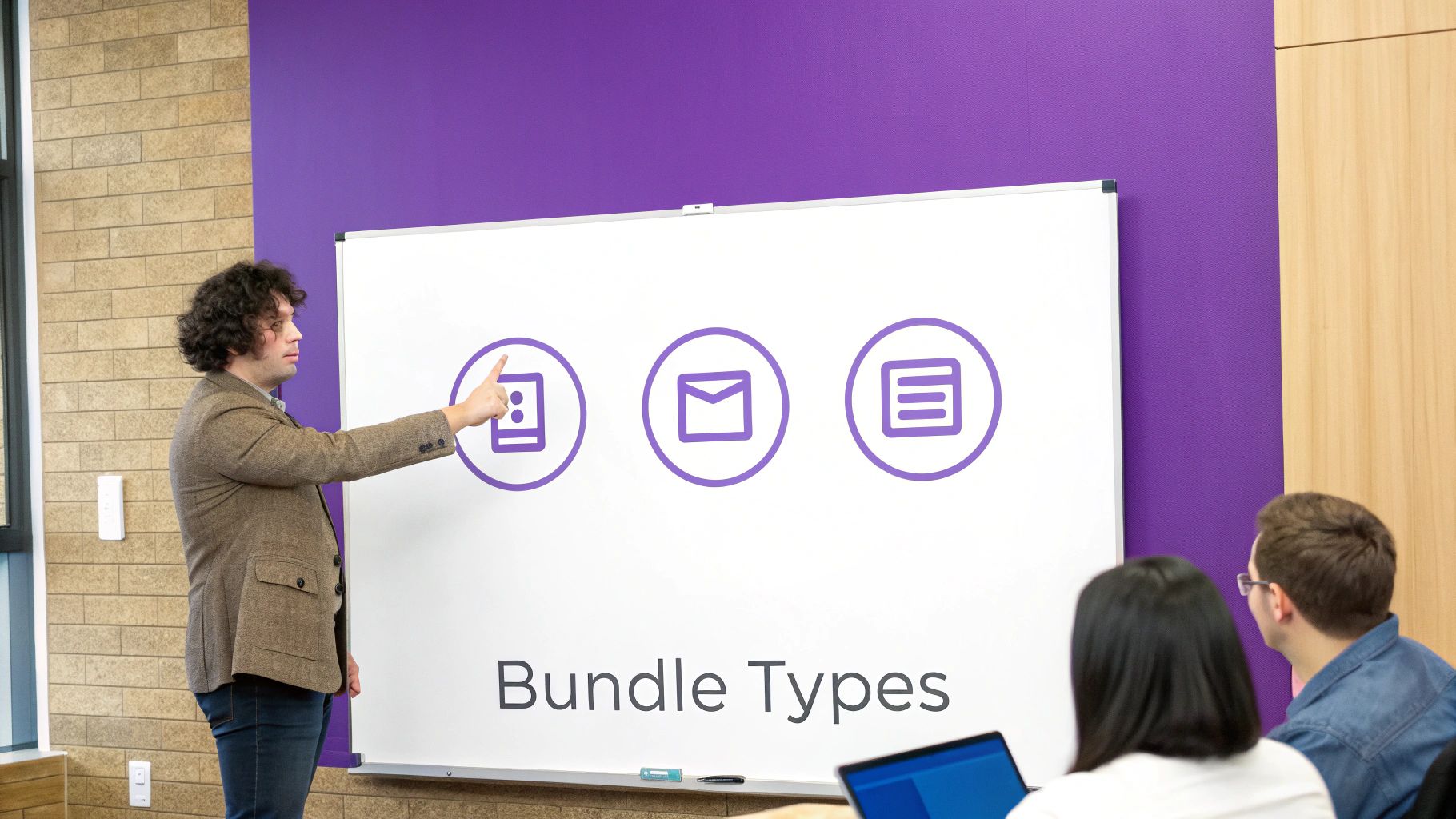
Pure Bundling
With pure bundling, the products are available only as a package. There is no option to purchase individual components separately. It is an all-or-nothing proposition designed to drive full adoption of a product ecosystem.
A common B2B use case is a software suite. A technology company might package its core application, an advanced analytics module, and a reporting tool into a single subscription. This simplifies the buying decision and can effectively lock out competitors by offering a complete, integrated solution.
Mixed Bundling
Conversely, mixed bundling provides customers with a choice: purchase the products individually or buy them together in a discounted package. This is the most prevalent approach in ecommerce because it balances upselling opportunities with customer flexibility. You can encourage a larger purchase without losing a sale from a customer who only needs a single item.
Use Case: An ecommerce manager for an electronics distributor wants to increase the AOV of a popular security camera. By monitoring competitor prices, they see rivals are deeply discounting the camera, threatening their MAP policy. Instead of a price drop, they create a mixed bundle: the camera, a memory card, and a mounting bracket for 15% less than the combined individual prices. This maintains the camera's RRP while offering a high-value alternative, protecting margins and satisfying the MAP agreement.
A key commercial decision is choosing between forcing ecosystem adoption (Pure) versus encouraging a larger cart size (Mixed). The choice depends on product interdependencies, customer buying habits, and competitive pressures.
This is not limited to physical goods. In the competitive streaming market, 26% of platforms now use bundling to reduce subscriber churn. Notably, 77% of these are partnerships with telecommunications companies, demonstrating the cross-industry value of bundling. You can explore global trends in bundling strategies for more applications.
Tiered and Volume Bundling
Tiered or volume bundling focuses on quantity rather than variety. This is a standard tactic for B2B sellers dealing with bulk purchasers. The logic is simple: the more a customer buys, the lower the per-unit price. This approach is effective for incentivizing larger orders, boosting AOV, and accelerating inventory turnover.
A Step-by-Step Bundling Pricing Example
Abstract theory is useful, but analyzing the numbers provides practical clarity. Let's walk through two B2B bundling scenarios to illustrate the calculations and margin considerations.
We will examine a mixed bundle for an industrial supplier and a pure bundle for a SaaS company. Breaking down the costs, pricing logic, and profit margins offers a clear implementation roadmap.
Example 1: Mixed Bundling for an Industrial Supplier
An industrial supplies distributor wants to create a "New Client Starter Kit" to encourage larger first-time orders. This is a mixed bundle, where each item is also available for individual sale.
First, establish the baseline data for each product.
| Item | Standalone Price | Cost of Goods Sold (COGS) | Margin ($) | Margin (%) |
|---|---|---|---|---|
| Safety Goggles (Pair) | $25.00 | $10.00 | $15.00 | 60.0% |
| Heavy-Duty Gloves (Pair) | $40.00 | $18.00 | $22.00 | 55.0% |
| Industrial Cleaner (1 Gal) | $35.00 | $15.00 | $20.00 | 57.1% |
| Total (Standalone) | $100.00 | $43.00 | $57.00 | 57.0% |
If purchased separately, the total retail price is $100. The total COGS is $43, resulting in a $57 gross margin.
Setting the Bundle Price and Calculating the New Margin
The next step is to set a bundle discount that is compelling but preserves profitability. A 10-20% discount is a standard range. We will apply a 15% discount.
The calculation is as follows:
- Bundle Discount: $100.00 x 15% = $15.00
- Final Bundle Price: $100.00 - $15.00 = $85.00
With the new price, we can calculate the bundle's gross margin:
- Bundle Gross Margin ($): $85.00 (Bundle Price) - $43.00 (Total COGS) = $42.00
- Bundle Gross Margin (%): ($42.00 / $85.00) x 100 = 49.4%
The bundle's margin percentage (49.4%) is lower than the standalone average (57%). However, the strategy is successful if it increases the Average Order Value (AOV) by selling more gloves and cleaner alongside the popular goggles. This trade-off is central to a successful bundling strategy.
Example 2: Pure Bundling for a SaaS Company
A SaaS company specializing in business intelligence tools is launching a new analytics add-on. They decide to package it with their core software in a pure bundle, meaning the components are unavailable separately.
For software, the marginal cost of delivering an additional unit is near zero, so the calculation centers on perceived value and market positioning. For a deeper analysis of this topic, our guide on how to determine product price is a valuable resource.
Here is the standalone value of each component:
- Core Software (Standalone Value): $150/month
- Analytics Add-On (Standalone Value): $75/month
- Total Standalone Value: $225/month
The company's objective is to make the bundle highly attractive. They set a price that emphasizes the savings.
- Bundle Price: $175/month
- Customer Perceived Savings: $225 - $175 = $50/month (a 22% discount)
In this scenario, the primary goal is driving user adoption of the new analytics feature. By bundling it, they ensure every new customer is exposed to the add-on, increasing engagement and platform "stickiness." The pure bundle simplifies the sales process and creates an integrated solution that is more difficult for competitors to replicate.
Strategic Advantages and Common Pitfalls
Implementing a bundling strategy can be a powerful driver of revenue, but it carries risks. A well-executed bundle can increase sales and clear inventory. A poorly executed one can erode profit margins and devalue core products.
Success requires a calculated approach. For instance, a B2B software company bundling its core platform with new, less-proven add-ons must price the offer to encourage adoption of the new features without making the core software appear overpriced when sold alone.
Strategic Benefits of a Well-Designed Bundle
When this balance is achieved, the benefits are tangible. A well-designed bundle enhances the customer experience and can provide a competitive advantage.
Key benefits include:
- Higher Average Order Value (AOV): The most direct benefit. Bundles encourage customers to purchase more in a single transaction, directly increasing AOV.
- Faster Inventory Turnover: A slow-moving product can be paired with a bestseller to accelerate its sale without resorting to steep, brand-damaging markdowns.
- Simplified Buying Decisions: A curated bundle presents a complete solution, reducing customer decision fatigue and creating a more seamless purchasing process.
This chart illustrates the financial considerations of a bundle.
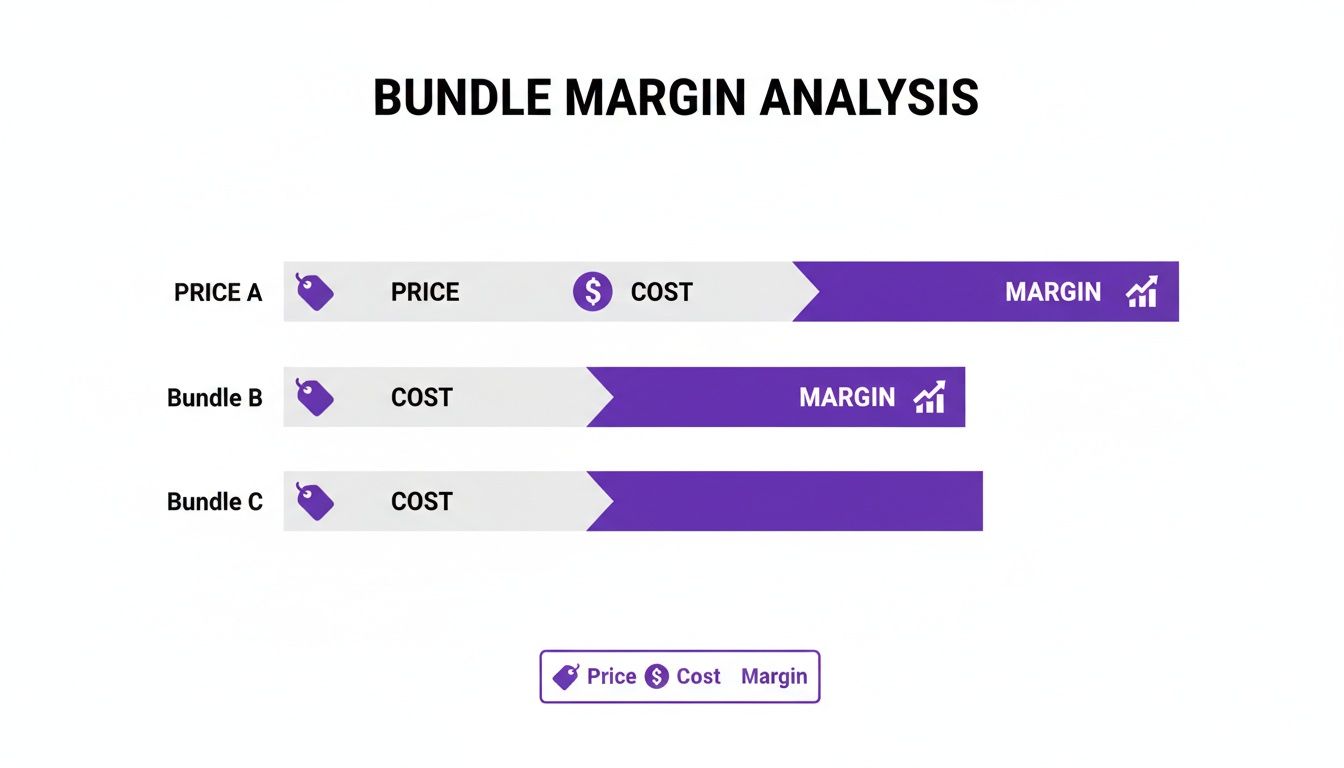
As shown, the final price is lower, but the objective is to ensure the total margin aligns with the business's strategic goals.
Potential Risks and How to Mitigate Them
Even a well-planned bundle can have unintended negative consequences. Without careful analysis, a business can encounter issues that impact profitability.
The most significant danger with bundling is margin erosion. An overly aggressive discount may increase sales volume but decrease overall profitability. This risk is amplified if the bundle cannibalizes sales of high-margin standalone products.
Determining the right discount is a major challenge. In technology and telecom, software-centric bundles might see discounts of 60-70% due to negligible marginal costs. Hardware bundles, with physical costs, typically have discounts in the 25-40% range. In B2B sales, where prices are often negotiated, a one-size-fits-all discount is rarely feasible. You can learn more about these complex B2B pricing dynamics from industry experts.
Finally, avoid over-complication. If a customer needs a calculator to determine the value of a bundle, the offer has failed. The value proposition must be immediately obvious for the bundle to be effective.
How to Build and Test Your Bundling Strategy
Developing a successful bundling strategy is a deliberate process. It begins with understanding your customer and concludes with monitoring the market to protect profitability.
This section outlines the steps required to move from concept to implementation and competitive monitoring.

Step 1: Identify Complementary Products
The most effective bundles consist of products that are naturally used together. Analyze your sales data to identify which items customers frequently purchase in the same transaction.
These "frequently bought together" patterns are the ideal foundation for creating a bundle that meets existing customer needs. For example, a customer buying an industrial printer will also require ink cartridges and specialized paper.
Step 2: Define Your Strategic Goals
Every bundle should be designed to achieve a specific business objective. Are you aiming to increase Average Order Value (AOV) by 15%? Or is the primary goal to sell through a slow-moving product?
Your goal dictates the bundle's structure and pricing. An AOV-focused goal might lead to pairing a bestseller with a high-margin accessory. An inventory-clearance goal might necessitate a deeper discount on a pure bundle. Specific, measurable targets are essential for evaluating success.
A well-defined goal transforms bundling from a simple discount tactic into a strategic lever for business growth. Without a clear objective, you risk eroding margins without achieving a meaningful commercial outcome.
Step 3: Calculate the Optimal Price Point
With products selected and goals defined, the next step is to determine a price that is attractive to customers and profitable for the business. Sum the individual prices of the items and their combined Cost of Goods Sold (COGS) to establish a baseline.
The goal is to offer a discount that makes the bundle compelling without devaluing the products or eliminating margins. This often requires testing and iteration. For a deeper analysis of pricing methodologies, our guide on using price optimization software provides valuable insights.
Step 4: Continuously Monitor Competitors
The work is not complete at launch. The market is dynamic, and it is crucial to monitor competitors' strategies. Are they bundling similar items? Are their discounts more aggressive? Is their package offering superior value?
With global e-commerce sales projected to exceed $6.3 trillion, price bundling is a key competitive tool. Effective bundles can create a one-stop-shop appeal that increases customer loyalty and scales cross-selling. To learn more, research the strategic impact of bundling on competitive dynamics.
This is where manual tracking is insufficient. Automated price monitoring provides the real-time intelligence needed to price bundles effectively, react to market changes, and protect your brand from MAP violations caused by competitors' aggressive pricing. This is where automated price monitoring tools like Market Edge become useful.
Actionable Checklist for Launching a Product Bundle
To implement your first bundle, follow this structured workflow to ensure all strategic and operational bases are covered.
Your Bundling Strategy Checklist
- [ ] Define a Specific Commercial Goal: What is the primary objective? (e.g., Increase AOV by 15%, clear 200 units of Product X, drive adoption of a new accessory). A measurable goal is non-negotiable.
- [ ] Select Products Based on Data: Analyze sales reports to identify "frequently bought together" items. Pair a high-performing "leader" product with a relevant but less popular item to maximize appeal and lift.
- [ ] Calculate Margins and Price Scenarios: Determine the COGS and standalone profit margin for each item. Model various bundle discount levels (e.g., 10%, 15%, 20%) to find the optimal balance between customer value and profitability.
- [ ] Conduct Competitor Analysis: Systematically track competitors' bundling strategies. Are they offering similar product combinations? What are their price points and perceived value? Use this data to position your bundle effectively. Automated tools for competitor tracking, such as Market Edge, can provide this data efficiently.
- [ ] Set KPIs and a Test Period: Define what success looks like before you launch. Set a specific test duration (e.g., 90 days) and identify the Key Performance Indicators (KPIs) you will track, such as bundle sales volume, AOV lift, and overall margin impact.
- [ ] Launch, Monitor, and Iterate: Deploy the bundle and continuously monitor its performance against your KPIs. Be prepared to adjust the price, swap components, or refine marketing based on real-world data and competitor actions.
Common Questions About Product Bundling
For managers new to this strategy, several questions typically arise. Addressing them upfront can prevent common mistakes and lead to a more successful implementation.
How Do I Know Which Products to Bundle Together?
Start with your sales data. Identify a "leader" product that sells consistently well. Then, find a complementary, less popular item to pair with it. For example, if your top-selling software license is your leader, a valuable but underutilized training module or premium support package would be a good candidate for the bundle. You leverage the star product's momentum to increase the visibility and sale of the other item.
What is the Right Discount for a Bundle?
There is no universal number, but successful B2B bundles often feature a discount between 10% and 30% compared to the sum of individual item prices. The key is finding the sweet spot: the discount must be significant enough to motivate a purchase but not so deep that it erodes profit margins. The final price must be viable for the business.
Where Can Bundling Go Wrong?
Without a clear strategy, bundling can lead to margin erosion and sales cannibalization. If you discount too aggressively, you sacrifice profit. Worse, customers who would have paid full price for a premium product may opt for the cheaper bundle instead, leading to higher volume but lower overall profit. This is why a thorough margin analysis before launch is absolutely critical.