
A Minimum Advertised Price (MAP) policy is a legal framework a brand establishes with its retailers that sets the lowest price they can advertise a product for. It does not dictate the final sales price. For B2B decision-makers—founders, ecommerce managers, and sales leaders—understanding this distinction is critical for protecting brand equity and maintaining healthy channel relationships.
The policy's focus is on managing the public perception of your product's value. In a competitive ecommerce landscape, a MAP policy prevents destructive price wars that erode margins and devalue your brand.

The Commercial Impact of MAP Pricing
A MAP policy is fundamentally a brand protection strategy. For founders and ecommerce managers, it directly addresses the problem of price wars that compress profit margins and damage brand perception.
When retailers compete solely on price, it creates a race to the bottom, especially on crowded online marketplaces. A single unauthorized discounter can trigger a chain reaction, forcing authorized partners to lower their prices to remain competitive. This spiral not only hurts retailer profitability but also trains consumers to devalue the product, making it difficult to ever sell at its full price again.
Why It Matters to Your Business
A well-enforced MAP policy provides stability across your entire sales ecosystem. Pricing and sales leaders should recognize its commercial benefits:
- Protects Brand Equity: Consistent advertised pricing reinforces a message of quality and value, preventing products from being treated as commodities.
- Levels the Playing Field for Retailers: MAP allows smaller, service-oriented retailers to compete based on customer experience and expertise rather than being undercut by high-volume discounters.
- Reduces Channel Conflict: When all partners adhere to the same advertising rules, it eliminates disputes between the brand and its authorized sellers.
- Stabilizes Profit Margins: By setting an advertised price floor, MAP ensures retail partners can operate profitably, giving them the confidence and financial incentive to invest in marketing your products.
It is essential to distinguish MAP from MSRP (Manufacturer's Suggested Retail Price). MAP is an enforceable policy governing the advertised price. MSRP is a non-binding suggestion for the final sale price. Understanding how to leverage these different data points is a core part of using big data in retail for strategic decision-making.
MAP vs. MSRP: A Practical Comparison
This table outlines the key operational differences between MAP and MSRP.
| Aspect | MAP (Minimum Advertised Price) | MSRP (Manufacturer's Suggested Retail Price) |
|---|---|---|
| Purpose | Sets the lowest advertised price to protect brand value and retailer margins. | A non-binding suggestion for the final selling price to the consumer. |
| Enforceability | Legally enforceable through a unilateral policy. Brands can impose sanctions for violations. | Not enforceable. It is purely a recommendation. |
| Focus | Controls the public perception of price and value before the final sale. | Guides retailers on an appropriate final transaction price. |
| Flexibility | Retailers can sell below MAP in the final transaction, but cannot advertise it publicly. | Retailers are free to sell at, above, or below the MSRP. |
| Legal Basis | Based on the brand's right to choose its business partners (Colgate Doctrine in the U.S.). | Acts as a simple price guideline without legal standing for enforcement. |
Understanding this distinction is the first step toward building a pricing strategy that is both legally compliant and commercially effective.
Navigating the Legal Landscape of MAP Policies
Implementing a MAP policy without understanding its legal context is a significant business risk. The regulations differ dramatically between major markets. A standard policy in the United States could lead to substantial fines in the European Union.
The legal divergence is clear from market data. The U.S. market's acceptance of MAP drives 60% of worldwide enforcement spending. This is unsurprising, given that 82% of Fortune 500 CPG firms had a MAP policy in place by 2023. In contrast, the European Commission generally views MAP as a form of resale price maintenance that illegally restricts competition, with potential fines reaching €10 million. You can dig deeper into these global legal frameworks to understand the full commercial implications.
The U.S. Legal Framework: The Unilateral Policy
In the United States, the legality of a MAP policy hinges on it being a unilateral policy. This means the brand independently decides on the policy's terms and announces them to its resellers. It is not a negotiated agreement. This structure is what separates a legal MAP policy from illegal price-fixing.
A unilateral policy is a one-way directive. The brand sets the advertising rules, and resellers choose to comply or face predefined consequences. The absence of a two-way negotiation is what prevents it from being classified as an illegal price-fixing agreement.
This legal foundation is based on the Colgate Doctrine, a U.S. legal precedent that affirms a manufacturer's right to choose its business partners. If a reseller violates the policy, the brand can legally cease supplying them with products.
European Union Regulations
The European Union operates under a different set of competition laws. The primary goal is to ensure maximum price competition for consumers. Any policy that could lead to higher consumer prices, including controlling the advertised price, is viewed as a form of resale price maintenance (RPM) and is generally prohibited.
Attempting to implement a U.S.-style MAP policy in the EU can result in severe penalties. This is where tools for ecommerce and marketplace monitoring become essential. A platform like Market Edge can be configured to monitor different pricing rules for different regions, ensuring compliance across international markets.
How to Construct an Enforceable MAP Policy Document
An effective MAP policy is a clear, comprehensive, and legally sound rulebook for your retail partners. Ambiguity leads to non-compliance, so the document must be precise. This is the operational blueprint for defending your brand’s value. When written correctly, it provides absolute clarity and transforms potential disputes into a predictable, manageable process.
Core Components of a MAP Policy
A reseller should be able to read the policy and understand exactly what is required and the consequences of non-compliance. A strong policy includes these essential elements:
- Official Unilateral Statement: A clear legal declaration that this is a unilateral policy, not a negotiated agreement. This phrasing is your primary defense against accusations of price-fixing.
- Covered Products List: An itemized and regularly updated list of all SKUs or product lines subject to the policy. This should be easily accessible to all retail partners.
- MAP Price List: A clear price list that corresponds directly to the covered products, leaving no room for interpretation about the minimum advertised price for any specific item.
These components establish the foundation. The policy's strength, however, comes from detailed definitions of advertising and enforcement.
Defining an "Advertisement"
A common source of conflict is the definition of an "advertisement." A vague definition invites resellers to find and exploit loopholes.
An effective policy defines any publicly accessible price as an advertisement. This includes prices on websites, marketplace listings, email newsletters, social media, and digital ads. Prices revealed only within a private shopping cart are typically excluded.
This distinction allows a reseller to offer a final discount at checkout without violating the publicly advertised price rule. Your policy should explicitly list the channels it covers:
- Online Marketplaces: Amazon, eBay, Walmart, and others.
- Retailer Websites: All product pages, category pages, and promotional banners.
- Paid Search & Social Media: Any ad displaying a price.
- Email Marketing: Newsletters and promotional campaigns sent to customer lists.
Structuring a Tiered Enforcement Process
A policy is only effective if it is enforced. A clear, step-by-step ladder of consequences for violations ensures fairness and gives resellers an opportunity to correct their behavior.
A standard three-strike structure is practical and effective:
- First Violation: A formal written warning is issued. The notice must include evidence of the violation (e.g., a timestamped screenshot) and a specific deadline for correction, typically 24-48 hours.
- Second Violation: The consequences escalate. This may involve suspending new inventory shipments or pausing co-op marketing funds for a set period, such as 30 days.
- Third Violation: The final step is the termination of the reseller partnership. Consistent application of this consequence is crucial to maintain the policy's integrity.
A structured and predictable enforcement process demonstrates that the policy is serious. This is where automated price monitoring tools like Market Edge provide significant value, systematically gathering evidence to support fair and unbiased enforcement.
Implementing a Systematic MAP Enforcement Workflow
A well-written policy is ineffective without consistent, predictable enforcement. The key is to build a scalable, step-by-step workflow that operationalizes the policy. This system depends on systematic competitor and marketplace monitoring. Manually checking reseller websites is not scalable and becomes unmanageable as your product line and partner network grow.
Before enforcement begins, the policy document must be clear. This flowchart outlines the essential building blocks.
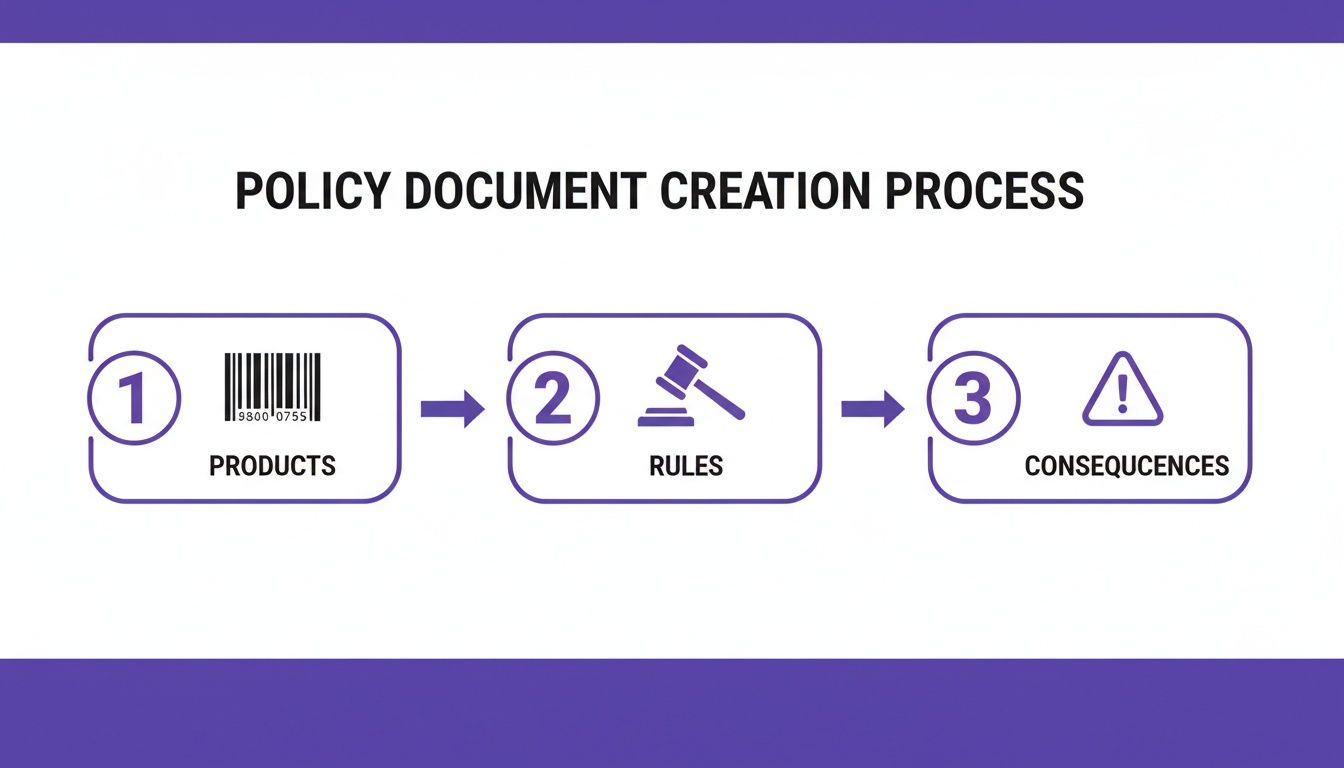
The process is straightforward: define which products are covered, set the advertising rules, and specify the consequences for violations. With a solid policy in place, you can proceed to enforcement.
A Step-by-Step Enforcement Checklist
An effective enforcement workflow prioritizes structured communication to correct behavior rather than immediately terminating partnerships. A graded enforcement ladder provides a fair and predictable process.
Here is a four-step checklist for MAP policy enforcement:
- [ ] Monitor and Document: The workflow begins when a violation is detected. Capture undeniable proof—a timestamped screenshot of the advertised price, the URL, and the date. This documentation is essential for fair and legally defensible enforcement.
- [ ] Issue First Violation Notice: Send an immediate, automated written warning. The email should include the evidence, reference the specific clause violated in your policy, and provide a clear remediation deadline (e.g., 24 to 48 hours).
- [ ] Apply Second Violation Sanction: If the violation persists or reoccurs, escalate the consequences. This could be a temporary suspension of new shipments or a hold on marketing funds for a defined period, such as 30 days.
- [ ] Terminate Partnership for Third Violation: For repeat offenders, the final step is partnership termination. This action is critical for demonstrating to all other partners that the MAP policy is taken seriously.
The Role of Automation in Enforcement
In the U.S., where unilateral MAP policies are legally supported, their commercial impact is significant. Data shows that brands with effective MAP enforcement see a 35% lift in average order value due to consistent pricing that reinforces a premium brand image. Furthermore, an automated workflow can resolve up to 85% of violations without requiring partner termination, helping to build a more compliant and healthier reseller network.
Manual tracking of thousands of SKUs across hundreds of websites is unsustainable. An automated price monitoring platform is the engine of an effective enforcement workflow. You can learn more in our guide on MAP policy monitoring software. These systems operate continuously to track prices, collect evidence, and initiate first-level warnings, which is precisely the function of a solution like Market Edge.
The Bottom-Line Benefits of Consistent Enforcement
Beyond policy and procedure, consistent MAP enforcement delivers tangible business results. It is a strategic tool for enhancing brand reputation, stabilizing profit margins, and preventing the price erosion that can undermine a product's market position. Consistent enforcement builds a healthier, more predictable sales channel and gives retail partners the confidence to invest in marketing your products, knowing their efforts will not be undercut by an unauthorized online discounter.

Preventing Margin Compression and Brand Devaluation
The business case for MAP enforcement is supported by data. One analysis of 10,000 products found that within one month of a new policy, 22% of Amazon listings and 31% of eBay ads were in violation. For premium brands, controlling these violations recouped an average of $2.3 million in protected annual revenue.
Unchecked discounting also damages brand perception. Studies show that rampant discounting can reduce a brand's perceived value by 14%, as 67% of shoppers associate heavy discounts with lower quality. This directly impacts profitability by resetting consumer price expectations and compressing margins across all sales channels.
Real-World Example: MAP Enforcement in Action
Consider a high-end consumer electronics brand that relies on knowledgeable retailers for product demonstrations.
- Scenario Without MAP Enforcement: A large online discounter advertises the brand’s flagship product at 30% below MSRP. Brick-and-mortar partners cannot compete. They lose the incentive to train staff or create in-store demos, as customers use them for research before buying from the online discounter. The brand’s perceived value declines, and its relationships with key retail partners deteriorate.
- Scenario With MAP Enforcement: All partners must advertise at or above the MAP price. The discounter can still offer a lower price in the shopping cart, but their public advertising cannot trigger a price war. This levels the playing field. Specialty retailers can now compete by providing superior service and expertise, protecting their margins and delivering a customer experience that reinforces the brand's premium positioning.
The commercial benefit is clear: a stable and fair environment for all sellers. This protects margins, enhances brand value, and builds stronger, more profitable partnerships. This is why strategic retail price monitoring is not an expense but a critical investment in the long-term health of your brand.
Frequently Asked Questions About MAP Policies
Implementing a MAP strategy often raises questions for sales, legal, and ecommerce teams. Here are answers to common queries.
Is a MAP policy the same as price fixing?
No. This is a critical legal distinction. Price fixing is an illegal agreement between competitors to set a final sale price. A MAP policy is a unilateral decision made by a single brand that sets the minimum advertised price, not the final selling price. Retailers remain free to sell the product for any price in the final transaction; they simply cannot advertise it publicly below the MAP. This unilateral nature is what keeps it legal in the U.S.
How should a growing brand begin implementing a MAP policy?
For a growing brand, the first step is to draft a clear policy document. This document should specify which products are covered, their exact MAP prices, and the consequences for violations. Distribute this policy to all authorized resellers.
The next step is monitoring. Manual spot-checking is a starting point but is not scalable.
To enforce a policy effectively over the long term, you need an automated tool. A dedicated platform can monitor thousands of SKUs across hundreds of websites—a task that is impractical to manage manually without significant resource allocation.
Does MAP apply to the price in an online shopping cart?
Typically, no. Most MAP policies define "advertising" as any price publicly visible to a consumer without requiring an action like adding an item to a cart. The price displayed after a shopper adds an item to their cart is generally considered part of the final transaction, not public advertising. This is why ecommerce sites often use phrases like "See price in cart." It allows them to offer a lower final price to an interested buyer without violating the brand's MAP policy.
A strong MAP enforcement strategy depends on consistent, accurate monitoring. This is where automated price monitoring tools like Market Edge become useful, handling the systematic data collection and violation detection required to protect your brand effectively.