
If your strategy for tracking competitor prices relies on occasional, manual checks, you are operating at a significant disadvantage. To protect margins and market share, a systematic, automated process is no longer optional.
A successful pricing intelligence program begins with clear business objectives—such as enforcing MAP compliance or optimizing margins—and leverages the right tools to gather and interpret market data in real time. The goal is to convert a constant stream of raw pricing data into actionable insights that directly impact profitability.
Why Tracking Competitor Pricing is a Commercial Imperative
In a dynamic market, ignoring competitor pricing is a direct threat to your bottom line. Making strategic decisions based on outdated or incomplete data leads to reactive, costly mistakes that erode margins and market share.
The commercial risks are immediate. A single competitor launching a targeted price drop can trigger a margin-squeezing domino effect across an entire product category before you can react. A major account can be lost to a rival who was simply better informed on market rates. These are not technical issues; they are fundamental business failures.
The Financial Impact of Inaction
Failing to monitor the competitive landscape has consequences that extend beyond lost sales. It affects brand perception, partner relationships, and long-term market position.
- Margin Erosion: When competitors lower prices, a slow response often leads to reactive discounting to maintain sales velocity. This directly compresses your margins.
- Lost Sales Opportunities: If a competitor goes out of stock on a high-demand product, it creates a clear opportunity to capture their customers. Without real-time tracking, you will miss this opportunity every time.
- Damaged Brand Equity: For manufacturers, failing to enforce MAP or RRP policies is detrimental. Unauthorized discounting devalues the brand and damages relationships with authorized retail partners who adhere to the rules.
Competitive price intelligence is a core operational function for any modern ecommerce business. Your competitors are almost certainly leveraging it, which means you must do the same to maintain your position.
The market trend confirms this shift. The competitor price monitoring industry is projected to grow from USD 0.8 billion in 2023 to USD 2.1 billion by 2030. This growth underscores why a structured approach, powered by dedicated competitor price monitoring software, is now essential.
Establishing a Framework for Competitor Price Monitoring
Deploying a tool without a clear strategy leads to data overload and inaction. A successful competitor monitoring program starts with a framework built around specific business goals.
First, define your primary objective. For a manufacturer, the key focus may be MAP (Minimum Advertised Price) enforcement to protect brand value and ensure channel equity. For a retailer or reseller, the goal might be maintaining a specific price index against key rivals to drive volume. Each objective requires a different strategy and set of metrics.
Define Your Primary Commercial Goal
The "why" behind your monitoring efforts dictates every subsequent decision. For a brand owner, the most critical KPI is often the MAP violation rate—tracking how frequently resellers price below the established floor. For an ecommerce retailer, the key metric might be the price index relative to a handful of top competitors.
A common mistake is attempting to track everything, everywhere, all at once. This "boil the ocean" approach creates noise and prevents decisive action. Focus first on the competitors and products that have the greatest commercial impact.
This strategic focus is designed to mitigate the commercial threats that can quietly undermine a business.
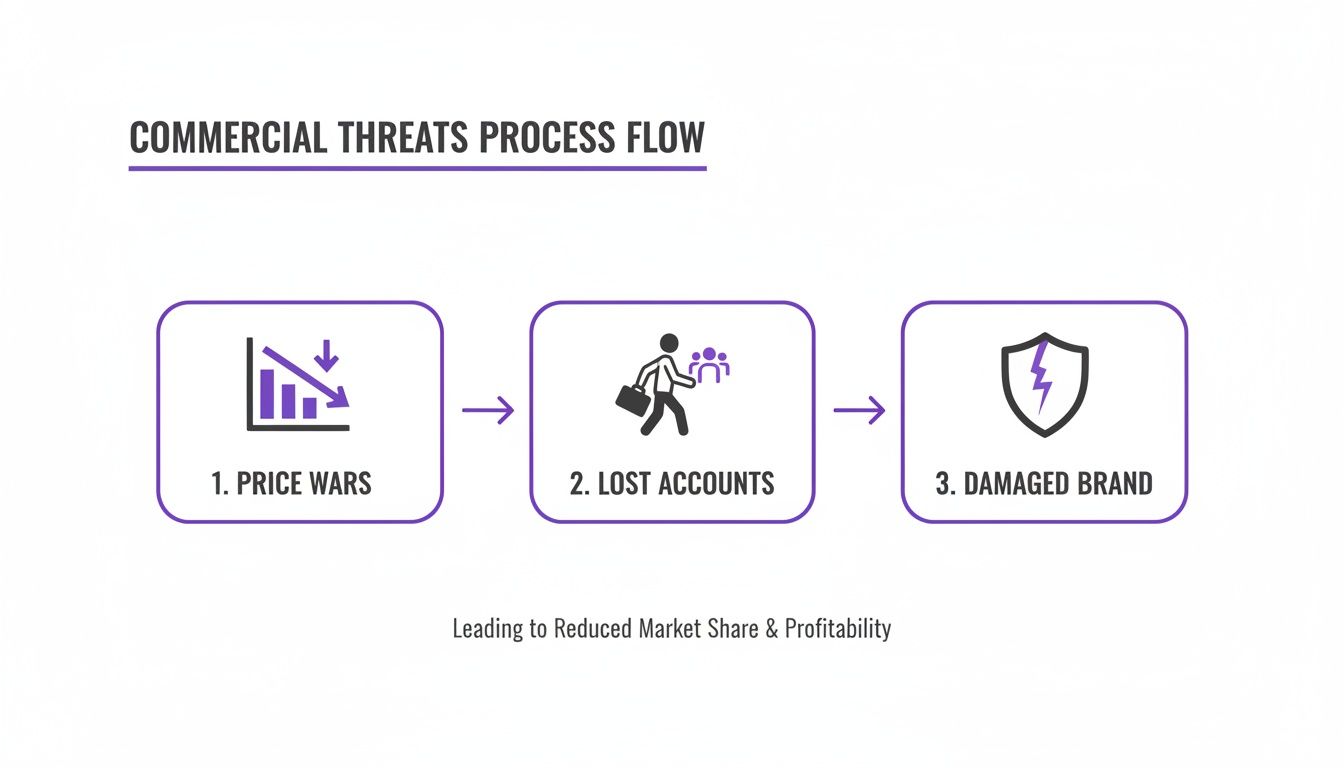
As the diagram illustrates, unchecked price wars can lead to lost accounts and a damaged brand, ultimately eroding market share. A well-defined monitoring framework is the primary defense against these outcomes.
The following KPIs are essential for any effective price monitoring dashboard.
Key Metrics for Your Price Monitoring Dashboard
| Metric (KPI) | What It Measures | Business Goal It Supports |
|---|---|---|
| Price Index | Your average price vs. the market average for identical products. | Competitive Positioning: Ensure pricing aligns with market strategy. |
| MAP Violation Rate | The percentage of resellers selling below your Minimum Advertised Price. | Brand Protection: Enforce pricing policies and maintain channel health. |
| Stock Availability | The in-stock vs. out-of-stock status of competitor products. | Sales Opportunities: Identify and capitalize on competitor stockouts. |
| Price Change Frequency | How often a competitor updates prices on key items. | Dynamic Pricing: Respond effectively to agile competitors and market shifts. |
| Share of Digital Shelf | Your product's visibility (e.g., first-page ranking) vs. competitors. | Market Penetration: Optimize visibility where customers are actively shopping. |
Selecting Data Sources and Defining Scope
With a clear objective, the next step is to choose your data sources. Monitoring a competitor's direct website provides one view, while tracking them on large marketplaces like Amazon or Walmart can reveal different pricing tactics.
A phased approach is most effective. Start with a focused scope to achieve early wins and demonstrate ROI.
- Prioritize High-Impact SKUs: Begin with best-sellers or products in highly competitive categories.
- Select Key Competitors: Focus on 3-5 direct competitors who most frequently impact your sales and pricing decisions.
- Choose Relevant Channels: Monitor the channels where your target customers make their purchasing decisions.
A wide range of software for price comparison is available. The key is selecting a platform that aligns with your specific objectives. This is where automated tools like Market Edge provide significant value, handling the data collection and structuring so your team can focus on strategy.
The Challenge of Product Matching and Data Normalization
The greatest technical challenge in tracking competitor pricing is ensuring accurate product matching. If you are not comparing identical products, the resulting data is useless for decision-making.
Attempting to match products manually is inefficient, prone to error, and does not scale.
Ecommerce data is inherently inconsistent. Product titles vary, identifiers like UPCs or EANs may be missing or incorrect, and sellers often create unique bundles. Imagine trying to track a specific industrial component across ten distributor sites, each using a slightly different product name and part number. This is where manual and basic rule-based tracking systems fail.
The Limitations of Manual and Rule-Based Matching
Manual product matching via spreadsheets is unsustainable. Simple, rule-based systems that rely on a single identifier (e.g., "match all products with UPC X") are also unreliable in real-world scenarios.
These systems break down when faced with common issues:
- Missing Identifiers: When a competitor does not list a UPC or EAN, a rule-based system cannot create a match.
- Product Variations: A listing for a "Drill Kit with Battery" is distinct from a "Drill Body Only," but a simple text search might incorrectly match them.
- Bundles and Multi-Packs: Competitors create unique product bundles or multi-packs that have no direct equivalent in your catalog.
Modern, AI-powered matching systems solve this problem. Instead of relying on rigid rules, AI uses a combination of identifiers, title analysis, image recognition, and attribute comparison to determine a match with a high degree of confidence.
Achieving True Apples-to-Apples Comparisons
Once products are matched, the next step is data normalization. Raw pricing data is often misleading without proper context. A competitor's lower shelf price may not be the best offer once shipping costs, taxes, or different units of measure are considered.
Normalization standardizes this data by converting prices to a single currency, calculating the "landed cost" (including shipping), and adjusting for different units (e.g., price per item vs. price per case). Skipping this step can lead to poor pricing decisions based on incomplete information.
For distributors managing thousands of SKUs or manufacturers enforcing MAP policies, accuracy and scale are non-negotiable. Leading automated solutions deliver product matching accuracy rates exceeding 99%, a level unattainable through manual processes. You can discover more about the advantages of automated solutions.
The Requirement for Automated Normalization
The scale of this challenge makes automation a necessity. Automated price monitoring tools handle both matching and normalization continuously, ensuring the intelligence you receive is consistently reliable.
For example, a robust platform can instantly identify that a competitor's price of €95 with free shipping is a better value than another's price of $90 plus a $15 shipping fee. This insight prevents reactive, margin-eroding price adjustments.
By solving the matching and normalization challenge, you build the foundation required for an effective pricing strategy.
Turning Competitive Data into Actionable Insights
Raw data has no intrinsic value. Its value is realized when it is converted into decisive, profitable action. An effective competitor tracking system should trigger intelligent responses across the business, integrating competitive intelligence into your core commercial strategy.
The focus should be on building automated alerts that empower your team to act, not just analyze. These alerts function as strategic tripwires. Instead of requiring team members to manually search for insights, the system delivers precise notifications that prompt a specific response.
From MAP Violation Detection to Automated Enforcement
For manufacturers and brand owners, the primary use case is often enforcing a Minimum Advertised Price (MAP) policy. Identifying a violation is the first step; the objective is to build an efficient, documented enforcement workflow.
An automated alert system can instantly flag a non-compliant reseller, capture a timestamped screenshot for evidence, and categorize the violation by severity. This creates a clear, undeniable record for enforcement.
An effective workflow would look like this:
- First Violation: An automated email is sent to the reseller with proof, requesting immediate price correction.
- Repeat Offense: The system escalates the issue, notifying a pricing or channel manager to initiate direct contact.
- Systemic Non-Compliance: The account is flagged for review, potentially leading to a temporary suspension of shipments.
This systematic process removes inconsistency and transforms MAP enforcement from a manual task into a scalable business operation.
Capitalizing on Competitor Stockouts
For distributors and retailers, real-time data creates immediate revenue opportunities. One of the most impactful triggers is an alert for a competitor stockout on a key product.
When a competitor's high-velocity product is out of stock, it is a signal to act. This is an opportunity to strategically increase your price to capture higher-margin sales or launch a targeted ad campaign to attract their customers.
This data can also reveal sourcing opportunities. An alert such as, "Notify me when the market retail price for SKU XYZ is 30% above my wholesale cost," highlights products with high margin potential that may be under-promoted.
Retailers that leverage automated price tracking and dynamic analytics see tangible results, with some achieving up to 18% revenue growth between 2020 and 2025.
Setting Up a Practical Alerting System
The foundation of an actionable system is intelligent alerting. Generic notifications create noise and are often ignored. Specific, conditional alerts drive results. The objective is to move from broad updates ("Competitor Z changed a price") to precise, rule-based triggers aligned with your business logic. For further reading, our guide on price optimization software offers additional strategies.
Here are examples of actionable alerts:
- "Notify me when Competitor X's price on SKU 123 drops below my cost plus 10% margin."
- "Alert the marketing team when more than three key competitors are out of stock on Brand Y."
- "Generate a weekly report of all MAP violations exceeding 5% below our floor price."
This is how you translate strategic goals into automated rules, transforming passive data into an active, revenue-generating asset.
Common Pitfalls and How to Scale Your Monitoring Efforts
Implementing a competitor price tracking program is a critical first step. However, several common mistakes can limit its effectiveness. Avoiding these pitfalls is key to building a system that delivers sustained value.
A primary mistake is tracking too many irrelevant competitors. This leads to "analysis paralysis," where your team is inundated with low-impact data from sellers who are not true rivals. The goal is surgical precision: monitor the players who genuinely influence your market.
Another frequent oversight is ignoring the total landed cost. Focusing only on the shelf price provides an incomplete picture. A competitor's price may appear lower, but high shipping fees or taxes can eliminate that advantage. A true apples-to-apples comparison must account for all components of the final price a customer pays.
Checklist for a Scalable Monitoring Strategy
As your business grows, your monitoring program must scale intelligently. A phased, strategic approach prevents data overload and ensures your insights remain actionable. Categorizing products by priority is a practical way to manage this.
- [ ] High-Priority SKUs: Best-sellers, flagship products, and items in highly price-sensitive categories. These require daily or even more frequent monitoring.
- [ ] Secondary SKUs: Products with steady sales volume and moderate competition. Weekly monitoring is typically sufficient.
- [ ] Long-Tail SKUs: Lower-volume items that can be monitored less frequently, such as bi-weekly or monthly, to ensure cost-effectiveness.
A mature monitoring strategy is not about tracking everything all the time. It is about allocating the right level of resources to the right products to ensure your efforts are both efficient and impactful.
Integrating Data for Maximum Impact
The ultimate goal is to connect competitive data with your other business systems, such as your ERP or BI platform. Manually transferring insights is inefficient and creates a risk of human error.
An automated flow of information enables powerful workflows. For example, integrating pricing data with your ERP allows for automatic price adjustments based on predefined rules, such as maintaining a 5% price advantage over a specific competitor. This is where automated price monitoring tools like Market Edge become useful, delivering the clean, structured data required for these integrations.
Frequently Asked Questions for Decision-Makers
Here are answers to common questions from business leaders evaluating competitor price monitoring solutions.
How often should my team track competitor prices?
The required frequency depends on your market's velocity. In fast-moving ecommerce categories where prices change multiple times per day, near real-time tracking is necessary to respond to flash sales or aggressive competitor moves.
For many B2B industries with more stable pricing structures, daily or weekly monitoring may be sufficient. A practical approach is to track high-priority, high-velocity products daily, while monitoring the rest of the catalog weekly. The goal is to align your tracking cadence with the rhythm of your industry.
What is the single biggest technical hurdle to getting started?
Product matching. This is consistently the most complex part of the process.
Automatically confirming that your "Model X-123 Power Drill" is identical to a competitor's "X123 PowerDrill Kit w/ Battery" across multiple websites is a significant technical challenge due to inconsistent titles, missing identifiers (UPCs/EANs), and unique product bundles.
Attempting to do this manually is not feasible at scale. This is why modern, AI-driven product matching is essential for obtaining clean, reliable data. Without accurate matching, your entire pricing strategy is built on a flawed foundation. This is also where dedicated platforms like Market Edge provide the most value.
How can I justify the ROI of a price tracking tool?
Justify the investment by connecting the tool's cost to tangible business outcomes. Focus on metrics that directly impact the bottom line.
- Margin Protection: Calculate the margin saved by responding immediately to a competitor's price drop versus a week later. Quantify the value of avoiding unnecessary "race to the bottom" discounting by holding firm on price when data supports it.
- MAP Enforcement: Measure the reduction in MAP violation frequency and the corresponding stabilization of your brand's price perception in the market.
- Sales Growth: Attribute revenue gains to specific, data-driven pricing actions. For instance, measure the sales lift from strategically adjusting prices to capitalize on a competitor's stockout.
When you can demonstrate that a $500/month tool protects $5,000 in monthly margin that would have otherwise been lost, the ROI becomes clear and compelling.