
A penetration pricing strategy is a calculated market entry tactic. It involves launching a new product or service at a deliberately low price, not for immediate profit, but to rapidly acquire a significant customer base and establish market share from the outset.
What Is a Penetration Pricing Strategy
Think of it as opening a new, toll-free lane on a congested highway. Traffic will immediately divert to the faster, cheaper route. For a business, this is a powerful method to disrupt an established market, build a foundational customer base, and create a significant barrier for future competitors.
This approach is a strategic trade-off. You consciously sacrifice short-term profit margins for a larger long-term prize: market dominance, economies of scale, and lasting brand recognition.
Differentiating Key Pricing Strategies
Understanding how this approach differs from other common pricing models is critical. Misinterpreting the strategy can lead to flawed execution and poor commercial outcomes.
- Penetration Pricing vs. Price Skimming: These are direct opposites. Penetration pricing starts low to capture the mass market. Price skimming starts high to maximize revenue from early adopters willing to pay a premium, then gradually lowers the price over time.
- Penetration Pricing vs. Predatory Pricing: The difference is intent. Penetration pricing is a legitimate competitive strategy to gain market share. Predatory pricing is an illegal tactic aimed at driving competitors out of business by setting prices below cost for an extended period.
To clarify the choice between the two most common market entry strategies, here's a direct comparison.
Penetration Pricing vs. Price Skimming At a Glance
| Attribute | Penetration Pricing | Price Skimming |
|---|---|---|
| Initial Price | Low | High |
| Primary Goal | Rapidly gain market share | Maximize profit from early adopters |
| Target Audience | Mass market, price-sensitive buyers | Innovators, early adopters, less price-sensitive |
| Market Conditions | High competition, price-elastic demand | Low competition, innovative product |
| Long-Term Plan | Gradually increase prices over time | Gradually decrease prices over time |
| Profit Margin | Low initially, increases later | High initially, decreases later |
The correct path depends on your product, market dynamics, and long-term business objectives.
The core idea behind penetration is to make the initial trial of your product an easy "yes" for a broad audience. The low price reduces the customer's perceived risk, accelerating adoption and building momentum that incumbents will find difficult to stop.
Real-World Example: Costco's Retail Dominance
Costco is a textbook example of penetration principles in action. Its warehouse model is built on an annual membership fee, which grants customers access to bulk goods sold at remarkably thin 10-14% gross margins—a stark contrast to the typical retail markup of 25-50%.
This aggressive pricing strategy helped Costco grow its membership to over 132 million loyal cardholders. By systematically undercutting rivals on high-margin products, Costco uses price as a strategic weapon to drive massive sales volume and secure market dominance. It's a clear illustration of how prioritizing market capture over per-unit profit can yield substantial long-term returns. You can read the full research about Costco's pricing model for a deeper analysis.
Ultimately, the power of this strategy comes from a simple commercial reality: acquiring a large user base quickly allows you to achieve economies of scale faster, build strong brand loyalty, and create a formidable barrier to entry for subsequent competitors.
The Strategic Payoff: The Commercial Goals of Penetration Pricing
Executing a penetration pricing strategy is a calculated business maneuver, not just a discount. It requires accepting a short-term hit to profit margins in exchange for specific, long-term commercial advantages. For founders and ecommerce managers, understanding these objectives is crucial—it's what justifies the initial financial sacrifice.
The primary goal is aggressive market share acquisition. When entering a crowded market, a disruptively low price is your most effective tool for getting noticed. It persuades customers to deviate from their established purchasing habits and try your product, pulling them away from entrenched competitors. This initial customer influx forms the foundation of your market presence.
Building a Competitive Moat
A well-executed penetration strategy does more than win customers; it builds a defensive barrier against future competitors. Once you capture a significant market segment at a low price point, you fundamentally reset customer price expectations.
Any new entrant now faces a difficult choice: match your low price and sacrifice their own profit potential, or spend heavily to justify a higher price point. You've effectively made the market less attractive for newcomers. For instance, a B2B SaaS platform that quickly onboards hundreds of businesses with a low-cost introductory tier makes it operationally difficult for those customers to switch to a new, more expensive competitor. You haven't just won customers; you've increased their switching costs.
Achieving Economies of Scale, Faster
Another significant commercial benefit is achieving economies of scale more rapidly than with a standard pricing model. The surge in sales volume generated by a low price allows you to increase production or service delivery, which in turn drives down your per-unit cost.
This high-volume operation provides several advantages:
- Supplier Leverage: Larger orders for raw materials or components give you greater negotiating power with suppliers.
- Operational Efficiency: Higher output often necessitates streamlining production and distribution processes.
- Accelerated Path to Profitability: While initial margins are thin, reaching scale can help you achieve a profitable operating level more quickly.
The high volume generated by low prices can create a permanent structural cost advantage, enhancing your competitiveness long after the introductory offer ends.
Igniting Word-of-Mouth Marketing
A compelling value proposition gets customers talking. When they feel they've discovered a high-quality product at an exceptionally low price, they become natural brand advocates. This sparks organic, word-of-mouth marketing that is often more effective than paid advertising.
By making the first purchase feel like a clear win for the customer, you empower your early adopters to become your most passionate advocates. Their genuine enthusiasm builds trust and attracts the next wave of buyers.
Amazon Prime is a classic case study. Launched in 2005 for just $79 a year, the service was an irresistible offer for frequent online shoppers. This move helped Amazon grow its Prime membership to over 200 million subscribers. Once this massive, loyal base was established, Amazon began layering in more value—streaming video, music, exclusive deals—which justified future price increases. Today, Prime members spend an average of $1,400 annually, more than double the $600 non-members spend. You can explore how Amazon's pricing evolved in this detailed analysis.
This is where automated tools become indispensable. A solution like Market Edge allows you to monitor competitor prices in real-time to ensure your penetration strategy is calibrated correctly against the market.
When to Deploy a Penetration Pricing Strategy
Penetration pricing is a high-impact, high-risk strategy. It is not a universal solution. For B2B leaders, determining the right conditions to use it—and when to avoid it—is critical. A successful deployment can secure a new market; a poorly timed one can destroy margins and brand equity.
This isn't about simply being the cheapest. It's a calculated investment in market share. A thorough analysis of the competitive landscape and your long-term goals must come first.
Green Lights: When Penetration Pricing Makes Sense
Certain market conditions are ideal for a penetration strategy. If you face one or more of these scenarios, this approach warrants serious consideration.
- Entering a Highly Competitive Market: When breaking into a mature market with established players, a low price acts as a battering ram. It compels price-sensitive customers to consider a new supplier and allows you to establish an initial foothold.
- Targeting Price-Sensitive Customers: In markets where products are largely undifferentiated (e.g., standard components, basic office supplies), price is a primary decision driver. A penetration strategy directly addresses the core motivation of these buyers.
- Needing Rapid Scale: If your business model relies on achieving high volume to be profitable (e.g., manufacturing, logistics), a low entry price can provide the necessary momentum to reach economies of scale quickly.
- Operating with a Price-Elastic Product: When a small decrease in price leads to a significant increase in demand, penetration pricing is highly effective. The resulting sales volume can more than compensate for the lower per-unit margin.
Use penetration pricing when the long-term value of acquiring a large customer base outweighs the short-term cost of reduced profits. This is particularly true if you have a high customer lifetime value (CLV).
Red Flags: When to Steer Clear
Conversely, deploying this strategy in the wrong environment can be disastrous for your brand and financial health. Avoid it if you encounter these red flags.
- Selling a Premium or Luxury Product: If your brand identity is built on prestige, quality, and exclusivity, a low price signals "cheap." This can rapidly devalue your brand and alienate your target customers.
- Facing Price-Inelastic Demand: If lowering your price does not significantly increase sales—perhaps because you serve a niche market or offer a highly unique product—a penetration strategy simply gives away margin for no strategic gain.
- Competing Against Price Warriors: If your rivals have deep pockets and a history of matching price cuts, you risk initiating a race to the bottom. This erodes profitability for the entire industry.
- Lacking Operational Capacity: A surge in demand is only beneficial if you can meet it. If your supply chain, production, or support teams cannot handle a rapid influx of orders, you will create stockouts, frustrate customers, and damage your reputation.
To see how this tactic fits within a broader framework, review our guide on competitive pricing strategy examples.
Your Go/No-Go Checklist
Before committing, use this checklist to validate your decision. Affirmative answers to most of these questions indicate you may be ready.
- Financial Runway: Can the business sustain a period of low or negative margins to achieve its market share objectives?
- Scalability: Are production, fulfillment, and customer support operations prepared for a sudden, significant increase in volume?
- Exit Strategy: Is there a clear, data-driven plan for when and how to raise prices to a sustainable level?
- Marketing Message: Can the marketing team frame the low price as a special introductory offer without devaluing the product itself?
- Competitor Monitoring: Do we have systems in place, such as automated price monitoring, to track competitor reactions in real-time and avoid being caught in a price war?
Answering these questions honestly is crucial. This is where a vendor-neutral tool for competitor tracking becomes essential, giving you the real-time data needed to plan your launch and monitor the market's response. For example, a platform like Market Edge can provide the necessary intelligence to make these informed decisions.
How to Implement Your Penetration Pricing Strategy
Launching a penetration pricing strategy is a planned operation, not an improvised tactic. It requires a clear, step-by-step process that balances aggressive market entry with long-term financial viability. For pricing and ecommerce managers, this is where theory becomes a practical, data-driven action plan.
Successful execution involves more than selecting a low number. It demands a deep understanding of your market, clear objectives, and a comprehensive plan for the entire lifecycle of the introductory price—from launch to the eventual, necessary price increase.
Step 1: Analyze the Competitive Landscape
Before setting a price, you need a precise map of the competitive environment. This foundational step involves gathering accurate, real-time data on key competitors to understand existing price structures and identify a strategic opening.
Your analysis must be granular, covering details such as:
- Competitor Pricing: What are their standard prices, promotional prices, and clearance prices for comparable products?
- Promotional Cadence: How frequently do they offer discounts, and what is the typical depth of those discounts?
- Stock Availability: Are key competitors experiencing stockouts? These gaps represent opportunities.
- MAP/RRP Enforcement: Understanding manufacturer-suggested retail prices is crucial for avoiding channel conflict and maintaining partner relationships.
This analysis ensures your entry price is disruptive enough to gain attention but not so low that it immediately triggers an unsustainable price war.
The flowchart below illustrates the ideal conditions for deploying this strategy.
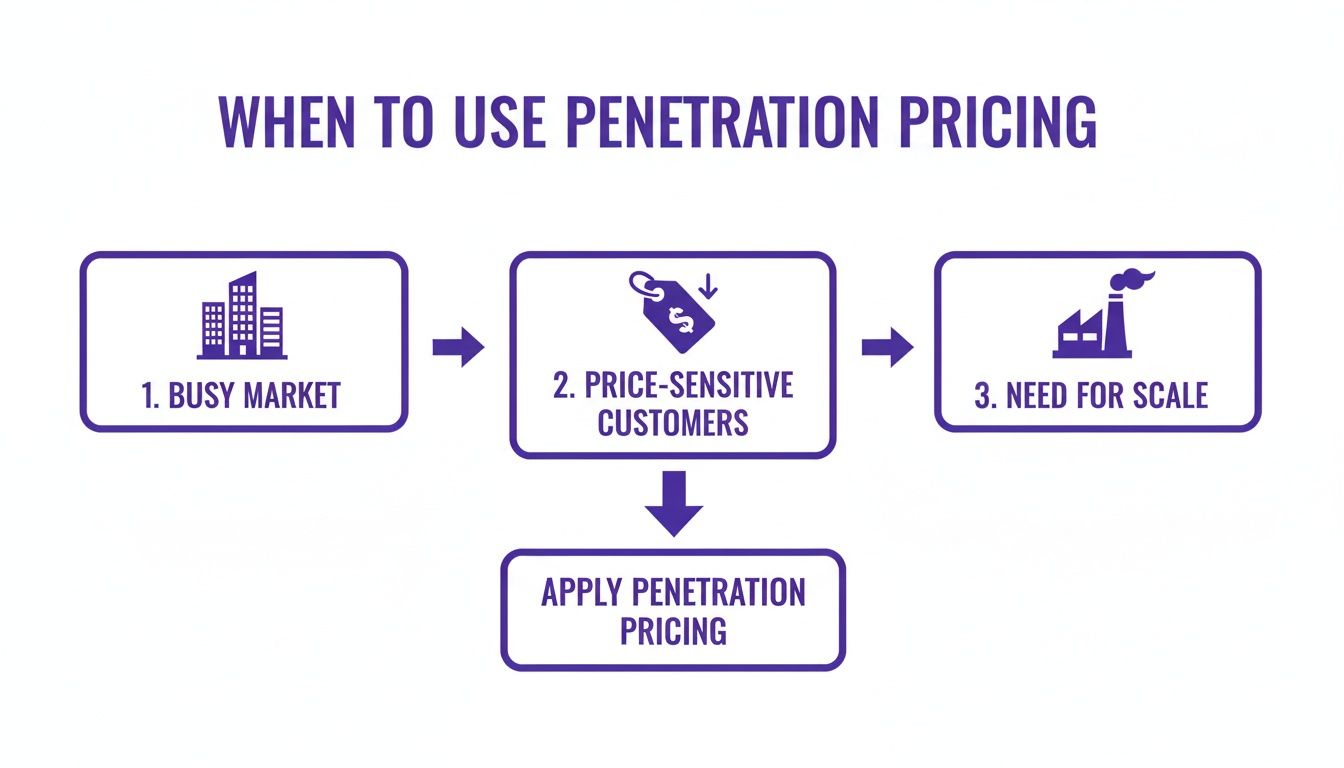
As shown, this approach is most effective in crowded markets with price-sensitive customers, especially when achieving economies of scale is critical for long-term profitability.
Step 2: Define Measurable Objectives and KPIs
A strategy without clear goals is not a strategy. Your team must define what success looks like in concrete, measurable terms. These Key Performance Indicators (KPIs) will guide your decisions and signal when the penetration phase should end.
Vague goals like "gain more customers" are insufficient. Be specific: "achieve 15% market share in the first six months" or "reduce Customer Acquisition Cost (CAC) by 30% compared to standard launch projections."
Other critical KPIs to monitor include:
- Rate of Customer Acquisition: How quickly are new customers being acquired?
- Market Share Growth: Are you measurably gaining share from specific competitors?
- Brand Mentions and Sentiment: Is the low price generating positive online discussion and brand awareness?
Tracking these metrics transforms a pricing tactic into a measurable business initiative.
Step 3: Calculate Your Minimum Viable Price
With market data and clear objectives, the next step is to determine your minimum viable price. This is the lowest price you can set that still covers your variable costs (e.g., materials, shipping) and contributes, even minimally, to fixed costs.
In highly aggressive scenarios, a company might price below total cost, treating the loss as a marketing expense. This is a high-risk move requiring a strong financial position and a precise understanding of unit economics. The key is to know your cost floor and never price blindly. This is where tools like specialized pricing optimization software become essential.
Step 4: Develop the Launch and Marketing Plan
How you communicate your price is as important as the price itself. Your marketing plan must frame the low price as a limited-time introductory offer, not the product’s permanent value. Messaging should consistently reinforce the product's quality, features, and unique selling propositions.
If your marketing focuses solely on price, you will primarily attract low-loyalty "deal chasers" who will leave as soon as prices rise. Your communication must build a bridge from the low entry price to the product's true, long-term value.
Step 5: Establish Triggers for the Price Transition
The most common failure point for a penetration strategy is the lack of a clear exit plan. From day one, you must define the specific triggers that will signal the end of the introductory period and the beginning of a price increase.
These triggers should be tied directly to the KPIs established in Step 2. Examples include:
- Market Share Trigger: "We will begin raising prices once we achieve 15% market share."
- Time-Based Trigger: "The introductory price is guaranteed for the first 90 days post-launch."
- Competitor-Action Trigger: "If our top three competitors permanently lower their prices to match ours, we will re-evaluate our strategy."
Data-driven triggers remove emotion and guesswork from the decision, enabling a strategic, controlled shift to a more profitable pricing model. This is where automated price monitoring tools like Market Edge prove their value, providing the continuous data feed needed to identify these triggers as they occur.
To help structure this process, refer to the following checklist.
Implementation Checklist for Penetration Pricing
| Phase | Action Item | Key Consideration |
|---|---|---|
| 1. Research & Analysis | Conduct a deep-dive competitive analysis. | Go beyond price. Analyze promotions, stock levels, and MAP policies. |
| 1. Research & Analysis | Define your target customer segment. | Ensure the segment is price-sensitive but also values long-term quality. |
| 2. Strategy & Planning | Set specific, measurable KPIs. | Link KPIs directly to business goals (e.g., market share, CAC). |
| 2. Strategy & Planning | Calculate your minimum viable price. | Understand your absolute cost floor to avoid unsustainable losses. |
| 2. Strategy & Planning | Define your price transition triggers. | Make them data-driven (e.g., time, market share, competitor action). |
| 3. Execution & Launch | Develop a value-focused marketing campaign. | Communicate the price as an introductory offer, not the permanent value. |
| 3. Execution & Launch | Prepare your customer service team. | Equip them to handle questions about the offer and future pricing. |
| 4. Monitoring & Transition | Continuously monitor KPIs and competitor actions. | Use automated tools for real-time insights to spot triggers as they happen. |
| 4. Monitoring & Transition | Communicate the price increase transparently. | Explain the value customers have received and will continue to receive. |
| 4. Monitoring & Transition | Analyze customer retention post-increase. | Measure churn and gather feedback to refine future strategies. |
This checklist provides a roadmap, but market conditions change. The ability to adapt your plan based on real-time data is what separates a successful strategy from a failed one.
Measuring Success and Navigating the Risks
Launching a penetration pricing strategy is just the first step. The real work lies in tracking performance and mitigating the significant risks associated with this aggressive approach.
Success is not measured by initial sales volume alone. It's about building a sustainable business with loyal customers. You need a robust plan for measuring performance and managing potential downsides. The goal is to acquire the right customers who will remain valuable long after the introductory price is gone.
Key Performance Indicators Beyond Sales Volume
To accurately assess the strategy's effectiveness, you must look beyond top-line metrics like revenue or units sold. Relying solely on these figures provides an incomplete and potentially misleading view.
The core metrics that provide true insight are:
-
Customer Acquisition Cost (CAC): How much are you spending in sales and marketing to acquire each new customer? A successful penetration strategy should significantly lower your CAC during the launch phase.
-
Market Share Growth: Are you measurably gaining ground against competitors? This must be tracked consistently to confirm that your low price is translating into a larger market position.
-
Customer Lifetime Value (CLV): This is the most critical long-term metric. CLV measures the total net profit you expect to earn from a customer over their entire relationship with your company. The fundamental premise of penetration pricing is that the CLV of newly acquired customers will eventually justify the initial margin sacrifice.
Monitoring these KPIs is the only way to determine if you are building a loyal customer base or simply renting an audience that will churn at the first price increase.
Inherent Risks and How to Mitigate Them
Penetration pricing is a high-stakes strategy. The potential rewards are substantial, but the risks can severely damage your brand and profitability if not managed carefully.
Risk 1: Attracting Low-Loyalty Deal Chasers
The most common pitfall is acquiring customers who are motivated solely by the low price. These bargain hunters have no brand loyalty and will churn as soon as prices rise, leaving you with a temporary sales spike but no sustainable growth.
- Mitigation: Your marketing message must focus on product value, not just the low price. Position the discount as a limited-time opportunity to experience a superior product. Emphasize unique features, quality, and customer support to build a relationship that transcends price.
Risk 2: Damaging Long-Term Brand Value
Maintaining a low price for too long can permanently position your brand as a "budget" option. Once this perception is established, it becomes extremely difficult to justify price increases, undermining your brand equity.
The price you set today teaches customers what your product is worth tomorrow. If you teach them it's worth very little, it's a hard lesson to un-teach.
- Mitigation: Define a clear and transparent "price path" from the outset. Communicate that the launch price is an introductory offer. Set a firm timeline or a public goal (e.g., reaching a certain number of users) that will trigger the transition to standard pricing. This makes the eventual increase feel planned and fair.
Risk 3: Igniting a Destructive Price War
A disruptively low price will be noticed by established competitors. If they have the financial resources, they may match your price, initiating a race to the bottom that destroys profit margins across the industry.
- Mitigation: This is where continuous competitor monitoring is non-negotiable. You must know immediately when a competitor adjusts their price. Your response should be strategic, not reactive. A competitor price monitoring tool provides real-time alerts when a competitor makes a move, allowing for an informed response.
This is why automated competitor tracking tools are so critical. For instance, a solution like Market Edge can provide near real-time notifications on competitor price changes. This intelligence empowers you to make a strategic decision—whether to hold your price, adjust your strategy, or shift focus to non-price value propositions—without being drawn into a profit-destroying war.
The Critical Role of Price Monitoring Technology
Executing a penetration pricing strategy effectively is impossible with manual tools like spreadsheets. It is not a "set it and forget it" tactic; it is a live, data-driven campaign that requires continuous market awareness.
Success depends on making informed decisions before, during, and after the launch. Manual tracking cannot keep pace with market velocity. Automated technology is a non-negotiable requirement.
Without a constant stream of market intelligence, you are operating blindly. Your entry price may not be aggressive enough to capture attention, you could miss a competitor’s reaction, or you could raise prices at the wrong moment, driving new customers away.
Automated price, promotion, and stock monitoring provides the market visibility needed to execute this complex strategy with confidence.
Technology Across the Three Phases of Penetration Pricing
A successful strategy requires accurate data across three distinct stages. While your focus shifts, the need for complete market visibility is constant.
-
Initial Research: Before launch, you must determine the optimal entry price. Automated technology can collect competitor pricing, promotional data, and stock levels, providing a 360-degree view of the market. This data helps identify the strategic sweet spot—a price low enough to be disruptive but grounded in market reality.
-
Active Execution: Once your price is live, competitors will react. Automated monitoring tools track their price changes in near real-time, ensuring you are never caught by surprise. This allows you to protect your price advantage and decide if a counter-move is necessary. For B2B brands, this includes MAP/RRP enforcement to ensure channel partners adhere to pricing policies.
-
Strategic Transition: The most challenging phase is knowing when to raise prices to a sustainable level. Monitoring tools help identify the right moment by tracking metrics like competitor price stability, market saturation, and your own sales velocity. A data-first approach enables a shift to a more profitable price without alienating the customer base you worked to build.
A penetration strategy managed with manual spreadsheets is destined to fail. The market moves too quickly. Automated, AI-powered product matching and continuous data collection are essential for making the precise, timely decisions that define success.
You can find more information about the best price monitoring software to support this strategic initiative.
Platforms like Market Edge are designed for this purpose. They deliver the near real-time intelligence required to manage the entire lifecycle of your pricing strategy. By equipping pricing managers and sales leaders with clean, structured data on competitor prices and stock, these tools help transform a high-risk penetration pricing strategy into a calculated—and successful—market entry.
Frequently Asked Questions
Here are answers to common questions B2B leaders have when considering a penetration pricing strategy.
How Long Should a Penetration Pricing Period Last?
There is no single answer. The optimal duration depends on your specific goals. The strategy needs enough time to achieve your market share targets but should not last so long that it erodes brand value or becomes financially unsustainable.
It's time to transition to standard pricing when you observe specific, predefined signals:
- You have achieved your target market penetration rate.
- The rate of new customer acquisition begins to slow significantly.
- Key competitors have ceased their attempts to match your price.
The key is to define these exit triggers before you launch, ensuring you have a data-driven plan from day one.
Can Penetration Pricing Work for B2B Services?
Yes, it is highly effective for SaaS platforms and other subscription-based services where customer lifetime value (CLV) is high. Offering a low initial subscription price or a feature-rich free trial is a powerful way to lower the barrier to adoption for businesses.
The objective is to make your service indispensable during that initial period. Once clients have integrated your solution into their workflows and recognize its value, they are far more likely to transition to standard pricing. This approach is particularly effective within a tiered pricing model that provides a clear upgrade path.
What Is the Biggest Mistake to Avoid?
The most critical mistake is failing to plan for the price increase. Many companies successfully acquire a large user base with a low price but then hesitate, uncertain of when or how to transition to a profitable model.
This indecision almost always leads to high customer churn and negative sentiment when prices are eventually raised without a clear rationale. A successful penetration pricing strategy is defined not just by the entry price, but by a continuous demonstration of value and the use of market data to execute a well-timed, transparent price transition.
Executing a dynamic strategy like this requires a constant read on the market. This is where automated price monitoring tools like Market Edge become useful.