
A pricing manager opens Monday's dashboard and finds three of the brand's top authorized resellers advertising a hero SKU below MAP. The listings appear across Amazon, a brand.com storefront, and a Shopify boutique. The policy binder says the price is noncompliant, but it doesn't say who confirms the breach, what evidence gets saved, or which consequence comes next.
That gap is where most MAP programs fail. Minimum advertised price enforcement only protects margins and channel trust when it operates as a repeatable system. The system needs clear rules, continuous price monitoring, defensible evidence, graduated escalation, market-specific legal review, and a scorecard that shows whether reseller behavior is changing.
Why MAP Enforcement Is an Operational Program, Not Just a Policy
A MAP document defines expectations. It doesn't detect a changed Amazon Buy Box, identify a hidden coupon, preserve a listing before the seller edits it, or tell your sales team whether to issue a warning or hold supply. Those jobs belong to the operating program behind the document.
The legal foundation matters. The Supreme Court's 2007 decision in Leegin Creative Leather Products v. PSKS moved vertical resale price restraints from a per se ban to a rule-of-reason analysis under federal antitrust law, creating broader room for brands to structure unilateral MAP policies while still avoiding coercive or collusive conduct. The practical situation was already uneven. FTC materials describe MAP provisions used by five major prerecorded-music distributors beginning in 1992 and 1993, later expanding to advertising funded by retailers themselves, with one violation capable of suspending cooperative advertising support for up to 90 days. (FTC case analysis)
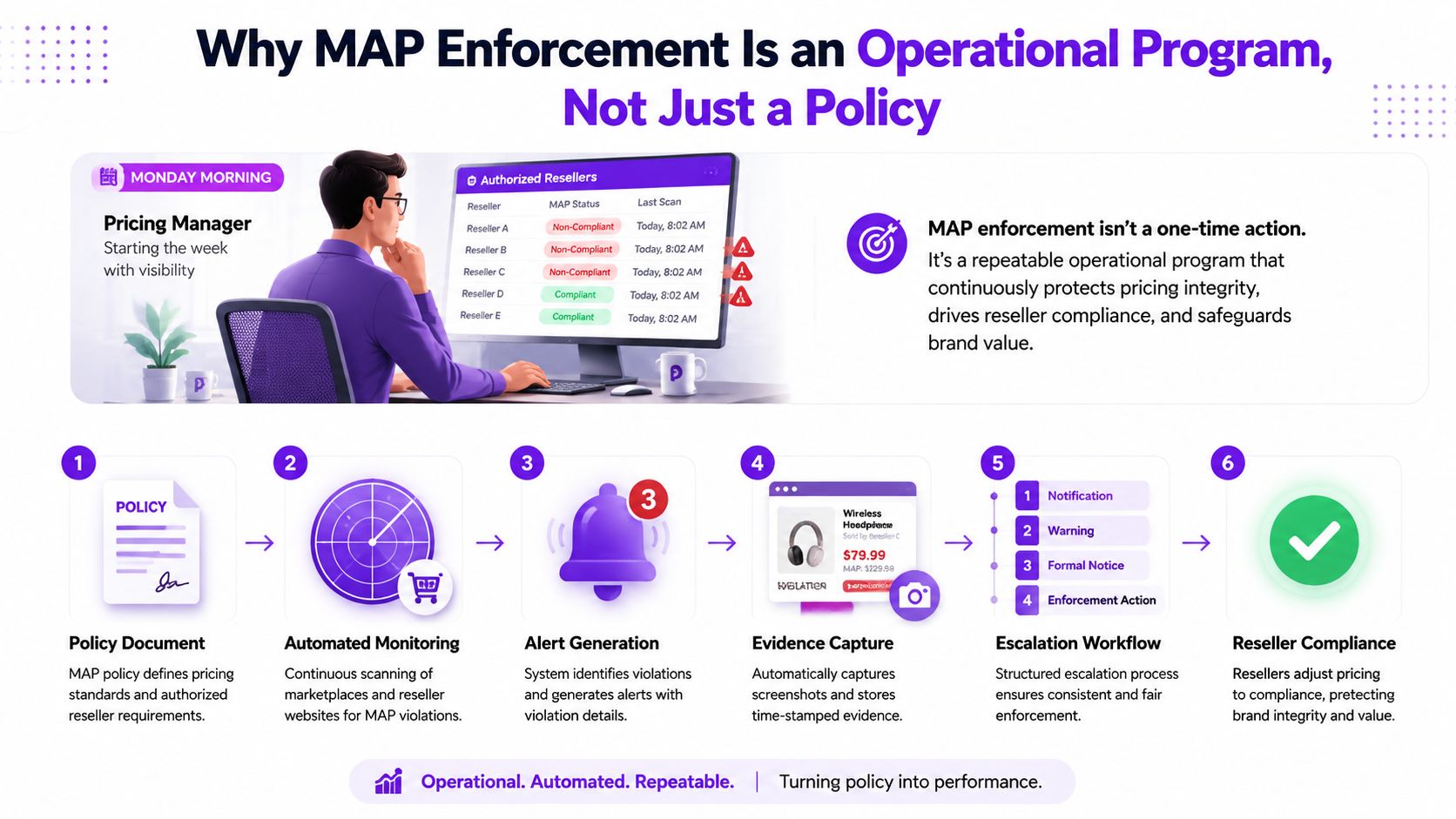
The six components of a working program
A functioning program connects six building blocks:
- Machine-readable policy: Each SKU, channel, geography, and advertising surface has an explicit rule.
- Automated monitoring: Crawlers and marketplace signals find violations across retailer sites and marketplaces.
- Evidence chain: Every alert preserves the observed price, MAP value, seller, URL, and capture time.
- Tiered escalation: A first notice doesn't get the same treatment as repeated noncompliance.
- Legal guardrails: Counsel reviews unilateral enforcement, fee treatment, promotions, and local competition rules.
- Metrics loop: The team measures detection, correction, recurrence, and enforcement consistency.
The business reason is straightforward. A compliant reseller can lose a sale when an unauthorized seller or weakly managed account advertises below the floor. Other sellers then match the visible price, and the brand's channel economics deteriorate. An FTC-hosted study found that 53% of unauthorized retailers violated MAP policies, compared with 15% of authorized retailers, making noncompliance more than three times as common outside the approved dealer network. (FTC-hosted paper)
Start this week with an audit. Check your highest-value SKUs across Amazon, Google Shopping, authorized storefronts, comparison engines, and known unauthorized sellers. Record every suspected breach before contacting anyone. Your first objective isn't punishment. It's finding the weakest link that other resellers are likely to copy.
Writing a MAP Policy That Survives Contact With Real Listings
A reseller disputes a violation because the product page shows the MAP price, while a coupon badge or cart offer lowers what shoppers see. If your policy cannot resolve that conflict from the listing record, enforcement becomes a negotiation. Write rules that a monitoring system can test and a reviewer can defend.
Start with a canonical SKU table. For every covered product, record the MAP value, product family, effective date, approved exceptions, geography, and channels. Identify marketplace seller names where relevant, authorized storefront domains, and regional variations. Keep the schedule versioned so the team can prove which rule applied when a listing was captured.
Define the price surface
Name every public surface that counts as advertising:
- Product-page list prices
- Strike-through and sale prices
- Marketplace Buy Box displays
- Cart-displayed prices
- Bundle subtotals
- Pre-applied coupon badges
- Shopping ads and comparison-engine prices
- Email, social, and promotional landing pages
You may exclude a final checkout price or a post-cart discount, but state that boundary plainly. Counsel should review it because consumer-protection rules and marketplace presentation vary by market. “Advertised price” cannot remain an undefined phrase.
Use a clause with machine-checkable terms:
Advertised price means the publicly displayed price for the covered SKU on a product page, listing, advertisement, cart display, coupon badge, or promotional placement. The MAP value applies by SKU, channel, and territory as listed in the current MAP schedule.
Avoid language such as “resellers should maintain an approximate advertised price.” “Approximate” gives sellers room to defend two-step checkouts, email-only coupons, bundles, and rounding differences.
Set tolerance and obligations
Set a defined rounding tolerance for ordinary display noise. A practical policy can use the greater of $0.50 or 1%, so a $29.99 MAP does not create a 30-cent loophole. These are policy-design recommendations, not universal legal requirements. Counsel should approve them before publication, especially where currencies, taxes, shipping charges, or marketplace fees affect the displayed offer.
Specify how cross-border listings are evaluated. State the relevant territory, currency treatment, and whether shipping, duties, taxes, or mandatory fees enter the comparison. Without those fields, an apparently compliant foreign listing can undercut the intended floor after conversion and required charges.
Require retailer acknowledgment, internal training, MAP-compliant repricing settings, and cooperation with audits. Document the process for authorized promotions, discontinued products, bundles, and policy updates. If a retailer uses a repricer, that retailer remains responsible for the resulting public listing.
For the policy's required components, including price-definition clauses and scope tables, review what a MAP pricing policy should contain, including price-definition clauses and scope tables.
| Policy Element | Defensible Clause | Anti-Clause to Avoid |
|---|---|---|
| Advertised price | Names product pages, ads, listings, cart displays, coupons, and other defined public surfaces | “Approximate advertised price” |
| SKU scope | Identifies covered SKUs, families, territories, and effective dates | “All products from time to time” |
| Rounding | Uses a stated tolerance for display and currency rounding | Silent flexibility |
| Exceptions | Requires written authorization with products, channels, dates, and price rules | Informal promotional exceptions |
| Enforcement | Describes staged, documented actions | Immediate discretionary punishment |
| Retailer duties | Requires acknowledgment, training, compliant repricing, and audit cooperation | No operational obligations |
Designing the Monitoring and Evidence Layer
Monitoring must follow how customers see prices, not how a policy spreadsheet groups products. A listing may meet MAP on its product page while a coupon, shipping credit, rebate, or marketplace display lowers the effective advertised offer. Set rules that your monitoring system can evaluate consistently across every public surface.
Use three collection methods together. Automated crawlers cover Google Shopping, brand.com, independent storefronts, and comparison engines. They can normalize retailer-specific HTML and collect repeated observations, but gated Amazon cart pricing may remain outside their view. Marketplace-native alerts catch Amazon and Walmart events quickly, while missing Shopify stores and regional retailer sites. Manual spot audits validate edge cases and parser accuracy, but they do not scale across a broad SKU and reseller set.
For marketplace context, the Million Dollar Sellers' price monitoring guide helps teams assess seller-level changes and Buy Box complexity. Use it as an operating reference, while your own policy remains the source for price definitions and enforcement decisions.
Build an evidence record that survives a dispute
Every alert should create a case record with:
- Timestamp and timezone: Record the observation time, not only the date.
- Full URL: Preserve the exact page or listing location.
- Product identity: Store the title, SKU, and marketplace identifier when available.
- Seller identity: Capture the storefront name, seller ID, and authorized or unauthorized status.
- Observed price: Record the visible price and every component affecting the offer.
- MAP value: Store the canonical MAP value used in the comparison.
- Page evidence: Save a screenshot and an HTML snapshot or its hash.
- User agent: Record the browser or crawler identity used for capture.
The evidence chain must connect observation, comparison, and decision. A screenshot cannot show whether a coupon was pre-applied, shipping changed the effective offer, or the page later rendered differently. Preserve the raw HTML, then link the case to the policy version and MAP schedule active at capture time.
Automation becomes operationally relevant here. Automating data collection for price intelligence helps create structured records instead of sending unsearchable alerts into an inbox.
Practical rule: If a reseller can edit the listing before your team preserves the page, you do not have an enforcement record. You have a recollection.
Run the workflow in this order: detect, normalize, capture, assign, review. Normalize currency, shipping, coupons, rebates, and marketplace display logic before comparing the result with MAP. Set retailer-specific parsers because Amazon, Walmart, brand.com, and small storefronts place equivalent price fields in different locations. Record cross-border currency conversion and required charges in the case so an apparently compliant foreign listing cannot undercut the intended floor after conversion.
Building the Escalation Workflow That Changes Behavior
A reseller changes behavior when every breach follows the same documented path. Build the escalation ladder around machine-checkable triggers, preserved evidence, and proportional consequences.
Use four defined tiers
Tier 1, automated detection. Send every suspected violation to one dashboard. Record the evidence fields, applicable policy clause, severity, seller status, and assigned owner. Separate marketplace inboxes are not an enforcement system.
Tier 2, first notice. Send the initial notice within 48 hours. Include the offending URL, capture timestamp, screenshot, exact advertised price, applicable MAP value, and a 72-hour cure window. Keep the wording neutral:
We identified a potential noncompliant advertisement for SKU [SKU] at [URL]. Our record shows an advertised price of [price] against the MAP value listed in the current policy schedule. Please review and correct the listing within 72 hours, or provide information showing that an approved exception applies.
Address the public advertisement and cite the unilateral policy. Do not say the reseller “agreed to fix prices” or that the brand is “requiring a resale price.”
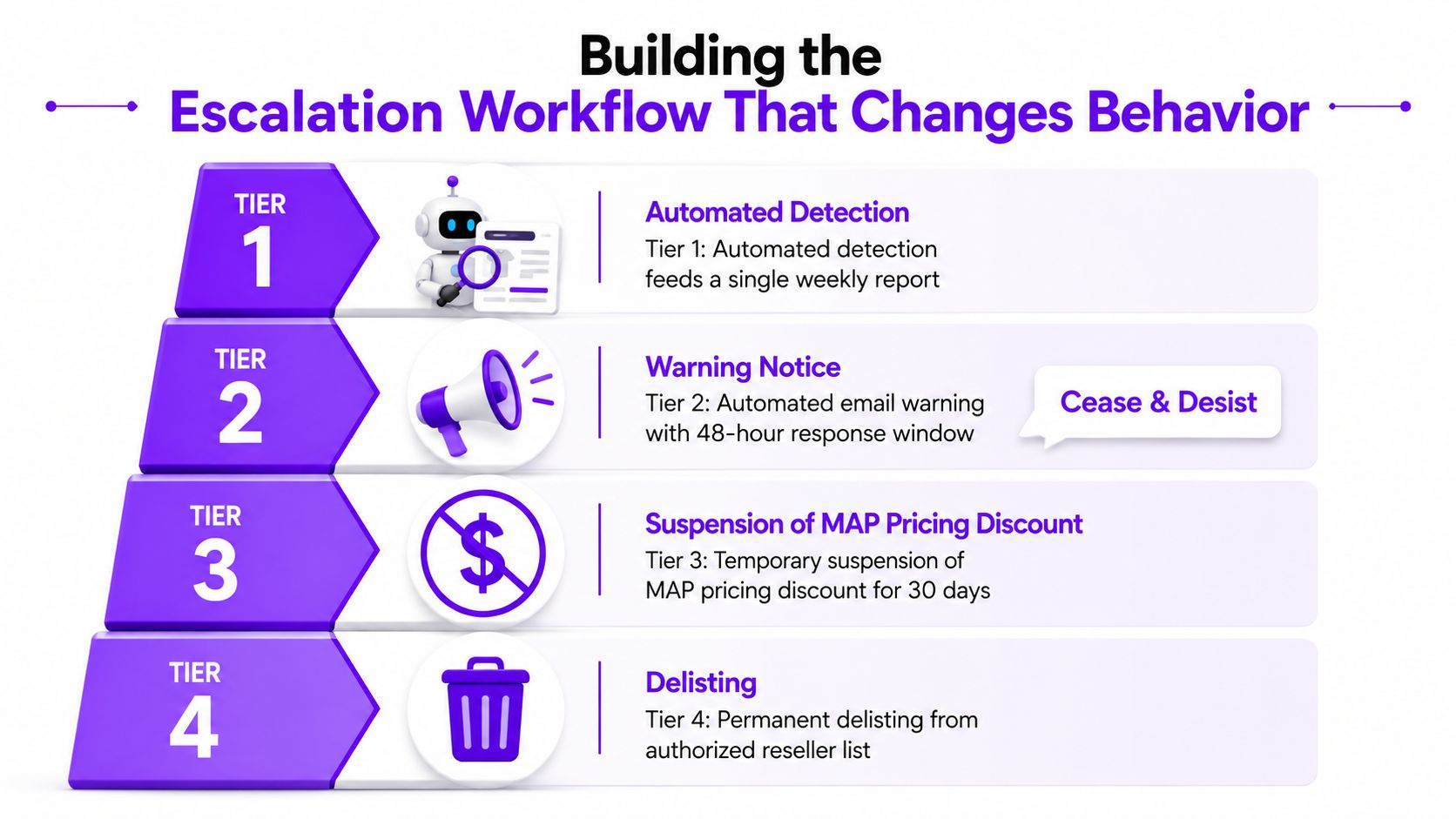
Tier 3, repeat-offender escalation. For a repeated or severe breach, issue a formal cease-and-desist through the approved legal or compliance channel. Give a 7-day correction window and notify the authorized distribution manager. Attach new evidence, the prior notice, delivery record, policy version, and correction history.
We have recorded a further potential breach of the advertised-price policy after the prior notice dated [date]. Please correct the identified advertisement within 7 days and confirm the action taken. Continued noncompliance may affect eligibility for distribution benefits under the published policy, subject to applicable law and agreement terms.
Tier 4, supply-side action. Continued violations trigger documented distribution consequences. These may include shipment holds, allocation cuts, removal of promotional support, or delisting from the authorized network. Per FTC enforcement analysis, some programs assigned the distributor responsibility for deciding whether a violation occurred, communicating the finding, and enforcing consequences.
A manufacturer policy illustrates a fixed correction process: the account is suspended, the reseller has 30 days to correct the violation, and the account closes on day 31 if the issue remains unresolved. (Field Controls MAP policy)
Keep the case file complete
Log every touchpoint:
- Detection time and source
- URL, seller ID, SKU, observed price, and MAP
- Screenshot, raw HTML, and evidence hash
- Policy version and clause
- Notice recipient, delivery status, and response
- Cure deadline and verification result
- Decision maker and approval record
- Action taken and review date
The case file should show the full chain from detection to decision. Assign authority before the first notice, and require approval for supply-side action. That structure keeps enforcement consistent across marketplaces, borders, and reseller accounts.
Legal and Compliance Traps Across Major Markets
A MAP program becomes legally exposed when enforcement shifts from policing public advertising to directing the actual resale price. In the United States, Leegin placed vertical restraints under a rule-of-reason framework, but that outcome does not make every enforcement method safe. Use a unilateral policy, apply it consistently, and preserve neutral records. Avoid threats, negotiated price commitments, and communications that coordinate retailers against one another.
Fee treatment now requires a separate control. The FTC's 2025 rule on unfair or deceptive fees requires mandatory fees to appear in advertised prices up front. A listing may therefore look compliant while shipping, handling, or service charges change the buyer's effective comparison. Define how your rule measures fee-inclusive advertising, marketplace checkout displays, and mandatory charges. Shopify's MAP pricing overview provides useful background, but your policy must state the machine-checkable treatment for each channel.
Cross-border enforcement needs market-specific review. In the European Union, Article 101 concerns arise when MAP enforcement becomes resale price maintenance or coordinated vertical pricing. Canada treats price-maintenance issues cautiously, and its 2024 amendments introduce monetary penalties for some conduct starting June 20, 2025. Australia also remains active in this area. The ACCC's 2026 action against Tekron restates that suppliers cannot prevent resellers from advertising or selling below a specified minimum price. (ACCC material discussed in the Canadian analysis)
Before expanding the program, have counsel review the exact policy, reseller communications, penalties, data collection, and distribution agreements for every market. Keep the evidence chain aligned with the rule you are applying. A fee-inclusive violation, an unauthorized seller, and an alleged resale-price restriction require different classifications and escalation paths.
Cross-border software creates another control problem. Automated repricing may combine marketplace fees, tax treatment, shipping charges, or currency conversion in ways the brand did not intend. Review the hidden costs of SaaS repricing before connecting repricing tools to enforcement decisions.
| Jurisdiction | MAP Permitted | RPM Red Flags | 2025 Watchpoint |
|---|---|---|---|
| United States | Unilateral public-advertising policies may have legal room after Leegin | Coercion, collusion, negotiated resale prices, or inconsistent pressure | Mandatory fees must be considered in advertised-price measurement under the FTC's 2025 fee rule |
| European Union | Requires careful, market-specific review | Coordinated minimum resale prices or enforcement that effectively fixes resale prices | Article 101 analysis and local consumer-price display rules |
| Canada | MAP requires cautious competition-law review | Pressure that restricts a reseller's freedom to advertise or sell below a price | Monetary penalties for some conduct begin June 20, 2025 under the amended framework |
| Australia | Unilateral programs require careful structuring | Preventing resellers from advertising or selling below a specified minimum | The 2026 Tekron action shows active enforcement attention |
For foundational terminology and the distinction between MAP and resale pricing, see minimum advertised price explained.
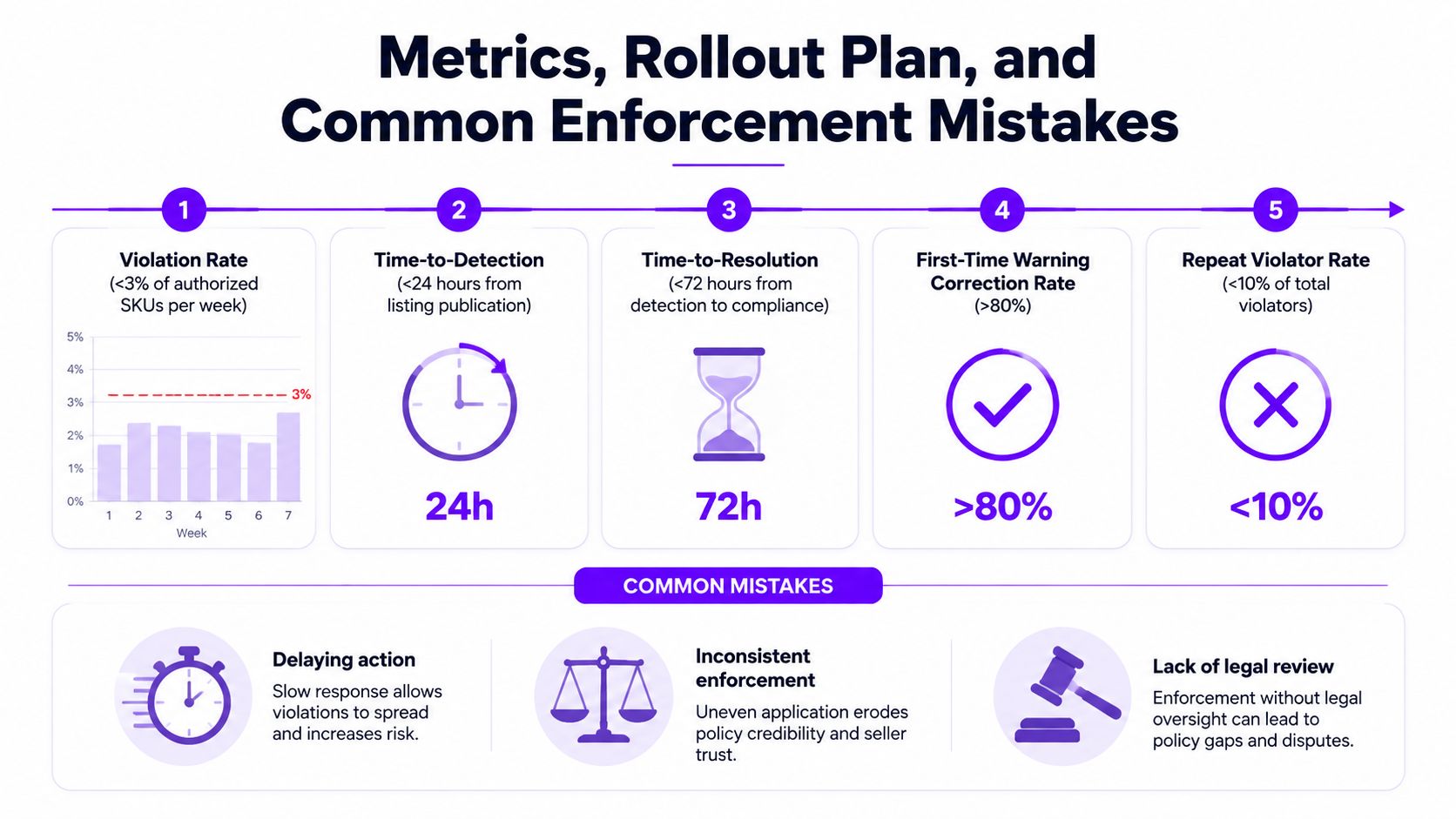
Metrics, Rollout Plan, and Common Enforcement Mistakes
A MAP program needs a scorecard that separates detection performance from reseller behavior. Assign one owner to each measure and keep definitions unchanged:
- Violation rate: Track covered SKUs below MAP each week.
- Time to detection: Measure the interval between listing publication and a verified alert.
- Repeat-offender rate: Count resellers with another confirmed breach during the review period.
- Enforcement-to-resolution time: Track the time from approved notice to correction.
- Compliant listings recovered: Measure the share restored within the stated cure window.
- Phase readiness: Before expanding coverage, confirm that false positives are reviewed, notices are approved, and the team can meet its response deadline.
These are operating targets, not legal standards. Enforcement vendors also suggest tracking SKU-retailer pairs below MAP on any day, with a target under 5% within 90 days of launching automated monitoring and detection under 24 hours. (MAP monitoring benchmarks) Select one internal definition for each metric. Changing the denominator mid-rollout makes performance comparisons unreliable.
Roll out in controlled stages
Days 1 to 30: Lock the policy, build the canonical MAP table, map authorized and unauthorized channels, establish baseline results, and run a soft launch. Review false positives before contacting resellers.
Days 31 to 60: Activate automated detection and first notices. The compliance owner should review every alert, confirm the applicable policy clause, and verify the captured page before sending a notice.
Days 61 to 90: Activate repeat-offender and supply-side actions, hold weekly reviews, and publish the scorecard to pricing, sales, ecommerce, and legal stakeholders.
Common mistakes weaken the operating loop:
- Inconsistent application: Applying consequences to small resellers while ignoring major accounts destroys credibility. Use the same decision rules.
- Vague cure windows: “Correct promptly” creates arguments. State the deadline and time zone.
- Undocumented supply threats: Do not threaten allocation cuts or delisting without an approved policy basis and complete case review.
- Marketplace blind spots: Amazon Buy Box displays, cart prices, coupons, and seller IDs require marketplace-specific monitoring logic.
- Late evidence capture: A listing can change before review. Preserve the raw page as soon as the alert fires.
- Premature expansion: Adding markets or product lines before alert quality stabilizes increases review load and delays notices.
Judge the program by corrected violations, declining repeat breaches, and authorized sellers' confidence in consistent treatment. Alert volume alone measures crawler activity, not enforcement performance.
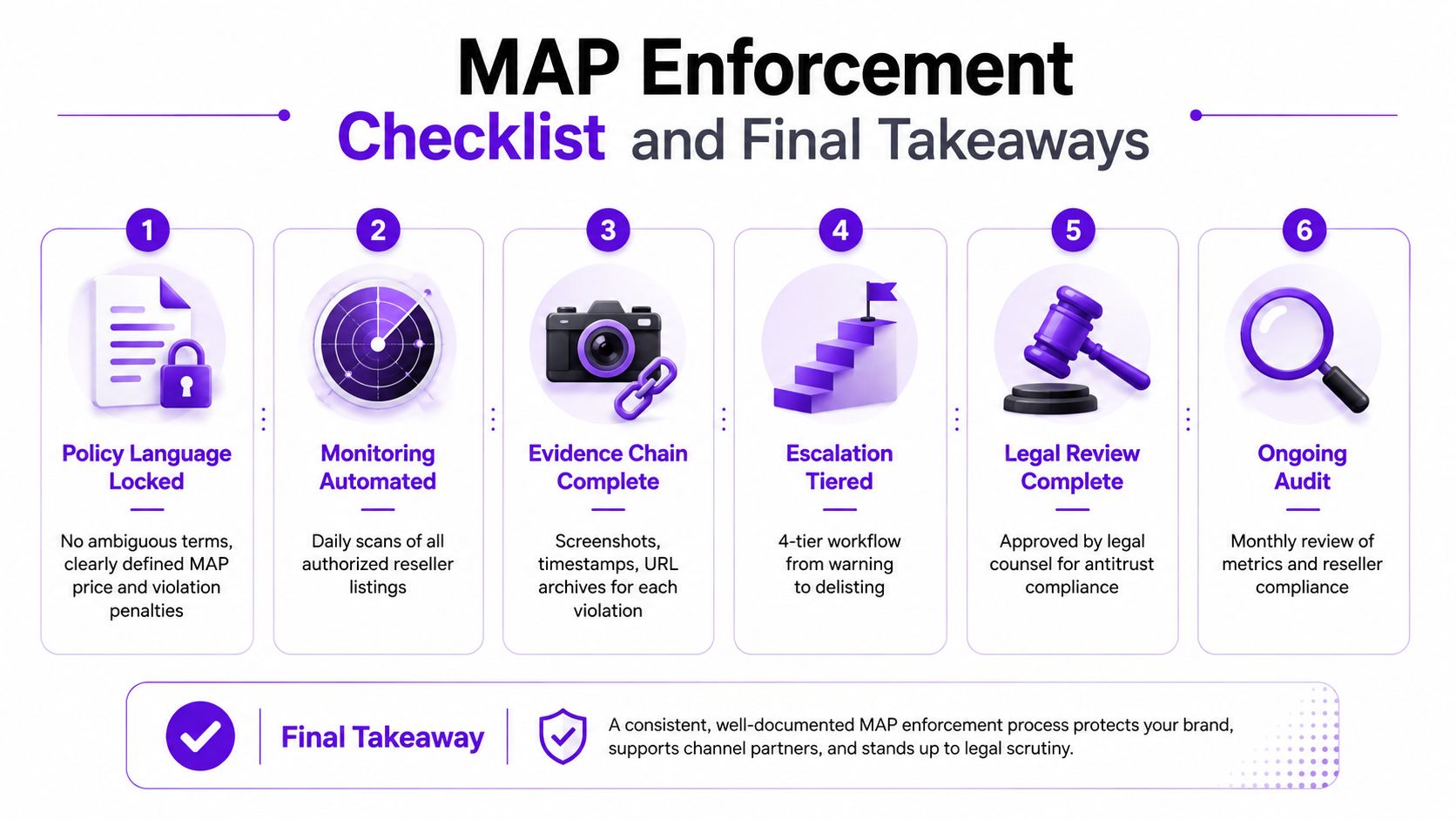
MAP Enforcement Checklist and Final Takeaways
A founder facing unauthorized sellers should make these decisions this week:
- Reseller notice ready: Prepare a neutral template naming the listing, breached rule, correction deadline, response channel, and required proof.
- False-positive procedure defined: Let sellers challenge a case with invoices, promotion details, or marketplace records. Assign an owner and close disputes with a written reason.
- Quarterly legal review scheduled: Recheck market-specific rules, fee-inclusive pricing, coupons, and cross-border advertising before expanding coverage.
- Account records reconciled: Confirm authorized seller names, territories, product versions, and distributor relationships.
- Management review assigned: Have pricing, sales, ecommerce, and legal review unresolved cases together, with one decision owner.
- Reseller feedback captured: Record recurring confusion, disputed wording, and correction barriers, then update training or policy language.
Use the same communication standard for every reseller. Keep notices private, factual, and specific. A seller should understand what appeared, what must change, when it must change, and how to contest an error. Reserve supply actions for documented repeat breaches or serious violations after the approved review.
Review the checklist each quarter and after a market, channel, or product-line change. The program is working when sellers correct listings, disputes close consistently, and authorized partners trust the process.
Market Edge can monitor competitor and reseller pricing across retail sites and marketplaces, match listings to your SKU catalog, and preserve URL, seller, timestamp, and price evidence for MAP cases. Visit Market Edge to review the monitoring workflow and start with the channels and SKUs creating problems this week.