
Monday morning starts with a familiar task. A pricing manager opens a spreadsheet, searches competitor listings, copies prices, checks stock, and tries to make sense of changes before the trading day gets away. The process may work for a narrow product range, but it becomes a liability when the business tracks thousands of SKUs across Amazon, eBay, direct-to-consumer stores, and reseller sites.
Automating data collection solves only the first part of that problem. A reliable operation also needs product matching, validation, storage, freshness controls, alerts, and ongoing maintenance. The UK Office for National Statistics demonstrated the credibility of automated collection when it began using web-scraped data for items in the CPIH basket in January 2016 as a proof of concept, moving the method from experimental research toward production use in official inflation measurement. The historical milestone is discussed in this overview of web scraping trends.
The practical model is a pipeline, not a script:
collector → matcher → cleaner → storage → alerting
That distinction matters commercially. A scraper that returns rows but misses products, misidentifies variants, or sends stale prices into a repricer can create more operational risk than a slower manual process.
Why Manual Competitor Tracking Breaks at Scale
The Monday spreadsheet routine usually begins with a manageable list. A manager checks a handful of Amazon listings, visits several eBay sellers, opens competitor storefronts, and records the visible price and availability. By midday, the sheet contains enough information to support a conversation, but not enough to support dependable market action.
Manual work fails first through coverage. An analyst may check the obvious competitors while missing a new marketplace seller, a regional storefront, a bundle variation, or a reseller that has changed its title. The business then treats an incomplete sample as the market view. That can lead to an unnecessary price reduction, a missed stock-out opportunity, or a false MAP escalation.
The second failure is freshness. A price copied in the morning may no longer reflect the Buy Box, shipping charge, seller mix, or stock status later in the day. The problem isn't just that people work slowly. Marketplaces change continuously, and manual collection creates snapshots that are difficult to compare consistently.
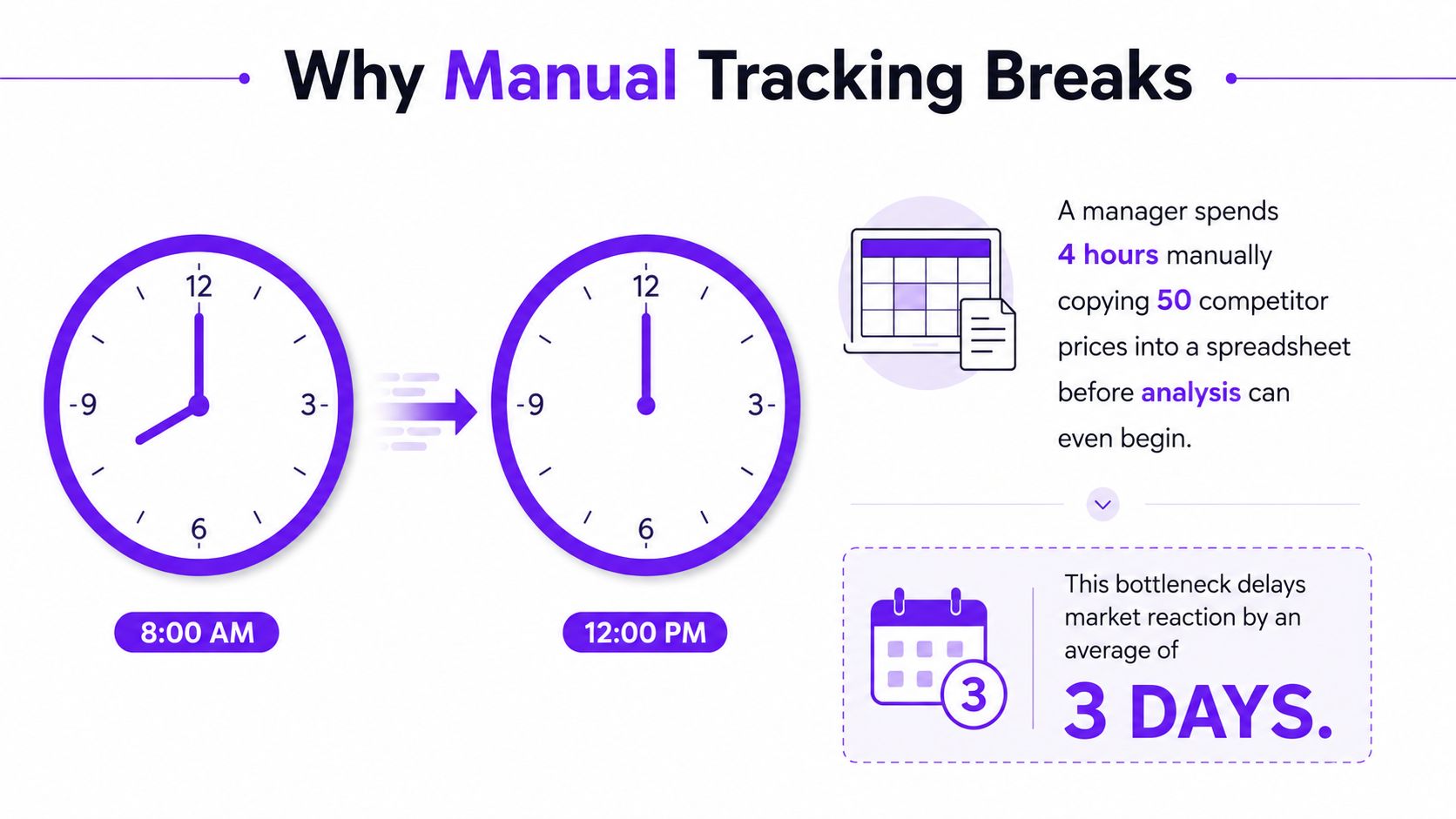
The commercial cost of incomplete records
Manual tracking also produces inconsistent fields. One person records the headline price, another includes delivery, and a third captures a promotional price without noting the qualifying condition. Product names vary across sheets, so teams spend more time reconciling records before they can compare them.
A useful competitor-intelligence workflow starts by defining the records that matter:
- Price position: Capture the visible offer, delivery context, currency, and timestamp.
- Availability: Record in-stock, out-of-stock, preorder, and unavailable states separately.
- Seller identity: Distinguish the marketplace itself from third-party sellers.
- Product identity: Match the competitor offer to the correct SKU, pack size, colour, and variant.
- Evidence: Preserve the page state or other audit evidence needed for commercial follow-up.
A business can still use manual research for discovery, exception handling, and high-value validation. It shouldn't use it as the primary collection layer for a broad catalog. Teams that want a broader framework for gathering intelligence on competitors can use that process to define which sources and signals deserve automation.
The operating model should assign a clear purpose to every stage. The collector retrieves source data, the matcher identifies the product, the cleaner standardizes it, storage preserves history, and alerting turns changes into action. If one stage has no owner, the pipeline becomes another spreadsheet with more technical vocabulary.
Practical rule: Automate repetitive observation first. Keep human judgment for ambiguous matches, policy decisions, and commercial action.
Choosing the Right Data Collection Architecture
Architecture decisions should start with the record you need, not the technology a vendor happens to promote. A marketplace API may return stable identifiers and offer data, while a crawler may expose the promotional language, shipping presentation, seller count, or page context that an API omits. Neither approach provides universal coverage.
Three workable collection paths
Headless crawling offers broad reach across long-tail reseller sites, DTC stores, and pages with no usable API. It can reproduce a customer-like browsing session and capture fields rendered by JavaScript. The trade-off is ongoing maintenance. Layout changes, consent screens, paywalls, geographic restrictions, and anti-bot systems can interrupt collection, so crawling requires monitoring rather than a one-time deployment.
Official or unofficial APIs usually provide cleaner responses and more predictable authentication. They suit structured marketplace data and reduce the burden of parsing HTML. Their limits are practical: rate limits, approval requirements, changing schemas, and incomplete commercial fields. An endpoint may expose a product price while excluding the MAP context, shipping tier, or full third-party seller picture required by a pricing team.
A hybrid model uses APIs where they provide durable, relevant coverage and managed crawling for sources that require page-level collection. In practice, this is often the sensible direction for larger catalogs because it balances stability with market breadth. The decision should be based on cost per validated record, not cost per request.
A source can respond successfully and still produce an unusable record. Measure the complete path from fetch to trusted output.
| Collection Architecture | Coverage | Reliability | Engineering Cost | Best Fit |
|---|---|---|---|---|
| Headless crawling | Broad across DTC, reseller, and long-tail sites | Sensitive to layout and access changes | Higher ongoing maintenance | Sources without useful APIs |
| Marketplace APIs | Stable for exposed fields and identifiers | Predictable within access limits | Lower parsing burden, higher integration constraints | Structured marketplace data |
| Hybrid collection | Balances structured and page-level coverage | Uses the strongest method per source | Moderate, with more orchestration | Multi-channel catalogs and complex monitoring |
A decision test that survives growth
Run a representative pilot rather than testing only easy pages. Include a major marketplace, a dynamic DTC storefront, a reseller with variant-heavy products, and a source with meaningful seller or shipping information. Measure fetch success, field completeness, product-match confidence, freshness, and the number of records needing review.
For teams comparing collection approaches, data collection techniques provides useful background on the mechanics and trade-offs. The next question is how quickly the collected records must move into operational systems. That depends on real-time data synchronization, particularly when price changes feed repricing or sales workflows.
Choose the architecture that minimizes the cost of a validated, decision-ready record, not the cost of extracting a raw page.
Core Building Blocks of the Collection Pipeline
A production pipeline begins before the first request. It starts by deciding which market objects deserve observation and how the business will judge whether collection remains trustworthy.
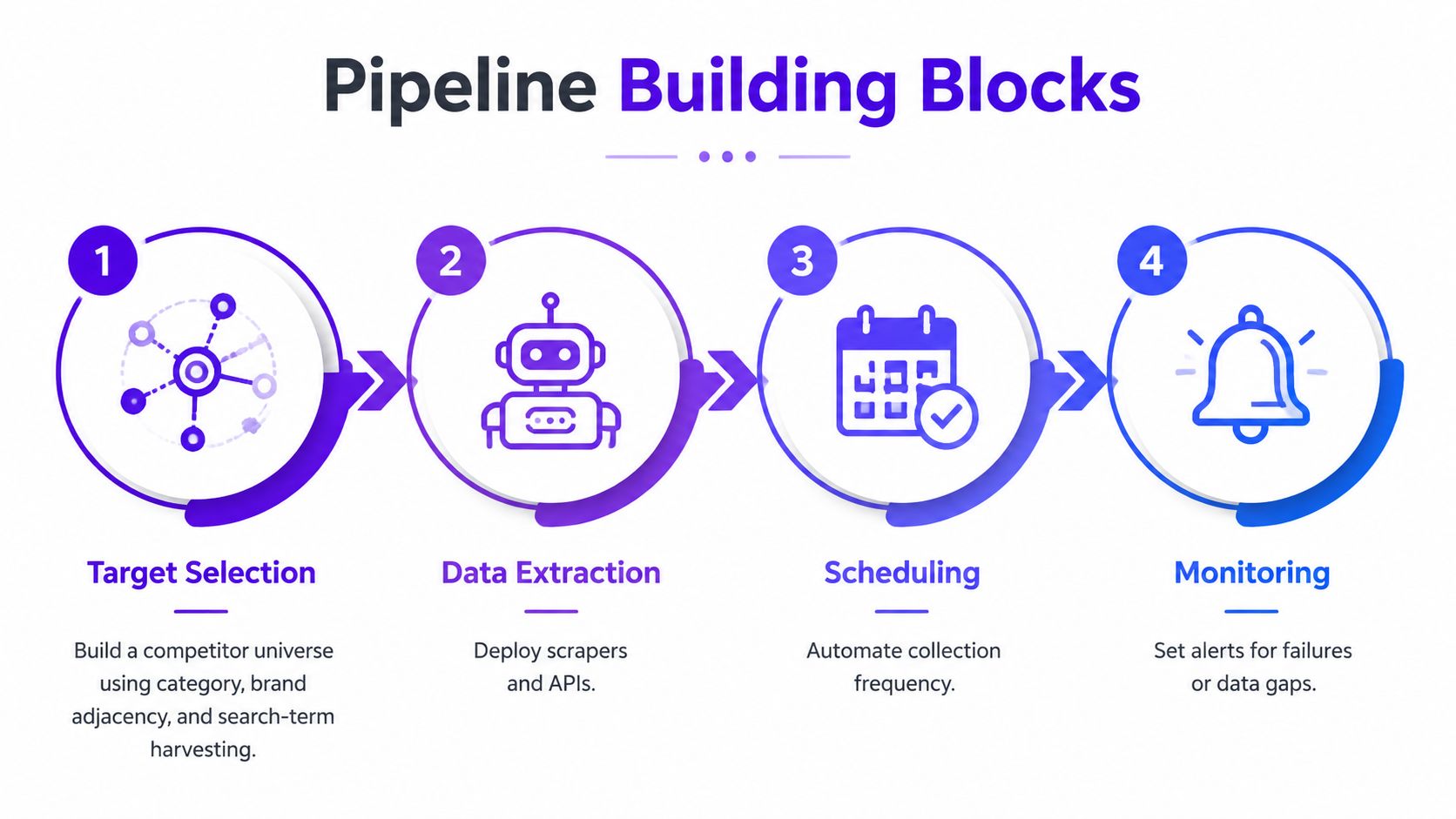
1. Define the target universe
Don't limit the competitor set to the five names sales already knows. Build it from category adjacency, brand overlap, marketplace search results, reseller relationships, and the search terms customers use. A useful target list records the source, country or region, product family, URL pattern, and business reason for tracking.
The owner might be a pricing manager, with an agreement that newly discovered sources are reviewed on a defined schedule. Without that ownership, the target universe becomes stale even if the collector runs perfectly.
2. Design collection logic
The collector needs a queue, scheduling rules, retry handling, access controls, and a clear response to failure. Polite scheduling and source-aware throttling protect both the operation and the websites being accessed. Proxy rotation may help with legitimate scale, but it isn't a substitute for authorization, rate-limit compliance, or resilient source design.
A customer-facing page and a bot-protected page may expose different content. Record the state you collected, not an assumption about what the customer must have seen.
3. Match products before comparing prices
Matching is usually harder than extraction. A deterministic match based on GTIN, MPN, manufacturer part number, or a trusted marketplace identifier should take priority. Where identifiers are absent, compare normalized title tokens, brand, pack size, model attributes, and variant values.
AI-assisted matching can help rank likely pairs, but it should learn from confirmed matches and route uncertain pairs to review. Do not let a high-confidence-looking title match merge a single unit with a multipack. The business consequence is direct: a false match can trigger an incorrect repricing decision or a bad MAP escalation.
This topic deserves its own operating discipline, which is why teams building a wider market-data workflow should also review how to collect market data.
4. Measure the coverage ceiling
No collector should claim completeness without an audit. A 2022 measurement found mean automated coverage of 56.61% for listings, 62.66% for reviews, and 74.71% for vendors, demonstrating that coverage differs by entity type and must be measured explicitly. The coverage findings and their methodological lesson are documented here.
Use periodic discovery audits to compare the pipeline with search results, known seller lists, category pages, and manually reviewed samples. Track missingness separately for products, offers, reviews, and vendors. A single overall coverage score hides the gaps that matter most.
A production-readiness checklist should include:
- Named ownership: Each pipeline block has a responsible person or team.
- Measured confidence: Matching and extraction confidence are stored with every record.
- Failure visibility: Jobs expose fetch, parse, and freshness failures.
- Audit sampling: Reviewers test both included and missing records.
- Evidence retention: The system preserves enough context to explain a commercial decision.
The pipeline is ready when it can explain not only what it collected, but also what it probably missed and why.
Teams evaluating alternatives to broad scraping tools can use a browse alternatives page as part of their vendor research, then validate each option against their own sources and review workload.
Scheduling, Freshness, and Alerting Workflows
A price snapshot can be technically successful and commercially obsolete. If a marketplace offer changed before the next collection run, the pipeline may deliver clean data that is already too old for a repricing decision. Scheduling therefore needs to reflect both source volatility and the time the business has to respond.
Set a freshness service-level agreement for each source group. Amazon Buy Box conditions may justify frequent polling when the team actively reprices. A major DTC competitor may need hourly observation, while a niche reseller can often be checked twice daily. Long-tail catalogs usually fit a weekly discovery or validation sweep, unless the category moves unusually fast.
| Source Type | Refresh Cadence | Alert Trigger | Rationale |
|---|---|---|---|
| Marketplace Buy Box and seller offers | Frequent polling aligned to category velocity | Buy Box loss, material price movement, seller or stock change | Marketplace conditions can change rapidly |
| Major DTC competitors | Hourly or business-priority schedule | Price change, promotion, availability shift | Supports active competitor tracking |
| Niche resellers | Twice-daily sweep | Undercut, stock-out, or listing change | Balances signal value with collection cost |
| Long-tail catalogs | Weekly discovery and validation | New listing, significant drift, or missing source | Reduces duplicate collection of slow-moving pages |
Use separate schedules for discovery, detail collection, and verification. A full recrawl is expensive and still cannot guarantee complete coverage when pages render dynamically, sellers rotate, or access controls intervene. A study documented in a 2017-2018 course report found that static scraping could not determine at least 33.8% of online news exposure. The study is available in this report. The operational lesson applies to ecommerce as well: freshness metrics must include collection gaps and stale records, not only successful requests.
Timezone alignment matters when sellers launch promotions or update prices on local schedules. Store timestamps in a consistent format, retain the source timezone, and avoid comparing a fresh local snapshot with an older record from another region as if they were simultaneous. Record the intended freshness target and the actual collection time so downstream users can distinguish a missed run from a slow-moving source.
Alert design determines whether data gets used
Threshold alerts work well for commercial exceptions. Route a material undercut to a pricing Slack channel, send a stock-out event to merchandising, and pass a validated price change to a repricing engine. Percentage-change rules can identify sudden movement, but pair them with absolute checks so rounding differences do not create noise.
Use event-driven alerts for action and digest reports for context:
- Immediate escalation: MAP concern, lost Buy Box, competitor stock-out, or failed high-priority source.
- Team queue: New competitor, uncertain product match, or price change needing review.
- Daily digest: Low-priority price drift, stable availability, and coverage summaries.
- Weekly audit: Sources with repeated failures, stale records, and unmatched products.
Alert ownership must be explicit. Every alert needs a recipient, severity, deduplication rule, and escalation path. Otherwise, repeated crawler failures become background noise while the commercial event that matters gets missed.
Cleaning, Normalizing, and Storing the Data
A successful request isn't a successful data record. Raw HTML and API responses often contain presentation markup, duplicated offers, inconsistent currencies, tax differences, bundle language, and variant values that can't be compared safely.
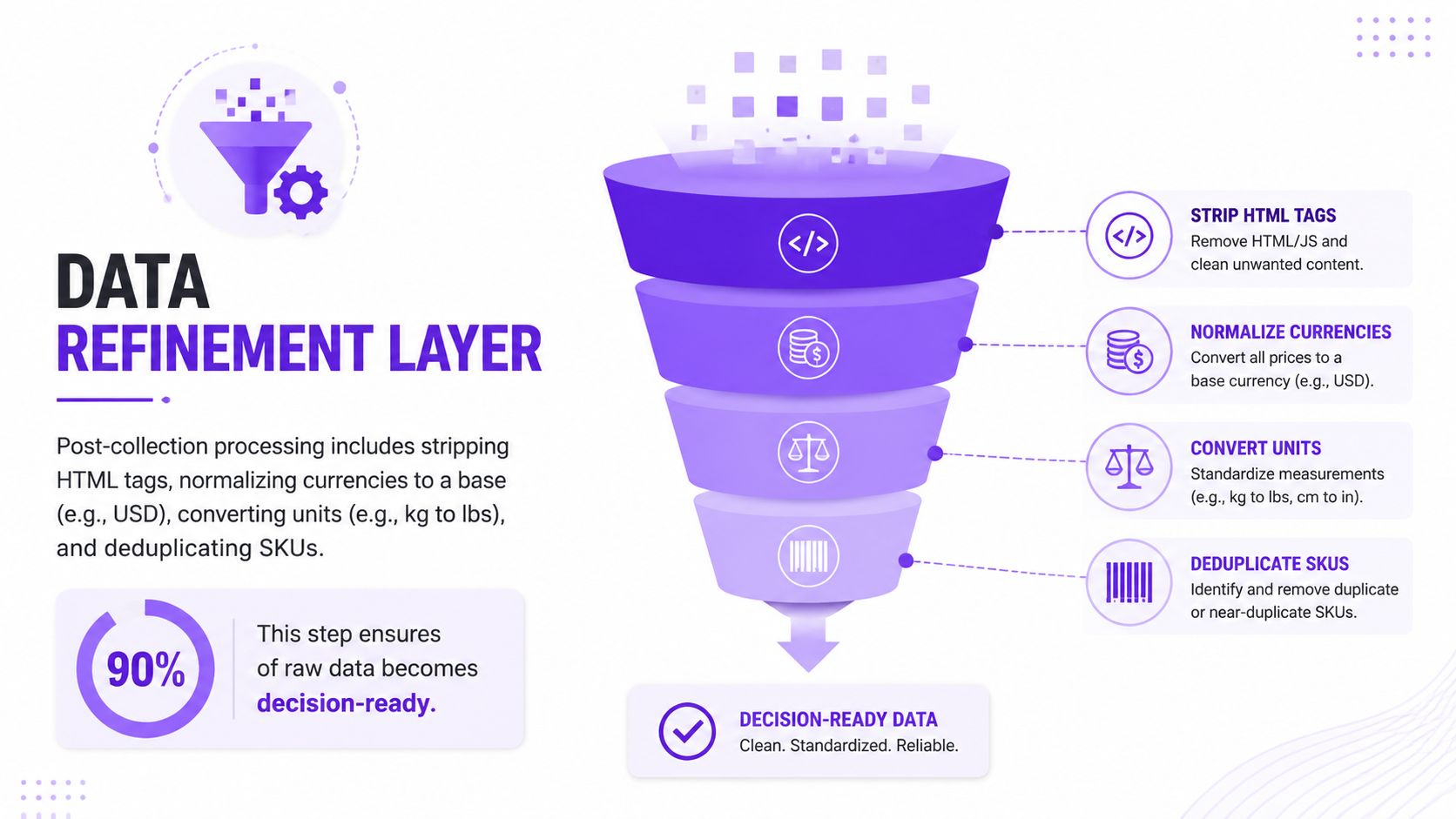
Normalize before interpretation
Strip HTML and tracking parameters, then standardize field names and types. Keep the original value alongside the normalized value when auditability matters. A price record should normally include the displayed amount, currency, tax treatment, delivery charge if available, collection timestamp, source URL, seller, and match confidence.
Currency conversion requires a recorded rate and conversion timestamp. Tax-inclusive and tax-exclusive prices must remain distinguishable, especially when comparing DTC stores across regions. A bundle shouldn't be compared with a single unit, and a product with multiple sizes or colours needs a variant-aware schema rather than a single generic product row.
Use validation rules before data reaches a dashboard or repricer:
- Range checks: Flag prices that fall outside the expected product or category range.
- Change checks: Hold abrupt changes for review when the source provides no corresponding promotion or stock event.
- Completeness checks: Reject records missing product identity, currency, or timestamp.
- State checks: Separate unavailable, out-of-stock, preorder, and access-blocked responses.
- Duplicate checks: Collapse repeated offers while retaining seller and source evidence.
Store facts and history separately
A practical model separates relatively stable product dimensions from changing offer facts. Product dimensions contain brand, model, GTIN, pack size, and variant attributes. Offer facts contain seller, price, shipping, stock, promotion state, and timestamp. Snapshotting offer facts preserves the history needed to distinguish a temporary promotion from a sustained market shift.
Postgres fits operational queries and alert workflows. BigQuery suits larger analytical workloads and cross-source reporting. S3 plus Athena can work when the team wants inexpensive object storage with query-on-demand patterns. The correct choice depends on access patterns, retention, governance, and the systems that consume the output.
The hardest quality question is not whether a row entered storage. It is whether a pricing manager trusts the number enough to act. Teams refining their controls should review what data quality means in practice, then define explicit handling for uncertain, incomplete, and conflicting records.
Store the raw observation, the normalized value, and the reason a human or rule accepted it. That lineage turns an argument about price into an answerable question.
Commercial Use Cases Powered by Clean Data
Clean collection earns its place when it changes a commercial decision. A dashboard full of competitor prices has limited value if the pricing manager still has to verify every row manually.
MAP and RRP enforcement
A manufacturer can monitor authorized resellers for advertised price violations, identify repeat offenders, and preserve evidence for channel conversations. The legal distinction matters: the FTC explains that a manufacturer may set a minimum advertised price while retailers remain free to sell below that price in the actual transaction. The FTC discussion of advertised versus resale price provides the relevant context.
That means the monitoring workflow should capture the advertised offer and its presentation, not claim that a retailer completed a sale at that amount. A timestamped record, seller identity, product match, and page evidence give the brand a defensible starting point for review. Historical enforcement also shows that MAP provisions can attach concrete consequences, including loss of cooperative advertising funding for typically 60 to 90 days in one music-distribution case. The FTC case analysis describes those provisions.
Sourcing and margin decisions
A distributor can compare supplier cost with observed competitor shelf prices, then flag products where the market appears to support a different buying decision. The pipeline doesn't decide whether to buy. It reduces the time needed to identify candidates for margin review, accounting for pack size, delivery, taxes, and channel differences.
Matching quality protects the analysis. A wholesale case pack matched to a consumer unit creates an artificial margin opportunity. A regional price displayed without delivery context can lead to an equally misleading conclusion.
Stock-out reactions
Availability signals can support merchandising and supplier escalation. If several comparable sellers disappear while the business still holds inventory, the team may review promotional placement, search visibility, or a temporary price position. If a key competitor returns, the alert can prompt a reassessment rather than leaving an old promotion in place.
The workflow should separate a true stock-out from a failed fetch, blocked page, discontinued listing, and temporary delivery restriction. Clean data creates operational advantage because it gives each team a specific event to investigate instead of another vague market report.
Maintenance, Monitoring, and Long-Term Reliability
The assumption that a scraper is finished after launch is one of the most expensive mistakes in automating data collection. Modern websites change their markup, render content dynamically, introduce access controls, alter seller layouts, and change the meaning of fields without notifying the teams that depend on them.
Reliability therefore needs instrumentation. Track fetch success, extraction confidence, freshness lag, match confidence, missing fields, duplicate rates, and the volume of records routed to review. A healthy pipeline should show whether a source failed technically, returned an empty page, changed its structure, or produced plausible but suspicious values.
Detect decay before users do
Layout drift detection should compare expected selectors, labels, schemas, and field distributions with recent observations. A sudden shift from populated prices to blank values deserves a page or source alert. A subtler problem, such as every product returning the same price, requires anomaly checks rather than a simple HTTP success metric.
Anti-bot mitigation should remain compliant and source-specific. Respect access terms, robots guidance where applicable, rate limits, authentication requirements, and regional restrictions. IP reputation hygiene and proxy rotation can support legitimate collection architecture, but they don't excuse aggressive request patterns or attempts to defeat controls.
A weekly reliability review can include:
- Source health: Review failed fetches, blocked responses, and stale records.
- Extraction drift: Compare field completeness and selector performance with the previous period.
- Matcher quality: Re-run uncertain pairs and inspect confirmed false matches.
- Catalog hygiene: Remove dead SKUs, redirected pages, and duplicate source records.
- Evidence review: Check that high-severity alerts retain usable page context.
- Governance: Revisit terms of service, permissions, retention, and access controls.
The broader data-collection ecosystem shows why this discipline matters. One industry report valued the alternative-data market at $4.9 billion in 2023 and projected 28% annual growth through 2032, while web-scraping software reached $1.01 billion in 2024 and was projected to exceed $2.49 billion by 2032. The market and usage figures are reported here. The same report records growth in active users, API runs, scheduled runs, and web runs, but adoption doesn't remove the operating burden. It makes reliability more important because more decisions depend on the output.
Retire a brittle source when its validated records cost more than an available API or a smaller, higher-quality monitoring scope. A pipeline stays valuable when the team is willing to change collection methods, reduce unsupported coverage, and protect trust in the records that remain.
Market Edge provides automated price and stock monitoring across selected competitor websites, resellers, and marketplaces such as Amazon, eBay, and eMAG, using web crawlers and AI-based product matching to deliver timestamped competitive records. If you're ready to replace spreadsheet checks with a maintained operating workflow, visit Market Edge to evaluate the fit for your catalog and monitoring priorities.