
Let's cut through the hype. Machine learning in retail isn't about futuristic concepts; it's about leveraging data to make smarter, faster, and more profitable business decisions. Every sale, market shift, and competitor price change becomes fuel for a system designed to optimize commercial outcomes.
Think of it as augmenting your most experienced manager with the ability to analyze millions of data points in seconds. This is the practical application of machine learning for retail: predicting trends, optimizing prices, and creating a more responsive business.
What Is Machine Learning in Retail?

Machine learning (ML) is a subfield of artificial intelligence where algorithms are trained on historical data to identify patterns. The system then applies this learned knowledge to new data, improving its predictions and decisions over time without explicit reprogramming for every scenario.
For retail leaders, this translates directly to solving complex commercial challenges. Instead of relying solely on past performance reports or intuition, ML models provide data-driven forecasts and recommendations. These insights directly impact margins, reduce operational waste, and improve customer retention.
Supervised Learning: Training on Known Outcomes
One of the most common methods is supervised learning. This approach is analogous to training a new pricing analyst by showing them historical pricing decisions and the resulting sales figures. The model is trained on a "labeled" dataset where the correct outcome is already known.
- Mini Use Case (Demand Forecasting): To forecast sales for a holiday promotion, you would provide the model with historical data on product prices, promotion types, seasonality, and the actual sales revenue (the "label"). The model learns the relationships between these variables, allowing it to predict sales for future promotions with a high degree of accuracy.
This method is the foundation for applications like demand forecasting and dynamic pricing, where a clear history of cause and effect exists. The quality of the underlying data is critical; clean, well-organized information is essential for model performance. To understand this better, you can explore the role of big data in retail.
Unsupervised Learning: Discovering Hidden Patterns
In contrast, unsupervised learning involves providing the model with unlabeled data and tasking it with identifying inherent structures or patterns. This is like asking an analyst to sift through years of transaction data to identify distinct customer personas that were previously unknown.
The commercial power of unsupervised learning is its ability to uncover opportunities you weren't actively looking for. It can reveal valuable new customer segments, detect anomalous purchasing behavior indicative of fraud, or identify products that are frequently bought together.
For instance, an unsupervised model could cluster customers into segments like "high-margin weekend shoppers" or "discount-driven bulk buyers." This provides the intelligence needed to create highly targeted marketing campaigns that resonate with each group.
Ultimately, machine learning in retail is about building intelligent systems that produce measurable business results. The table below outlines how specific ML applications solve concrete commercial challenges.
Machine Learning Applications and Their Commercial Impact
This table provides a high-level view of how common machine learning applications in retail address specific business problems and improve financial performance.
| ML Application | Business Problem Solved | Primary Commercial Benefit |
|---|---|---|
| Dynamic Pricing | Inability to respond quickly to market changes and competitor pricing. | Maximizes profit margins on every transaction. |
| Demand Forecasting | Overstocking unpopular items and understocking bestsellers. | Reduces holding costs and prevents lost sales. |
| Personalization | Generic marketing that fails to engage individual customers. | Increases conversion rates and customer lifetime value. |
| Inventory Optimization | Inefficient stock allocation across different locations or channels. | Improves cash flow by minimizing tied-up capital. |
| MAP Enforcement | Manual, slow detection of pricing policy violations by resellers. | Protects brand value and maintains fair channel pricing. |
These applications demonstrate that the objective is not simply to adopt new technology, but to solve persistent business problems more effectively, leading to tangible gains across the organization.
Driving Revenue with Intelligent Pricing and Personalization
For most retail businesses, the most direct path to revenue growth through machine learning involves two key areas: optimizing pricing to protect margins and personalizing the customer experience to increase sales and loyalty.
ML models automate complex, data-intensive decisions that are infeasible for teams to manage manually, especially at scale. Let's examine three high-impact applications where machine learning is a proven revenue generator.
Adjust Prices Automatically with Dynamic Pricing
Static pricing strategies based on fixed rules or infrequent competitor analysis leave significant margin on the table. Dynamic pricing utilizes supervised learning models to adjust prices in near real-time based on a range of market signals, going far beyond simple price matching.
A dynamic pricing engine continuously analyzes variables such as:
- Competitor Pricing Data: Real-time price tracking across key competitors and marketplaces.
- Current Demand Signals: Changes in website traffic, conversion rates, and cart additions.
- Inventory Levels: Automatically increasing prices for low-stock, high-demand items or discounting overstocked products.
- Seasonality and Time of Day: Identifying periods of peak and off-peak purchasing behavior.
The commercial benefit is clear: maximizing the profit margin on every transaction. Instead of a uniform price, each product is priced optimally for its specific market context at that moment.
Mini Use Case: An electronics brand struggled with MAP (Minimum Advertised Price) compliance, as unauthorized sellers frequently undercut their pricing, eroding brand value. They implemented an ML-driven monitoring system that tracked prices across dozens of e-commerce sites. When a violation was detected, the system automatically logged the evidence and sent an alert. This reduced the time-to-detection from days to minutes, leading to a 90% improvement in seller compliance within three months and stabilizing their market pricing. This is where automated platforms like Market Edge provide the clean, timely data required for effective enforcement.
Predict Future Sales with Demand Forecasting
Traditional forecasting methods, often based on trailing historical sales, are notoriously unreliable in dynamic markets. They fail to account for emerging trends, marketing campaign impacts, or supply chain disruptions.
ML-powered demand forecasting analyzes complex datasets to predict sales with significantly greater accuracy. It incorporates dozens of variables—from promotional calendars and holidays to external factors like weather patterns or economic indicators. You can learn more about how this fits into a broader strategy in our guide on price optimization software.
Accurate forecasting generates substantial operational and financial benefits. Better predictions lead to fewer stockouts on popular products and less capital tied up in slow-moving inventory, directly improving cash flow and profitability.
Increase Lifetime Value with Customer Personalization
Generic marketing no longer meets customer expectations. Consumers expect retailers to understand their preferences and purchase history. Machine learning is the engine that enables sophisticated customer personalization at scale.
These systems analyze browsing behavior, past purchases, and demographic data to create a unique experience for each individual. Common applications include:
- Product Recommendations: "Frequently Bought Together" or "You Might Also Like" sections powered by collaborative filtering algorithms.
- Targeted Marketing: Email and ad campaigns featuring products relevant to a specific customer segment's interests.
- Customized Site Experience: Dynamically changing homepage banners or product sorting based on a user's previous interactions.
The commercial impact is significant. Personalized recommendations are projected to capture a 32% share of the AI in retail market by 2026. Amazon’s recommendation engine reportedly drives up to 35% of its total sales. Retailers that successfully implement personalization can see conversion rates increase by up to 40% and customer retention improve by 30% compared to those using generic approaches.
Optimizing Operations from Inventory to Price Enforcement
Some of the most significant gains from machine learning in retail occur in back-office operations. These improvements strengthen the business foundation by addressing complex, data-intensive challenges that are impossible to manage effectively at scale with manual processes.
For sales and e-commerce leaders, two areas stand out for creating a sustainable competitive advantage: optimizing product assortment and ensuring pricing policy enforcement.
Fine-Tuning Your Assortment and Inventory
Mismatched inventory is a primary driver of margin erosion. Overstocking ties up working capital, while understocking results in lost sales and customer frustration. Traditional inventory management, often based on simple historical sales data, is ill-equipped for modern retail dynamics.
Machine learning enables a more intelligent approach to assortment and inventory optimization. The models analyze complex patterns to answer critical questions:
- What should we stock? By analyzing sales velocity, search trends, and market data, ML can predict which new products are likely to succeed.
- Which products should be discontinued? It can identify slow-moving items that incur unnecessary holding costs and recommend a clearance strategy.
- What is the optimal stock level? Models factor in seasonality, promotions, and external data to maintain ideal inventory levels across all locations.
- Which products are purchased together? Unsupervised learning can uncover "market basket" affinities, revealing opportunities for product bundling and cross-selling.
The objective is to ensure the right product is in the right place at the right time. An ML-driven strategy shifts inventory management from being reactive to proactive, directly benefiting cash flow and customer satisfaction.
Automating MAP and RRP Enforcement
For manufacturers and brand owners, maintaining price integrity across a distributed network of resellers is a persistent challenge. Minimum Advertised Price (MAP) or Recommended Retail Price (RRP) policies are only effective if they are consistently enforced. Manually tracking thousands of SKUs across numerous online sellers is inefficient, error-prone, and unscalable.
Machine learning automates the monitoring and enforcement process with superior speed and accuracy.
Here’s how ML-powered systems accomplish this:
- AI-Powered Product Matching: Accurately identifies your products on reseller sites and marketplaces, even with variations in naming, descriptions, or imagery. This eliminates the false positives and missed violations common with basic text-based searches.
- Image and Content Recognition: Detects non-compliant use of brand assets or unapproved product descriptions in addition to price violations.
- Violation Detection and Documentation: Automatically captures screenshots of violations, logs timestamps and seller details, and compiles the necessary evidence for enforcement action.
A human team member might check a few dozen sellers per day; an ML system can scan thousands in minutes, flagging violations almost instantly. This frees your team to focus on communicating with non-compliant partners rather than on manual detection. Our guide to MAP policy monitoring software explores this further. This is where an automated platform providing clean, structured intelligence is crucial. A solution like Market Edge, for example, can serve as the data engine for these enforcement workflows, protecting your brand's market value.
Your Roadmap to Implementing Machine learning
Adopting machine learning should be a phased, practical process focused on demonstrating business value at each stage. This roadmap is designed for retail leaders who require tangible results to justify investment, rather than pursuing technology for its own sake.
The key is to move from abstract concepts to solving a specific, high-impact business problem. By starting small, proving the concept, and building on early successes, you de-risk the process and build organizational buy-in.
1. Isolate a High-Impact Business Problem
The first step is strategic, not technical. Instead of asking, "Where can we use ML?" ask, "What is our most significant operational bottleneck or source of margin leakage?" Frame the problem around a clear commercial outcome.
The best starting points are often areas characterized by repetitive manual work or known inefficiencies.
- Pricing Strategy: Are you consistently reacting to competitor price changes, leaving margin on the table, or losing sales due to uncompetitive pricing?
- MAP Enforcement: Is your team spending excessive hours manually checking reseller websites, only to discover violations days after the brand damage has occurred?
- Inventory Management: Are stockouts on best-selling products and overstocks on slow-movers creating a persistent drag on profitability?
Selecting one well-defined problem provides a focused target for your initial machine learning project and ensures efforts are tied to a key business metric from the outset.
2. Address Data Collection and Preparation
A machine learning model is only as good as the data it's trained on. This stage is critical and often represents the most significant effort in the implementation process. The goal is to establish a clean, consistent, and reliable data pipeline.
You have two primary options: build an internal data pipeline or leverage a specialized data-as-a-service platform. Building in-house offers complete control but requires a substantial investment in engineering talent, ongoing maintenance, and expertise in web data extraction.
For most retailers, a specialized platform like Market Edge provides the fastest path to value. It delivers structured, near real-time pricing and competitor data without the need to build and maintain a complex data-scraping infrastructure, dramatically reducing the time-to-return.
A common mistake is underestimating the importance of data hygiene. Inconsistent product identifiers, missing attributes, and unstructured competitor data will derail an ML project. Clean data is not optional; it is the foundation of the entire initiative.
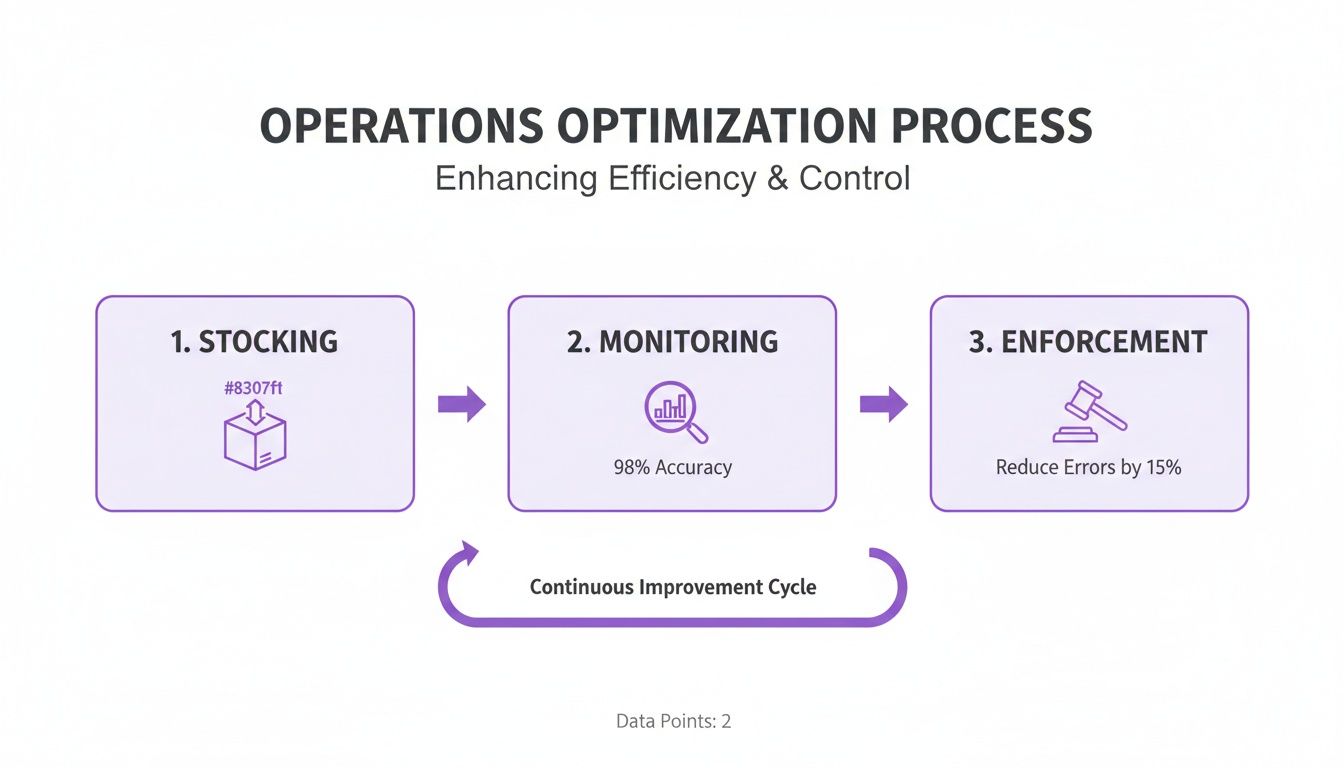
This flow chart illustrates an operational process where high-quality data is the essential starting point for all subsequent activities, from stocking to enforcement.
As shown, effective monitoring and enforcement are contingent on accurate data inputs. The quality of your data directly determines the quality of your outcomes.
3. Navigate the Build Versus Buy Decision
With a clear problem and a reliable data source, you face the classic "build versus buy" decision. Do you assemble an internal team to create a custom ML model, or do you license a pre-built solution?
- Buy Off-the-Shelf: For common challenges like dynamic pricing or MAP monitoring, specialized tools can deliver 80% of the value for 20% of the effort. These solutions are pre-trained and designed for rapid implementation, making them ideal for initial projects.
- Build Custom: This path is best suited for unique business problems where no existing tool is a good fit. It is a major investment requiring a dedicated team of data scientists and engineers and a significantly longer timeline.
For most retailers, a "buy" approach for a well-understood problem is the most sensible starting point. It allows your team to focus on integrating new insights into daily workflows rather than on algorithm development.
4. Execute a Pilot Project to Prove ROI
The final step is to demonstrate value through a small-scale pilot project before committing to a full rollout.
- Select a Controlled Group: Apply the new tool or model to a specific product category, geographic region, or a select group of online channels.
- Define Success Metrics: Establish clear, business-focused KPIs. Instead of "model accuracy," use metrics like "a 5% increase in gross margin for Category X" or "a 75% reduction in time-to-detection for MAP violations."
- Run and Measure: Execute the pilot for a defined period, such as one fiscal quarter. Compare the pilot group's results against a control group using existing methods.
- Analyze and Scale: If the pilot demonstrates a clear, positive ROI, you have a compelling internal case study to justify scaling the solution across the business.
This step-by-step process transforms machine learning from an intimidating concept into a manageable, value-driven business initiative.
How to Measure Success and Avoid Common Pitfalls

Implementing a machine learning model is only the first step. The critical challenge is proving its business value, which is essential for securing future investment and driving adoption. Success is measured not by technical specifications, but by tangible commercial outcomes that impact the P&L.
The required mindset shift is from that of a technologist to that of a business leader. A model with 95% prediction accuracy is an abstract achievement; a pricing manager needs to understand its direct effect on gross margin.
Defining Commercially Relevant KPIs
To measure the true return on investment, you must track metrics that are meaningful to the business. This involves translating a model's technical performance into its real-world commercial impact. Your KPIs should be specific, measurable, and directly tied to the business problem you set out to solve.
Here are examples of translating technical metrics into business-focused KPIs:
- For Dynamic Pricing: Instead of "price prediction accuracy," measure Gross Margin Increase per SKU or the Change in Conversion Rate for dynamically priced items.
- For Demand Forecasting: Rather than "forecast error rate," track the Reduction in Stockout Incidents for key products and the Decrease in Days of Inventory on Hand.
- For MAP Enforcement: The key metrics are Time to Violation Detection and the Percentage of Compliant Sellers over a defined period.
These KPIs tell a clear business story. Demonstrating a significant drop in violation detection time makes it evident how an automated platform like Market Edge actively protects your brand and channel health.
Checklist: Avoiding Common ML Pitfalls
Even well-resourced machine learning projects can fail. These failures are rarely due to faulty algorithms; they almost always stem from strategic missteps. Awareness of these common traps is the most effective way to avoid them.
-
Mistake 1: Starting Without a Clear Business Goal.
- Problem: Initiating a project with a vague mission like "implementing AI" leads to a solution in search of a problem.
- Fix: Begin with a specific, quantifiable business objective. For example: "Reduce the manual effort required for MAP monitoring by 50% within six months."
-
Mistake 2: Underestimating Data Quality Requirements.
- Problem: Feeding a powerful model with incomplete or inaccurate data will produce unreliable results.
- Fix: Invest in data hygiene before investing in algorithms. This means committing resources to cleaning and structuring your data sources or partnering with a provider that delivers clean, reliable intelligence.
-
Mistake 3: Treating ML as a One-Time Project.
- Problem: Markets evolve, competitors react, and customer behavior changes. A model trained on outdated data will quickly become ineffective.
- Fix: Establish a process for continuous monitoring and model retraining. Plan to regularly refresh your models with new data to maintain their accuracy and relevance.
-
Mistake 4: Failing to Integrate Insights into Workflows.
- Problem: An insight is useless if it remains confined to a dashboard and is not acted upon.
- Fix: Design the integration plan from the beginning. Determine exactly how the model's outputs will be delivered to your team and how they will trigger specific actions, such as an automated price change or a compliance alert.
Frequently Asked Questions About Machine learning in Retail
Adopting any new strategy raises questions. For retail leaders, the priority is to understand the practical implications of machine learning for business performance. This section addresses common questions from a commercial perspective.
"How much data do we need to get started?"
You do not need petabytes of data from day one. The critical factor is the quality and relevance of the data for the specific problem you are solving, not the sheer volume.
For applications like dynamic pricing or MAP enforcement, you can often begin with just a few months of sales history, basic product catalog information, and high-quality competitor pricing data. The model will improve as it is fed more data over time, but the initial data requirement is often smaller than anticipated.
The guiding principle is that clean, structured data is paramount. A model trained on 1,000 high-quality records will outperform one trained on 100,000 messy ones. Prioritize data hygiene first.
"Isn't machine learning only for large enterprise retailers?"
No. While large retailers like Amazon and Walmart generate headlines, modern tools and platforms have made machine learning accessible to businesses of all sizes. An in-house data science team and significant upfront capital investment are no longer prerequisites.
In many cases, smaller and mid-sized businesses have an advantage due to their agility. They can implement a dedicated MAP monitoring tool or a dynamic pricing engine and realize a return on investment much faster than a large corporation navigating internal bureaucracy.
"What is the practical difference between AI and ML?"
These terms are often used interchangeably, but their distinction is straightforward.
- Artificial Intelligence (AI) is the broad concept of creating machines that can perform tasks requiring human intelligence, such as problem-solving or language comprehension.
- Machine Learning (ML) is a specific method for achieving AI. Instead of being programmed with explicit rules, an ML system learns and improves by analyzing data.
When you encounter an "AI-powered" MAP monitoring tool, it is using machine learning algorithms to perform the specific tasks of matching products and detecting violations. For business leaders, the important takeaway is what the system does, which is almost always powered by ML.
"How do I integrate ML insights into our current pricing strategy?"
Integration should be a gradual process, not an abrupt transition. The objective is to augment the expertise of your pricing team with data-driven insights, not to replace them.
Here is a practical, step-by-step approach:
- Start with Recommendations: Initially, use the ML model as a suggestion engine. It can recommend price adjustments based on real-time market data, with a human manager providing final approval.
- Establish Guardrails: Maintain control by defining clear business rules, such as minimum and maximum price points, to ensure the model's suggestions protect margins and align with brand strategy.
- Automate in Phases: As your team gains confidence in the model's performance for a particular product line or channel, you can begin to automate pricing for that specific segment.
- Monitor and Refine: Continuously track key performance indicators like margin, sales velocity, and conversion rates to ensure the strategy is meeting its commercial objectives.
This phased rollout allows your team to blend its industry experience with the analytical power of machine learning.
This is where automated price monitoring tools like Market Edge become useful. By providing the clean, structured competitor data that machine learning models require, Market Edge helps you build a solid foundation for any intelligent pricing or brand protection strategy.