
Monitoring Amazon prices is not a one-time task; it's a continuous process of tracking your products, key competitors, and third-party resellers. An effective strategy begins with defining your scope (which SKUs and competitors are critical), selecting a data collection method (automation is non-negotiable), and establishing alerts for commercially significant events like MAP violations or losing the Buy Box.
Why Consistent Amazon Price Monitoring is a Commercial Imperative

On Amazon, pricing is never static. For founders, ecommerce managers, and sales leaders, treating price monitoring as a core business function is essential for commercial survival. Ignoring market dynamics doesn't just leave money on the table—it exposes your brand to significant risk.
Inaction leads to swift financial consequences. Unchecked competitor price wars erode margins, pulling your products into a race to the bottom that devalues your brand. For manufacturers, the stakes are even higher.
Protecting Brand Integrity and Profit Margins
When unauthorized sellers disregard your Minimum Advertised Price (MAP) policies, the damage extends beyond a single lost sale. It erodes your brand's perceived value across the entire market, frustrating authorized retail partners and dismantling the pricing structure you've built. Systematic monitoring is your primary defense.
The sheer velocity of the marketplace makes manual tracking impossible. Amazon’s algorithms can reprice millions of items up to 2.5 million times daily based on real-time supply, demand, and competitor actions. You can discover more insights about Amazon's pricing strategies to understand why this pace requires an automated approach.
A consistent monitoring strategy is the only way to protect profits, maintain brand integrity, and secure a competitive advantage. It transforms your team from reactive problem-solvers into proactive strategists.
Without a structured system, you are exposed to major commercial risks:
- Margin Erosion: Persistent undercutting by competitors systematically eats away at your profitability on every sale.
- Brand Dilution: Widespread MAP violations train customers to expect discounts, permanently damaging your brand’s premium positioning.
- Lost Sales: Failing to notice when a key competitor goes out of stock or raises prices means missing prime opportunities to win the Buy Box and capture revenue.
This is where automated price monitoring tools like Market Edge become useful, providing the visibility needed to stay ahead.
Building Your Amazon Price Monitoring Blueprint

Effective price monitoring on Amazon starts with a clear, strategic blueprint. Without one, you risk drowning in irrelevant price changes and reacting to market noise instead of focusing on profit drivers. For any brand owner or pricing manager, a blueprint makes your efforts targeted, efficient, and tied directly to commercial goals. Attempting to monitor everything at once is a common mistake; a focused approach is always more powerful.
Prioritize Your Core SKUs
Not all products in your catalog are created equal. Concentrate on the SKUs that have the most significant impact on your business. This allows you to allocate resources where they will deliver the most immediate and substantial returns.
A practical prioritization strategy focuses on:
- High-Volume Sellers: These are your core revenue drivers. Even minor price shifts or MAP violations on these items can have a major financial impact.
- High-Margin Products: While they may not sell in the same volume, these SKUs are critical to overall profitability. Protecting their price integrity is non-negotiable.
- Strategic Brand Assets: This category includes flagship products, new launches, or any item that defines your market position. Monitoring them is about protecting long-term brand equity.
By categorizing your catalog this way, you create a focused, manageable list that becomes the foundation of your monitoring system.
Identify Your True Competitors
Next, define who you are actually competing against. On Amazon, your competition is any seller impacting your sales for a specific product. This includes authorized distributors, major brands, and a host of unknown third-party resellers.
For example, a premium kitchen appliance manufacturer might discover its biggest threat is not another major brand but a handful of aggressive third-party sellers consistently violating MAP and capturing the Buy Box. Identifying these specific sellers is the only way to effectively enforce your policies. Your competitor list must be dynamic, adapting as new sellers enter the market.
A well-defined monitoring strategy is tied to a specific business objective. Are you enforcing MAP compliance, gathering competitive intelligence for repricing, or identifying new sourcing opportunities? Your goal dictates the data you collect and how you act on it.
Mini Use Case: A Distributor's Focused Start
Consider a mid-sized distributor of consumer electronics facing margin compression from suspected unauthorized resellers across a 5,000-SKU catalog. A comprehensive approach is impractical.
Instead, they build a focused blueprint:
- Objective: Enforce MAP and stabilize pricing for their most important products.
- SKU Selection: They identify their top 20 best-selling SKUs, which account for over 60% of their Amazon revenue.
- Competitor Identification: Initial analysis pinpoints three specific third-party sellers who are consistently the lowest-priced offenders.
- Key Metrics: Their dashboard is configured to monitor just two things for these SKUs and sellers: Buy Box ownership and seller stock levels.
This targeted approach provides actionable data from day one, revealing who is violating MAP, when the Buy Box is lost, and if a competitor is about to run out of stock. This is where automated price monitoring tools like Market Edge become invaluable, delivering the precise data needed to execute such a strategy without manual effort.
Choosing Your Method for Collecting Pricing Data
Once you've defined what to track, the next step is determining how to collect the data. For any serious distributor or brand team, this choice directly impacts the speed and effectiveness of your market response.
Manual checks of competitor listings provide a static snapshot of a dynamic marketplace. By the time you enter data into a spreadsheet, prices may have already changed, rendering your analysis—and any decisions based on it—instantly obsolete. This method does not scale.
The Pitfalls of Building an In-House Solution
When manual tracking proves insufficient, some companies consider building a proprietary web scraper. While a custom tool sounds appealing, the reality is a path of hidden costs and technical challenges that divert engineering resources from core business functions.
Beyond the significant upfront development cost, the primary drain is relentless maintenance. Amazon frequently updates its site structure, and any change can break your scraper without warning, creating data gaps until your engineers can implement a fix.
Beyond technical issues, you face operational risks:
- Getting Blocked: Amazon employs sophisticated systems to detect and block scrapers. If detected, your company’s IP addresses could be blacklisted.
- Dirty Data: Raw scraped data requires extensive cleaning, structuring, and normalization before it is usable, creating more work for your team.
- Legal Gray Areas: Navigating Amazon's Terms of Service regarding data collection is complex and can expose your business to legal vulnerabilities.
Ultimately, building your own tool forces your team to become data harvesters instead of strategic decision-makers.
The Strategic Advantage of Dedicated Monitoring Platforms
For most businesses, the most efficient and reliable path is a dedicated third-party price monitoring platform. These services are purpose-built to handle the scale and complexity of ecommerce data collection, using resilient crawlers that navigate anti-bot measures to deliver clean, consistent data.
The true benefit of a third-party platform is not just data acquisition. It is receiving clean, structured, and actionable intelligence without internal operational overhead. This allows your team to focus on strategy—protecting margins and driving growth.
These platforms track millions of products, revealing historical price swings that can average 15-20% annually in competitive categories. Given that Amazon itself reprices products over 2.5 million times a day, automation is the only way to keep pace and spot sudden 75% price drops in volatile categories.
A core feature of modern platforms is AI-powered product matching, which accurately links your SKUs to competitor listings even with variations in titles, images, or descriptions. This ensures you are always comparing equivalent products. There are many capable ecommerce price monitoring tools available.
Comparison of Amazon Data Collection Methods
This table breaks down the three primary methods for gathering Amazon pricing data. The right choice depends on your scale, resources, and strategic goals.
| Method | Best For | Pros | Cons |
|---|---|---|---|
| Manual Spot-Checks | Small sellers with a handful of SKUs, or initial market research. | - No cost - Simple to start - No technical skills needed | - Not scalable - Prone to human error - Data is quickly outdated - Incredibly time-consuming |
| In-House Web Scraper | Large enterprises with dedicated engineering resources and unique data needs. | - Fully customizable - Total control over data | - High development and maintenance costs - Risk of IP blocks - Requires constant updates - Legal/ToS compliance risks |
| Third-Party Platform | Most B2B distributors, manufacturers, and e-commerce teams. | - Scalable and reliable - Provides clean, actionable data - Handles all technical complexities | - Subscription cost - Less customization than a fully in-house build - Requires some initial setup and integration |
While manual checks and in-house tools have their place, a dedicated platform like Market Edge handles the entire data collection and cleaning process, providing your team with the reliable intelligence needed to execute your pricing strategy with confidence.
Configuring Your Automated Monitoring System
A price monitoring system that only delivers raw data is a missed opportunity. Your goal is to build an early-warning system that translates data into actionable business intelligence. For B2B teams, a properly configured system is the difference between reactive firefighting and strategic market positioning. The objective is to receive clear signals, not more noise.
The process begins with accurate SKU and product matching. Manually linking your products to every relevant Amazon listing is prone to error. Modern tools use algorithms to match your SKU to a seller's listing even with variations in title, bundles, or images, ensuring accurate, apples-to-apples comparisons.
Setting Up Alerts That Actually Matter
Once products are matched, the next step is configuring alerts. A constant stream of notifications for minor price changes will be ignored. The key is to create rules that flag only commercially significant events.
Consider configuring rules for these scenarios:
- MAP Violation Alerts: For brand owners, an instant notification when a seller's price drops below your Minimum Advertised Price is critical for timely policy enforcement.
- Significant Competitive Undercuts: Instead of tracking minor fluctuations, set a percentage-based alert, such as: "Notify me if a key competitor undercuts my price on this SKU by more than 5%."
- Buy Box Loss: For your most important products, you need immediate notification when you lose the Buy Box to investigate the cause—whether price, stock, or seller rating—and take corrective action.
- Competitor Stock-Outs: Set an alert to notify you when a major competitor on a shared listing goes out of stock. This creates an opportunity to capture their sales, often at a higher margin.
The true power of an automated system is its ability to filter signal from noise. When you configure smart alerts for events like MAP breaches or major price drops, you free up your team to focus only on issues that directly impact revenue and brand integrity.
The ecommerce landscape is increasingly complex. By 2026, Amazon's 22 global marketplaces will present immense opportunities alongside greater management challenges. With U.S. online sales projected to comprise 60% of the market, aggressive pricing is standard—especially since winning the Buy Box drives 82% of sales on platforms like Amazon.
How Often Should You Be Checking Prices?
The optimal monitoring frequency depends on your product category's velocity.
For fast-paced markets like consumer electronics or popular health supplements, where prices can change multiple times a day, hourly monitoring may be necessary to maintain your Buy Box position.
Conversely, for slower-moving goods like industrial equipment or specialty B2B products, a daily check is typically sufficient to catch meaningful shifts without creating excess data. The goal is to align your monitoring cadence with your market's rhythm. Using the best price monitoring software allows you to set different frequencies for different SKUs, optimizing your approach.
This level of customization enables you to fine-tune your strategy, ensuring your alerts and monitoring schedule align perfectly with your commercial objectives.
Turning Pricing Data into Profitable Decisions
Collecting Amazon pricing data is only the first step. The real value is realized when that data informs daily operations and triggers profitable actions. For B2B teams, this requires building workflows that convert a price alert into a decisive business move, whether that's enforcing brand policies or outmaneuvering a competitor. Without an action plan, you have a dashboard of data, not a tool that impacts the bottom line.
The process is straightforward: match products, receive alerts on key events, and use the data to inform your response.
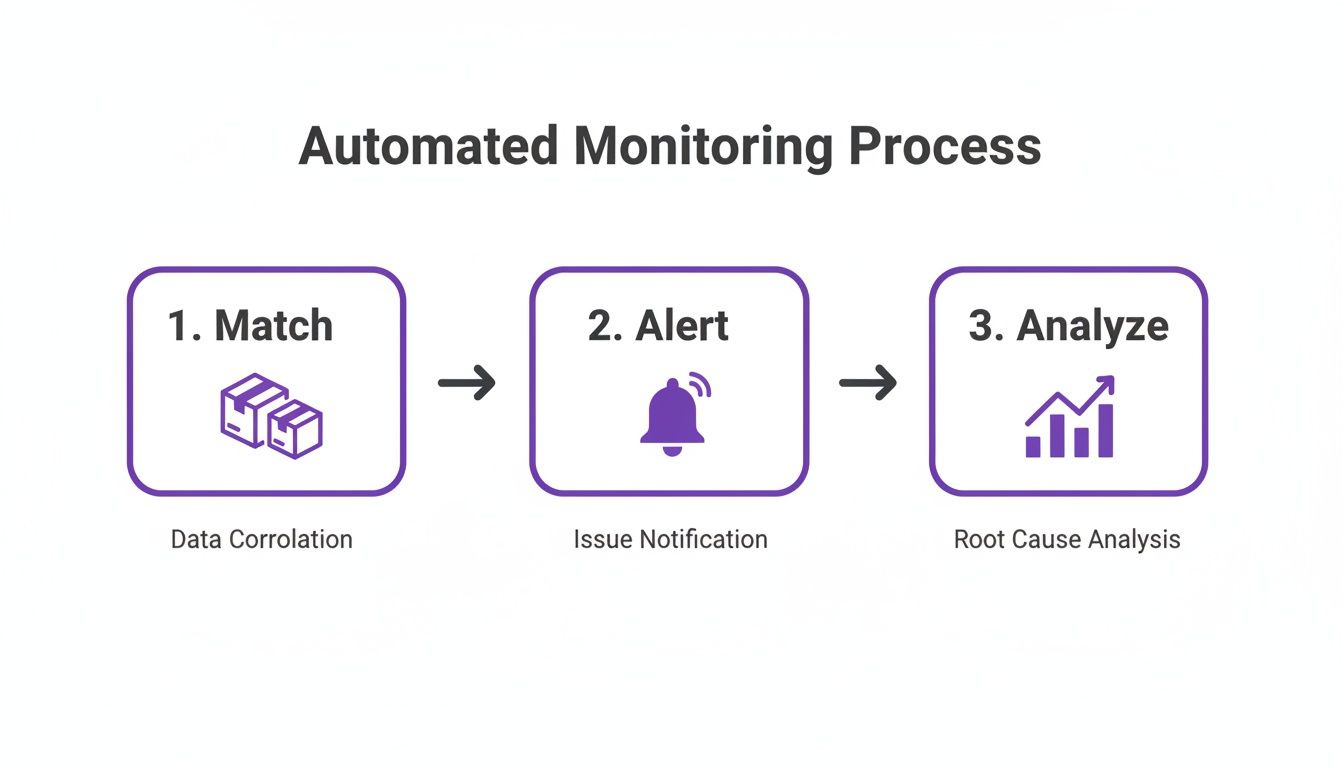
This structure ensures your team is not bogged down searching for problems but is instead presented with clear signals that demand a strategic response.
A Manufacturer's MAP Enforcement Workflow
For manufacturers, protecting brand value is paramount. When an alert flags a Minimum Advertised Price (MAP) violation, you must act swiftly and consistently. A delayed or inconsistent response signals to resellers that your policies are not a priority, inviting further violations.
A robust MAP enforcement workflow is a documented, repeatable process:
- Receive the Alert: An automated notification identifies the specific reseller, SKU, and price violating your MAP policy.
- Verify and Document: A team member clicks through to the live Amazon listing to confirm the price and captures a timestamped screenshot as evidence.
- Initiate Contact: A pre-written email template is used to contact the reseller. The message should be professional and firm, clearly stating the product, violation, and including the screenshot.
- Track and Follow Up: The violation is logged in a central system. Calendar reminders are set to ensure the reseller corrects their pricing within the timeframe specified in your policy.
This methodical process removes emotion and guesswork, transforming MAP enforcement from a reactive fire drill into a manageable business function.
A Distributor's Competitive Repricing Workflow
For distributors, the objective is to protect margins while capturing market share. A knee-jerk reaction to match a competitor's price drop can be detrimental, leading to a race to the bottom.
A more intelligent repricing workflow combines market intelligence with internal business rules. Consider this scenario:
- An alert is received: a key competitor has dropped their price on a high-volume SKU.
- Before taking action, your pricing manager reviews the competitor's stock level and Buy Box status to understand the context.
- Armed with this data and your own margin rules, you can make an informed decision:
- Hold Price: If the competitor is nearly out of stock or does not hold the Buy Box, no action may be necessary. Our guide on how to win the Buy Box on Amazon explains these dynamics.
- Match Price: If they are a legitimate threat and you have sufficient margin, matching their price maintains your competitive position.
- Undercut Strategically: If winning the sale is critical and you have a cost advantage, a slight price reduction can capture the Buy Box.
The ultimate goal is to integrate Amazon price monitoring so deeply into your operations that it becomes second nature. The data should actively guide pricing, enforcement, and inventory strategies.
This is where an automated tool like Market Edge becomes a strategic asset. It delivers the clean, timely data required to power these workflows, freeing your team from data collection to focus on profitable decision-making.
Your Actionable Price Monitoring Checklist
This checklist provides a roadmap for implementing a structured, repeatable process for Amazon price monitoring. It focuses on turning data into action.
Strategy and Scope Definition
A clear strategy is the foundation of effective monitoring.
- Define Your Core Mission: What is your primary objective? Is it strict MAP enforcement, competitor intelligence, or dynamic repricing? Your goal will shape all subsequent decisions.
- Prioritize SKUs: Do not attempt to monitor your entire catalog initially. Focus on high-volume, high-margin, and strategically important products first.
- Identify True Competition: List the specific brands and third-party sellers that directly impact your sales on key SKUs.
Data Collection and System Configuration
With a clear strategy, you can set up the technical infrastructure.
- Choose Your Data Source: Manual checks are inefficient and building an in-house scraper is resource-intensive. A reliable third-party platform is almost always the most practical choice.
- Ensure Accurate Product Matching: Verify that your system correctly matches your SKUs to the right Amazon listings, accounting for variations in titles or images.
- Set the Right Frequency: Align monitoring frequency with your category's velocity. Hourly updates may be necessary for competitive categories, while daily checks are sufficient for slower-moving products.
Alerts, Workflows, and Reporting
Turn raw data into actionable intelligence.
An effective monitoring system is not a data firehose; it's a smart alarm that triggers only for significant events, providing your team with a clear course of action. This shifts your posture from reactive to proactive.
- Configure Smart Alerts: Set rules for what truly matters: MAP violations, a competitor's price drop exceeding a certain threshold (e.g., 5%), or losing the Buy Box on a top seller.
- Develop an Action Playbook: Document the exact steps to be taken when an alert is triggered. Define the process for a MAP violation or a competitive price drop.
- Review Dashboards Regularly: Schedule weekly or bi-weekly meetings to analyze trends. Identify patterns in competitor behavior to inform high-level strategy.
Following this checklist provides the structure needed to master your Amazon pricing. A dedicated tool like Market Edge is designed to help you execute on each of these points without the manual effort.
Common Questions About Amazon Price Monitoring
Here are answers to some of the most frequent questions from brand managers and ecommerce leaders about Amazon price monitoring.
How Often Should I Be Checking Prices?
This depends on the velocity of your product category. For high-velocity spaces like consumer electronics, where prices can change multiple times a day, hourly or near-real-time monitoring is necessary to remain competitive and hold the Buy Box. For more specialized items like industrial components, a daily check is typically sufficient. The key is to match your monitoring frequency to the rhythm of your market.
What's The Best Way To Catch MAP Violations?
Manual spot-checks are ineffective, as they miss violations that occur overnight or on weekends. The only reliable method is an automated system configured to send specific alerts.
The best systems not only notify you of a price drop below MAP but also capture timestamped evidence, such as a screenshot of the product listing. This documentation facilitates direct and professional communication with non-compliant resellers.
Can I Actually Monitor Amazon Prices For Free?
Free browser extensions and tools are designed for consumers, not businesses. Attempting to track prices manually with a spreadsheet is inefficient and leads to poor decisions based on outdated information.
For business needs like MAP enforcement, competitor analysis, and catalog-wide tracking, investing in a professional platform is necessary. The ROI comes from protecting brand value, saving time, and making smarter strategic decisions. This is where dedicated tools like Market Edge provide the reliable, actionable data that free tools cannot.
This is where automated price monitoring tools like Market Edge become useful. Find out how we can help you turn pricing data into profitable decisions by visiting https://marketedgemonitoring.com.