
Ecommerce competitor price monitoring is the systematic process of tracking competitor pricing and product data online. It replaces guesswork with data-driven insights, enabling businesses to make strategic pricing decisions, protect profit margins, and maintain a strong market position. This typically involves automated tools that collect real-time intelligence on competitor prices, stock availability, and promotional activities.
Why Competitor Price Monitoring Is a Non-Negotiable Strategy
In today's hyper-competitive ecommerce landscape, monitoring competitor prices is not a back-office technical task—it is a core commercial function essential for survival and growth. For founders, ecommerce managers, and sales leaders, it is a critical tool in the daily battle against margin compression, lost sales, and brand positioning challenges.
You simply cannot price your products effectively in a vacuum.
Ignoring market pricing dynamics means operating with a significant blind spot. This reactive approach directly impacts the bottom line, often in ways that are not visible until substantial damage has been incurred.
The Commercial Urgency of Market Awareness
Consider this common scenario: a B2B distributor loses a major account over a 5% price difference on a key product line. The sales team was unaware that a competitor had been systematically reducing their price over several months. The loss was not due to a poor relationship or product quality; it was a direct result of a data blind spot. By the time the team noticed declining order volumes, the account was lost.
This issue extends to brand manufacturers. When unauthorized third-party sellers discount products on marketplaces, it can quickly devalue a brand's image and undermine its premium positioning. Without systematic monitoring, these MAP (Minimum Advertised Price) violations often go undetected for weeks, damaging relationships with compliant retail partners and eroding customer trust.
The bottom line is this: pricing decisions made without competitor intelligence are fundamentally flawed. You either leave money on the table by pricing too low or you lose customers by pricing too high.
From Reactive Defense to Proactive Strategy
Proactive competitor price monitoring shifts a business from a defensive posture to a strategic, offensive one. It is one of the most effective levers for protecting profitability and building a sustainable competitive advantage.
This is particularly critical as ecommerce continues to expand. In a market where the US sector alone is projected to hit USD 1.38 trillion in 2026 and USD 2.28 trillion by 2031, a proactive stance is essential. Data from a report by Mordor Intelligence highlights this urgency: 78% of US ecommerce businesses already use AI-powered pricing automation to adapt in real time to price shifts that can occur multiple times a day.
An automated price monitoring system provides the intelligence to:
- Protect Margins: Avoid reactive price wars by understanding if a competitor's price drop is a short-term promotion or a long-term strategic shift.
- Increase Sales Velocity: Identify opportunities to price key products more competitively to capture market share without sacrificing profit.
- Enforce Brand Policies (MAP/RRP): Instantly detect and address unauthorized discounting to protect brand equity and maintain channel partner relationships.
This type of immediate, actionable insight is precisely what automated solutions are built to deliver. For instance, a platform like Market Edge provides the infrastructure for this level of market visibility.
Let's examine the specific business problems that a robust price monitoring strategy addresses.
Key Business Objectives Solved by Price Monitoring
A systematic approach to price monitoring solves tangible business challenges that directly impact revenue and brand health.
| Business Challenge | How Price Monitoring Provides a Solution | Primary Beneficiary |
|---|---|---|
| Margin Erosion & Price Wars | Provides context to avoid reactive price drops. Identifies if a competitor's price change is a short-term sale or a long-term strategy, allowing for a measured response. | Ecommerce & Sales Teams |
| Lost Sales to Competitors | Delivers real-time alerts on competitive price drops for high-value SKUs, enabling rapid counter-moves to retain customers at the point of decision. | Sales & Marketing Teams |
| Brand Devaluation (MAP Violations) | Automatically scans the web for unauthorized discounts below the Minimum Advertised Price, providing evidence to enforce pricing policies with sellers. | Brand & Channel Managers |
| Inefficient Manual Tracking | Automates the time-consuming and error-prone process of manually checking competitor websites, freeing up teams for strategic analysis and action. | Operations & Data Teams |
| Uninformed Product Strategy | Reveals market pricing trends, competitor assortment gaps, and opportunities to introduce new products at optimal price points. | Product & Category Managers |
Ultimately, implementing a price monitoring strategy gives every commercial team—from sales and marketing to brand and product management—the clear-sighted view they need to make winning decisions.
Building Your Price Monitoring Framework
An effective price monitoring strategy requires a deliberate, structured framework. This blueprint ensures the data collected is relevant and drives intelligent business decisions. Without this structure, you risk collecting noise, and unreliable data leads to flawed pricing moves that can damage your bottom line.
The first step is to define precisely what—and who—you need to monitor. This focus is non-negotiable for narrowing your scope to the threats and opportunities that truly impact revenue and market share.
Defining Your Competitive Landscape
Before tracking a single price, you must identify your key competitors. Not all competitors matter equally. Attempting to monitor everyone is a surefire way to drown in useless data, which is just as ineffective as tracking no one at all.
A practical approach is to segment competitors into tiers:
- Direct Competitors: These businesses sell identical products to the same customer base. If you sell branded electronics, this includes other retailers carrying the same laptop and headphone models. They are the highest priority.
- Indirect Competitors: These businesses solve the same customer problem with a different product. For example, a retailer selling certified refurbished versions of the high-end cameras you sell new. They present a different type of threat and should be monitored accordingly.
- Aspirational Competitors: These are the market leaders you aim to emulate. While you may not compete with them on most SKUs, tracking their pricing on overlapping products provides valuable insights into market positioning and consumer price sensitivity.
Once you know who to watch, you must decide what to track. It is a waste of resources to monitor your entire catalog. Prioritization is key.
A great starting point is the 80/20 rule. Focus on the vital 20% of your products that are driving 80% of your revenue. This simple guideline immediately brings clarity to what's most important.
Specifically, focus on products that are:
- High-Volume Sellers (KVIs): Your core products that attract customers.
- High-Margin Products: SKUs where small price adjustments can significantly impact profitability.
- Strategic Products: New launches, key promotional items, or products in highly competitive categories.
This process is a continuous cycle: monitor the market to identify threats, adjust your strategy, and protect your profits.
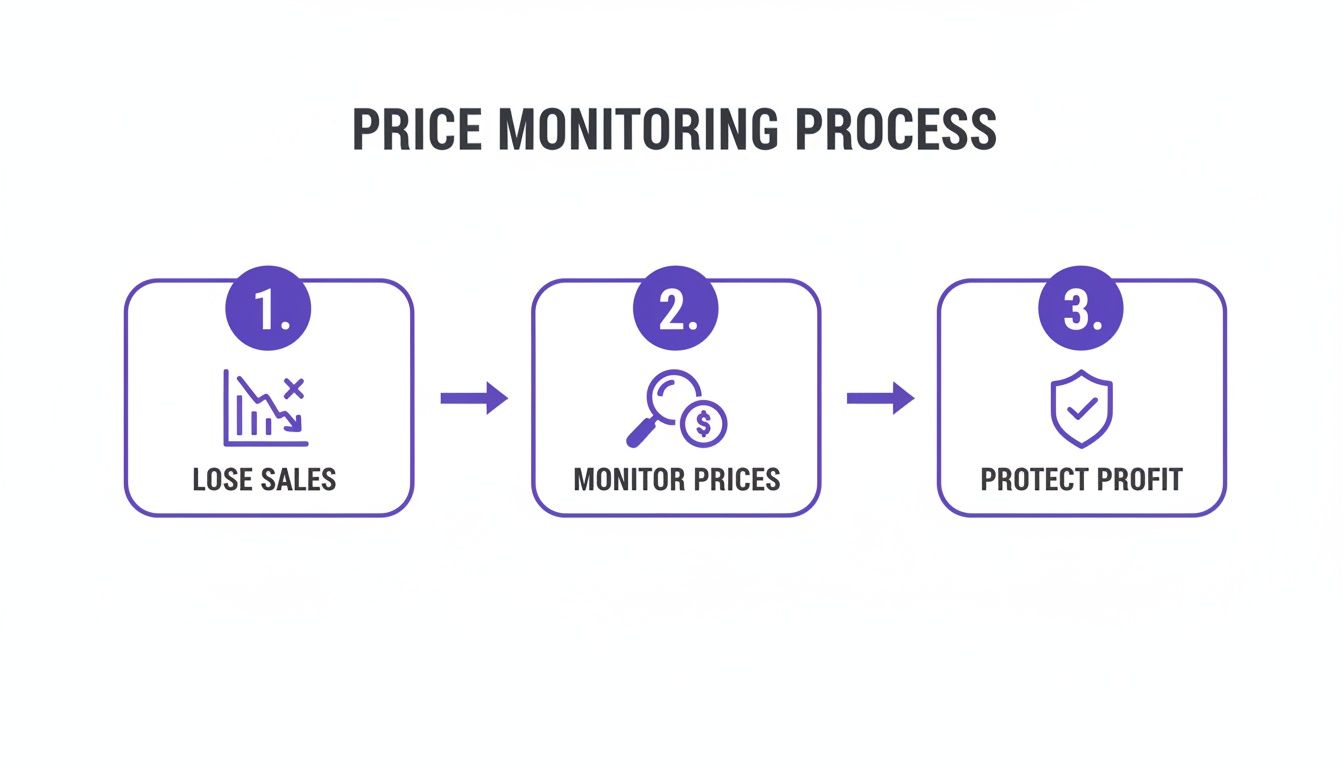
As the visual illustrates, a lack of active monitoring leaves your business exposed. Data collection is the essential shield for your profit margins.
Establishing Your Data Collection Engine
With target competitors and SKUs identified, the next step is building a reliable data collection engine. The quality of your pricing strategy is entirely dependent on the accuracy and timeliness of your data. Stale or incorrect information can lead to unnecessary price cuts or missed opportunities to increase prices.
Modern systems are built on automated web crawlers—bots programmed to visit competitor sites and marketplaces on a defined schedule. They extract relevant data points like price, stock levels, and promotions for your target products.
However, collecting raw data is only half the battle. The most critical challenge is product matching—correctly linking the data scraped from a competitor's page to the corresponding product in your catalog. Manual processes and basic tools often fail here, resulting in "dirty" data that compares your premium blender to a competitor's budget model. This is a recipe for poor decision-making.
Sophisticated, vendor-neutral systems use a multi-layered, often AI-driven approach to ensure accuracy:
- Product Codes: Using universal identifiers like UPCs, EANs, or MPNs (Manufacturer Part Numbers) delivers the highest matching accuracy.
- Product Titles and Descriptions: When codes are unavailable, AI can analyze text to find a match by comparing attributes, keywords, and specifications.
- Image Recognition: Advanced platforms can use visual AI to compare product images across different websites to confirm a match.
Use Case: Imagine a consumer electronics brand launching a new smartphone. To achieve 99%+ matching accuracy when tracking its price, an automated tool would first attempt to match via the phone's UPC. If a retail site does not list the UPC, the system's rules would trigger a fallback to match via the MPN. This layered logic ensures you are always comparing apples to apples. A good overview of ecommerce price monitoring tools can show you which platforms are built for this kind of detailed matching.
Finally, a robust data engine must include data cleansing. This automated process validates the data, flags outliers (such as a $1.00 price that is clearly a typo), and standardizes formats. This is where professional platforms excel, managing the complexity of crawling, matching, and cleaning massive datasets to deliver an intelligence feed you can trust.
Translating Raw Data into Actionable Intelligence
Collecting pricing data is the first step. Raw numbers in a spreadsheet do little to improve your bottom line. The real value is created when you transform that data stream into specific, automated actions that protect margins and capitalize on market opportunities.
This is the point where a price monitoring system evolves from a simple data feed into the strategic nerve center of your ecommerce operation. The goal is to move from passive observation to proactive, intelligent execution.

Setting Up Smart Alerts and Reports
The most direct way to operationalize your data is through smart alerts and reports. These are custom triggers that initiate a notification or an action the moment a significant market event occurs. Instead of manually searching for insights, the insights are delivered directly to you. This shift frees your team from repetitive data checks, enabling them to focus on high-value strategic work.
Use Case: A pricing manager for a home goods brand can set an alert to trigger the moment a key competitor drops the price on a best-selling blender by more than 10%. The notification, delivered via email or a dedicated Slack channel, provides the intel needed to make an immediate, informed pricing decision before sales are lost.
Here are a few other powerful, trigger-based alerts to configure:
- MAP Violation Alerts: Instantly notify your brand enforcement team when a reseller’s price falls below your Minimum Advertised Price (MAP). The alert should include a screenshot and URL for immediate evidence gathering.
- Competitor Stockout Alerts: Receive a notification when a rival runs out of stock on a popular product. This presents an opportunity to capture their customers, potentially at a higher price point.
- "Below Your Cost" Alerts: Create a rule to flag any competitor price that drops below your own cost of goods, helping you identify and ignore irrational pricing behavior.
- Price Leadership Alerts: Generate a daily digest showing every SKU where you are the lowest-priced seller, allowing you to quickly identify potential underpricing and opportunities to increase margins.
These alerts are not just notifications; they are real-time prompts for smarter business decisions.
Smart Alert Configuration Examples
| Scenario | Alert Trigger Rule | Automated Action/Workflow |
|---|---|---|
| Reseller breaks MAP policy | If reseller_price < MAP_price for SKU-123 | Send email with screenshot and link to Brand Protection team. |
| Key competitor out of stock | If competitor_stock_status = "Out of Stock" for SKU-456 | Notify Merchandising via Slack to review our price and ad spend for SKU-456. |
| Losing the Buy Box | If our_buy_box_status = "False" on Amazon for ASIN-789 | Push new, slightly lower price to the automated repricing engine. |
| Top competitor price drop | If competitor_price drops by > 15% for SKU-ABC | Create a task in the Pricing team's project board to analyze and respond. |
As demonstrated, the right alert does not just inform—it initiates a direct business process.
Integrating Intelligence into Your Workflows
For competitive intelligence to have a meaningful impact, it must be integrated directly into the systems your teams use daily. Creating this closed-loop system ensures that insights are not confined to a dashboard but actively shape commercial decisions across the organization.
This approach breaks down data silos and makes competitive awareness a natural part of your operational rhythm. For a deeper look at this, our guide on competitive intelligence gathering walks through how to build this system-wide process.
Remember the bigger picture: while price is a massive driver, it isn’t everything. Recent data shows 65% of shoppers prioritize product quality, with 56% pointing to price as their main factor. In a global ecommerce market barreling toward $6.4 trillion by 2029, your pricing needs to signal value, not just a bargain. Smart monitoring helps you strike that perfect balance between staying competitive and upholding your brand's integrity. You can dig into more of these ecommerce statistics on Hostinger to see how consumer behavior is shifting.
By plugging price monitoring data directly into your core business systems, you create an automated feedback loop. Market changes trigger alerts, which inform strategic decisions, leading to actions that directly grow revenue.
This integration can be implemented in several key areas:
- ERP Systems: Feed competitor stock level data into your Enterprise Resource Planning (ERP) software to improve inventory forecasting and purchasing accuracy.
- Repricing Engines: Push real-time competitor prices directly to your automated repricer, enabling dynamic adjustments on marketplaces like Amazon based on predefined rules.
- Sales Team Dashboards: Equip your sales team with competitor pricing for key accounts by piping data into their CRM or sales dashboards, enabling them to negotiate from a position of strength.
This is where automated platforms come into their own. They are built not just to scrape data but to provide the APIs and integrations needed to inject that intelligence directly into the tools your business depends on, turning raw data into a measurable competitive edge.
Common Pitfalls in Price Monitoring and How to Avoid Them
Implementing ecommerce competitor price monitoring is a significant step, but several common traps can undermine the strategy and lead to poor decisions. Understanding these pitfalls is the first step to avoiding them.

The most significant mistake is treating price monitoring as a simple numbers game. A successful program requires a holistic view of the competitive landscape, built on a foundation of clean, reliable data.
Pitfall 1: Focusing Only on Price
A singular focus on a competitor's sticker price while ignoring the total offer is a frequent error. A rival may advertise a lower price, but this is irrelevant if they charge high shipping fees, have poor seller ratings, or are consistently out of stock. These factors fundamentally alter the competitive reality.
Reacting to price alone invites a race to the bottom that erodes margins without strategic justification. Matching a competitor's "low price" is a poor decision if that competitor has a two-week shipping delay. Customers purchase the entire offer, not just the price.
Solution: Monitor the complete competitive landscape. Your system must track:
- Shipping Costs and Times: To calculate the true "landed cost" a customer will pay.
- Stock Availability: A competitor’s low price is an opportunity, not a threat, if they are out of stock.
- Seller Ratings and Reviews: A poorly rated seller is not an equivalent competitor.
- Promotions and Discounts: To understand if a price drop is a temporary coupon or part of a bundle.
Pitfall 2: Using Dirty or Inaccurate Data
Bad data is worse than no data. If your system incorrectly matches your premium product with a competitor’s budget version, any resulting pricing decision will be flawed. This is a common issue with manual tracking or basic tools that lack sophisticated product-matching logic. This problem quickly erodes trust in the system, leading teams to abandon it and rendering the investment useless.
Key Takeaway: The accuracy of your product matching directly dictates the quality of your pricing strategy. "Garbage in, garbage out" isn't just a saying; it's a harsh reality here.
Solution: Prioritize data quality above all else. Vet any monitoring solution with this checklist:
- Matching Accuracy: Does it prioritize high-integrity codes like UPCs, EANs, and MPNs?
- AI and Fallback Logic: What is the process when primary codes are missing?
- Data Validation: Does it automatically flag and quarantine obvious errors, like a $1,000 item listed for $10?
- Refresh Rate: Is the data updated frequently enough to match the velocity of your market?
For brands, this is also critical for enforcing MAP policies. Inaccurate data can lead to falsely accusing a compliant retail partner of a violation, which can permanently damage a critical business relationship. You can learn more in our guide on what is minimum advertised price, where we detail why policy enforcement demands absolute precision.
Pitfall 3: Suffering from Analysis Paralysis
The final pitfall is collecting vast amounts of data without taking any action. Teams can become so inundated with reports and dashboards that they are unable to convert insights into execution. A sophisticated dashboard is merely noise if it does not drive a decision.
This typically occurs when there are no clear workflows or accountability linked to the data. An alert about a MAP violation is useless if no one is assigned to contact the reseller. This is where automated tools that integrate alerts directly into a team's workflow are invaluable, converting a data point into a clear, actionable task.
Measuring the ROI of Your Monitoring Efforts
Any investment in a new tool must be justified by its financial return. To secure executive buy-in, you must draw a direct line from monitoring activities to measurable business outcomes. When you track the right metrics, the impact becomes clear.
Treating ROI calculation as a core part of the process transforms your monitoring platform from a cost center into a proven profit driver. The process begins by establishing a clear performance baseline before implementation.
Defining Your Core Commercial KPIs
To measure the impact of your strategy, focus on the high-level metrics that matter to the business's financial health. These Key Performance Indicators (KPIs) serve as your proof of value.
Start with these four critical areas:
- Margin Uplift: The most direct measure of success. By identifying opportunities to increase prices where you are under-market or by avoiding unnecessary price drops, you will see a direct increase in gross margin.
- Increased Sales Velocity: Track the units sold per day for your Key Value Items (KVIs). When pricing is informed by real-time data, these core products should sell at a faster rate.
- MAP Compliance Rate: For brands, this is a crucial metric. Measure the percentage of resellers adhering to your Minimum Advertised Price policy. An effective monitoring system should drive this number significantly higher.
- Reduction in Lost Buy Box Percentage: On marketplaces like Amazon, winning the Buy Box is paramount. Track the frequency with which you lose it to a competitor. An integrated monitoring and repricing solution will reduce this percentage, translating directly into increased sales.
A Straightforward Method for Calculating ROI
A complex financial model is not necessary. A disciplined "before and after" approach is sufficient.
First, establish a baseline. For at least one full month before activating your monitoring system, document performance against the KPIs listed above. This is your control period.
Once your monitoring and repricing workflows are active, track the same KPIs over the next three to six months. The difference between your baseline and your new performance demonstrates the direct impact of your investment.
The formula for ROI is simple but powerful: (Gain from Investment - Cost of Investment) / Cost of Investment. A positive result proves the system is an asset, not an expense.
Getting this right is more important than ever. With the global ecommerce market projected to hit $3.89 trillion in 2026, competition will only intensify. You can dive deeper into the global ecommerce market on Statista.
Real-time monitoring is no longer a luxury; it is a necessity, particularly when 67.8% of consumers report wanting AI to help them compare prices across different sites.
This is where automated price monitoring tools like Market Edge become useful. They provide the dashboards and historical data required to track these KPIs consistently, making it simple to demonstrate the value of your work to stakeholders.
Frequently Asked Questions
Even with a solid plan, practical questions often arise when implementing a competitor price monitoring strategy. Here are answers to some of the most common inquiries from ecommerce managers and founders.
How Often Should I Monitor Competitor Prices?
The answer depends entirely on your market's velocity. There is no single correct frequency. The objective is to match the speed of your industry.
In fast-moving categories like consumer electronics or for sellers competing for the Amazon Buy Box, prices can change multiple times per day. In these environments, near real-time monitoring is required to avoid falling behind and losing sales.
Conversely, for specialized B2B equipment or in categories with slower price cycles, daily or even weekly monitoring may be sufficient. The key is to align your monitoring frequency with the rate of competitive price changes. This is why automated tools are essential—they perform the continuous tracking required to keep pace.
Is It Legal to Scrape Competitor Pricing Data?
In most jurisdictions, yes. Scraping publicly available information, such as product prices on a retail website, is generally considered legal. This information is accessible to any consumer visiting the site.
The nuances lie in the method of data collection. It is crucial to be a responsible digital citizen. This means respecting a website's robots.txt file (which specifies which pages should not be accessed by bots) and ensuring your crawling activity does not overload or disrupt the target server.
Using a professional third-party service is the safest approach. These platforms are designed to gather data ethically and responsibly, navigating the technical and legal complexities on your behalf.
How Do I Handle Competitors Who Use Dynamic Pricing?
Manually tracking a competitor that uses dynamic pricing algorithms is impossible. Their prices adjust continuously based on demand, inventory levels, and other real-time factors. The only effective strategy is to counter their automation with your own.
This requires a high-frequency monitoring tool that can detect rapid price changes as they occur. This data can then be fed directly into your own pricing engine, where you can establish rules to respond automatically. For example, a rule could be set to maintain your price within 2% of a key competitor's, with a floor price defined by your minimum profit margin. This allows you to react in minutes, not days, maintaining competitiveness without constant manual oversight.
What Is More Important: The Number of Competitors or SKUs I Track?
Focus on quality over quantity. A common mistake is attempting to track too broad a scope from the outset.
You will get far more value from closely tracking your top 5-10 direct competitors on the 20% of your products that generate 80% of your revenue.
This focused approach is far more effective than superficially monitoring 50 competitors across a random assortment of SKUs. Start by identifying your Key Value Items (KVIs) and your most direct rivals. The resulting data will be immediately actionable and directly linked to your business's financial performance.
Once you have mastered this initial scope and can demonstrate a clear ROI, you can strategically expand your monitoring. Ensure the platform you choose is built to scale with your business as your needs evolve.
This is where automated price monitoring tools like Market Edge become useful. You can learn more about how they work.