
Supplier negotiation is a disciplined process built on solid data, strategic tactics, and robust contracts. When executed correctly, it protects margins, secures the supply chain, and forges partnerships that provide a genuine market advantage. For B2B decision-makers, mastering this skill is a direct lever for improving profitability.
Why Mastering Supplier Negotiations Is Non-Negotiable
For any B2B buyer—be it a distributor, importer, or manufacturer—effective supplier negotiation is a core function that directly impacts the P&L. Every percentage point saved on the cost of goods sold (COGS) drops straight to the bottom line, freeing up capital for growth.
In a volatile economy, a strong supplier agreement acts as a buffer against unexpected price hikes and supply chain disruptions.
However, this is not about squeezing every last cent from suppliers in a zero-sum game. The goal is to create mutual value and build reliable, transparent partnerships that strengthen the entire supply chain.
The Commercial Imperative of Strategic Negotiation
Focusing solely on the unit price is a common and costly mistake. The primary target should be optimizing the Total Cost of Ownership (TCO), which includes all ancillary costs that simple haggling overlooks. A strategic approach secures advantages that are just as valuable as a lower unit cost.
Here’s what this looks like in practice:
- Improved Cash Flow: Negotiating better payment terms—for instance, moving from Net 30 to Net 60—can free up significant working capital without altering the product price.
- Reduced Operational Overhead: Agreeing on realistic Minimum Order Quantities (MOQs) and practical delivery schedules prevents tying up cash in excess inventory and reduces warehousing costs.
- Enhanced Supply Chain Resilience: Strong relationships transform suppliers into partners who are more likely to prioritize your orders during shortages or offer innovative solutions.
- Stronger Market Positioning: Favorable terms and stable costs are foundational to competitive retail pricing. This helps enforce MAP/RRP policies, preserving brand value and protecting margins.
A negotiation grounded in objective market data transforms a subjective debate into a fact-based business discussion, which is the primary source of leverage. This is where automated price monitoring tools like Market Edge become useful.
Building Your Case with Market Intelligence
Entering a negotiation without comprehensive data means leaving money on the table. The most effective negotiators build an evidence-based case long before the meeting, turning a subjective debate into a data-driven discussion.
The goal is to shift the conversation from "I think your price is too high" to "Here is what the market data indicates."
Start with a deep analysis of your Total Cost of Ownership (TCO). Fixating on the per-unit price is a mistake; it ignores critical costs like shipping, tariffs, quality control rejects, and the cost of capital tied up in payment terms. Negotiating without a complete TCO picture is negotiating with a handicap.
Benchmarking with Real-Time Data
The core of preparation is benchmarking your supplier's pricing against the current market—not historical data. Automated market intelligence tools are indispensable for this task.
Without objective data, you are forced to accept the supplier's definition of a "fair price." With it, you control the narrative. For example, a pricing manager sourcing an electronic component can use a price monitoring tool to instantly see if a quote is misaligned with the market average. This discrepancy becomes a powerful, factual anchor for a counteroffer.
This is a proven strategy. Buyers who leverage data to consolidate their supplier base and negotiate more effectively consistently achieve significant savings. Industry studies show that companies using this approach often realize unit-cost reductions of 5–15%. With 86% of supply-chain executives planning to increase investment in sourcing analytics, data-backed negotiations are becoming standard practice.
Mini-Scenario: An Ecommerce Manager's Data-Driven Case
An ecommerce manager receives a notification from a key supplier about a 7% price increase on a blender motor, citing rising raw material costs.
Instead of accepting or arguing, the manager uses her market intelligence platform. Here is what she finds:
- Component Cost Analysis: The platform tracks commodity prices for copper and steel. The data shows that while copper prices spiked three months ago, they have since stabilized. Steel prices have remained flat.
- Competitor Benchmarking: She pulls pricing for similar-spec motors from two alternative suppliers and finds they are offering comparable components for 3-5% less than the supplier's current price.
- Finished Goods Monitoring: The tool reveals that retail prices for competing blender brands, which would be subject to MAP policy enforcement, have not increased. This suggests competitors are not facing the same cost pressures or are absorbing them.
Armed with this intelligence, the manager schedules a call. She shares her screen and presents the dashboards showing stabilized commodity prices, lower competitor quotes, and a flat retail market.
The conversation shifts from a defensive back-and-forth to a collaborative discussion about aligning pricing with market reality. The supplier not only waives the increase but also agrees to a small price reduction in exchange for a larger volume commitment.
Turning Insights into Action
This data-driven approach does more than secure a better price. It signals that you are a sophisticated buyer who operates on facts. It builds a more transparent relationship grounded in a shared understanding of the market. This is precisely what solutions like Market Edge are designed to provide: SKU-level intelligence to benchmark quotes and challenge increases.
A negotiation without market data is an argument. A negotiation with market data is a business decision.
Use this checklist to prepare for your next negotiation.
Pre-Negotiation Data Checklist
| Data Point | Why It Matters | Example Source |
|---|---|---|
| Current Supplier Spend | Establishes your value as a customer and the volume you represent. | Your ERP or accounting software |
| Total Cost of Ownership (TCO) | Reveals the true cost beyond the unit price, including freight, duties, and quality issues. | Internal analysis of logistics, finance, and operations data |
| Market Benchmark Prices | Provides an objective baseline for what the market is currently paying for the same or similar items. | Automated price monitoring platform (e.g., Market Edge) |
| Competitor Supplier Quotes | Creates direct leverage by showing viable alternatives and their pricing. | Direct quotes from at least two alternative suppliers |
| Raw Material Cost Trends | Helps validate or challenge supplier price increases based on commodity market fluctuations. | Public commodity price indexes, market intelligence reports |
| Your BATNA | Defines your walk-away point, ensuring you don't accept a deal worse than your next best alternative. | Analysis of alternative suppliers or in-house production costs |
Having these data points on hand makes you a more strategic and effective negotiator.
Time to Talk: Tactics and Scripts That Actually Work
With market intelligence gathered and numbers analyzed, it's time to put that preparation into action. Your data is the leverage that transforms a potentially tense conversation into a productive business discussion.
The tone set in the first five minutes often determines the final outcome. A hardline, zero-sum demand puts the supplier on the defensive, hindering creative solutions. A collaborative opener frames the negotiation around finding a path to mutual success.
Ditch the Adversarial Mindset
Shifting from a win-lose battle over price to a win-win partnership changes the dynamic. It elevates the conversation from a simple transaction to a strategic alliance with a real impact on your bottom line.
One study found a significant performance gap between collaborative and adversarial buyers. Among the bottom 10% of buyers, 64% described their negotiations as adversarial. Top performers, in contrast, built partnerships.
Suppliers allocate their best resources—priority delivery, innovative ideas, and first call on limited inventory—to customers they view as partners. This yields tangible benefits like fewer late shipments and faster problem resolution. For more on this, scmr.com has a great piece on strategic sourcing.
An aggressive stance might secure a small, one-time discount. A collaborative approach unlocks long-term value, including better service and priority access to inventory.
Always Know Your Walk-Away Point (Your BATNA)
Before initiating contact, you must have a clear Best Alternative to a Negotiated Agreement (BATNA). This is your plan B—the concrete, actionable course you will take if the deal fails.
A solid BATNA cannot be a vague idea. It must be a specific plan:
- You have a quote from a secondary supplier and are ready to sign.
- You have calculated the cost of bringing a process in-house.
- Your engineering team has a plan to redesign the product with a more common component.
A well-defined BATNA provides confidence, allowing you to walk away from an unfavorable deal. It is equally crucial to analyze your supplier's BATNA. What happens to their business if they lose your volume? Understanding their position reveals your negotiating flexibility.
Real-World Scripts for Common Scenarios
Here are practical scripts for common situations that integrate data without sounding robotic.
Scenario 1: The Sudden Price Hike
Your supplier announces a 6% price increase, citing "rising market costs."
Ineffective response: "We can't accept this. It's too high."
Professional response:
"Hi [Supplier Name], thanks for sending the new pricing. I've reviewed it and wanted to connect. We've been tracking raw material costs for this component using our market monitoring platform, and our data shows the commodity inputs have actually decreased by about 2% this past quarter. We also have recent quotes that are below your proposed price. We value our partnership and hope we can work together to align this pricing with the current market."
This approach is effective because it:
- Initiates the conversation professionally.
- Uses objective, third-party data as a neutral foundation.
- Frames the goal as a shared problem to solve ("work together").
Scenario 2: Getting Better Payment Terms
You need to improve cash flow and want to shift from Net 30 to Net 60 terms.
Ineffective response: "We need Net 60 terms now."
Professional response:
"As we map out our purchasing plan for the next fiscal year, we're projecting a 15% increase in our order volume with you. To facilitate that growth on our end, moving to Net 60 terms would significantly improve our cash flow. It would allow us to place those larger, more consistent orders, which I imagine aids your production planning. Would you be open to exploring that in exchange for a larger annual commitment from us?"
You are not just asking; you are trading value—offering them predictability for something you need.
Scenario 3: Moving Beyond Price
When price is inflexible, real wins can be found by negotiating other levers, like Minimum Order Quantities (MOQs).
Ineffective response: "Your MOQ is too high."
Professional response:
"We're ready to bring your new product line on board, but the 5,000 unit MOQ is a significant initial inventory commitment for us. What if we started with a trial order of 2,500 units for the first quarter? That would allow us to test the market and gather sales data. If it performs as expected, we would commit to the standard MOQ on all reorders. This approach would lower the initial risk and support a strong product launch."
You have turned a demand into a logical, shared-risk business proposal.
By anchoring every conversation in solid data and focusing on mutual value, negotiation becomes a strategic business discussion. This is where automated tools like Market Edge provide the objective facts needed to build a compelling case.
Crafting Contracts That Protect Your Business
A verbal agreement is insufficient. In B2B procurement, a successful negotiation is only as strong as the contract that makes it legally binding. For distributors, importers, and manufacturers, the contract is a critical risk management tool that protects your business from supply chain volatility and preserves margins.
The foundation of any robust supplier agreement is clarity. Ambiguity invites future disputes. The contract must detail every key commercial element, moving beyond unit price to establish a complete partnership framework, including payment schedules, performance metrics, and the precise pricing model.
Defining Your Pricing and Payment Structures
The pricing model is the engine of the contract. Each type carries distinct risks and rewards.
- Fixed Pricing: This model locks in a price for a specific period, offering predictability for budgeting and protection from short-term market spikes. The drawback is potentially missing out on savings if market prices fall.
- Cost-Plus Pricing: You agree to pay the supplier's actual cost plus a predetermined margin. This offers transparency but exposes you to fluctuations in the supplier’s raw material and labor costs. It requires a high degree of trust and verifiable cost auditing.
- Indexed Pricing: The price is tied to an independent commodity index (e.g., the London Metal Exchange for copper). It provides a transparent and fair method for price adjustments based on objective market data, not supplier discretion.
Beyond price, payment terms directly impact cash flow. Negotiating for Net 60 or Net 90 terms can free up significant working capital. These terms must be explicitly stated in the contract, along with any penalties for late payments.
Mitigating Risk with Modern Contract Clauses
Today’s supply chains are fraught with geopolitical and logistical risks. An outdated contract template is a liability. Your agreement must include clauses that address current challenges.
Recent tariffs and global instability have made protective clauses non-negotiable. In a recent survey, 82% of companies reported that new tariffs impacted their supply chains, with 39% experiencing direct cost increases. Savvy sourcing teams now insist on clear tariff-sharing clauses, which have been shown to reduce contract-level cost variability by 30–50%. As six in ten companies alter freight strategies, negotiating flexible shipment terms is a standard defense against volatility. You can discover more insights about these global sourcing trends on novexglobal.com.
A proactive contract anticipates potential problems and defines the solution in advance. It turns a future crisis into a manageable business process.
This decision tree provides a visual for thinking through common negotiation triggers and tactical responses.
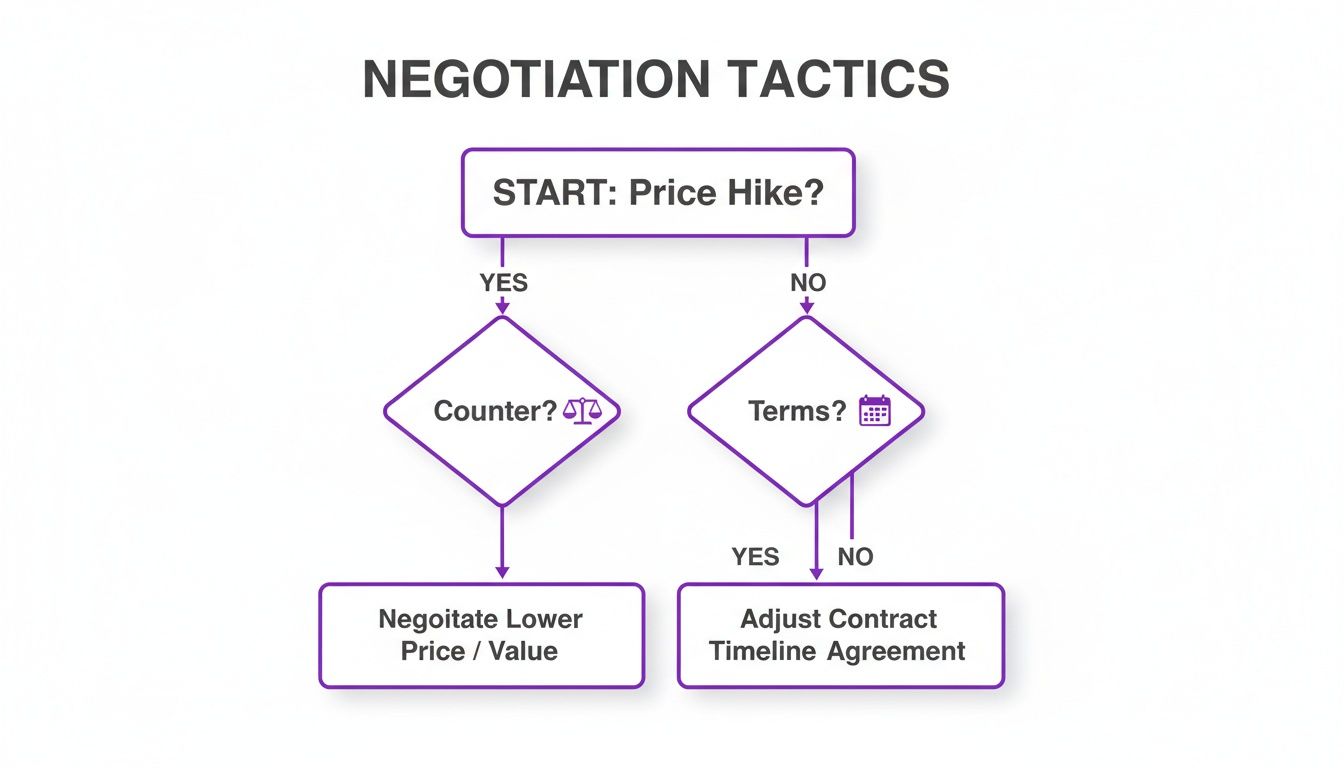
As the chart illustrates, you always have multiple levers to pull beyond price.
Real-World Examples of Key Clauses
Practical language is more useful than abstract legal theory. Here are examples of clauses that address common risks.
1. Tariff-Sharing Clause
This clause ensures you are not solely responsible for unexpected government-imposed duties.
- Example Language: "In the event that a new governmental tariff or import duty exceeding 2% is imposed on the products covered by this agreement, the parties agree to share the additional cost equally (50/50). This adjustment will be reflected in subsequent invoices upon documented proof of the tariff’s implementation."
2. Freight Cost Escalation Formula
This creates a shared-risk model to protect against volatile shipping costs.
- Example Language: "The agreed-upon unit price is based on the current freight index rate of $X per container. Should the index rate increase or decrease by more than 10% from this baseline in any given quarter, the parties agree to adjust the unit price to cover 75% of the variance. The adjustment will be calculated quarterly."
Building specific, measurable clauses into your agreement transforms your contract from a static document into a dynamic partnership management tool. It also helps set clear expectations around pricing policies like MAP/RRP.
Ultimately, crafting a strong contract requires foresight. It means thinking through "what-if" scenarios and documenting solutions before they become emergencies. Objective data from a tool like Market Edge is invaluable here, providing the market intelligence needed to set fair and defensible baselines for clauses like indexed pricing.
Managing and Monitoring Supplier Performance
Signing the contract is the beginning, not the end. A successful negotiation only delivers value if the agreed-upon terms are consistently met. Ongoing supplier relationship management (SRM) is the process that ensures the value secured on paper materializes in your operations.
Without diligent monitoring, "contract drift" is inevitable. Prices creep up, delivery dates slip, and quality degrades. Proactive management turns the static contract into a living guide for the partnership.
Establishing Clear Performance Metrics
You cannot manage what you do not measure. Vague expectations lead to frustration. To hold suppliers accountable, track their performance against clear, quantifiable Key Performance Indicators (KPIs). These should be agreed upon during negotiation and embedded in the contract.
Focus on the metrics that directly impact your business:
- On-Time Delivery (OTD): The percentage of orders that arrive within the promised window. A late shipment can halt production or lead to lost sales.
- Order Fill Rate: The percentage of orders filled correctly on the first attempt. Backorders and incorrect items create administrative overhead and inventory issues.
- Quality Acceptance Rate: The percentage of products that pass quality control. A low acceptance rate increases costs and risks brand reputation.
- Price Compliance: A check to ensure invoices match the contracted price list and are free of unapproved charges.

Top-tier procurement teams understand that negotiation and performance management are two sides of the same coin, both essential for achieving strategic goals.
Conducting Data-Driven Business Reviews
With objective data, supplier check-ins can become structured, high-impact business reviews. Schedule these quarterly or semi-annually to review performance against the agreed-upon KPIs.
A business review is not about assigning blame. It is about using data to identify the root cause of problems and collaborating on future solutions.
For example, if the On-Time Delivery rate has slipped to 85%, present the data and frame it as a shared challenge: "We've noticed OTD has dipped this quarter. Can we walk through your fulfillment process to identify any potential bottlenecks?" This collaborative approach is more productive than an accusation. These reviews are also an opportunity to share forecasts, discuss market shifts, and explore new opportunities.
Using Continuous Monitoring to Maintain Leverage
The market is dynamic, and pricing agreements should not be static. Market conditions can change significantly between contract renewals, creating new opportunities to refine terms. Continuous, automated monitoring provides a strategic advantage.
By constantly tracking market prices for key products, you can immediately see if your negotiated prices remain competitive. If the market price for a key raw material drops 10%, you have a concrete, data-backed reason to initiate a conversation with your supplier, long before a formal contract renewal.
This is where automated platforms such as Market Edge demonstrate their value. They monitor the market on your behalf, alerting you when a supplier's pricing is misaligned with current benchmarks. This data also supports the enforcement of your own pricing policies, such as MAP, by providing visibility into how your products are priced across the market. This ensures you never miss a chance to renegotiate from a position of strength, turning negotiation into a continuous improvement cycle.
Questions We Hear All the Time
Here are answers to some of the most common questions we receive from B2B decision-makers on supplier negotiations.
What's the One Thing I Absolutely Have to Do Before Any Negotiation?
Prepare. Walking into a negotiation without solid data is a critical error.
You must know your numbers, especially your Total Cost of Ownership. Equally important is having objective market data to ground the conversation. What are other suppliers charging? What are the underlying commodity trends?
Real-time market intelligence transforms a subjective argument into a factual, data-driven discussion. Your walk-away point (BATNA) is crucial, but backing it up with hard numbers provides real leverage.
My Long-Term Supplier Just Hit Me with a Big Price Hike. What Now?
First, do not react emotionally or burn the bridge. Acknowledge the long-term relationship to show you value the partnership. Then, get firm.
Request a detailed breakdown of the cost increases. Are they from raw materials, logistics, or labor? Do not accept a vague justification like "our costs have gone up."
This is your cue to present your own market intelligence. If you have data showing that commodity prices have stabilized or that their competitors are not implementing similar hikes, present it clearly.
A productive approach is to shift into problem-solving mode. You could suggest a smaller, phased increase, offer a larger volume commitment to maintain the current price, or propose a joint effort to find cost savings elsewhere in the supply chain. The goal is to act as a partner who cannot absorb unjustified price increases.
When Should I Just Walk Away from the Table?
Walking away is a strategic move, not a failure. You exit a negotiation when the supplier's "best and final" offer is worse than your Best Alternative to a Negotiated Agreement (BATNA).
Your BATNA could be a confirmed price from another supplier, the cost to bring production in-house, or another viable solution. If a supplier cannot meet essential quality standards, refuses reasonable contract terms, or is inflexible on a price you know is misaligned with the market, it is time to disengage.
Protecting your business from a bad deal is always the correct decision. It also signals that you operate with non-negotiable standards.
This is precisely where continuous market intelligence becomes a game-changer. A tool like Market Edge provides the data needed to validate supplier pricing, find better sourcing options, and ensure you always negotiate from a position of strength. You can see how it works at marketedgemonitoring.com.