
Product bundling is a critical lever for increasing average order value (AOV), improving customer loyalty, and protecting margins. However, a successful bundling strategy is more than a simple discount; it is a calculated science. For B2B decision-makers, ecommerce managers, and pricing leaders, understanding the mechanics behind different models is essential for staying competitive. Simply copying a competitor's bundle without analyzing its structure and market impact is a direct path to margin erosion.
This article provides a practical breakdown of 10 distinct bundling pricing examples. Each example includes an analysis of its structure, commercial impact, and strategic considerations, such as MAP enforcement. We will explore how leaders in SaaS, ecommerce, and retail use bundles to drive growth and how you can adapt these proven strategies.
The goal is to equip you with actionable frameworks to design, implement, and monitor profitable product bundles. We will cover everything from SaaS tiered bundles to marketplace multi-buy discounts, providing the tactical insights needed to turn bundling into a powerful competitive advantage. You will learn not just what these companies do, but why their strategies work and how to replicate their success.
1. Software-as-a-Service (SaaS) Tiered Bundling
SaaS tiered bundling is one of the most effective bundling pricing examples for digital products. This strategy involves packaging software features into distinct, value-based tiers (e.g., Basic, Pro, Enterprise) at escalating price points. Instead of selling features a la carte, companies bundle core functionality with increasingly premium services like advanced analytics, higher usage limits, or dedicated support.
This model simplifies the buying decision and creates clear upgrade paths. For instance, a price monitoring platform might offer a starter plan tracking 50 SKUs and two competitors, while a professional tier bundles 500 SKUs, 10 competitors, and MAP monitoring alerts. This structure aligns value directly with customer needs and growth.
Strategic Analysis & Application
- When to Use It: Ideal for platforms with a diverse feature set that serves customers of varying sizes and needs, from small businesses to large enterprises.
- Margin Impact: High. By bundling high-demand, low-cost features (like basic reporting) with high-value, high-margin features (like AI-driven repricing analytics), you can significantly increase the average revenue per user (ARPU) and protect margins.
- Actionable Takeaway: Use product analytics to identify your most-used "sticky" features. Package these in your entry-level tier to drive adoption. Isolate high-value features that solve major pain points for larger customers and reserve them for higher-priced bundles, creating a compelling incentive to upgrade.
2. E-Commerce Marketplace Bundle Discounts (Amazon, eBay)
Marketplace bundle discounts are a cornerstone of modern ecommerce and one of the most visible bundling pricing examples. This strategy involves sellers creating a single listing for multiple, often complementary, products offered at a lower price than if purchased separately. It's a powerful tool for increasing average order value (AOV) and moving inventory more efficiently on platforms like Amazon and eBay.

This tactic simplifies the customer journey by anticipating their needs. For example, a retailer might bundle a new television with a compatible soundbar and mounting hardware, offering a 10% discount on the total price. For sellers, this not only boosts revenue per transaction but also reduces individual shipping and handling costs. Monitoring these bundles is critical, as a competitor's aggressive bundle can make your standalone products appear overpriced. Learn more about effective Amazon pricing strategies to stay competitive.
Strategic Analysis & Application
- When to Use It: Excellent for retailers with complementary product catalogs, sellers needing to clear slow-moving inventory by pairing it with a bestseller, or brands aiming to increase market penetration for a new product.
- Margin Impact: Moderate to High. While the bundle discount slightly reduces the margin per unit, the increased sales volume, higher AOV, and reduced marketing/shipping costs per item often lead to a significant net profit increase.
- Actionable Takeaway: Use SKU-level sales data to identify which products are frequently purchased together. Create "pure" bundles with these items, starting with a 5-10% discount. An automated platform like Market Edge can track competitor bundle offerings and ensure your combined price remains competitive without eroding essential margins.
3. Telecommunications & Utility Provider Bundling
A classic and powerful model, telecommunications and utility bundling is one of the most visible bundling pricing examples in the B2C world, with powerful lessons for B2B. This strategy packages core services like internet, phone, and TV into tiered "play" bundles (e.g., Double Play, Triple Play) that offer greater perceived value and convenience than purchasing each service separately. This approach is designed to maximize customer lifetime value and create high switching costs.
Companies like Comcast with its Xfinity Triple Play and Verizon with its Fios bundles have mastered this model. They lock customers into an ecosystem, making it inconvenient and costly to unbundle services and switch to a competitor for just one component. This strategy secures long-term revenue streams and reduces customer churn by integrating multiple essential services under a single bill.
Strategic Analysis & Application
- When to Use It: Best for businesses offering multiple complementary services or products that are frequently used together. It's especially effective in markets with high customer acquisition costs and a need to increase customer "stickiness."
- Margin Impact: Moderate to High. While the bundled price is lower than the sum of individual services, the strategy significantly reduces churn and marketing costs per service. Increased customer lifetime value and predictable revenue often offset the initial discount. This requires a well-defined competitive pricing strategy to ensure bundles remain attractive.
- Actionable Takeaway: Identify a core, high-demand product in your portfolio. Create bundles by adding complementary, higher-margin accessories or services at a compelling discount. For example, a hardware distributor could bundle a primary product with an installation service and an extended warranty. Use a tool to monitor how competitors package similar service-product combinations to ensure your offer provides superior value.
4. Retail Fast-Moving Consumer Goods (FMCG) Multi-Buy Bundling
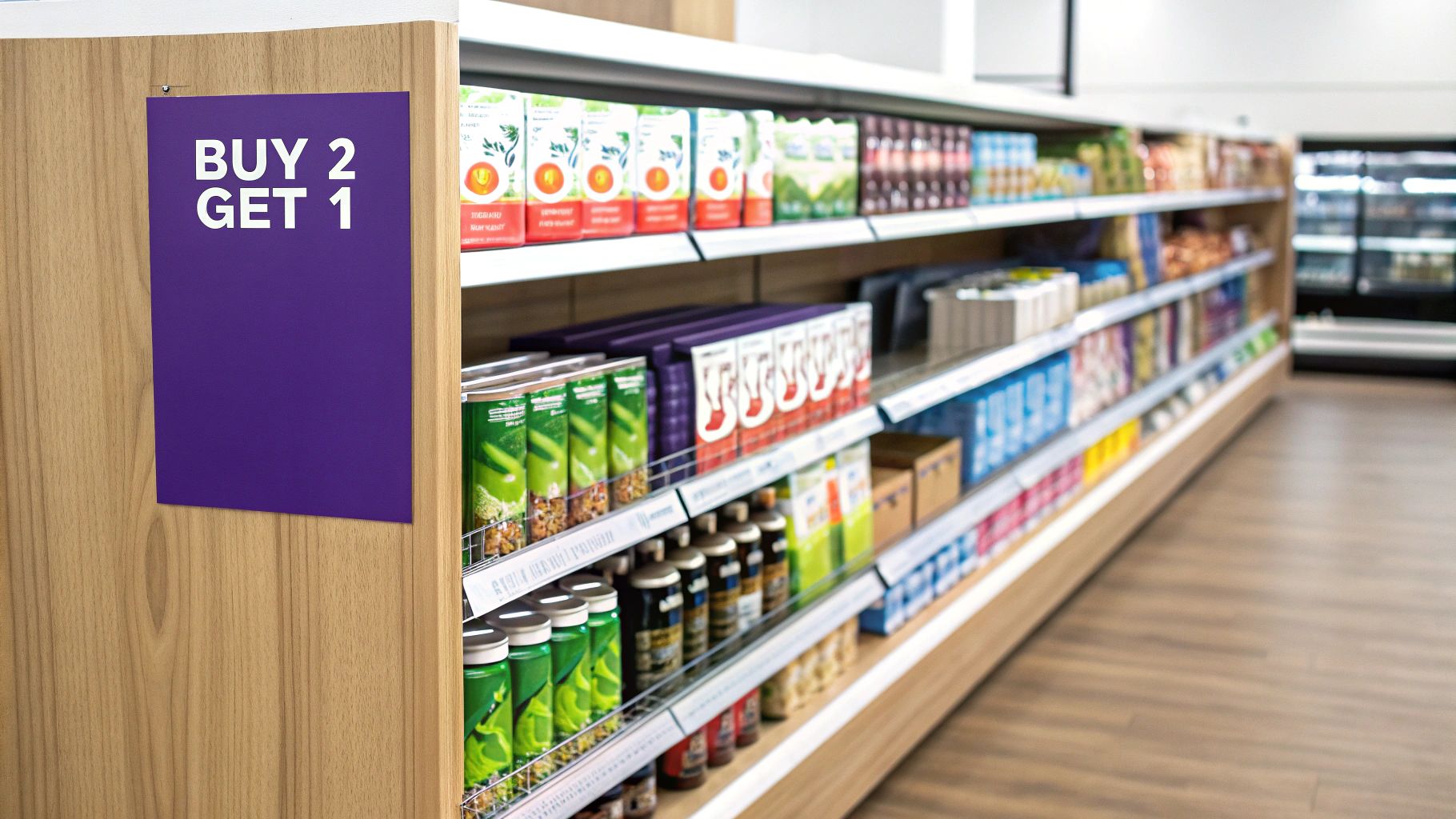
For Fast-Moving Consumer Goods (FMCG) brands and retailers, multi-buy bundling is a high-velocity strategy used to increase sales volume and accelerate inventory turnover. This common tactic, seen in promotions like 'Buy 2, Get 1 Free' or discounted multi-packs, is one of the most visible bundling pricing examples in the physical and digital retail space. It encourages larger basket sizes by offering a lower effective per-unit price.
For example, a beverage company might bundle a 6-pack of cans at a price that is more appealing than buying six individual units. Similarly, many CPG brands frequently bundle complementary items like shampoo and conditioner. This strategy simplifies the consumer's choice while locking in a larger, immediate sale for the brand.
Strategic Analysis & Application
- When to Use It: Ideal for high-volume, low-margin products where increasing the quantity per transaction is a primary goal. It's also effective for clearing slow-moving inventory or introducing new products alongside established sellers.
- Margin Impact: Variable. While it decreases the per-unit margin, the goal is to drive enough incremental volume to increase overall profit. This requires careful monitoring, as deep discounts can quickly erode profitability if sales lift doesn't compensate for the lower margin.
- Actionable Takeaway: Use a price monitoring tool to track competitor multi-buy promotions across different retailers in real time. Platforms like Market Edge can help you analyze historical sales data to determine the optimal bundle depth (e.g., a 3-pack vs. a 6-pack) that maximizes promotional lift without excessively sacrificing margin.
5. Video Streaming Service Bundling (Netflix, Disney+, Amazon Prime)
Video streaming services provide a masterclass in modern bundling pricing examples. This strategy involves packaging content and features into distinct tiers, often based on video quality (HD, 4K), number of simultaneous streams, or the presence of ads. It's a powerful model for maximizing subscriber acquisition and lifetime value by catering to different budget and usage needs.
For example, Netflix offers Basic, Standard, and Premium plans, bundling higher resolution and more screens at each level. Disney takes it further with its multi-service bundle, combining Disney+, Hulu, and ESPN+ at a significant discount compared to individual subscriptions. This ecosystem approach locks in users and drastically reduces churn by increasing perceived value.
Strategic Analysis & Application
- When to Use It: Excellent for digital product and content-based businesses where marginal costs for adding features are low. It’s also effective for companies with multiple complementary services that can be packaged together to create a stronger value proposition.
- Margin Impact: High. Bundling increases the total addressable market by offering accessible entry-level price points while creating high-margin upgrade paths. Multi-service bundles, like Apple One, boost customer lifetime value and create a defensive moat against competitors.
- Actionable Takeaway: Analyze customer segments to identify distinct value drivers. Create a basic tier that serves as a low-friction entry point, then bundle high-demand features like 4K streaming or offline downloads into premium tiers. This strategy shares principles with other pricing models; you can learn more about dynamic pricing examples to expand your tactical playbook.
6. Quick-Service Restaurant (QSR) Combo Meal Bundling
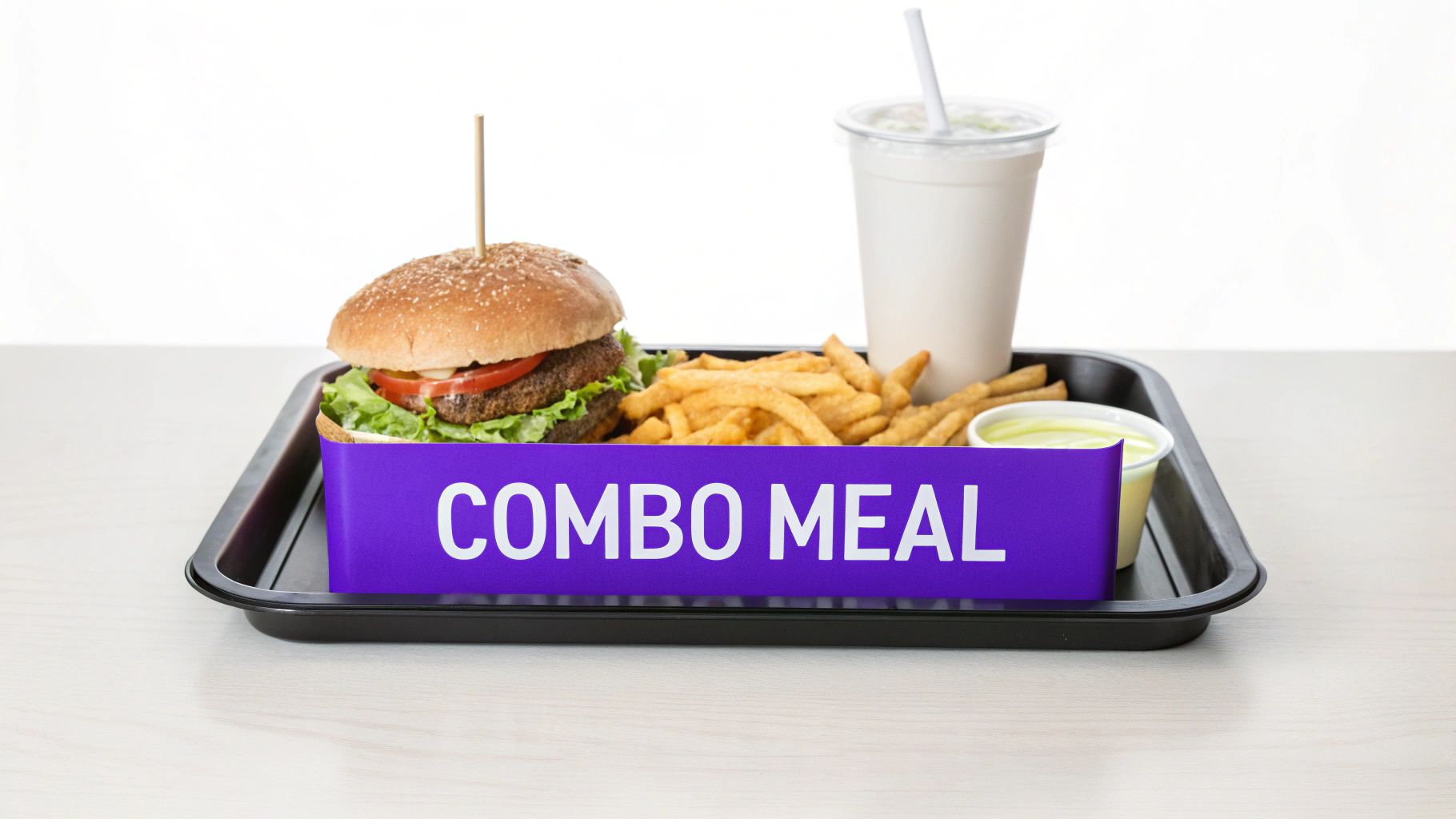
A classic high-volume tactic, QSR combo meal bundling groups a main item (like a burger), a side (fries), and a drink for a single, discounted price. This is one of the most recognizable bundling pricing examples, designed to increase the average order value (AOV) while simplifying the customer's decision-making process. The perceived value and convenience drive higher sales volumes and streamline kitchen operations.
For instance, a customer might buy a $7 burger, $3 fries, and a $2 drink individually for $12. The combo meal offered at $10 creates an immediate, easy-to-understand saving of $2, making it an almost automatic choice for most buyers. This strategy is not limited to QSRs; its psychological principles can be adapted for B2B distributors bundling a core product with accessories and a service plan.
Strategic Analysis & Application
- When to Use It: Excellent for high-volume, low-margin environments where increasing average transaction value is a key goal. It's also effective for products with natural complements, such as a power tool bundled with a battery and a carrying case.
- Margin Impact: Moderate to High. While the per-item margin on the bundle is lower than selling a la carte, the significant increase in AOV and sales volume often leads to higher overall profit. The highest margin item (the drink) acts as a profit anchor for the entire bundle.
- Actionable Takeaway: Identify a high-demand "anchor" product and pair it with high-margin complementary items. Use price monitoring to track how competitors in your channel price similar bundles. Test different combinations and clearly communicate the savings to the customer at the point of sale to maximize uptake and drive revenue growth.
7. Enterprise Software & Cloud Bundling (Salesforce, Microsoft 365)
Enterprise bundling is a powerful B2B strategy where software suites, cloud services, and user licenses are packaged into comprehensive solutions. This approach moves beyond single-feature sales to offer an integrated ecosystem. These are some of the most impactful bundling pricing examples because they lock in large contracts and increase customer lifetime value by solving broad organizational challenges rather than isolated problems.
Microsoft 365 perfectly illustrates this by bundling its core Office apps (Word, Excel) with cloud services (OneDrive, Teams) and advanced security features. Similarly, Salesforce bundles its Sales Cloud, Service Cloud, and Marketing Cloud into unified platforms tailored to different business functions. This strategy simplifies procurement for large organizations and creates significant barriers to entry for competitors offering point solutions.
Strategic Analysis & Application
- When to Use It: Best for companies with a multi-product ecosystem serving large, complex organizations. It is ideal when different departments or roles within a client company can benefit from an integrated toolset.
- Margin Impact: Very High. Bundling essential, high-adoption tools with newer or more niche high-margin products boosts the overall contract value. It also significantly lowers customer acquisition costs for the bundled products compared to selling them individually.
- Actionable Takeaway: Use customer data to identify natural product pairings and create role-based bundles (e.g., a "Sales Operations" bundle or a "Marketing Analytics" bundle). Monitor how competitors price their enterprise packages to find gaps. Offer customization with optional add-ons to provide flexibility while anchoring the deal to a high-value core bundle.
8. Insurance & Financial Services Bundling
In the insurance and financial sectors, bundling is a cornerstone strategy used to increase customer lifetime value (LTV) and create high switching costs. This is one of the most classic bundling pricing examples, where companies package multiple policies or services, like home, auto, and life insurance, into a single, discounted offering. Financial institutions use a similar model, bundling checking accounts with investment services to become a one-stop shop for a client's financial needs.
This approach locks in customers by deeply integrating services into their financial lives, making it inconvenient to switch individual components to a competitor. For instance, a provider like State Farm might offer a 15% discount for combining auto and home insurance. This provides immediate savings for the customer and also significantly boosts retention and wallet share for the insurer, a principle directly applicable to B2B SaaS and ecommerce loyalty programs.
Strategic Analysis & Application
- When to Use It: Excellent for industries with high customer acquisition costs and a portfolio of complementary services. It’s particularly effective when individual services are commoditized and bundling adds a unique value proposition.
- Margin Impact: Moderate to High. While bundles are offered at a discount, the strategy dramatically reduces churn and increases the total revenue per customer. The higher volume and retention from bundled customers often outweigh the per-service margin reduction.
- Actionable Takeaway: Identify complementary products or services in your catalog that are frequently purchased together. Create a "multi-policy" discount-style bundle that offers clear, tangible savings. Use a price monitoring tool to analyze how competitors package their services, ensuring your bundled offer is competitively positioned to attract and retain high-value customers.
9. Subscription Box & Curation Bundling
Subscription box bundling combines physical products with the intangible value of curation and convenience, delivering a recurring package at a fixed price. This is a powerful bundling pricing examples strategy popularized by companies like Birchbox and HelloFresh. Instead of selling individual items, businesses create a unique experience, bundling product discovery, expert selection, and predictable delivery into a single subscription fee.
This model transforms commodity products into a high-value service. For instance, HelloFresh doesn't just sell groceries; it bundles pre-portioned ingredients, recipes, and the convenience of skipping a store visit into a weekly meal kit. Similarly, Dollar Shave Club bundles razors with shaving cream and the simplicity of automatic replenishment, creating immense customer loyalty and predictable recurring revenue.
Strategic Analysis & Application
- When to Use It: Ideal for ecommerce brands in categories like beauty, food, apparel, or hobbies where customers value discovery, convenience, and expert curation. It works best when component products have a high repurchase rate.
- Margin Impact: Variable but can be high. Profitability depends on sourcing component products at a low cost and maintaining a high perceived value for the curated bundle. The key is bundling low-cost supplier items with exclusive, high-margin products to protect overall bundle margin.
- Actionable Takeaway: Use price monitoring software to track the market cost of individual items you plan to include in your box. This allows you to assemble bundles where the total perceived value far exceeds your component costs. Bundle "hero" products (well-known brands) with high-margin private label items to optimize profitability and introduce customers to your own product lines.
10. Gaming & Digital Content Bundling (Game Pass, PlayStation Plus)
Gaming and digital content bundling is a subscription-based model where a vast library of products is offered for a single monthly fee. Instead of one-time purchases, platforms like Microsoft’s Game Pass or Sony’s PlayStation Plus bundle hundreds of titles, online services, and exclusive content into value-packed tiers. This creates a compelling "all-you-can-eat" proposition that locks in customers and generates predictable recurring revenue.
This strategy is one of the most transformative bundling pricing examples from the B2C world, offering key lessons for B2B services. For example, a data provider could bundle access to different market intelligence reports, or an ecommerce platform could bundle premium design themes and marketing integrations into a single subscription, mirroring the high-perceived-value approach of services like Xbox Game Pass Ultimate.
Strategic Analysis & Application
- When to Use It: Excellent for digital product ecosystems with a large, diverse catalog where the cost of providing one additional unit is near zero. It’s ideal for building customer loyalty and increasing the lifetime value of a user.
- Margin Impact: High. The model thrives on volume and perceived value. While the per-unit price is low, the incremental cost of delivering digital goods is negligible, leading to high-profit margins as the subscriber base grows. Adding exclusive, high-demand content further justifies premium pricing tiers.
- Actionable Takeaway: Identify a "hero" product or service in your catalog that drives significant interest. Use it as the anchor for a new bundle, then package it with complementary, lower-cost digital assets to create an irresistible high-value offer. Monitor competitor bundle compositions with a tool like Market Edge to ensure your offer remains superior and competitively priced.
10-Example Bundling Pricing Comparison
| Bundle Type | Complexity (🔄) | Resources (⚡) | Expected Outcomes (📊) | Ideal Use Cases (💡) | Key Advantages (⭐) |
|---|---|---|---|---|---|
| Software-as-a-Service (SaaS) Tiered Bundling | 🔄 Medium–High: pricing design, billing & telemetry integration | ⚡ Medium: product engineering, billing, analytics, support | 📊 Predictable ARR, higher ARPU, scalable upsell | 💡 B2B SaaS, price-monitoring platforms, growing user bases | ⭐ Captures segment WTP; simplifies purchase; enables expansion |
| E-Commerce Marketplace Bundle Discounts (Amazon, eBay) | 🔄 Low–Medium: listing & SKU coordination | ⚡ Low–Medium: inventory management, repricing, fulfillment | 📊 Higher AOV and inventory turnover; margin sensitivity | 💡 Marketplace sellers, clearance promos, complementary SKUs | ⭐ Boosts AOV & visibility; clears slow stock |
| Telecommunications & Utility Provider Bundling | 🔄 High: regulatory, contract and systems integration | ⚡ High: network/infrastructure, customer support, hardware | 📊 High retention and CLV; hard to attribute component value | 💡 Telcos, cable operators, B2B service bundles with SLAs | ⭐ Raises switching costs; enables premium pricing and retention |
| Retail FMCG Multi-Buy Bundling | 🔄 Low: simple promo mechanics, supply-chain effects | ⚡ Medium: packaging, inventory planning, retail execution | 📊 Immediate volume lift and larger baskets; per-unit margin erosion | 💡 Grocery, drugstores, high-velocity retail promotions | ⭐ Fast sales lift; clear customer value and easy messaging |
| Video Streaming Service Bundling | 🔄 Medium: tier design and licensing complexity | ⚡ High: content acquisition, CDN, DRM, UX infrastructure | 📊 Higher ARPU and retention; content-cost sensitivity | 💡 Streaming platforms, multi-service entertainment bundles | ⭐ Segmented monetization; reduces churn via bundle value |
| Quick-Service Restaurant (QSR) Combo Meal Bundling | 🔄 Low: menu and POS updates; operational standardization | ⚡ Low–Medium: kitchen ops, packaging, supply coordination | 📊 Increases average check size; speeds ordering; can compress margin | 💡 Fast-food chains, high-throughput outlets, point-of-sale promos | ⭐ Simplifies decision-making; reliably increases ticket size |
| Enterprise Software & Cloud Bundling | 🔄 High: complex licensing, procurement and customization | ⚡ High: modules, presales, legal, support and account teams | 📊 Predictable enterprise revenue, strong stickiness, long cycles | 💡 Large enterprises, departmental procurement, integrated suites | ⭐ Simplifies procurement; enables cross-sell and high CLV |
| Insurance & Financial Services Bundling | 🔄 High: underwriting, regulatory and actuarial complexity | ⚡ High: risk capital, compliance, CRM and distribution channels | 📊 Significant CLV increase and retention; regulatory limits | 💡 Banks, insurers, firms seeking deep customer relationships | ⭐ Large CLV uplift; stronger switching-costs and cross-sell |
| Subscription Box & Curation Bundling | 🔄 Medium: sourcing, curation, personalization and logistics | ⚡ Medium–High: marketing acquisition, supplier coordination, fulfillment | 📊 Recurring predictable revenue; churn risk tied to curation | 💡 D2C curated brands, meal kits, discovery & convenience models | ⭐ Predictable recurring revenue; reduces slow-moving inventory |
| Gaming & Digital Content Bundling | 🔄 Medium–High: licensing, rights management, platform ops | ⚡ High: content licensing, cloud services, platform maintenance | 📊 High subscriber value and engagement; risk of cannibalization | 💡 Game platforms, digital content services, ecosystem builders | ⭐ High perceived catalog value; drives subscriptions and retention |
From Examples to Execution: Your Bundling Strategy Checklist
The diverse bundling pricing examples we've explored all point to a single conclusion: bundling is not a one-time tactic but a dynamic strategy. It is a powerful lever for increasing AOV, enhancing customer loyalty, and creating a distinct competitive advantage. However, its success hinges entirely on data-driven execution and continuous refinement.
Merely copying a competitor’s bundle or launching an offer without a clear hypothesis is a recipe for margin erosion. The true value emerges when you move from observing examples to implementing a structured, analytical process. The most successful brands treat their bundling strategy as a core component of their commercial operations, subject to the same rigor as product development or marketing campaigns.
Key Strategic Takeaways
Reflecting on the examples, several core principles stand out as universally applicable for any B2B or ecommerce business:
- Customer-Centricity is Non-Negotiable: The best bundles solve a real customer problem or fulfill a clear need. Analyze purchase history and customer behavior to identify products that are frequently bought together.
- Perceived Value is Everything: The customer must feel they are getting a deal that is too good to pass up. The combined value of the bundle must be clearly communicated and perceived as significantly greater than the sum of its individual parts.
- Margin Protection is Paramount: Every bundle must be modeled for profitability. Understand your COGS for each component and set a price that achieves your target margin. Never sacrifice profitability for a short-term revenue spike.
- MAP Compliance Cannot Be Ignored: Bundles are a common source of Minimum Advertised Price (MAP) violations. It is critical to have a clear policy for how your products can be bundled and to monitor retailers to ensure they aren't using bundles to circumvent your pricing policies and devalue your brand.
Your Actionable Bundling Checklist
Transitioning from theory to practice requires a clear plan. Use this checklist to guide your next bundling initiative:
-
Analyze Your Data:
- Identify Product Affinities: Which products are most frequently purchased together? Use your ecommerce platform's analytics to find these natural pairings.
- Segment Your Customers: Do certain customer segments buy specific product combinations? Tailor bundles to these high-value segments.
- Review Inventory Levels: Can you create a compelling bundle to move excess inventory of a specific SKU alongside a high-demand hero product?
-
Define Your Strategic Goal:
- What is the primary objective of this bundle? Is it to increase AOV, liquidate stock, introduce a new product, or acquire new customers? Be specific.
-
Structure and Price the Bundle:
- Choose a Model: Will this be a pure bundle (products only available together) or a mixed bundle (products available separately and together)?
- Calculate the Anchor Price: Sum the individual retail prices of all items.
- Set the Bundle Price: Apply a discount that is attractive to customers but protects your target profit margin. Clearly display the savings.
-
Monitor and Iterate:
- Track Key Metrics: Monitor sales volume, AOV, gross margin, and attachment rate.
- Monitor Competitor Bundles: How are competitors bundling similar products? What are their price points? Manually tracking this across multiple channels is inefficient.
- Enforce MAP: Actively monitor how your retail partners are pricing and advertising your bundles to prevent unauthorized discounting. This is where automated price monitoring tools become useful.
Successfully implementing these steps is an ongoing process of analysis, testing, and monitoring. The examples in this article provide the map, but consistent, data-informed execution is what will drive a more profitable and resilient pricing strategy.
This is where automated price monitoring tools like Market Edge become useful. With a platform that delivers near real-time visibility into how competitors and retailers are pricing and bundling products, you can ensure your offers are competitive, profitable, and MAP compliant. See how automated monitoring can transform your pricing strategy by visiting Market Edge.