
Effective MAP monitoring software is more than a price scraper. It is a front-line defense for brand equity, providing real-time alerts on violations, automatically capturing evidence, and integrating with your enforcement workflow. This is a strategic tool for maintaining brand value and preserving retail channel integrity.
Why MAP Monitoring is a Commercial Imperative
Minimum Advertised Price (MAP) monitoring is not a technical back-office task; it is a core business strategy that directly protects brand reputation and profitability. In a crowded ecommerce landscape, unauthorized discounts are a persistent threat, eroding margins, creating channel conflict with compliant retail partners, and initiating a price race-to-the-bottom that can devalue a brand.

Consider this common scenario: a brand launches a new product, only to see it listed on Amazon a week later at 30% below the MAP. This occurs daily to brands lacking a robust monitoring and enforcement system. For founders, sales leaders, and ecommerce managers, controlling this dynamic is critical to financial performance.
(For a detailed review of policy fundamentals, our guide on what a Minimum Advertised Price policy entails provides a useful starting point.)
The Commercial Cost of an Unenforced MAP Policy
Failure to enforce pricing policies triggers a cascade of negative commercial outcomes that extend beyond a single discounted sale.
- Margin Erosion: Every unauthorized discount directly reduces the profitability of both the brand and its compliant retail partners. While individual discounts may seem minor, their cumulative effect can significantly impact financial results.
- Channel Conflict: Compliant retailers who invest in marketing and customer service are put at a competitive disadvantage by unauthorized discounters. This friction can damage or destroy a brand's most valuable distribution channels.
- Brand Devaluation: Widespread discounting conditions consumers to expect lower prices, permanently reducing the perceived value of a product. This makes it difficult to command premium pricing and protect brand equity.
A strong MAP policy, supported by consistent monitoring and swift enforcement, is fundamental to brand equity. It signals to the market that a brand values its products and its retail partners, creating a stable and predictable commercial ecosystem.
Moving Beyond Manual Spot-Checks
Manual checks of key retail websites are no longer a viable method for MAP enforcement. The volume of sellers across numerous online marketplaces makes this approach unsustainable and too slow to prevent damage. Violations can occur and influence market pricing before manual checks can identify them.
This is where automated intelligence becomes essential. The best MAP monitoring software does not simply flag a low price; it provides the necessary documentation for effective enforcement. Key outputs include timestamped screenshots for evidence, detailed seller data, and analytics that identify repeat offenders. This transition from manual labor to automated intelligence is why the market for this technology is projected to more than double by 2030. Brands are recognizing the need to convert overwhelming marketplace data into clear, actionable intelligence.
Core Features of High-Performance MAP Software
Having established the commercial importance of MAP monitoring, the next step is to define the specific features that distinguish an effective platform from a basic price scraper. These features are not superfluous; they are the functional core of a brand protection strategy that delivers a tangible return on investment.
This can be viewed as an essential feature checklist. The right software automates the process, from comprehensive web crawling to providing the evidence needed for policy enforcement. Without these integrated functions, brand managers are left with inefficient manual searches and reactive, inconsistent communication.
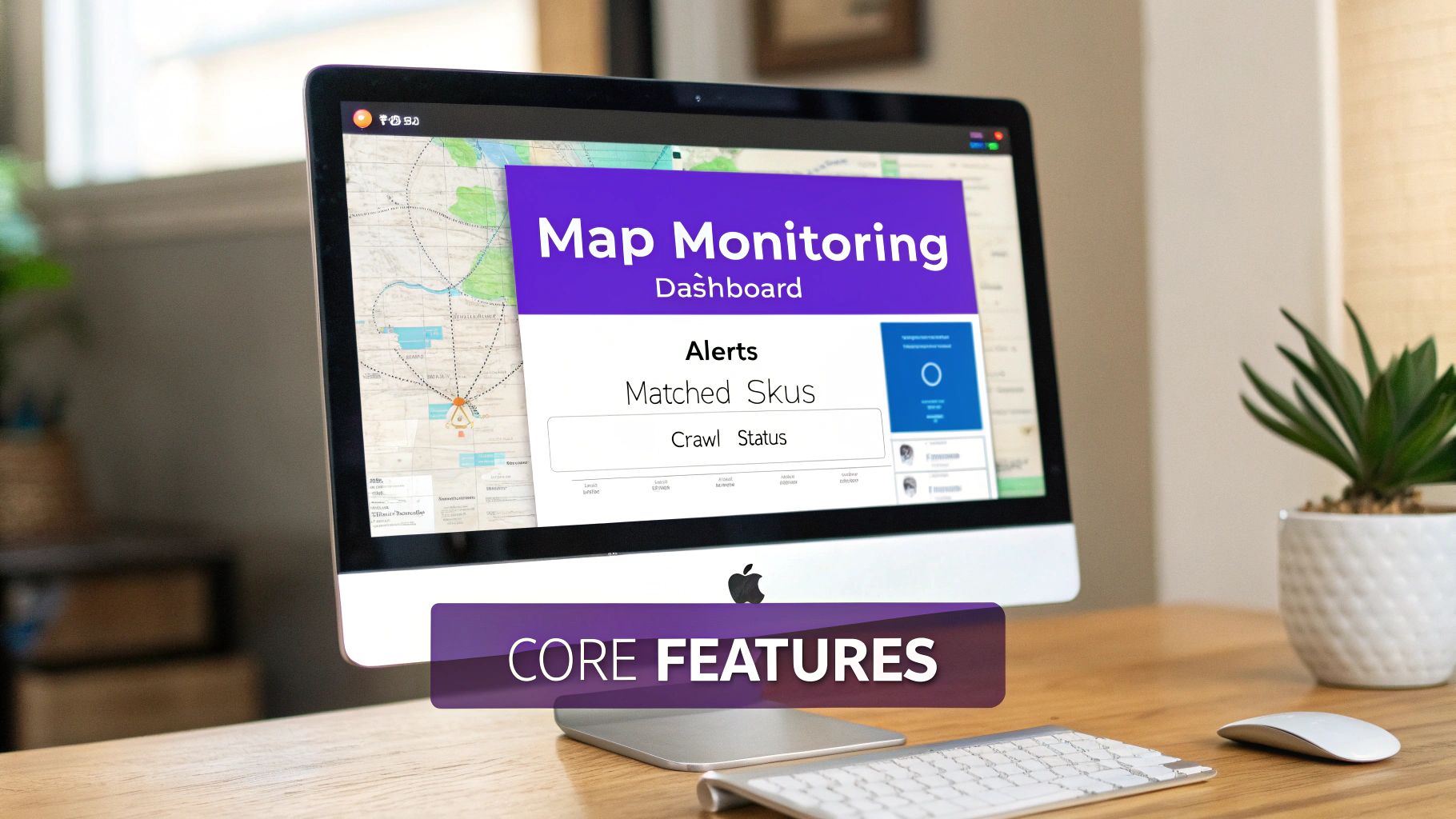
Comprehensive Web Crawling
At its foundation, effective MAP software is a sophisticated data collection engine. Its primary function is to continuously scan the internet to identify where a brand's products are sold and at what price. This capability goes far beyond simple search engine queries.
High-performance crawlers systematically monitor major marketplaces like Amazon and eBay, individual retailer websites, and price comparison engines. This provides a complete view of a brand's online presence, rather than a limited snapshot of known sellers.
- Mini Use Case (Competitor Tracking): An ecommerce manager for a consumer electronics brand used MAP software to discover a dozen unauthorized third-party sellers on a regional marketplace they were not actively tracking. This exposed a "gray market" leak in their distribution that was causing significant price erosion.
AI-Powered Product Matching
Identifying a webpage listing your product is only the first step. The critical challenge is correctly matching inconsistent online listings to specific SKUs. Sellers often use non-standard titles, unique images, and varied descriptions, rendering simple text-based searches ineffective.
AI-driven product matching is the solution. The best platforms use machine learning to analyze images, product attributes, and other metadata to accurately match a listing to the correct SKU, even when a UPC or model number is absent. This level of precision is what turns raw data into actionable intelligence.
Without reliable AI-powered matching, your team will waste significant time manually verifying potential violations, slowing down enforcement and allowing price erosion to persist. Top-tier systems achieve over 99% accuracy.
Real-Time Violation Alerts
Online marketplaces operate at high velocity. A price can drop, trigger competitor reactions, and devalue a brand within hours. A weekly report is insufficient for effective management.
A powerful MAP tool provides instantaneous notifications when a price falls below the established policy. These alerts should be customizable, allowing for different rules for specific products and routing notifications to the appropriate team members via email or other communication platforms. The mechanics of modern software for price comparison offer further insight into this process. This immediate notification is the trigger for a rapid and effective enforcement workflow.
Automated Evidence Capture
To enforce a MAP policy, you need objective, undeniable proof. A verbal claim is insufficient. The best MAP monitoring software automates this evidence collection process.
The system captures timestamped screenshots and logs all relevant data from the violating product page. This creates a clear, objective record of the violation, preempting disputes and providing the necessary leverage for enforcement.
- Mini Use Case (MAP Enforcement): A brand manager receives an alert for a MAP violation. Logging into the software, they find a complete evidence file, including a screenshot with the date, time, and advertised price. They attach this evidence to a pre-written violation notice template and send a formal, indisputable notice in under five minutes.
This is where automated tools like Market Edge Monitoring become useful, converting a tedious manual task into a seamless, scalable process.
How to Choose the Right MAP Monitoring Partner
Selecting the right MAP monitoring software is a partnership decision, not just a tool purchase. The optimal solution delivers reliable, timely data that integrates directly into your enforcement workflow. To make a sound investment, it is necessary to evaluate not only the features but also the underlying technology and support services.
The selection process should begin with a clear definition of your requirements and conclude with a practical test of potential vendors. A structured approach ensures you choose a partner that can protect your brand, support your retailers, and scale with your business.
Define Your Monitoring Scope
Before evaluating any platform, you must define the scope of your monitoring needs. This forms the basis of your search and will directly influence pricing and technical requirements.
Begin by quantifying these three core areas:
- SKU Count: How many unique products require tracking? Include all variations such as size and color.
- Retailer Landscape: List all known authorized retailers and key competitors. Identify the primary marketplaces where your products appear, such as Amazon or eBay.
- Channel Coverage: Specify the types of websites to be monitored, including direct-to-consumer sites, marketplaces, and comparison shopping engines.
Having these metrics established will facilitate accurate quotes and help you quickly assess if a potential partner can meet your scale requirements.
Verify Data Accuracy and Matching Precision
The core of any MAP monitoring platform is data quality. Without clean, accurate information, the system produces noise, not intelligence.
Inaccurate product matching is a common failure point, leading to a high volume of false positives. This wastes your team's time investigating compliant retailers and can damage those relationships. The only way to verify accuracy is through a trial period.
Do not rely on a generic product demonstration. A credible vendor should be willing to conduct a proof-of-concept using your actual product data. This is the only way to validate their claims in a real-world context.
A practical test involves providing a potential partner with a list of 10 to 20 of your most challenging SKUs—products that are often bundled, have inconsistent online listings, or lack a clean UPC. Request that they track these products for a one- to two-week period. The results will reveal the effectiveness of their matching algorithms and data collection technology. The data returned should be nearly perfect, as all other software functions depend on this foundational accuracy.
Assess Scalability and System Integrations
Your monitoring partner must be able to scale with your business. As you add new products, enter new markets, or onboard more retailers, the software should accommodate this growth without friction. Inquire about the process for adding new SKUs or websites; it should be straightforward and not require a major contract renegotiation.
System integrations are equally important. Effective MAP enforcement is not an isolated activity. Your monitoring platform must integrate with your other business systems. For most mature brands, an Application Programming Interface (API) is a non-negotiable requirement. An API enables you to pull violation data directly into internal dashboards, ERP systems, or business intelligence tools, transforming the software from a standalone application into an integrated component of your broader ecommerce and pricing analytics software strategy.
Review Onboarding and Ongoing Support
Finally, evaluate the human element of the partnership. Powerful software requires effective support to deliver its full value. Seek direct answers to these questions:
- Onboarding: Is a dedicated onboarding specialist provided? Will they assist with product catalog uploads, policy rule configuration, and initial alert setup?
- Training: Is comprehensive team training included? How do they ensure all relevant personnel, from sales to legal, can use the platform effectively?
- Support: What is the process for issue resolution? What are the support hours, available channels (email, phone, chat), and expected response times for critical issues?
A true partner is invested in your success from the start. They should offer transparency, a meaningful trial to validate their capabilities, and a smooth transition from evaluation to daily operation.
Calculating the ROI of Your MAP Monitoring Investment
A software investment must be justified by its financial return. The business case for a MAP monitoring platform rests on its ability to protect revenue and strengthen the brand, not just its features.
Calculating the return on investment (ROI) demonstrates the software's tangible financial impact, positioning it as a strategic asset rather than an expense. The justification focuses on three primary areas: margin protection, operational efficiency (time savings), and the preservation of long-term brand equity.

Unpacking Common Pricing Models
To calculate ROI, you first need to understand the cost structure. Most providers use one of the following models:
- Per-SKU or Per-URL Pricing: You pay for each product or specific retailer site you monitor. This is suitable for brands with smaller catalogs or a limited number of key online sellers to track.
- Tiered Subscriptions: These are pre-defined packages offering a set number of SKUs, competitors, and features for a predictable monthly or annual fee. This model works well for growing businesses with clear budget requirements.
- Custom Enterprise Plans: For businesses managing thousands of products across complex distribution networks, custom plans provide volume discounts and dedicated support to handle the scale.
Some platforms, such as the solution offered by Market Edge, provide transparent, usage-based pricing that scales with your needs, ensuring you only pay for the resources you use.
A Simple Formula for Calculating Your Potential ROI
A complex financial model is not necessary to estimate ROI. A straightforward formula can provide a clear picture of the potential financial return.
ROI = (Margin Protection + Time Savings + Brand Equity Value) - Software Cost
Here is a breakdown of each component:
- Margin Protection: This is the most direct financial benefit. Quantify the revenue lost due to margin erosion from unauthorized discounts. Recovering even a small percentage of this leakage can be substantial.
- Time Savings: Calculate the cost of employee time spent manually searching for MAP violations. Determine their hourly cost and multiply it by the hours saved per week through automation. This represents a direct operational efficiency gain.
- Brand Equity Protection: While more difficult to quantify, this is a critical long-term value driver. Consistent pricing reinforces a product's perceived value. Preventing brand devaluation protects future pricing power.
A Real-World ROI Calculation
Here is a practical example of the ROI calculation:
A brand with $5 million in annual revenue estimates that MAP violations cause an average margin erosion of 3%. This represents a $150,000 annual loss.
By implementing an automated MAP monitoring platform, the brand reduces these violations by half in the first year, recovering $75,000 in margin. Additionally, a team member who previously spent 10 hours per week on manual checks is now reallocated to higher-value tasks. This reclaimed time is valued at $15,000 annually. The total tangible gain is $90,000.
If the software subscription costs $15,000 per year, the net gain is $75,000, representing a 500% ROI from direct savings alone.
Presenting a clear financial case like this makes the investment decision straightforward. The demand for these data-driven tools is growing. The broader mobile mapping market, which underpins the real-time dashboards in these systems, is projected to reach nearly USD 89.74 billion by 2030, with the software segment growing at a 17.7% CAGR. You can discover more insights about these market trends on grandviewresearch.com. This is no longer a niche tool; it is becoming a standard operational practice for serious brands.
From Onboarding to an Effective Daily Workflow
Selecting the right MAP monitoring software is the first step. The true value is realized when the tool is integrated into the team's daily operations, transforming it from a simple alert system into a command center for managing the brand's market presence. This requires a shift from reactive violation-chasing to proactive channel management.
A structured implementation process delivers value from day one. It begins with clean data, transitions to intelligent automation, and culminates in a consistent enforcement process that protects the brand and strengthens relationships with compliant retail partners. The objective is not merely to penalize rule-breakers but to create a stable, fair, and predictable market for all sellers.
The Four Pillars of Implementation
A successful implementation should follow a clear, logical sequence. Each step builds on the previous one, creating a solid foundation for your monitoring program.
- Initial Setup and Policy Definition: The first step is to populate the system with accurate information. This includes uploading your complete product catalog with all SKUs, UPCs, and corresponding MAP prices. Concurrently, you will configure your MAP policy rules within the platform, establishing the price floors that trigger violation alerts.
- Alert Configuration and Customization: With products and policies loaded, you must define the monitoring parameters and notification workflows. The best systems allow for high specificity. For example, you can configure instant, high-priority alerts for violations on major marketplaces while creating a separate, lower-urgency notification stream for a designated group of independent retailers.
- Standardized Enforcement Protocol: This is where strategy translates into action. It is essential to create a documented, step-by-step workflow for the team to follow when a violation is detected. This protocol should detail the communication sequence (e.g., first warning email, follow-up call, final notice) and assign clear responsibility for each step.
- Strategic Data Integration: The ultimate goal is to leverage this data beyond simple enforcement. The platform's analytics and reporting capabilities are a valuable source of strategic insight. By identifying patterns—such as which products are frequently discounted or which channels have the highest violation rates—you can make more informed decisions about distribution partnerships, promotional strategies, and inventory management.
Building Your Weekly Enforcement Checklist
To operationalize your strategy, a simple weekly routine ensures consistency and prevents issues from being overlooked.
- Monday Morning Review: Review all alerts generated over the weekend. Triage them by severity and assign them to the appropriate team members for action, following the documented enforcement protocol.
- Wednesday Check-In: Assess the status of all open violation cases. Determine if retailers have become compliant after the first notice. If not, initiate the next step in the enforcement sequence.
- Friday Analytics Deep Dive: Dedicate time to analyze the week's data. Identify trends in seller behavior, product-specific violations, and overall market price integrity. Use these insights to inform weekly sales and channel management meetings.
A structured approach does more than enforce a policy; it signals to the market that your brand's value is non-negotiable. Consistency builds respect from compliant partners and deters potential violators.
The technology powering these workflows continues to advance. The global digital map market, a core component of these platforms, is expected to reach USD 94.28 billion by 2034. This growth is significant because top-tier MAP and pricing tools now incorporate GIS-like capabilities. They do not just scrape prices; they tag each data point with its geography, channel, and time, enabling a level of sophisticated analysis previously reserved for specialized teams. You can read the full research about these market dynamics on fortunebusinessinsights.com.
This is where automated price monitoring tools like Market Edge become useful. They provide the capability to execute this daily workflow efficiently and extract the strategic intelligence needed to gain a competitive advantage.
Common MAP Enforcement Mistakes and How to Avoid Them
Even the most powerful MAP monitoring software cannot compensate for a flawed enforcement strategy. A common mistake is for a brand to invest in a platform but then undermine its effectiveness through inconsistent application. This not only results in lost sales but also damages partner relationships and weakens the brand's market position.
Your software is a high-performance engine; it requires a skilled driver and a clear road map—your enforcement process—to be effective. Without a disciplined and consistent approach, alerts and analytics are merely noise. Successful brands pair automation with a robust, repeatable process.
This four-step workflow illustrates how to transform reactive MAP monitoring into a strategic advantage.
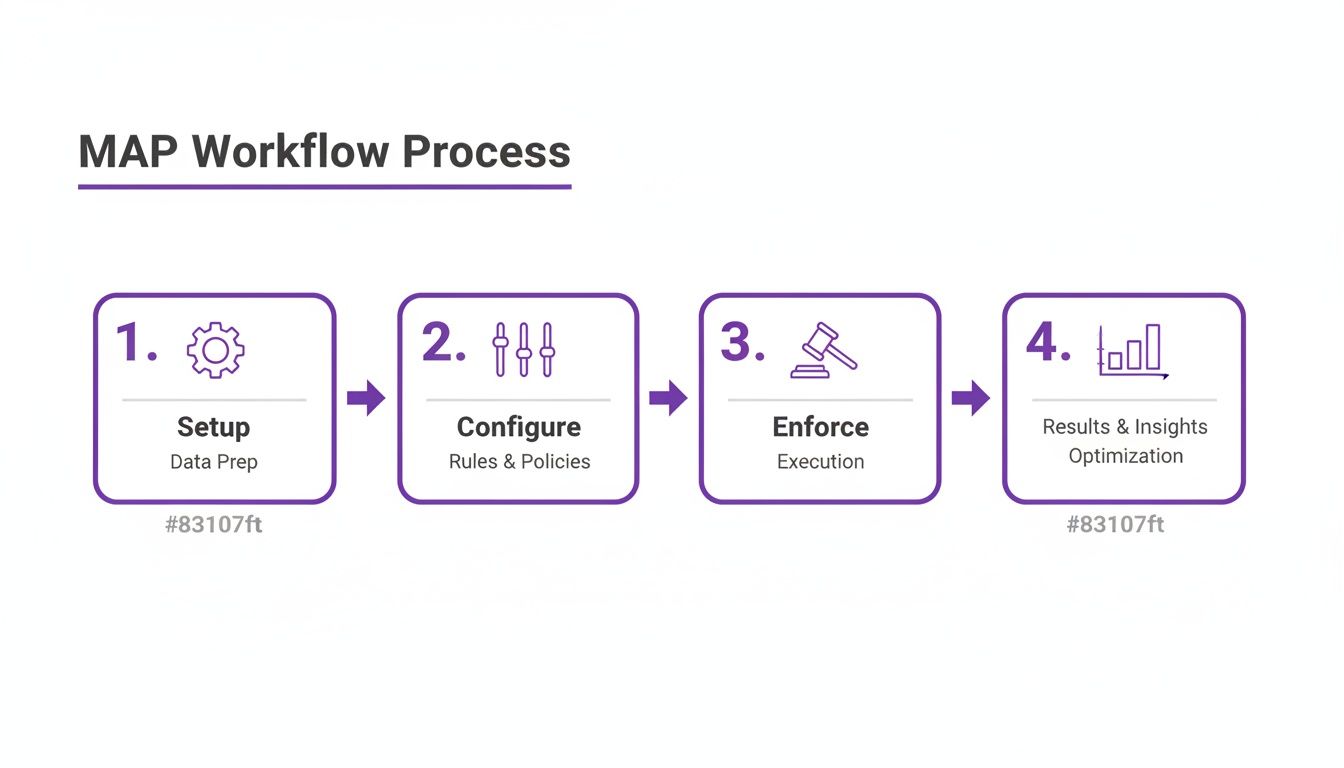
As shown, effective MAP management is a continuous cycle of setup, configuration, enforcement, and analysis, not a one-time task.
Inconsistent Enforcement
This is a critical error. It occurs when a brand enforces its policy against small online sellers but ignores violations from high-volume retail partners. This practice not only alienates compliant partners but can also create legal risks by establishing a pattern of preferential treatment.
- The Fix: Apply the policy universally and consistently. The rules must be the same for every seller, regardless of size. This fairness is the foundation of a strong MAP policy and is essential for maintaining healthy channel partnerships.
A Weak or Vague MAP Policy
A policy without clear, escalating consequences is ineffective. Sellers will not comply if the only repercussion is a polite email. Your policy must explicitly state the consequences for first, second, and third violations.
A strong MAP policy is about creating predictability, not being punitive. When every partner understands the rules and the consequences for violating them, it fosters a stable and fair market for all.
Relying on Manual Tracking for Too Long
Manual website checks may be feasible for a small number of products and sellers, but this approach does not scale. As a business grows, manual spot-checks become unsustainable, allowing numerous violations to go undetected and erode the pricing structure.
Ignoring the Data for Strategic Insights
Using MAP software solely as an alert system is a significant missed opportunity. The collected data is a rich source of market intelligence. It can reveal which products face the most pricing pressure, which retail channels are least compliant, and can help identify unauthorized "gray market" sellers.
- The Fix: Allocate time to analyze trends within your dashboard. Use this intelligence to inform your sales strategy, address distribution leaks, and make better partnership decisions. This is where automated tools like Market Edge particularly excel, providing the consistency and efficiency needed for effective oversight.
Your Top Questions About MAP Monitoring, Answered
When evaluating a new tool like MAP monitoring software, many questions arise. It is a significant decision, and clear answers are necessary to make an informed choice for your brand.
Here are the most common questions from decision-makers.
How Quickly Can I Actually See Results?
Initial results are nearly instantaneous. The first software scan will provide a clear list of all sellers violating your MAP policy.
However, the primary objective—a reduction in violations and more stable pricing—typically materializes within the first 30 to 60 days. During this period, your retail partners recognize that monitoring is consistent and enforcement is systematic. This realization usually leads to a rapid increase in compliance, protecting your brand value from the outset.
Is This Kind of Monitoring Even Legal?
Yes, MAP monitoring is legal in the United States, provided it is executed correctly. The legal foundation is a properly structured unilateral MAP policy.
A unilateral policy means your brand independently sets the advertising price guidelines for its products and unilaterally decides with whom it will do business. If a retailer chooses not to adhere to your guidelines, you can unilaterally choose to cease supplying them. It is critical that the policy is professionally drafted (with legal counsel) and, most importantly, enforced uniformly for all sellers at all times. Selective enforcement is the primary source of legal risk.
Can This Software Find Unauthorized Sellers, Too?
The best platforms can, and this capability distinguishes basic tools from powerful brand protection solutions. Unauthorized sellers often attempt to evade detection by not using official UPCs or product titles.
Top-tier systems employ advanced technologies like AI-powered image recognition and attribute matching to overcome this. They can identify your product on a marketplace like Amazon or eBay based on its image or other key details, even if the seller is unknown. This is a critical function for shutting down gray market sales and identifying previously unknown leaks in your distribution network.
This is where automated price monitoring tools like Market Edge become useful. You can learn more by visiting the Market Edge website.