
Finding the right competitor price tracking software is not a technical exercise—it is a strategic business decision. The objective is to secure accurate, real-time market intelligence that protects margins and drives profitable growth. The best tools move beyond simple data scraping, delivering actionable insights for critical functions from MAP enforcement to dynamic pricing.
Why Accurate Competitor Price Tracking Is a Revenue Driver, Not a Cost
In a competitive digital market, manual price tracking using spreadsheets is not just inefficient; it's a direct threat to profitability. Operating with stale or incomplete data leads to reactive, uninformed decisions. This guesswork results in margin erosion from unnecessary price cuts and lost market share from being unknowingly overpriced.
This lack of visibility creates significant commercial risk. For example, a parts distributor can lose a major B2B account because a competitor launched an aggressive, undetected pricing strategy on a handful of key SKUs. By the time the sales team notices a decline in orders, the commercial damage is done. In another common scenario, a brand’s equity is eroded daily as unauthorized resellers ignore Minimum Advertised Price (MAP) policies without consequence.
The Commercial Impact of Inaction
Failing to monitor the market is not a missed opportunity; it's a financial liability. The global Competitor Price Monitoring Software Market is projected to grow at a CAGR of 8.3% through 2035, a clear indicator that businesses are recognizing this pressure.
Market analysis indicates that companies ignoring these competitive dynamics face potential revenue losses of up to 15-20% from being consistently undercut. Conversely, optimized price tracking can lift sales by 5-10% on average. You can learn more about the competitive intelligence gathering findings that highlight this trend.
Use Case: A pricing manager for a consumer electronics brand discovered that over 30% of their online resellers were violating MAP agreements, causing significant friction with compliant retail partners. After implementing automated monitoring, they could identify and document violations in hours instead of weeks, protecting both brand value and key channel relationships.
Shifting from Expense to Investment
Viewing price tracking software as a cost center is a fundamental mistake. It is an investment in revenue protection and strategic positioning. A robust platform provides the data necessary to:
- Protect Margins: Understand precisely when and where to adjust prices to avoid destructive price wars.
- Enforce Brand Value: Automatically detect and document MAP or RRP violations to maintain pricing integrity across all channels.
- Grow Market Share: Identify opportunities to price products strategically to win key customers or enter new market segments.
This is where automated price monitoring tools like Market Edge become useful, delivering the clean, reliable data required to turn competitive intelligence into a direct driver of commercial success.
Core Features of Effective Price Monitoring Software
When evaluating competitor price tracking software, decision-makers must look past marketing claims and analyze the underlying technology. Not all platforms are built equally. The difference between a simple web scraper and a strategic intelligence tool lies in the quality and reliability of its core features. Understanding these distinctions is critical to selecting a tool that protects revenue rather than just generating noisy data.
The initial choice is whether to automate this process at all. Manual tracking is fraught with risks and inaccuracies. This decision tree illustrates the divergent outcomes.
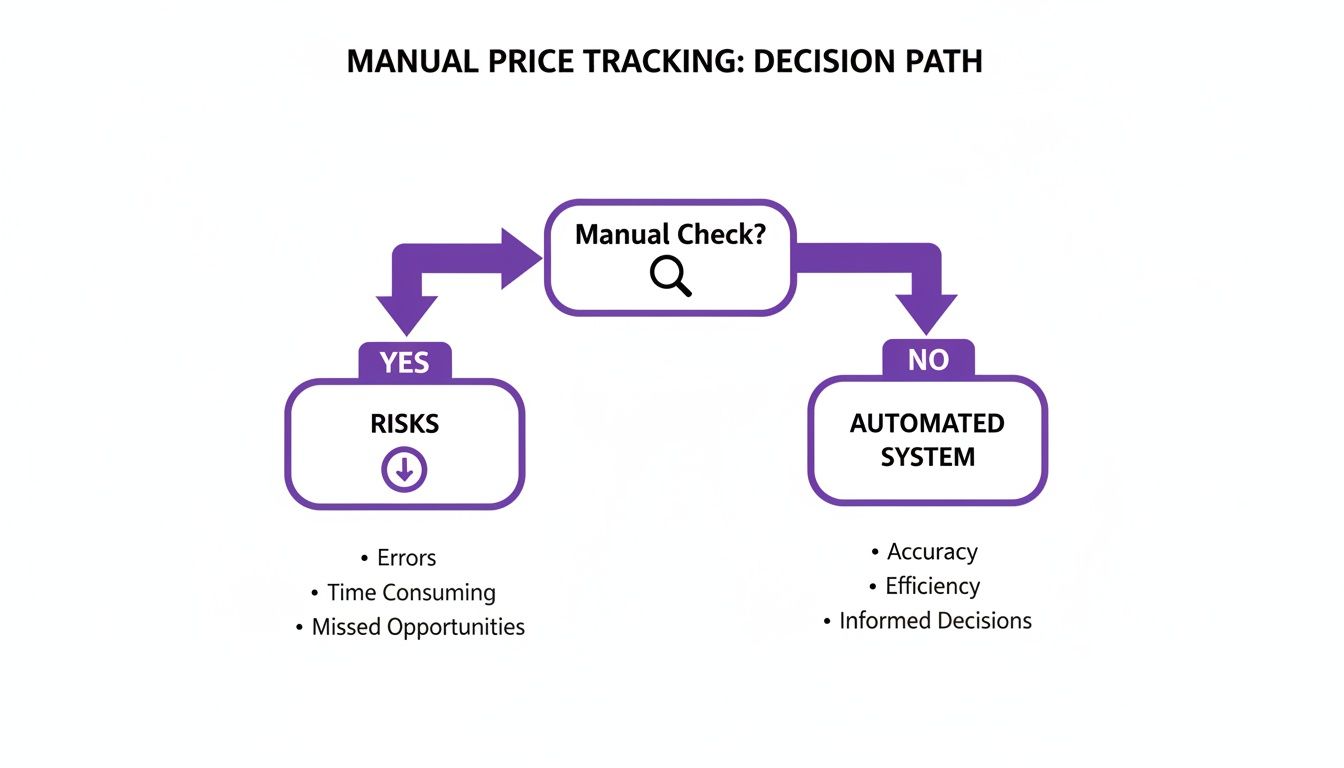
As the flowchart shows, a manual process often leads directly to margin erosion and competitive blind spots. Automation, conversely, enables strategic growth and rapid market response.
Data Accuracy and Global Coverage
The foundational requirement of any price monitoring tool is accurate data. If the data is flawed, the resulting pricing strategy will be flawed, straining partner relationships and leading to lost sales. The best software platforms integrate robust data validation and cleansing processes, ensuring that decisions are based on trusted intelligence.
Equally critical is the tool's global and marketplace coverage. The software’s reach must mirror your own. This includes comprehensive monitoring of:
- Direct Competitor Websites: Extracting prices directly from their ecommerce stores.
- Major Marketplaces: Tracking sellers across platforms like Amazon and eBay.
- Comparison Shopping Engines (CSEs): Monitoring visibility where shoppers actively compare offers.
An effective solution provides coverage relevant to your specific markets, not a generic list of top websites.
Reliable Crawling and Anti-Blocking Technology
All price tracking software uses web crawlers to gather data. However, many websites employ sophisticated anti-bot measures to block them. If a tool is blocked, the data feed is severed, creating dangerous blind spots in your market view.
Basic tools often fail when encountering complex site structures or security measures like CAPTCHAs. This results in incomplete or outdated information, rendering competitive analysis useless at critical moments.
Advanced platforms use a combination of techniques—such as distributed proxy networks, intelligent browser fingerprinting, and dynamic request patterns—to emulate human behavior. This ensures consistent, reliable data collection without being flagged, providing an uninterrupted view of competitor pricing.
AI-Powered Product Matching
Identifying the same product across dozens of websites is a significant operational challenge. Retailers use varied product titles, descriptions, and internal SKUs. For this reason, AI-powered product matching is a core necessity, not an optional feature. This technology typically operates in two ways:
- Identifier-Based Matching: Uses universal codes like EANs, UPCs, or ISBNs to find exact matches. This method is fast and highly accurate for standardized products.
- Attribute-Based Matching: When standard codes are unavailable, this method uses machine learning to compare product attributes like brand, model number, color, and size. It can also leverage image recognition to confirm matches.
For example, an ecommerce manager for a private-label apparel brand cannot rely on UPCs. They require a tool with strong attribute-based matching, like the system used by Market Edge, to accurately identify similar products based on specifications and images alone.
Data Refresh Frequency
Ecommerce pricing is dynamic. A price that was accurate yesterday can be irrelevant today. The refresh frequency of a tool determines how quickly you can react to market changes. While some businesses may only require daily updates, those in competitive sectors like consumer electronics or FMCG need data that is as close to real-time as possible.
This need for speed is why modern price monitoring tools are essential. Market leaders have advanced this technology, with some platforms delivering dynamic pricing insights that can reduce manual oversight by as much as 80%. The most sophisticated tools combine MAP enforcement with digital shelf analytics for a holistic view. You can explore more about the top price monitoring tools on metricscart.com. Ultimately, the best software offers flexible scheduling, allowing you to set the data collection cadence to match strategic needs.
Core Feature Evaluation Checklist
Use this checklist to systematically evaluate potential software vendors. It structures the inquiry around business impact and provides key questions to ask during a product demonstration.
| Feature | What to Look For | Business Impact (Low/Medium/High) | Vendor Question |
|---|---|---|---|
| Data Accuracy | Error rates, validation processes, data cleansing methods. | High | "What is your verified data accuracy rate, and how do you handle discrepancies or missing data points?" |
| Coverage | Relevant marketplaces, competitor sites, and geographic regions. | High | "Can you demonstrate your coverage for these specific channels and countries that are critical to our business?" |
| Crawling Tech | Anti-blocking capabilities, proxy networks, CAPTCHA handling. | High | "How does your system handle anti-bot measures from sophisticated sites like Amazon or Target?" |
| Product Matching | Accuracy with/without UPCs/EANs, use of AI/ML, image matching. | High | "What is your match rate for products without universal identifiers in our category?" |
| Refresh Frequency | Real-time, hourly, daily options. Customizable scheduling. | Medium/High | "What is the fastest refresh rate available, and can we schedule different frequencies for different competitors?" |
| MAP Monitoring | Automated violation detection, screenshot evidence, communication tools. | High (for brands) | "Show me your platform's workflow for automating MAP violation detection and enforcement." |
| Alerts & Reporting | Custom triggers (e.g., stock-outs, price drops), dashboard usability. | Medium | "Can we create custom alert rules based on percentage changes and competitor stock levels?" |
By scoring each potential tool against these criteria, you can move beyond feature lists and focus on the solution that will deliver a tangible impact on strategy and profitability.
Analyzing Advanced Capabilities for Strategic Advantage
While core features provide essential data, advanced capabilities are what separate the best competitor price tracking software from standard tools. These features enable automated workflows and predictive insights, allowing pricing and sales leaders to move from reacting to the market to actively shaping it.

Automated MAP and MSRP Enforcement
For manufacturers and brands, maintaining pricing integrity is paramount. Manually policing Minimum Advertised Price (MAP) or Manufacturer's Suggested Retail Price (MSRP) policies across hundreds of online sellers is an inefficient and resource-intensive task. Advanced platforms automate this entire process.
These systems do more than just flag a violation; they build an evidence-based case for enforcement. Key features include:
- Automated Violation Detection: The software continuously scans reseller sites, instantly flagging any price below the established MAP policy.
- Screenshot Evidence Collection: Upon detecting a violation, the platform captures a time-stamped screenshot, creating indisputable proof of the infraction.
- Violation Communication Workflows: Top-tier tools can initiate automated email workflows, sending pre-configured warnings to non-compliant sellers with the screenshot evidence attached.
This automation transforms a reactive, manual task into a proactive, scalable strategy for brand protection.
Dynamic Pricing Rule Engines
In a fast-moving market, static pricing is a competitive liability. A dynamic pricing engine enables the creation of automated, rules-based strategies that respond to market shifts in real time. Instead of merely observing competitor actions, these engines empower you to act on them instantly.
A pricing manager can configure rules such as:
- "If Competitor X is the market low and has stock, set our price $0.01 below theirs, but never drop below our 15% floor margin."
- "If we capture the Amazon Buy Box, increase our price by 2% every hour until reaching our target ceiling."
- "If our top three competitors are out of stock, immediately increase our price by 5%."
These rules operate 24/7, ensuring prices are continuously optimized for profit and market position without constant manual intervention. Clean data feeds, like those provided by solutions such as Market Edge, are the foundation that makes these sophisticated repricing strategies viable.
Historical Data and Trend Analysis
Viewing only current prices provides an incomplete picture. The real strategic value lies in analyzing historical data to identify patterns and predict competitor behavior. Top-tier software stores years of pricing data, enabling you to answer critical business questions.
Use Case: A category manager analyzing historical data notices a key competitor consistently drops prices on a specific product line during the final week of each quarter to meet sales targets. Armed with this insight, the manager can proactively plan a counter-promotion or adjust inventory levels.
This capability transforms a price tracking tool into a powerful forecasting asset.
Comprehensive API Access and Integration
Pricing data should not be siloed. The best competitor price tracking software offers a robust API (Application Programming Interface), allowing its data stream to be fed directly into other core business systems.
This integration unlocks significant operational efficiencies. You can pull competitive pricing data directly into your:
- ERP System: To inform smarter purchasing and inventory decisions.
- BI Tools (e.g., Tableau, Power BI): To build custom dashboards that combine competitive data with internal sales and margin metrics.
- Product Information Management (PIM) System: To enrich product data with valuable market context.
This seamless flow of information ensures that all commercial teams—from sales and marketing to procurement—are operating with the same timely, accurate market intelligence. The price optimization software market, which powers these advanced trackers, is expected to reach $3.59 billion by 2030, a surge driven by these AI-powered dynamic pricing and integration features. You can explore the full market analysis on mordorintelligence.com to learn more.
Understanding Pricing Models and Total Cost of Ownership
When evaluating competitor price tracking software, it is easy to focus on the monthly subscription fee. However, the sticker price rarely reflects the true cost. A vendor's pricing structure can significantly alter total costs over time, especially as your business scales.
A plan that appears inexpensive initially can become costly once ancillary fees are included. To accurately forecast expenses, it is essential to understand the common pricing models.
Common Platform Pricing Structures
Most pricing plans fall into one of three categories, each designed for a different business need.
- Pay-Per-SKU (or URL): This is a transparent model where you pay a small fee for each product you track. It scales predictably with your monitoring needs, making it suitable for businesses starting out or those wanting to expand their monitoring at a controlled pace.
- Tiered Subscriptions: These are packages (e.g., Basic, Pro, Enterprise) that bundle a set number of SKUs, competitors, and features for a flat monthly or annual fee. They are easy to budget for but can result in paying for unused features or facing a significant price jump when a tier limit is exceeded.
- Usage-Based Pricing: Some platforms charge based on consumption, such as the number of data refreshes or API calls. This can be cost-effective for occasional updates, but costs can become unpredictable in dynamic markets requiring frequent data collection.
Calculating the Total Cost of Ownership (TCO)
The monthly subscription is only one component of the investment. To get an accurate financial picture, you must calculate the Total Cost of Ownership (TCO), which includes all direct and indirect costs. Overlooking these hidden expenses can lead to significant budget overruns.
The real cost is not the monthly fee; it is the sum of all expenses required to derive actionable intelligence from the platform. A low-cost plan that requires hours of manual data cleanup or lacks critical automation is often more expensive in the long run.
To determine your TCO, be sure to inquire about these often-overlooked costs:
- Implementation and Onboarding Fees: Are there charges for initial setup, product catalog migration, or system configuration?
- Training and Support: Is premium customer support included or an additional expense? What is the cost to train new team members?
- Additional User Seats: How many users are included? Adding personnel from sales, marketing, or merchandising teams can sometimes incur unexpected fees.
- API Access Charges: Many vendors cap API usage in standard plans. If you need to integrate data with BI tools or an ERP system, you may need to pay extra for a higher volume of API calls.
A Practical TCO Scenario
Consider a mid-sized retailer tracking 5,000 SKUs across 10 competitors, evaluating two platforms.
- Vendor A: Offers a tiered plan for $999/month, covering up to 10,000 SKUs and 5 users. However, they charge a $2,500 one-time implementation fee and an additional $500/month for the API access required for their BI dashboard.
- Vendor B: Offers a pay-per-URL model at $0.15 per tracked product per month. This price includes unlimited users, free setup, and full API access.
Vendor A’s plan appears straightforward. However, the first-year TCO for Vendor A is $20,488 ($999*12 + $500*12 + $2,500). In contrast, Vendor B's total cost for the year is $9,000 (5,000 * $0.15 * 12).
This illustrates why a solution like Market Edge is often preferred. With transparent, usage-based models, you pay only for what you use, eliminating the hidden fees that can inflate the total cost of ownership.
A Practical Guide to Implementation and Integration
Selecting the right price tracking software is only the first step. The true value is realized when the data is thoughtfully integrated into daily operations. A structured implementation process is the difference between a tool that fails to gain adoption and one that drives smarter pricing and inventory decisions from the outset.

Without a clear plan, even the most powerful platform will not deliver its expected ROI. A successful deployment is a phased process that moves from a controlled pilot to full integration across commercial teams.
Step 1: Define the Initial Scope
A common mistake is attempting to monitor everything from the start. This approach leads to data overload and implementation fatigue. Instead, begin with a focused pilot program to minimize risk and secure early wins.
- Key Value Items (KVIs): Start with the top 20% of SKUs that drive 80% of your revenue. Pricing intelligence here will have the most immediate financial impact.
- Primary Competitors: Select your top three to five direct competitors whose pricing most directly influences your sales.
- Core Use Case: Define a single, clear objective for the pilot, such as MAP compliance enforcement, price optimization for a specific product line, or benchmarking against a new market entrant.
This focused approach makes initial data onboarding manageable and provides clear metrics to demonstrate success.
Step 2: Onboard Product Data and Configure Alerts
With the scope defined, the next step is to load product data into the system. Most platforms support this via CSV or Excel upload, containing product identifiers (SKUs, UPCs) and the competitor URLs to monitor.
Once the data is loaded, configure alerts strategically. Flooding inboxes with irrelevant notifications is the fastest way to ensure a new platform is ignored.
Begin with a few high-value alerts. For example, create a rule that notifies the pricing manager only when a key competitor's price on a KVI drops by more than 5%, or when a critical product goes out of stock.
Effective alert configuration delivers actionable signals, not noise. An example solution, Market Edge, offers granular control over these rules to align with specific business objectives. You can find more tips in our guide on how to track competitor pricing effectively.
Step 3: Train the Team and Drive Adoption
A tool is only as effective as the team using it. A brief, mandatory training session is essential for user adoption. The focus should be on the "why," not just the "how."
Demonstrate to each team member how the platform simplifies their job and helps them achieve their goals. For a brand manager, this means instant access to MAP violation evidence. For an ecommerce manager, it means having data to support a promotional strategy.
A successful launch is not a one-time event; it is the beginning of a data-informed approach to business. By planning the implementation in this structured manner, your investment in price tracking software can deliver a sustainable competitive advantage.
Evaluation Checklist: Putting Price Tracking Software to the Test
Choosing the right price tracking software requires a disciplined evaluation process that goes beyond a feature comparison. The goal is to find a reliable partner whose technology can solve your specific business challenges.
This checklist provides a framework for guiding vendor demonstrations and, more importantly, maximizing the value of a free trial. The objective is to see the software perform with your products and your competitors to validate its capabilities in a real-world context.
Data Quality and Reliability
Your entire pricing strategy depends on the accuracy of the data. Flawed data leads to flawed decisions. Begin by investigating how a vendor collects and verifies information.
- Product Matching: What is your real-world match accuracy for products without a UPC or EAN? Please demonstrate by matching a sample of our product catalog.
- Data Freshness: What is the fastest achievable data refresh rate? Can we configure different update frequencies for different competitors?
- Crawling Technology: How do you navigate sites with advanced anti-bot defenses? How do you handle prices hidden behind a customer login?
- Data Validation: What is your process for identifying and correcting erroneous data—such as typos or incorrect currencies—before it reaches our dashboard?
Feature Set and Use Case Alignment
A tool with features you will never use is merely a distraction. The key is to connect the software's capabilities directly to your business objectives, whether that is brand protection through MAP enforcement or implementing a dynamic pricing strategy.
- MAP/RRP Enforcement: Can your tool capture time-stamped screenshots as evidence of a violation? Does it include automated workflows for sending warnings to non-compliant sellers?
- Reporting and Alerts: How granular are the alert configurations? Can I create a notification for when a competitor's price drops by more than 5%, or when their stock level falls below 10 units?
- Historical Analysis: How much historical data do you retain? Can you demonstrate how I would use it to identify a competitor's predictable promotional patterns from the previous year?
A critical test is to ask vendors to show exactly how their tool tracks prices on a complex marketplace like Amazon. Can it clearly differentiate between Amazon's own price, FBA offers, and other third-party sellers? The ability to handle this complexity is a strong indicator of a robust platform.
Scalability and Integration
The platform you choose today must support your future growth. Consider not only the 1,000 SKUs you track now, but the 100,000 you might track in two years. The underlying technology must be able to scale accordingly.
- API Access: Do you offer a well-documented API, and is it included in the standard package? What are the API call limits, and what are the costs if we exceed them?
- Platform Performance: How do system speed and report generation times perform as our product and competitor lists expand?
This is precisely where dedicated automated price monitoring tools like Market Edge demonstrate their value, handling the heavy lifting so you can focus on strategy.
Frequently Asked Questions
Here are concise answers to common questions from business leaders evaluating competitor price tracking software.
How Often Should I Check Competitor Prices?
The optimal frequency depends on your market's velocity. In highly dynamic sectors like consumer electronics, near real-time data is necessary. A competitor's flash sale can impact your sales within hours, so multiple daily checks are essential.
For more stable markets, such as B2B industrial equipment, a single daily check is likely sufficient. The best tools offer flexible scheduling, allowing you to monitor aggressive rivals hourly while tracking others less frequently. This approach provides necessary intelligence without creating data overload or unnecessary costs.
Can These Tools Track Prices on Marketplaces Like Amazon?
Yes, but this is a key differentiator between basic scrapers and professional platforms. While any tool can attempt to scrape a price, understanding the complex ecosystem of a marketplace like Amazon requires sophisticated technology.
A robust solution is designed to handle this complexity. It can differentiate between prices offered by:
- First-party sellers (e.g., "Sold by Amazon")
- FBA sellers (using Amazon's fulfillment network)
- Third-party merchants (shipping directly)
Superior software provides additional critical context, such as tracking Buy Box ownership, seller ratings, and stock availability. Without this complete picture, you are making decisions with incomplete information.
What Is the Difference Between Price Scraping and Price Monitoring?
This distinction is crucial. Price scraping is the raw data collection—the technical task of extracting numbers from a website. It is a component, not a complete solution.
Price monitoring, in contrast, is the end-to-end business intelligence process. It transforms raw data into actionable insights for strategic decision-making.
A true monitoring platform handles the value-add processes that a simple scraper cannot. It uses AI to match products, cleans and validates the data, visualizes historical trends, and sends intelligent alerts. For brands, it also provides the workflow for MAP enforcement. In essence, a monitoring platform turns data into intelligence. This is where automated tools like Market Edge provide significant value.
Ready to turn competitive data into a strategic advantage? With Market Edge, you get the accurate, real-time intelligence needed to protect your margins, enforce MAP policies, and make smarter pricing decisions. Start your free trial today and see the difference for yourself.