
Your Amazon pricing strategy is not just a lever for protecting profit margins; it is the core driver of visibility, sales velocity, and your ability to win the Buy Box. How you price products directly signals Amazon's A10 algorithm how to rank them, making it one of the most critical components for commercial success on the platform.
Why Your Amazon Pricing Strategy Drives Commercial Success

On Amazon, price is a powerful signal to both shoppers and the platform's search algorithm. A well-executed pricing approach can elevate products to the top of search results. Conversely, a miscalculation can render them invisible, regardless of product quality or marketing spend.
For founders, ecommerce managers, and sales leaders, mastering pricing is essential for survival and growth. The impact extends beyond daily revenue, shaping market share, brand perception, and the overall stability of your sales channel. A "set it and forget it" approach is a direct path to margin erosion and competitive disadvantage.
The Commercial Impact of Strategic Pricing
A deliberate, strategic approach to pricing yields measurable business outcomes. It moves your team beyond reactive price cuts and transforms pricing into a tool for achieving specific commercial goals.
- Win the Buy Box More Often: The Buy Box is responsible for over 82% of all Amazon sales. Price is a heavily weighted factor in the algorithm that determines the winner. A competitive price is your ticket to entry.
- Protect Your Brand's Value: For manufacturers and brand owners, pricing is the first line of defense for brand equity. A robust Minimum Advertised Price (MAP) or Recommended Retail Price (RRP) policy prevents price wars that devalue products in the eyes of consumers.
- Maximize Profitability: Strategic pricing is not a race to the bottom. It is about identifying the optimal point between sales volume and healthy profit margins. This requires setting intelligent price floors and ceilings based on costs, fees, and market dynamics.
- Increase Organic Visibility: Amazon’s algorithm favors products that sell. Competitive pricing generates initial sales velocity, which signals the algorithm to boost your organic ranking and creates a flywheel effect for growth.
Amazon itself did not capture 37.6% of the US ecommerce market by chance. It achieved this dominance by continuously adjusting prices—reportedly as often as every 10 minutes—based on competitor actions, demand, and inventory levels. You can review Amazon's pricing tactics on Metricscart.
This relentless, data-driven approach is what sellers compete against, highlighting why manual guesswork is insufficient. This is where automated price monitoring tools like Market Edge become useful, providing the data necessary to compete effectively.
Aligning Pricing Actions with Business Goals
Before adjusting a single price, you must answer a fundamental question: What is the commercial objective? "Increasing sales" is not a strategy; it is a wish that often leads to reactive price cuts and margin compression. An effective pricing strategy is always anchored to specific, measurable business goals.
Consider the different priorities. A brand owner's primary concern might be protecting brand equity, focusing on price integrity across all channels. In contrast, a high-volume distributor might prioritize winning the Buy Box for top-moving products to drive volume and acquire customers, even at lower margins. Each goal demands a distinct pricing playbook.
Defining Your Core Pricing Objectives
Your pricing objectives must reflect your real-world business priorities. A brand enforcing a Minimum Advertised Price (MAP) policy clearly values long-term brand equity over short-term sales spikes. For them, success is measured not by being the cheapest but by the compliance rate of their retail partners.
Conversely, a retailer with a warehouse full of aging inventory has a different goal: liquidation. Their primary KPI is inventory turnover. Price becomes a lever to move product and free up working capital. Without this clarity, pricing actions lack purpose and fail to produce meaningful impact.
Choosing KPIs That Measure What Matters
Once objectives are clear, you must translate them into trackable numbers. These Key Performance Indicators (KPIs) determine if your strategy is working, turning abstract goals into concrete targets that inform daily decisions.
The following table connects common business goals with the KPIs you should be monitoring.
Mapping Business Goals to Pricing KPIs
This table helps align common business objectives with specific, measurable Key Performance Indicators (KPIs) for your Amazon pricing strategy.
| Business Objective | Primary KPI | Supporting Metrics | Business Model Example |
|---|---|---|---|
| Maximize Sales Velocity | Buy Box Win % | Units Sold, Session Percentage, Page Views | Retailer/Reseller: Focused on moving high volumes of popular products. |
| Protect Brand Equity | MAP Compliance Rate | Average Selling Price, Number of Unauthorized Sellers | Brand Owner: Enforcing pricing policies to maintain perceived value. |
| Optimize Profitability | Target Profit Margin | Gross Margin per SKU, Return on Investment (ROI) | Private Label Seller: Balancing price competitiveness with healthy margins. |
| Liquidate Aging Stock | Inventory Turnover Rate | Sell-Through Rate, Days of Supply | Distributor: Clearing out old inventory to make room for new products. |
| Establish Market Leadership | Market Price Position | Share of Voice, Price vs. Key Competitors | Emerging Brand: Strategically pricing to be seen as a premium or value leader. |
This illustrates how different Amazon sellers have entirely different scorecards for success.
Here are a few of the most critical pricing KPIs in more detail:
- Buy Box Win Rate: For sellers dependent on sales volume, a high win rate on key ASINs is a direct indicator of competitive pricing and fulfillment.
- Target Profit Margin: This shifts the focus from revenue to actual profitability. Tracking margin per SKU ensures that automated repricing tools are not eroding profits.
- MAP/RRP Compliance Rate: For brands, this is a non-negotiable measure of channel health and policy adherence.
- Market Price Position: This KPI tracks your price relative to competitors (e.g., top 3, at market average, lowest). It helps you execute a strategy to be a price leader or a premium option.
A common mistake is focusing solely on the Buy Box win rate while ignoring profitability. Winning the Buy Box by losing money on every sale is a short-term victory that leads to long-term failure. You must pair the win rate with a hard floor price to protect your margin.
For example, a distributor could use a price monitoring platform to track its top 100 SKUs. The rule might be to match the lowest FBA seller, but only if the final price yields a 15% minimum margin. If it doesn't, they hold their price.
This is where a tool like Market Edge provides significant value. It automates the collection of competitor data and the tracking of these KPIs. You can implement rules-based repricing tied directly to your business goals, allowing the system to manage tactical adjustments while your team focuses on strategic analysis.
Choosing the Right Pricing Tactics for Your Catalog
Applying a single pricing strategy across your entire Amazon catalog is an inefficient way to manage your business. High-velocity, competitive products require a different approach than unique, private-label items. To optimize performance, you must segment your catalog and deploy specific tactics that align with the commercial goals of each product category.
This is not about finding one "perfect" price. It is about building a blended model where each tactic serves a clear business purpose, whether that is winning the Buy Box or protecting perceived brand value.
Dynamic Pricing for Competitive Battlegrounds
This is the primary tactic for highly competitive categories like electronics, office supplies, or popular consumer goods. In these markets, prices can change minute-by-minute, and a few cents can determine who gets the sale. The objective is to capture the Buy Box as frequently as possible without sacrificing all profit.
Use Case: A distributor selling a popular brand of headphones competes against dozens of other sellers on the same ASIN. Manual price tracking is impossible. The solution is an automated repricing rule: "Price $0.01 below the lowest FBA competitor, but never go below a floor price of $149.99." The floor price is calculated to cover cost of goods, fees, and a target 10% margin. This automates the competitive response, allowing the business to compete 24/7. Pricing is a key factor in securing the top spot, a topic we cover in our guide on how to win the Buy Box on Amazon.
The key to successful dynamic pricing is control. Without a non-negotiable price floor calculated from your true landed cost and all Amazon fees, automated repricers can easily drag you into a race to the bottom that destroys profitability.
Value-Based Pricing for Private Label and Exclusive Brands
If you sell a unique product—such as a private-label item or an exclusively distributed brand—competing on price is a strategic error. When you are the only seller on a listing, your price should reflect the value delivered to the customer, not the price of a different product.
The focus must shift from competitor monitoring to strengthening your product listing to justify a premium price.
- High-Quality Imagery and Video: Show the product in use and highlight its superior features.
- Compelling A+ Content: Use this space to tell your brand story and detail product benefits.
- Strong Social Proof: Proactively manage customer reviews and ratings. Positive feedback is a valuable asset.
- Clear Differentiation: Your product description must immediately answer the question: "Why is this product worth more than cheaper alternatives?"
A brand selling a proprietary skincare formula would not price it against a mass-market lotion. They would price it based on its unique ingredients, premium packaging, and customer testimonials that position it as a luxury good.
Cost-Plus Pricing as a Foundational Baseline
Cost-plus pricing is straightforward: calculate your total cost per unit, add the desired markup, and set the price. While too simplistic to react to market dynamics, it serves a critical function as the foundation for your price floors.
Before implementing any dynamic repricing rule, you must know the absolute lowest price you can sell an item for without incurring a loss. This calculation must include:
- Landed cost of the product
- Amazon referral fees
- Fulfillment costs (FBA or seller-fulfilled)
- Storage fees
- A non-negotiable minimum profit margin
An importer of kitchen gadgets might use cost-plus to establish a baseline. If a gadget has a landed cost of $8, FBA fees are $4.50, and they require a 20% margin, their absolute floor price is $15. That number becomes the critical safety net within their more aggressive dynamic repricing rules.
MAP Enforcement for Brand Integrity
For brand owners, pricing is about protecting long-term brand value and maintaining healthy retail partnerships. A Minimum Advertised Price (MAP) policy is a formal agreement with resellers establishing the lowest price at which they can advertise your products.
The primary tactic here is not repricing, but price monitoring and enforcement.
Use Case: A luxury watch brand must protect its premium image. If unauthorized sellers consistently violate MAP, it devalues the brand and harms relationships with legitimate retailers. This requires a systematic workflow: continuously scan Amazon for all sellers on their ASINs, flag anyone pricing below MAP, and automate the initial violation notice. As the marketplace moves faster, this has become a daily—or even hourly—task, making automated price monitoring tools like Market Edge essential for effective enforcement.
Building a Price Monitoring Workflow That Works
A sound Amazon pricing strategy is ineffective without robust execution. A scalable system for monitoring the market and acting on insights is what separates sellers who are constantly reacting from those who strategically lead.
This is not about manually checking competitor prices. It is about creating an automated system that collects data, applies your rules, and flags exceptions for human review. The goal is to let technology handle repetitive tasks so your team can focus on analysis and strategy refinement.
Know Who and What to Watch
First, decide what is worth monitoring. Tracking every seller on every ASIN creates data noise and leads to poor decisions. A targeted approach provides clearer signals.
Segment your competitors into tiers, as not every seller poses the same threat.
- Direct FBA Competitors: These are your primary rivals for the Buy Box. Their Prime eligibility makes their prices the most significant.
- FBM Sellers: Sellers fulfilling their own orders may offer lower prices, but without Prime status, they are often less of a direct threat for the Buy Box.
- Amazon Retail: Competing directly with Amazon requires a different strategy. It is often wiser to hold your price and compete on stock availability rather than engage in a price war you cannot win.
Once you know who to watch, define what to watch. Price is only one data point. To make intelligent decisions, you must also track stock levels and seller ratings. A competitor with a low price but only two units in stock is less of a threat than one with hundreds of units and a 99% positive feedback score. You can explore this further in our guide to ecommerce competitor price monitoring.
Define the Logic Behind Your Repricing
Next, translate your strategy into a set of automated rules. This is where you codify your business goals into instructions that a repricing tool can execute 24/7. Your rules must be specific, tied to your KPIs, and include safeguards to protect profit margins.
Many sellers start with a simple rule like, "Stay $0.01 below the lowest FBA competitor." A more effective strategy requires nuance.
The best repricing rules are not just about being the cheapest; they are about being the smartest. A well-designed rule might instruct the system to match the Buy Box price, but only if the resulting profit margin remains above 15%. Otherwise, it should hold its price, protecting the product's long-term value.
Amazon's pricing algorithm reportedly considers millions of variables, from competitor inventory to a customer’s purchase history. While you cannot replicate that complexity, it demonstrates the importance of a multi-layered, data-driven approach.
This flowchart outlines core pricing tactics that can form the basis of your repricing rules.
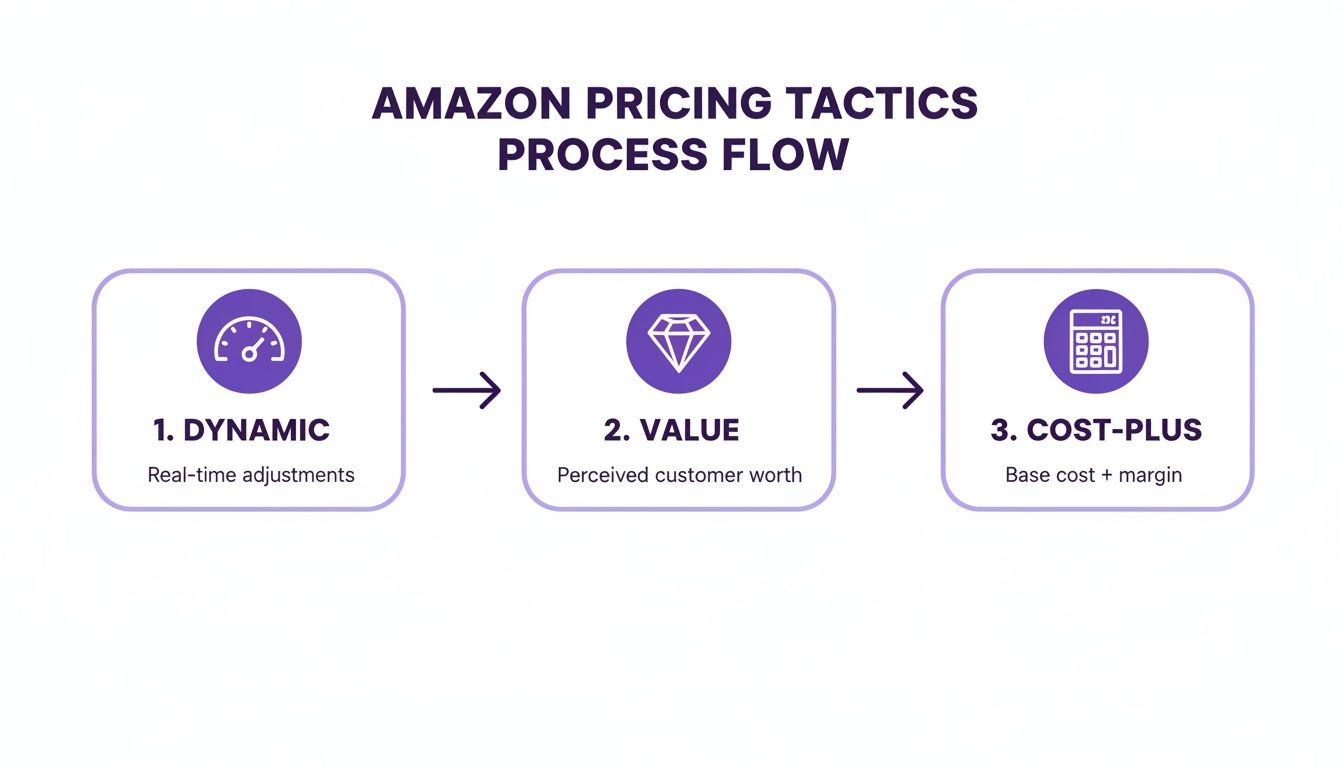
As shown, tactics range from aggressive, market-driven dynamic pricing to foundational, cost-based approaches. A strong strategy often blends several of these.
Set Up Clear Rules for MAP Violations
For brand owners, a significant part of the monitoring workflow is MAP policy enforcement. This requires a clear, systematic process that is both fair and firm. An effective escalation protocol removes emotion from enforcement and ensures consistency.
- Automatic Detection: Your monitoring tool should instantly flag any seller advertising below MAP, capturing evidence like a screenshot with the date, time, seller name, and price.
- First Automated Warning: The initial violation triggers an automated but personalized email, giving the seller a chance to correct the price without immediate penalty.
- Human Follow-Up: If the price is not corrected within 24-48 hours, the system should escalate the issue to a team member for a direct call or a more strongly worded email outlining consequences.
- Enforce Consequences: If the seller remains non-compliant, you must follow through. This could mean reporting the seller to Amazon or, for direct wholesale partners, suspending their account.
This structured process ensures every violation is handled consistently. This is where automated tools like Market Edge prove their worth, handling continuous data collection and initial alerts so your team can focus on strategic enforcement.
Measuring Performance and Refining Your Strategy

An Amazon pricing strategy can never be "set and forget." The marketplace moves too quickly. The most successful sellers treat their pricing as a dynamic system, creating a continuous feedback loop where performance data informs the next strategic adjustment.
The goal is to move beyond surface-level metrics to understand the true consequences of your pricing actions. For instance, did aggressively lowering the price on a key ASIN increase your Buy Box win rate and lead to a profitable sales lift, or did it ignite a race to the bottom that eroded margins for everyone? Answering these questions requires a disciplined, systematic review process.
Connecting Your Actions to Real-World Outcomes
The KPIs you defined earlier are your guide. By tracking them consistently, you can draw a direct line from a specific pricing change to its business impact.
If your objective was to increase market share, a more competitive repricing rule should lead to a measurable increase in your Buy Box win percentage and unit session percentage. If those metrics remain flat, the strategy is not working. This data-driven clarity allows you to pinpoint the issue—perhaps a new competitor has emerged, or your price floor is too high—and make targeted adjustments instead of guessing. To get more granular, it is valuable to understand the full capabilities of pricing analytic software.
A Framework for Quarterly Strategy Reviews
Schedule regular, structured reviews to keep your pricing strategy effective. A quarterly review provides enough time for changes to generate meaningful data without allowing a flawed strategy to cause prolonged damage. This is a dedicated time to challenge assumptions and adapt to market signals.
A quarterly review is not just to see if you hit your targets, but to understand why. Did you achieve your sales goal because your strategy was effective, or did a key competitor run out of stock for two weeks? Context is critical.
The following checklist can guide ecommerce managers and sales leaders through this process.
Quarterly Pricing Strategy Review Checklist
This checklist provides a systematic method to review your Amazon pricing strategy's performance and identify necessary adjustments.
| Review Area | Key Question to Ask | Data Source / Metric | Action Item if Negative |
|---|---|---|---|
| KPI Performance | Did we hit our primary KPI targets (e.g., Buy Box win rate, profit margin, MAP compliance)? | Sales & Traffic Reports, Pricing Analytics Dashboard | Re-evaluate the specific repricing rules tied to any underperforming KPI. |
| Competitor Behavior | Have new, significant competitors emerged on our key ASINs? Have our usual rivals changed their pricing behavior? | Competitor Price Monitoring Data, Buy Box Win/Loss History | Update competitor tiers in your repricing rules to include, exclude, or re-prioritize players. |
| Rule Profitability | Which automated repricing rules are generating the most profit? Which are sacrificing too much margin for volume? | Profitability Reports (per SKU/ASIN), Margin Analysis | Deactivate or tighten the floors on low-profit rules. Apply successful rule logic to similar products. |
| Market Position | Is our average selling price trending up or down? How do we compare to the market average today versus 90 days ago? | Average Selling Price (ASP) Trend, Market Price Position Report | Adjust price floors and ceilings to align with your desired market position (e.g., premium vs. value). |
| Catalog Changes | Have we launched new products that need a unique pricing tactic (e.g., value-based for a new private label item)? | New Product Launch Calendar, Catalog Management System | Assign and configure the correct pricing strategies for all new SKUs. |
Following this process ensures your pricing strategy remains a sharp, effective tool. This is where platforms like Market Edge deliver value by providing the clean, structured data needed to answer these questions confidently and make adjustments that drive results.
Common Questions About Amazon Pricing
Implementing a sophisticated Amazon pricing strategy raises practical, real-world questions. For decision-makers, direct answers are needed to guide teams and protect margins. Here are some of the most common ones.
This section bridges the gap between high-level strategy and daily operational execution.
How Often Should I Change My Prices on Amazon?
There is no single correct frequency. The optimal rate of change depends on the competitive intensity for your specific products.
For high-demand items like popular electronics or office furniture, you may need to adjust prices several times a day. In these competitive environments, being priced too high for even a few hours means losing sales and visibility by failing to win the Buy Box.
Conversely, for a branded product with a strict MAP policy or a unique private-label item, frequent price changes can erode brand value and stability.
The key is not a fixed schedule but the capability to react instantly when necessary. An automated repricing tool is essential here. You set the rules, and it adjusts the moment a competitor makes a move, eliminating the need for manual intervention.
What Is a Price Floor and Why Is It So Critical?
A price floor is your financial safety net. It is the absolute lowest price you are willing to accept for a product, calculated to cover your cost of goods, all Amazon fees, shipping, and a non-negotiable minimum profit margin.
Without a hard price floor, automated repricers can be dragged into a "race to the bottom." A single competitor with a misconfigured pricing tool can trigger a catastrophic price war, eliminating profits in minutes. Your price floor acts as a circuit breaker to prevent this.
A common mistake is setting a floor based only on the item's cost. A true price floor must account for every variable cost—FBA fees, referral fees, and storage costs—to ensure every sale is profitable.
How Do I Compete with Amazon Retail on a Listing?
Attempting to beat Amazon on price is almost always a losing proposition. Their scale and willingness to operate on razor-thin margins make a head-to-head price war unwinnable. The intelligent approach is to change the competitive dimension.
Focus on areas where a third-party seller can outperform:
- Improve Stock Reliability: If Amazon's stock levels are inconsistent, maintaining better in-stock availability can help you win the Buy Box even at a slightly higher price.
- Leverage Seller Fulfilled Prime (SFP): If you qualify, SFP provides greater control over your fulfillment process and can be a significant advantage.
- Build a Strong Seller Rating: Excellent customer service is crucial. A higher feedback score is a major factor in the Buy Box algorithm.
- Create Unique Bundles: Pairing your product with a complementary item creates a new ASIN where Amazon is not a direct competitor.
The goal is to be aware of Amazon's price but never let it dictate your profitability.
Is Manual or Automated Pricing Better?
For any seller with more than a few SKUs, the answer is clear: automated pricing is superior. The speed and scale of the Amazon marketplace make manual repricing operationally unfeasible.
An automated system works 24/7 to execute your strategy, protect your margins with price floors, and maintain competitiveness at a scale no human team can match.
This frees up your team to focus on strategic work, such as analyzing performance, refining repricing rules, and identifying new opportunities. This is where tools like Market Edge become indispensable, providing the data needed to make these intelligent, strategic decisions.
You cannot refine a pricing strategy without clear market visibility. Market Edge delivers the clean, near-real-time competitive data you need to understand the market and execute winning moves on Amazon. Learn more about how we can help.