
A $3,375 gap between MSRP and advertised retail price was visible across U.S. automotive inventory in April 2025. The average advertised MSRP was $51,828, while the average list price was $48,453, a difference of 6.5%, according to S&P Global's automotive pricing analysis. That isn't a labeling detail. It's a direct signal about discount pressure, inventory conditions, and the price customers may ultimately accept.
Pricing teams that treat MSRP as market reality can misread margin, competitive position, and channel health. A product can look profitable against its recommended price while losing ground at retail. Conversely, a product selling above MSRP may indicate scarcity, strong demand, or an opportunity to change sourcing and allocation decisions.
The MSRP vs Retail Gap and Why It Matters
A $3,375 gap between MSRP and advertised retail price appeared across U.S. automotive inventory in April 2025. Average advertised MSRP was $51,828, compared with an average list price of $48,453, a difference of 6.5%, according to S&P Global's automotive pricing analysis. That spread is more than a labeling detail. It signals discount pressure, inventory conditions, and the price customers may accept.
MSRP is a benchmark. Retail is the market signal. Manufacturers recommend a price, while retailers decide what customers see and pay. The U.S. Federal Trade Commission confirms that a dealer may set retail pricing at MSRP or choose another price independently, as explained in the FTC's supply-chain guidance.
The commercial effects reach beyond a displayed discount. A dashboard built only on MSRP can overstate market price, distort gross-margin forecasts, and misdirect promotional planning, inventory allocation, and distributor discussions. Persistent retail prices below MSRP may also indicate that the recommended price no longer matches customer willingness to pay.
The gap is not fixed. It widens when retailers need to stimulate demand or clear inventory, and it narrows when supply tightens or buyers accept less promotional support. A product selling above MSRP can point to scarcity or stronger demand, which may influence sourcing and allocation decisions.
Practical rule: Treat MSRP-to-retail variance as a diagnostic metric, not merely a discount field.
A competitor's lower advertised price does not automatically justify a response. The offer may involve aged inventory, a different bundle, or a different cost structure. Pricing teams need SKU-level monitoring, competitor context, stock visibility, and a clear separation between recommended pricing and actual transaction conditions. Those controls show whether a gap reflects channel deviation, deliberate promotion, or a margin problem that requires action.
Defining MSRP and Retail Price
MSRP means manufacturer's suggested retail price. It's the price a manufacturer recommends for a product's retail sale. The word “suggested” is decisive. MSRP doesn't compel a retailer to charge that amount, and it doesn't establish a mandatory resale price.
The FTC says a dealer is free to set a retail price above or below MSRP when the decision is made independently. Michigan consumer guidance makes the same distinction, explaining that manufacturers may suggest a price while retailers retain the ability to choose their own pricing, as described in Michigan's consumer protection guidance on price fixing.
Retail price is the amount a seller offers or charges through a specific channel. Depending on the context, that may mean an advertised list price, an online shelf price, a marketplace offer, or a final transaction price after incentives. Those values aren't interchangeable, so pricing teams should label each one precisely.
A useful working model separates the fields:
- MSRP or RRP: The manufacturer's recommended reference point.
- Advertised retail price: The price displayed by a retailer or marketplace seller.
- Transaction price: The amount paid after negotiated discounts, incentives, or promotions.
- Net realized price: The amount remaining after applicable rebates, channel costs, and other commercial adjustments.
The distinction between list price and actual paid price is particularly important in categories with negotiated selling. For a broader explanation of how list price functions as a reference point, see this guide to defining list price.
Historically, MSRP developed as manufacturers sought a standardized way to communicate recommended prices while retailers retained pricing autonomy. A historical review identifies an early example in a 1918 newspaper advertisement for Liggett's and connects the term's development to antitrust pressure following the 1911 Dr. Miles ruling, as documented in the history of MSRP.
For operational purposes, the takeaway is straightforward. MSRP tells you what the manufacturer recommends. Retail tells you what the channel is doing. Margin analysis and competitive benchmarking should prioritize the latter while using the former as a comparison anchor.
Why MSRP and Retail Prices Diverge
Retail prices depart from MSRP when market conditions outweigh the manufacturer's intended position. Retailers adjust for demand, inventory age, competition, product configuration, location, and channel economics. Manufacturers may leave MSRP unchanged while sellers revise advertised prices repeatedly, creating a measurable signal of margin pressure or pricing power.
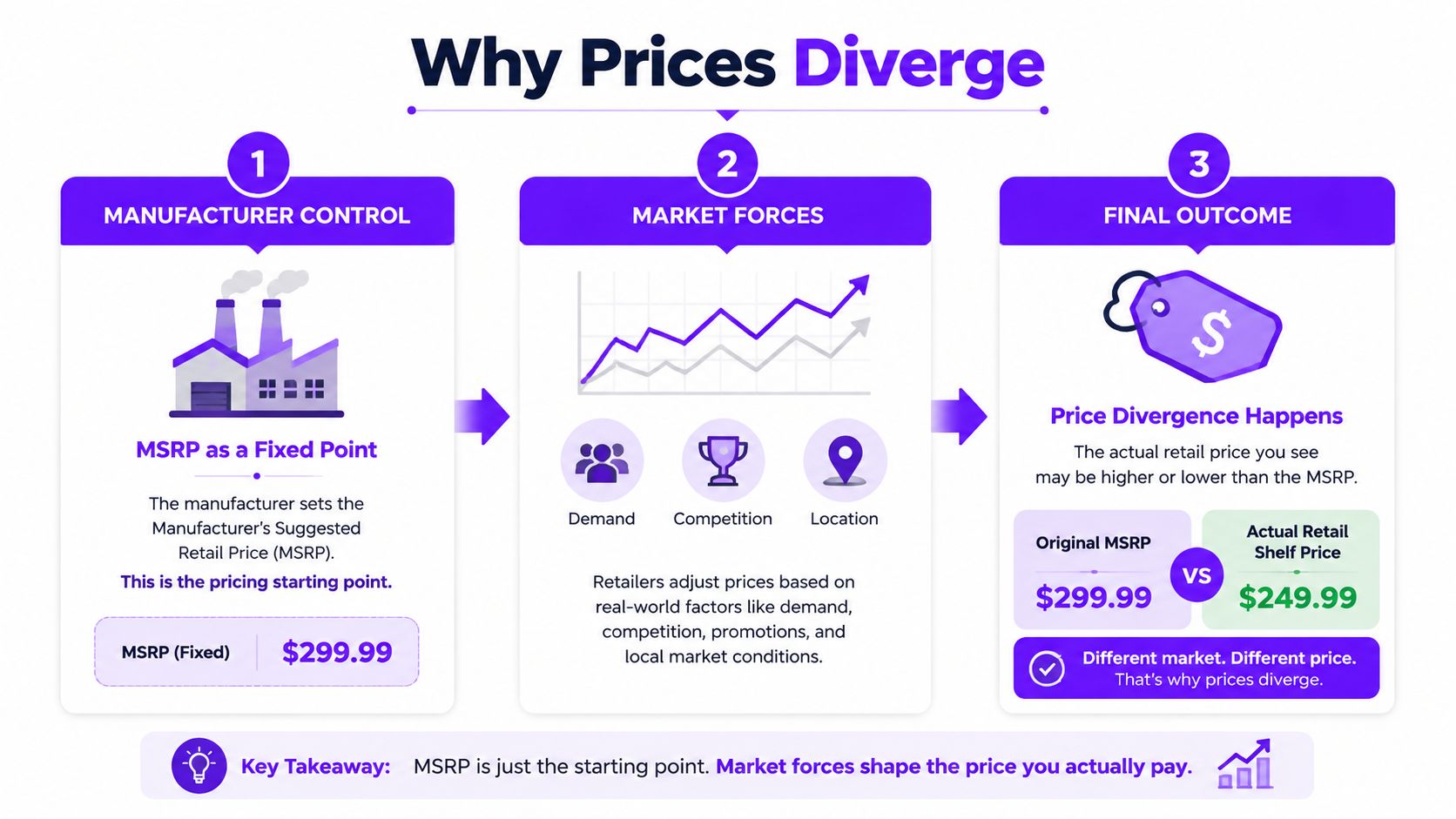
The main drivers of divergence
| Aspect | MSRP | Retail Price |
|---|---|---|
| Price owner | Manufacturer recommendation | Retailer or marketplace seller |
| Legal status | Non-binding suggestion | Seller's independently chosen price |
| Primary purpose | Reference point and price anchor | Market-facing offer |
| Main inputs | Brand positioning, product costs, channel guidance | Demand, competition, inventory, incentives, and seller economics |
| Operational use | Benchmark for positioning and policy | Signal for margin, sourcing, and competitive response |
Automotive pricing illustrates the pattern. As shown earlier, the April 2025 U.S. market had advertised prices regularly below the manufacturer's reference point. That gap matters operationally because repeated underpricing can affect dealer incentives, sourcing decisions, and the priority given to MAP or channel-policy enforcement.
Technology categories can produce the reverse outcome. The cited GPU research and market discussion describes one flagship graphics card priced roughly 142% above MSRP, while a lower-tier model was near 9% above MSRP. The comparison shows why retail price cannot be treated as an automatic discount signal. Scarcity, product tier, and customer willingness to pay can move retail far above the recommended benchmark, as discussed in this academic and market discussion of MSRP reference effects.
A pricing team should examine each MSRP-to-retail gap through four lenses:
- Demand: Are customers accepting the current price, or are sellers discounting to create movement?
- Availability: Are stock-outs giving sellers room to charge above MSRP?
- Competition: Is one reseller undercutting while others preserve their position?
- Economics: Does the retail price cover the intended margin after channel costs?
Forecasting can connect these observations to purchasing and inventory decisions. Teams evaluating internal development against external tools can review this resource on build vs buy AI forecasting.
The same spread can support opposite diagnoses. Below-MSRP retail may indicate margin leakage, inventory pressure, or disciplined promotion. Above-MSRP retail may indicate pricing power, constrained supply, or a sourcing plan that cannot meet demand. The direction of the gap is only the starting point. Its cause determines the response.
Business Implications of the Pricing Gap
The commercial impact begins with margin. If a retailer or distributor plans economics around MSRP but repeatedly sells below it, the business may absorb discounts without understanding their cumulative effect. The problem becomes more severe when sales teams use MSRP in forecasts while finance uses actual realized prices for reporting.
A below-MSRP gap can point to several conditions:
- Channel pressure: Resellers may be competing aggressively for the same demand.
- Inventory aging: Sellers may be reducing price to exit stock.
- Weak positioning: Customers may not perceive enough value at the recommended price.
- Policy leakage: Partners may be advertising below an agreed MAP level.
A price above MSRP sends a different signal. It may indicate constrained supply, a strong product launch, or a category where customers prioritize availability over the recommended benchmark. In technology, the cited GPU examples show how sharply outcomes can vary between product tiers, with one flagship model around 142% above MSRP and a lower-tier model near 9% above MSRP in the referenced market coverage.
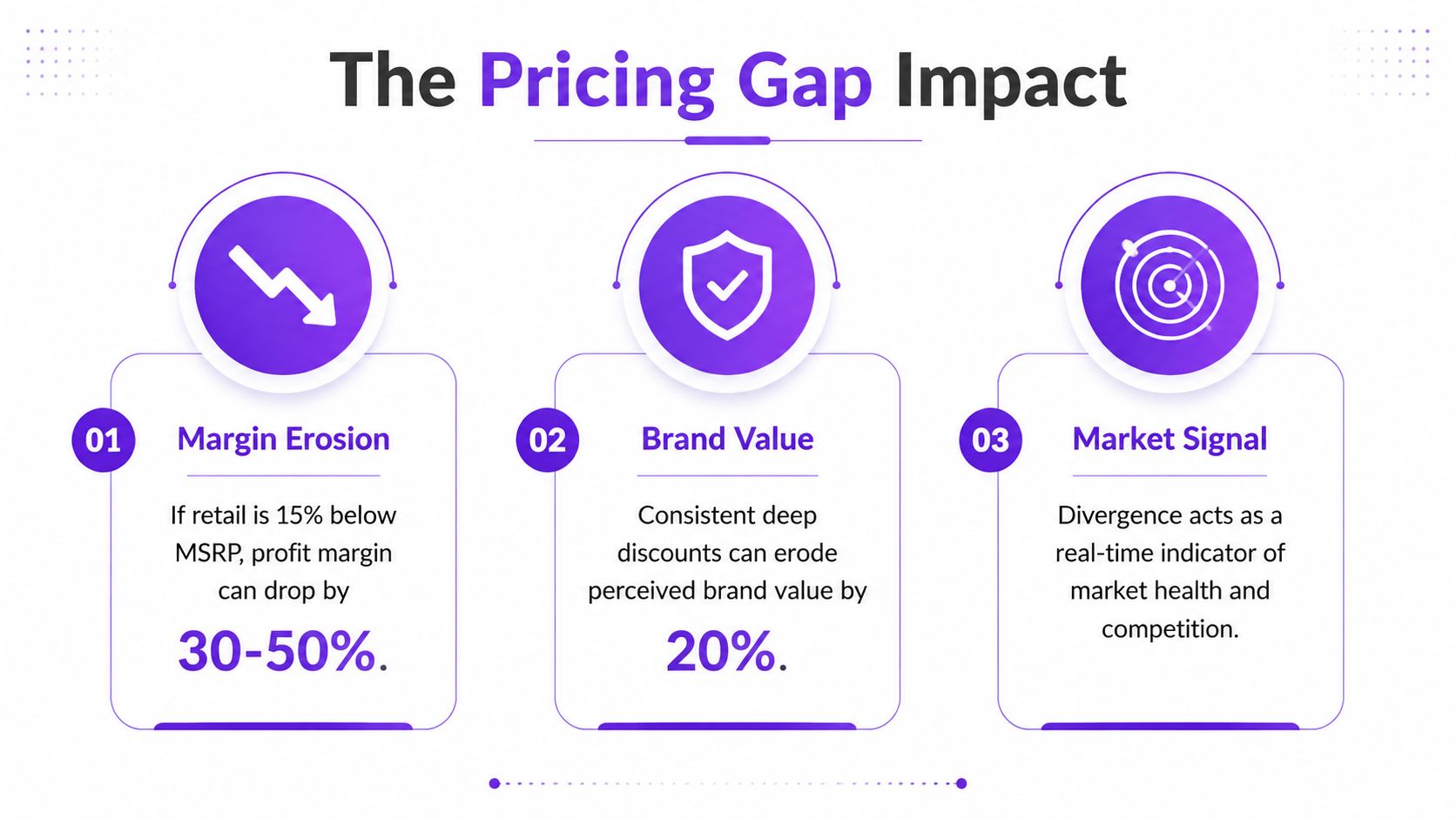
MAP and RRP require careful handling
MAP, or minimum advertised price, governs an advertised price policy. It isn't the same as forcing a retailer to sell at a fixed resale price. RRP, or recommended retail price, similarly communicates a reference level rather than automatically controlling the final price.
Legal risk arises when a supplier uses pricing communications or enforcement mechanisms to impose resale prices unlawfully. UK competition guidance warns that minimum advertised price policies can form part of illegal resale price maintenance, as set out in the Competition and Markets Authority's guidance for suppliers and retailers.
That means a MAP workflow shouldn't start with automatic penalties. It should preserve evidence, identify the seller, distinguish an advertised price from a checkout price, and route cases through an appropriate commercial and legal review. A manufacturer can protect channel consistency without assuming every deviation has the same cause or remedy.
A widening gap is not automatically a violation. It's an investigation trigger.
The most useful dashboard combines MSRP, observed retail, stock status, seller identity, product match confidence, and time history. Executives can then distinguish a temporary promotion from sustained price erosion. Sourcing teams can identify products where market retail remains above MSRP, while sales leaders can see where discounting has become the default rather than an exception.
Implementing Pricing Strategy and MAP Enforcement
A pricing strategy should begin with a clean distinction between reference price, advertised price, and realized price. Without that separation, teams may debate whether a product is “discounted” while using different definitions of discounting.
Start with a SKU-level baseline. Record the manufacturer's MSRP or RRP, current direct price, approved promotional price, channel-specific MAP where applicable, and the observed prices of relevant competitors. A practical ecommerce margin calculation guide can help teams connect selling price with the broader cost structure rather than evaluating the gap in isolation.
Build the workflow around evidence
A workable process has five parts:
- Define the product match. Confirm model, variant, bundle, region, currency, and condition. A lower price for a different configuration isn't a genuine undercut.
- Capture the channel context. Record retailer, marketplace, seller, fulfillment method, shipping treatment, and stock status.
- Set escalation thresholds. Use commercial rules that distinguish a single observation from repeated deviation. The threshold should reflect margin exposure and channel importance.
- Review before contacting partners. Check promotions, authorized campaigns, bundles, and data errors before sending a compliance notice.
- Document the response. Store the URL, timestamp, observed price, product evidence, communication, and resolution.
A manufacturer enforcing MAP should also define what the policy covers. Does it apply to marketplace listings, coupons, membership discounts, bundles, or search advertising? Ambiguous policies create channel conflict because partners can't reliably determine which actions trigger review.
The guide to enforcing MAP pricing is useful as a reference for structuring that process, but enforcement still requires judgment. Automated detection can identify deviations. It can't decide whether a seller had authorization for a campaign or whether the advertised item matches the protected SKU.
Protect relationships while protecting price
Avoid treating every deviation as intentional misconduct. Contact the seller with evidence, ask for context, and apply the same policy consistently across comparable partners. Selective enforcement can damage trust and may create additional legal and commercial concerns.
Pricing leaders should review three outcomes separately:
- Margin protection: Did the observed price threaten contribution economics?
- Channel stability: Did the deviation trigger a broader response from other sellers?
- Customer perception: Did repeated discounts change how buyers interpret the brand's normal price?
The objective isn't to force every seller to display MSRP. The objective is to understand where retail behavior departs from strategy, why it happens, and what response is lawful and commercially rational.
Continuous Price Monitoring for Competitive Advantage
A distributor notices that a key product is selling below MSRP on a marketplace. The sales team asks whether to match the price. The pricing manager checks a manually maintained spreadsheet and finds that the data is several days old. By then, the competitor has gone out of stock, another seller has lowered its price, and the original decision would have turned a temporary anomaly into a lasting margin cut.
Near-real-time monitoring changes that workflow by connecting price, availability, and seller activity. Marketplace monitoring systems can track those signals across platforms such as Amazon, eBay, and Mercadolibre, which matters because a price change without stock context can produce the wrong response.

A practical monitoring loop
The workflow should answer four questions every time a gap appears:
- What changed? Compare current retail with the previous observation and the MSRP baseline.
- Who changed it? Identify the retailer, seller, marketplace offer, or distributor responsible.
- Is the product comparable? Validate the exact SKU, condition, bundle, and fulfillment terms.
- What action follows? Decide whether to monitor, contact a partner, adjust price, change sourcing, or escalate internally.
Automated product matching is especially important for catalogs with similar models or regional variants. False comparisons create false alerts, and false alerts train teams to ignore the monitoring system. A focused price monitoring tool workflow should therefore prioritize match quality, alert relevance, and evidence that a commercial team can act on.
The operational value appears in several use cases. An online retailer can compare its offer with competing sellers before matching a price. A manufacturer can identify repeated MAP deviations by partner. An importer can spot products where retail remains above MSRP and investigate whether supply, allocation, or sourcing should change.
For broader guidance on designing a competitor-monitoring program, Next Point Digital's competitor tracking resource provides useful context. The core principle remains simple: monitor both price and availability, because a low price attached to limited stock doesn't carry the same competitive meaning as a low price supported by persistent inventory.
The video below provides another practical view of market intelligence workflows.
A dashboard should route findings to the right owner. Pricing handles strategic response, sales handles partner communication, supply teams handle availability and sourcing, and legal reviews policy questions. Monitoring creates value only when those roles and escalation paths are explicit.
Making Smarter Pricing Decisions
The strongest pricing decision rarely comes from choosing MSRP or retail in isolation. MSRP provides the reference frame. Retail provides the operating reality. The gap between them becomes useful when teams compare it with product availability, seller behavior, margin requirements, and competitive alternatives.
Use a different response for each market condition:
- Retail below MSRP with broad availability: Investigate discount pressure, inventory age, and whether the recommended price still reflects demand.
- Retail below MSRP from one seller: Validate the listing and check for a promotion, bundle, or unauthorized deviation before changing your own price.
- Retail above MSRP with scarce inventory: Review sourcing, allocation, and replenishment decisions before assuming the premium will last.
- Retail clustered near MSRP: Maintain discipline, but continue monitoring because a stable gap can change quickly when supply or competition shifts.
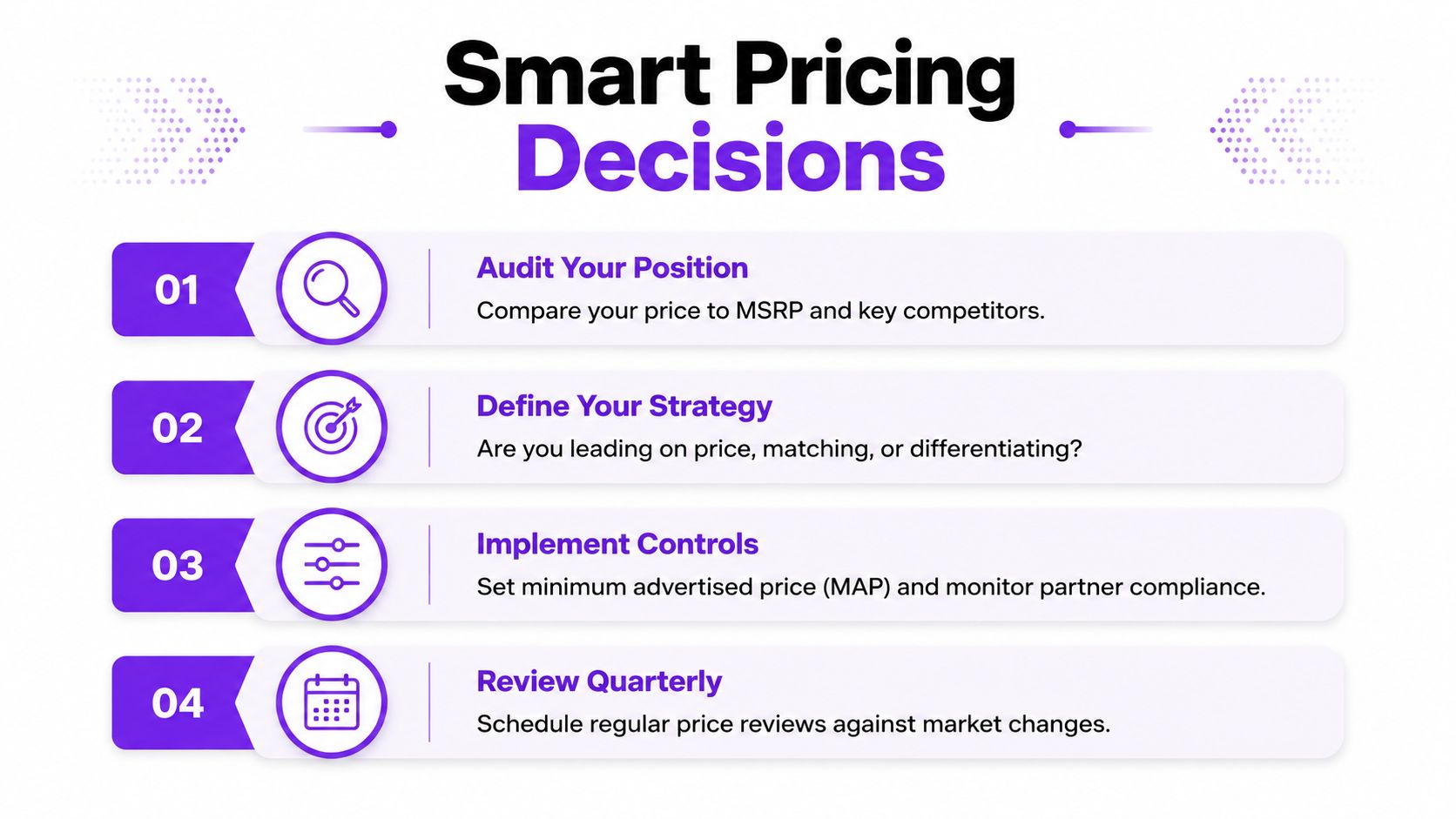
A decision checklist for the next review
- Confirm the baseline. Is the MSRP current, and are you comparing the same product configuration?
- Measure the gap. Record advertised retail, transaction price where available, and the direction of variance.
- Add market context. Check competitor prices, seller identity, availability, promotions, and fulfillment terms.
- Assess the consequence. Quantify margin exposure internally and identify whether the gap affects brand or channel position.
- Choose the response. Match, hold, reposition, contact a partner, change sourcing, or continue observing.
- Review the rule. For MAP or RRP programs, confirm that the policy and enforcement approach have received appropriate legal review.
A quarterly review can establish governance, but fast-moving categories need more frequent observation. The right cadence depends on how quickly competitors change prices, how volatile supply is, and how much margin a deviation puts at risk.
Market Edge tracks competitor prices, stock, and seller activity across retail sites and marketplaces, helping teams compare MSRP with observed retail at the SKU level and identify potential MAP deviations. Visit Market Edge to assess whether automated monitoring fits your pricing, sourcing, or channel-compliance workflow.