
A reseller undercuts your MAP price on Amazon, the listing wins visibility, and your authorized dealers start asking why they're following the rules. Your policy document is clear, but the screenshot is already outdated by the time someone reviews it. Meanwhile, sales wants immediate action, legal wants a defensible evidence trail, and the marketplace offers no simple “enforce my MAP policy” button.
That situation captures the operational reality of how to enforce MAP pricing. The policy matters, but detection, documentation, channel coverage, and consistent escalation determine whether it works. A practical program monitors the public offer across the reseller network, distinguishes genuine violations from exceptions, and gives every case a traceable path from discovery to resolution.
Why MAP Enforcement Fails in Practice
Most brands don't fail because they forgot to define a minimum advertised price. They fail because enforcement is treated as a one-time legal exercise instead of a recurring pricing operation.
The first problem is incomplete visibility. A team may check a few authorized retailer sites while an unauthorized seller undercuts the same SKU on Amazon, eBay, Google Shopping, or a direct storefront. By the time the brand notices, the lower offer may have influenced competing listings and created pressure on compliant dealers.
Research on MAP compliance shows why checking only approved partners is inadequate. One empirical study found that 14–22% of authorized dealers violated MAP, compared with 46–54% of unauthorized dealers. Another analysis found 53% of unauthorized retailers violated MAP policies, while 15% of authorized retailers did so. These findings are documented in the Berkeley MAP compliance study.
Authorized status isn't a compliance guarantee
An authorized account can still have a pricing problem. A merchandising employee may upload an old price file, an automated repricer may respond to a competitor, or a distributor may move inventory into a channel the brand doesn't routinely inspect. Unauthorized sellers create a separate challenge because the brand may not have a direct commercial relationship with the account.
That's why a reseller database alone isn't enough. The monitoring system needs to connect the seller identity, product, advertised price, channel, and time of observation. Without those fields, the team can't reliably distinguish a current breach from an outdated page, a mismatched product, or a legitimate promotion.
Practical rule: A MAP policy has no operational force if your team can't prove what was advertised, by whom, where, and when.
Inconsistent action destroys credibility
Selective enforcement causes more damage than a difficult policy. If a small reseller receives a supply warning while a major account repeatedly advertises below MAP without consequence, every dealer notices the inconsistency. Sales teams then negotiate exceptions informally, and the written policy stops reflecting actual behavior.
The solution is a repeatable case process. Monitor continuously, preserve evidence, review edge cases, and apply the same decision rules regardless of account size. The core challenge isn't writing another policy document. It's detecting recurring undercutting at scale and responding before compliant sellers conclude that following MAP puts them at a disadvantage.
Building a Legally Defensible MAP Policy
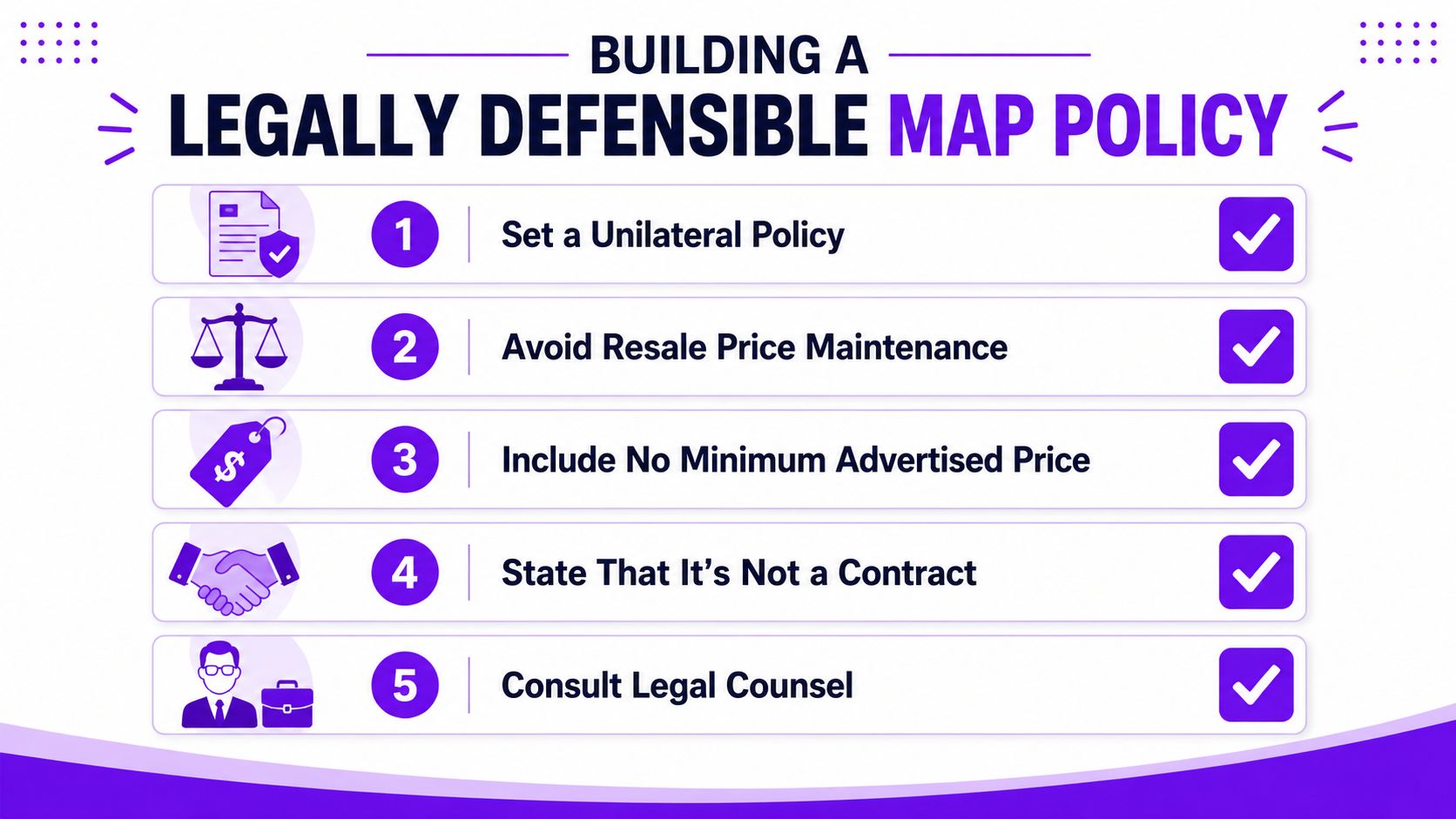
A MAP policy should govern the manufacturer's unilateral terms for public advertising. It shouldn't become a disguised agreement among retailers about the prices they must charge at checkout.
Legal guidance emphasizes that the manufacturer must communicate the policy separately to each retailer and enforce it directly. Coordination with other sellers, dealer councils, or trade groups can create serious risk because it may suggest that retailers are collectively setting or maintaining resale prices rather than responding to an independent brand policy.
The distinction between advertised price and actual resale price is central. MAP generally controls the public price shown on a product page, shopping ad, email, or other visible offer. It doesn't automatically control the final amount negotiated in a cart, at checkout, or through an offline conversation. Monitoring actual transaction prices and penalizing sellers for selling below a threshold can move the program toward resale price maintenance exposure.
For a practical definition and policy framework, review this guide to what a MAP pricing policy covers.
Put the operating rules in writing
A defensible policy should identify the covered products, the applicable advertised-price floor, the channels included, and the process for handling suspected breaches. It should also explain how the brand treats bundles, rebates, coupons, loyalty offers, closeout inventory, and temporary promotions.
Temporary-waiver language matters because seasonal campaigns and inventory events may require a controlled exception. A waiver should come from the brand, apply under stated conditions, and have a defined period. Retailers shouldn't be encouraged to coordinate promotional pricing among themselves.
Before launch, verify:
- Unilateral structure: The manufacturer adopts and communicates the policy independently.
- Advertising scope: The document defines what counts as a public advertisement.
- No transaction-price control: The policy doesn't require a retailer to sell at a specific checkout price.
- Exception process: Temporary waivers, bundles, and promotions have written treatment.
- Separate communication: Each retailer receives the policy directly, without coordinated discussions.
- Legal review: Counsel reviews the policy, regional application, communications, and escalation language.
- Evidence retention: The brand can preserve policy versions, delivery records, notices, and case history.
The policy should also state that it isn't a contract requiring a retailer to sell at a particular resale price. That language doesn't eliminate legal risk by itself, but it clarifies the intended boundary and supports disciplined communication.
Monitoring Violations Across All Channels
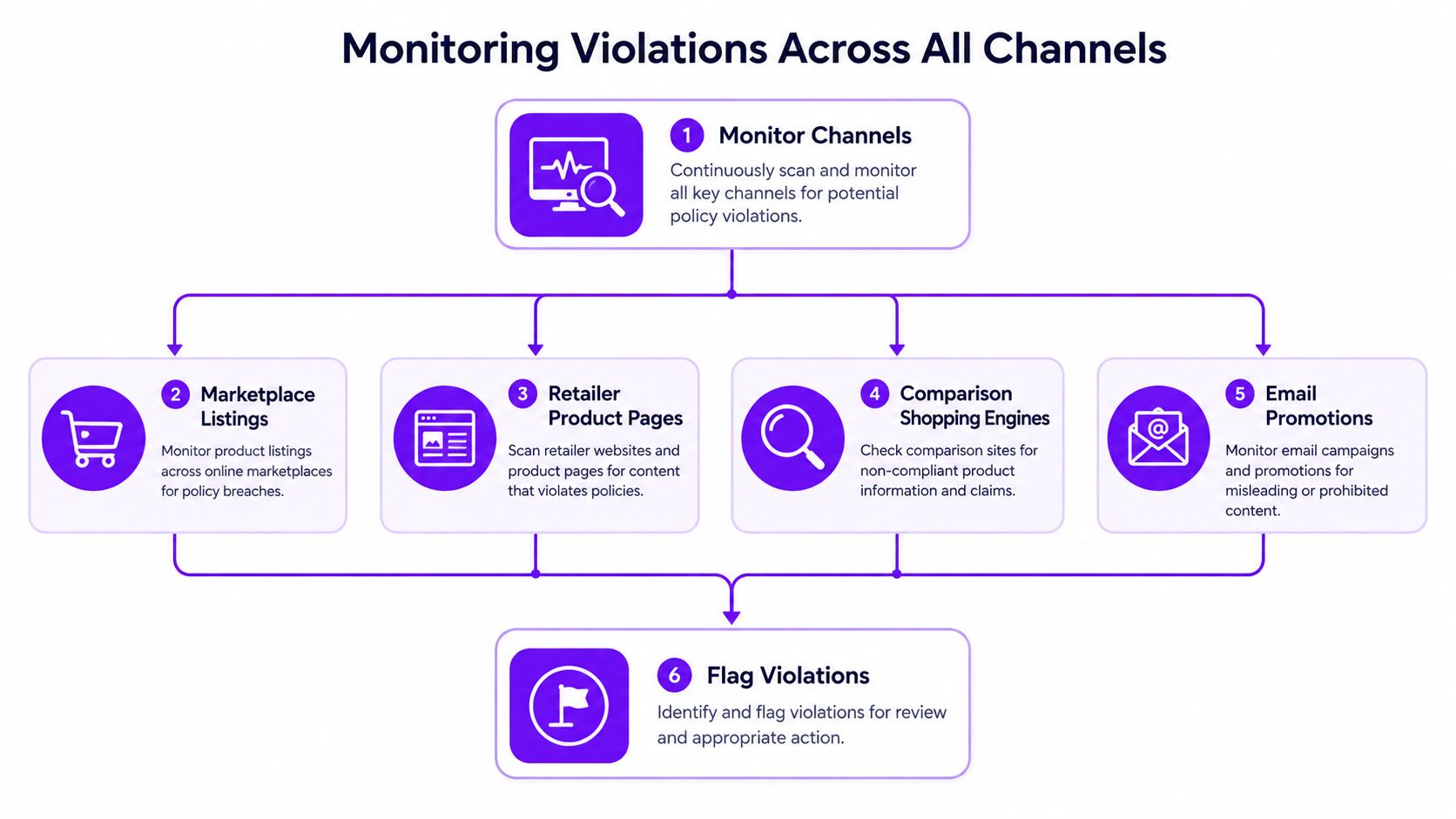
MAP monitoring should begin with a simple rule: measure the public offer, not only the final transaction amount. A seller may display a price below MAP on a product page and then reveal a higher amount in the cart. The visible listing can still be the relevant issue for an advertised-price policy.
Coverage needs to include the places where buyers encounter offers:
- Marketplace listings: Check Amazon and eBay product pages, seller offers, featured offers, and relevant variations.
- Retailer product pages: Review direct reseller sites, category pages, promotional landing pages, and indexed product feeds.
- Comparison shopping engines: Inspect Google Shopping and similar results where a below-floor offer can gain immediate visibility.
- Email promotions: Include public promotional emails and digital circulars when the policy covers those advertisements.
Use a case-ready detection workflow
A reliable workflow has four operational stages: detect, capture, log, and review.
Detection compares the observed public price with the current MAP value for the exact SKU or variation. Matching must account for model numbers, pack sizes, color, condition, bundles, and regional differences. A false match wastes a reseller's time and weakens the brand's credibility.
Capture the listing before contacting the seller. Save the product URL, reseller name, SKU, displayed price, currency, channel, timestamp, and a screenshot that shows the relevant offer. If the page includes a coupon, “from” price, membership condition, or cart disclosure, preserve that context too.
Log each event in a central case record. The record should show whether the issue is open, under review, corrected, disputed, or escalated. It should also connect repeat observations to the same seller and SKU, rather than treating every scan as an unrelated incident.
Human review remains important. A reviewer should confirm that the price is public, the product matches, the policy covers the channel, and no approved waiver or special circumstance applies. Teams evaluating data collection infrastructure can also compare the Webscrapingapi success rate and cost when assessing external scraping options.
Near real-time monitoring matters because lower prices can spread across reseller feeds and marketplace results before a weekly audit catches them. The practical MAP price monitoring workflow should therefore prioritize the SKUs, channels, and sellers most likely to create market-wide pricing pressure.
Escalation Paths and Penalty Structures
Detection only creates value when the response is predictable. A reseller should know what happens after a verified breach, and your internal teams should not invent a different consequence every time a large account calls.
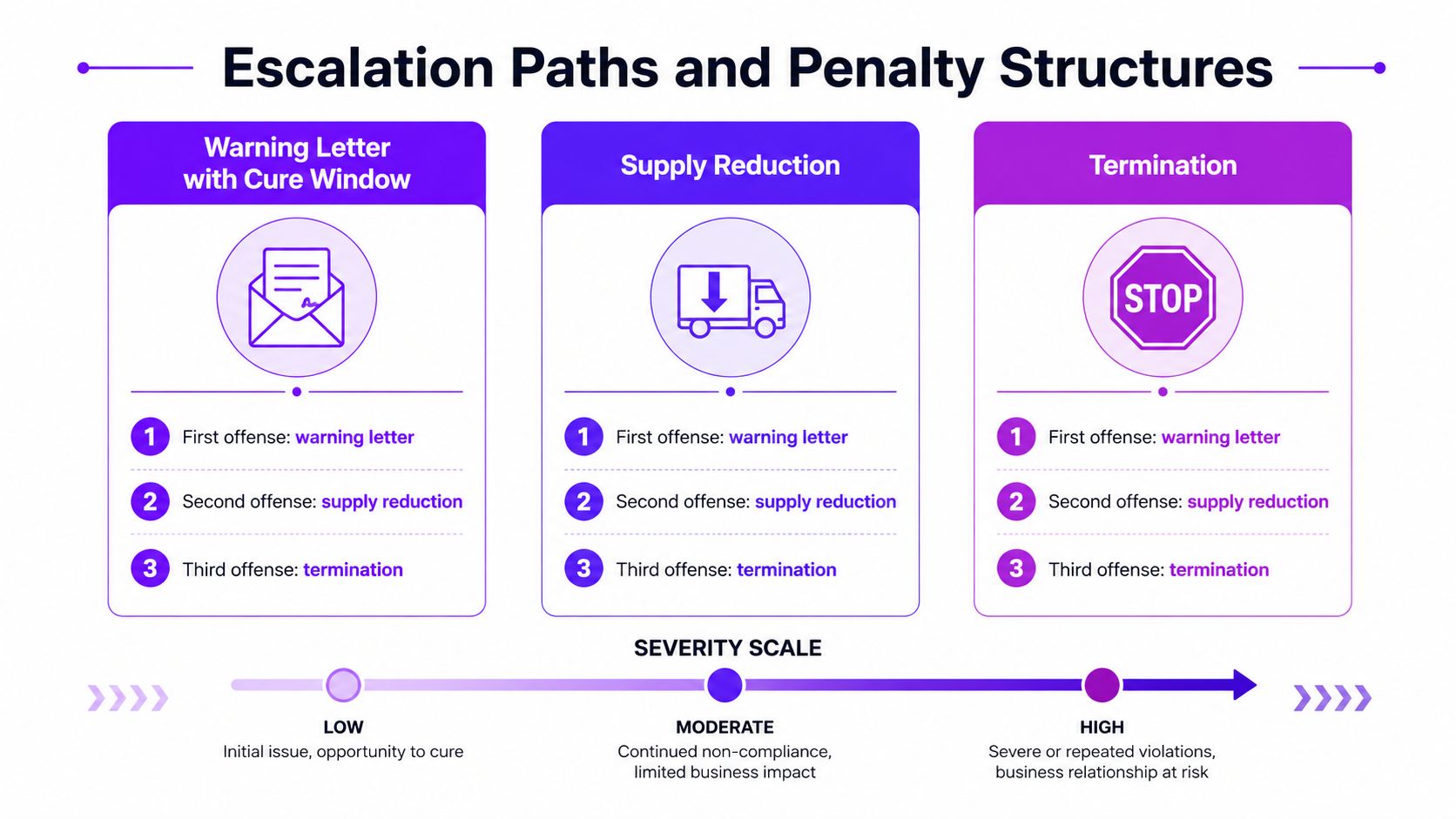
A tiered ladder usually works better than a single severe penalty. The first response can be a written notice with the listing, timestamp, applicable policy language, and a clear cure deadline. For online listings, practical enforcement guidance commonly recommends a short repair window, often around 24 hours, because the seller can usually update a web price quickly. The recommendation is discussed in this MAP enforcement workflow guide.
Match the response to the case
| Response | Appropriate use | Main trade-off |
|---|---|---|
| Warning letter | First verified breach or likely operational mistake | Gives the seller a chance to correct the listing, but may be ineffective with deliberate undercutting |
| Supply restriction | Repeated breaches after documented notices | Creates commercial leverage, but requires consistent policy language and legal review |
| Account suspension | Persistent non-compliance or unresolved evidence | Protects the network, but can affect sales coverage and partner relationships |
| IP or listing complaint | Inaccurate product representation, counterfeit concerns, or unauthorized content issues | May address a marketplace problem, but it isn't a substitute for MAP enforcement |
The supplier in the enforcement case described by the UK Competition and Markets Authority threatened higher costs or stopped supply when dealers advertised below the floor. That example shows why supply actions must be designed carefully. A commercial consequence can enforce a unilateral policy, but the wording, rationale, and surrounding conduct matter.
Track resolution time and recurrence rate for each seller. A seller that corrects a single accidental listing should not be treated like an account that repeatedly restores the same below-floor price. Your case history should also record notices sent, seller responses, waivers, and final decisions.
Automation can route a verified case to the right owner and prepare a draft message, while a person approves the communication and sanction. Teams exploring workflow triggers can review AI escalation to email, but automated outreach should never bypass policy review or legal controls.
Consistency matters most when accounts differ in size. If the brand ignores large sellers and pressures only small ones, the ladder becomes performative rather than enforceable.
Legal Risks and Antitrust Exposure
A common assumption is that calling a rule “MAP” makes enforcement safe. It doesn't. The legal boundary depends on what the brand controls, how it communicates the policy, what it monitors, and whether its actions effectively force a resale price.
The UK Competition and Markets Authority provides a clear warning. In May 2016, it fined a commercial catering equipment supplier more than £2 million for a policy that restricted online advertising below a floor price. The CMA later cited a £2.7 million penalty against a domestic light fittings supplier in 2017, as well as more than £780,000 against a bathroom fittings manufacturer for similar conduct. These figures and case details appear in the CMA resale price maintenance case studies.
The concern isn't just that a brand published an advertising standard. The risk increases when the policy restricts a reseller's freedom to set online prices, when the supplier pressures dealers through punitive cost changes or supply termination, or when the advertised-price rule functions as a mechanism for maintaining actual resale prices.
Keep advertised pricing separate from resale pricing
Monitoring a product page is materially different from monitoring the price paid by a customer. A brand that tracks sold prices, penalizes deviations at checkout, or ties rebates and dealer status to transaction-price compliance may attract resale price maintenance scrutiny. Commentary concerning Turkey highlights this risk, particularly where suppliers monitor sold prices or use commercial benefits to pressure compliance. The analysis of common compliance violations is a useful reminder that operational shortcuts can create legal exposure.
Regional review is essential. A structure that appears acceptable in one market may require different treatment elsewhere, especially where competition authorities take a strict view of resale restrictions. U.S. scrutiny can also arise in industry-specific contexts, including a 2025 firearms-industry report that argued MAP policies covering a large share of domestically produced handguns could attract antitrust attention.
Use counsel to review the policy before launch and when changing enforcement. Keep communications factual, avoid discussing retailer coordination, don't ask sellers to report competitors' resale prices, and make sure every commercial action follows the written unilateral policy.
Scaling Enforcement with Automation and Tooling
Manual checks work for a small pilot. They break when the catalog expands across Amazon, eBay, Google Shopping, direct reseller sites, and multiple product variations. Human reviewers miss listings, lose screenshots, and apply different standards when cases arrive through scattered spreadsheets and inboxes.
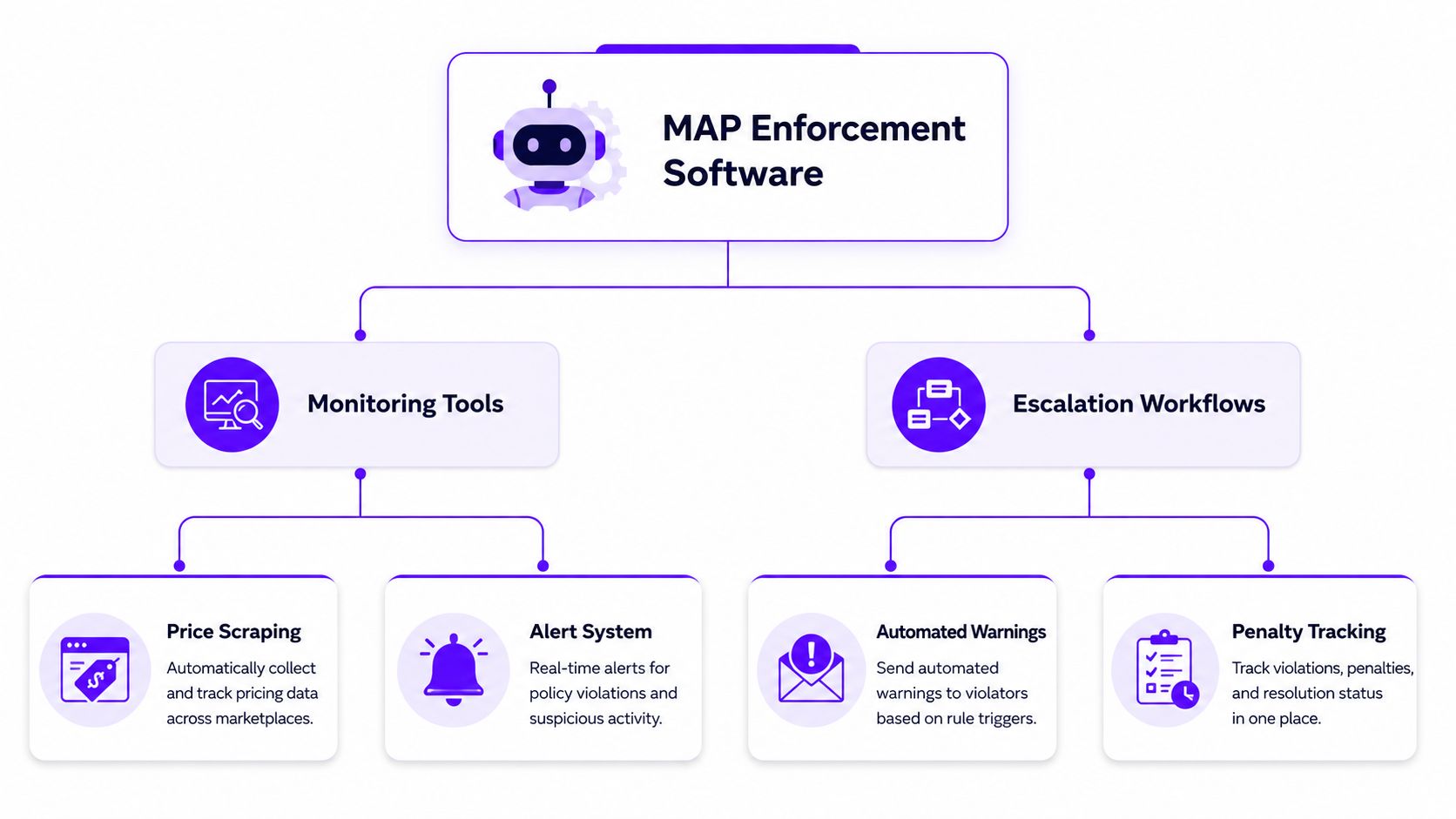
Automation should handle repetitive observation, not make unreviewed legal decisions. A scalable architecture connects four layers:
- Product and policy data: Maintain current SKUs, variations, MAP values, effective dates, exceptions, and approved channels.
- Channel collection: Gather public offers from marketplaces, retailer pages, comparison results, and other covered surfaces.
- Evidence and case management: Store screenshots, URLs, timestamps, seller identity, observed price, and reviewer decisions.
- Escalation workflow: Route verified cases to sales, channel management, or legal owners, then track notices, cures, repeat breaches, and sanctions.
Design for review, not blind automation
Product matching needs safeguards. A system should flag a possible breach when the public offer falls below the applicable floor, but a person should confirm product identity, seller status, policy scope, and any waiver before outreach. This prevents a bundle, used item, regional listing, or cart-only price from becoming an incorrect violation notice.
Reporting should answer operational questions rather than produce decorative charts:
- Which SKUs generate recurring breaches?
- Which sellers take longest to correct listings?
- Which channels produce the most unresolved cases?
- Are violations isolated, or are several sellers reacting to the same market event?
- Which accounts receive exceptions, and who approved them?
A platform such as MAP policy monitoring software can centralize monitoring, evidence capture, alerts, and case records. Market Edge is one example of a B2B price monitoring platform that tracks reseller and marketplace offers, matches products, captures violation evidence, and supports review workflows for MAP compliance. The right choice depends on channel coverage, product complexity, data access, and the level of human control your legal and commercial teams require.
Operational takeaway: Automate discovery and recordkeeping first. Keep policy interpretation, exception approval, and sanctions under accountable human control.
Market Edge can monitor competitor and reseller pricing across retail sites and marketplaces, capture evidence for MAP cases, and centralize alerts for channel teams. Visit Market Edge to review the workflow and test whether it fits your reseller network.