
A pricing manager starts Monday by checking the marketplace dashboard and finds a key SKU selling 12% below the company's advertised price on Amazon. The undercut has been active since the weekend. By the time the team reacts, the product has lost visibility, the margin plan is compromised, and nobody can say with confidence whether the competitor is selling the same pack, a different variant, or a refurbished unit.
That situation is common because marketplace pricing changes faster than manual review cycles. Teams checking a spreadsheet once a day can miss price movements, stock-outs, seller changes, and MAP violations across Amazon, eBay, Walmart, Wayfair, Google Shopping, and specialist retail sites. Marketplace price monitoring software replaces scattered spot-checks with a system that collects listing data, matches products, and routes meaningful changes to the people who need to act.
Why Marketplace Price Monitoring Matters Now
The commercial problem isn't just that competitors change prices. It's that pricing teams often discover those changes after the decision has already affected sales. A retailer may hold a profitable price while another seller wins attention with a lower offer. A manufacturer may learn about a reseller's MAP violation only after channel partners complain. A distributor may miss an available sourcing opportunity because a competitor has gone out of stock.
A practical definition of marketplace price monitoring software includes three connected jobs:
- Listing collection: The system gathers prices, seller information, stock signals, and related offer details from selected marketplaces and retail sites.
- Product identification: It determines whether another listing represents the same SKU, variant, bundle, multipack, or condition.
- Decision delivery: It turns verified changes into alerts, reports, dashboards, or feeds for pricing and commercial workflows.
That last step separates useful monitoring from a large data dump. A pricing manager doesn't need every captured number. They need to know which competitor moved, whether the comparison is valid, whether the item is available, and what action fits the margin and channel strategy. The practical definition and role of monitoring are also outlined in this guide to what price monitoring means.
The cost of delayed visibility
Manual monitoring creates three forms of exposure.
Margin leakage occurs when a retailer reacts late to a competitor's move, or changes price without understanding the competitive context. The team may discount unnecessarily, protect the wrong offer, or allow a product to remain uncompetitive while inventory accumulates.
MAP leakage creates a different risk. A brand with a written Minimum Advertised Price policy needs evidence that a reseller publicly advertised below the permitted level. MAP is an advertised-price rule, not necessarily a restriction on the private selling price, so teams must capture the public listing and preserve the relevant context. Trade Vitality's MAP policy guidance describes the role of URLs, screenshots, and timestamps in documenting violations.
Reactive pricing also weakens decision quality. A manager who sees only the current price can't distinguish a stable market position from a short promotion, an out-of-stock listing, or a seller offering a different product configuration.
The category is moving into a mainstream commercial workflow. Retail pricing software was valued at USD 3.2 billion in 2023 and is projected to reach USD 7.8 billion by 2033, at a 9.3% CAGR over the 2025 to 2033 forecast period, according to DataHorizzon Research. A focused price monitoring software estimate places the market at about USD 1.2 billion in 2023, with a projection of roughly USD 3.6 billion by 2032 and a 12.5% CAGR, while another report projects USD 2.49 billion in 2025 and USD 5.8 billion by 2035, at an 8.8% CAGR. DataIntelo notes that differing estimates reflect fragmented market definitions, but the direction is consistent: sellers want automated visibility that supports pricing, merchandising, compliance, and promotions.
The rest of this guide focuses on the parts that determine whether that investment works, including data collection, product matching, commercial use cases, buying criteria, alert governance, and implementation discipline.
How Price Monitoring Software Actually Works
Reliable monitoring is a pipeline, not a dashboard feature. The system must collect the right page, identify the right product, normalize the offer, and deliver a signal that a person or connected pricing system can trust.
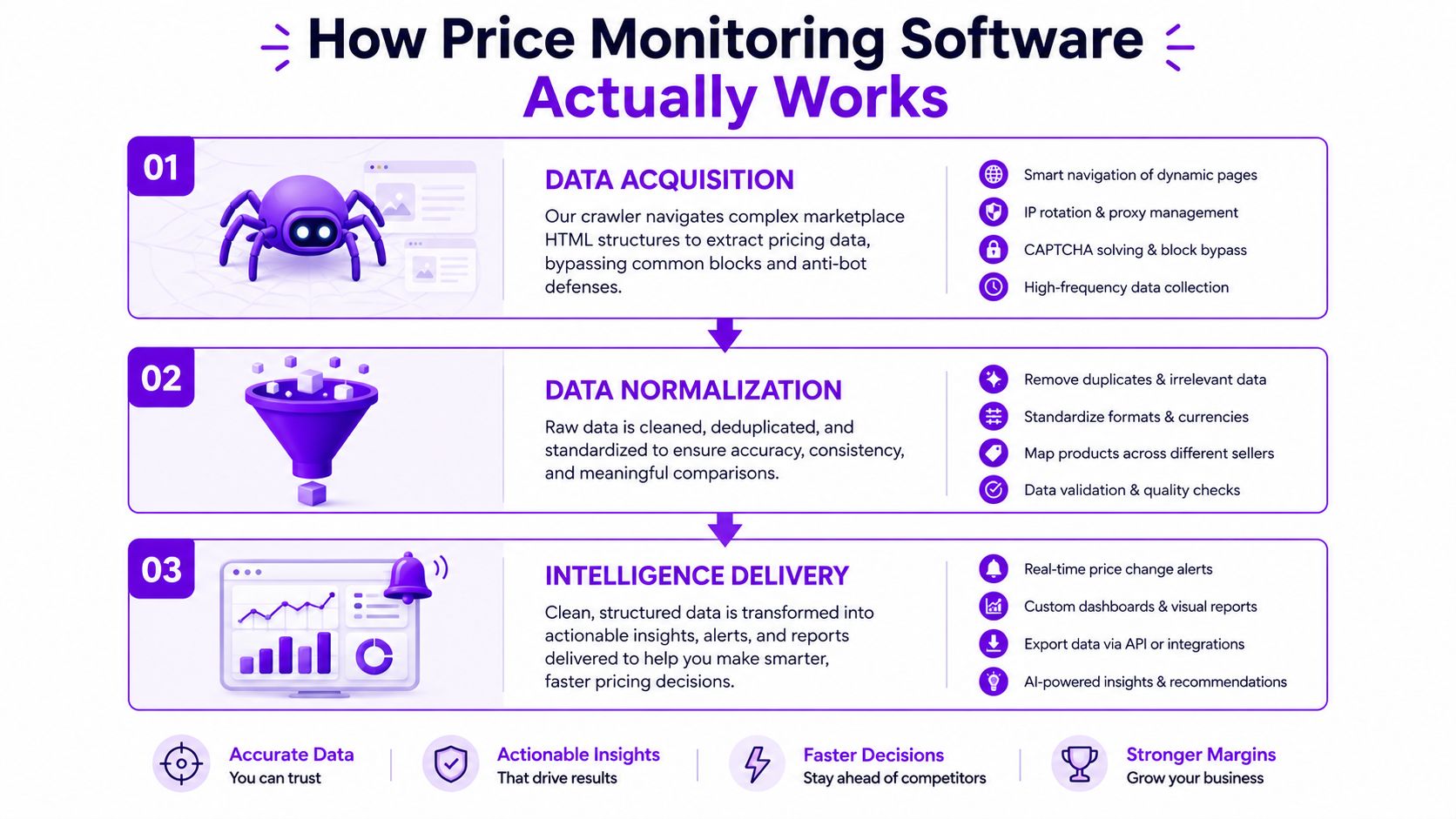
Data acquisition determines freshness
Crawlers process marketplace pages, category structures, seller offers, pagination, and changing HTML layouts. They also need to handle practical collection problems, including rate limits, intermittent pages, consent layers, missing fields, and inconsistent product states.
Crawl cadence matters, but frequency alone is a weak buying metric. A fast schedule that returns incomplete or unstable records can be less useful than a slower schedule with dependable coverage. One 2026 comparison describes a segment of tools offering coverage across 22 marketplaces with hourly checks, while another offers up to 8 checks per day, screenshot capture, and MAP compliance monitoring. Those differences affect reaction time and evidence quality, as shown in this comparison of price monitoring software.
A monitoring plan should therefore assign faster checks to high-value or volatile SKUs and less frequent checks to products where market movement has limited commercial impact. The system should also expose collection failures instead of presenting an old result as current.
Product matching is the control point
The most important question isn't “what number did the crawler find?” It's “does this number belong to the same commercial product?”
GTINs, UPCs, EANs, ASINs, manufacturer part numbers, and internal SKU relationships provide strong matching signals. They're not always available, however. Marketplace listings may omit identifiers, use different titles, combine regional naming conventions, or describe bundles and multipacks in ways that make a simple title comparison unsafe.
Attribute-based matching can compare brand, model, size, colour, capacity, pack count, condition, compatibility, and other category-specific fields. Fuzzy matching can help identify likely relationships, but it must be constrained by rules. A similar title isn't enough when a single pack is compared with a case, or a new product is compared with refurbished stock.
Academic research on competitive online pricing separates identifying the same item across sellers from deciding how to respond. That distinction matters because a wrong SKU-to-listing relationship contaminates every downstream alert, margin calculation, and repricing rule. The research also contrasts simple rule-based monitoring with algorithmic optimization that incorporates product attributes and marketplace context. The INFORMS research on competitive online pricing supports treating matching as a prerequisite, not a minor setup task.
Practical rule: An uncertain match should be visible as uncertain. It shouldn't silently enter an automated repricing rule.
Normalization turns offers into comparable data
Raw marketplace data needs to be standardized before a pricing manager can compare it. The pipeline should normalize currency, units, tax treatment where relevant, shipping, condition, seller identity, stock status, promotional labels, and time of capture. It should also deduplicate repeated offers and retain the original listing reference for investigation.
Often, “lowest price” becomes “lowest comparable price.” A seller with a cheaper item but expensive delivery may not be a competitive threat. A product marked temporarily unavailable shouldn't drive an immediate price reduction. A marketplace's featured offer may also reflect seller performance, fulfilment, and other context beyond the visible item price.
Research on dynamic pricing in online marketplaces emphasizes continuous adjustment and the difficulty of optimizing across multiple offer dimensions. For monitoring teams, that means collection speed, alert latency, and coverage need to be designed together rather than evaluated as isolated features. The University of Twente marketplace pricing research provides useful context for why event-driven data flows are harder to manage than static reports.
For teams integrating monitoring with internal systems, an API or structured export is often more useful than another dashboard. An Amazon price API workflow can support automated feeds, but only when the underlying product and offer records are already reliable.
Real-World Use Cases for Brands and Retailers
The same monitoring platform can support different decisions depending on who owns the catalog. A manufacturer cares about channel discipline. A retailer cares about competitive positioning and contribution. A distributor may care more about availability gaps and sourcing power.
MAP enforcement for manufacturers
A manufacturer starts with a product or SKU feed and assigns a MAP value to each relevant item. The monitoring system checks reseller and marketplace listings, identifies public prices below policy, and preserves evidence for review.
A workable workflow looks like this:
- Load the policy data: Store the SKU, permitted advertised price, effective dates, and any channel or regional exceptions.
- Monitor the relevant sellers: Track authorized resellers, suspected unauthorized sellers, marketplaces, and retail sites.
- Validate the listing: Confirm the product, pack size, condition, seller identity, advertised price, and page status.
- Capture evidence: Retain the URL, screenshot, timestamp, and supporting listing information.
- Route the case: Send the violation to the channel owner, legal team, or account manager according to the escalation policy.
MAP enforcement commonly relies on a product feed, a per-SKU MAP value, and software that can monitor marketplace and reseller listings. One corrective workflow gives the seller a 24 to 72 hour window to correct a violation before escalation, as described in this MAP enforcement guide. The exact response should follow the company's policy and legal review process.
Margin protection for retailers
Retailers use the same data differently. Suppose a retailer sells a coffee machine with several legitimate configurations. A competitor lowers the price on the identical model, while another seller remains out of stock. The retailer can compare the valid offer, assess the stock context, and decide whether to hold price, adjust within a margin floor, or promote a substitute.
The critical controls are:
- A minimum margin or price floor, so the rule can't trigger a race to the bottom.
- Competitor eligibility rules, excluding mismatched conditions, bundles, or unreliable sellers.
- Stock-aware logic, so an unavailable competitor doesn't automatically pressure the price.
- Approval thresholds, requiring a person to review larger changes or strategic products.
Marketplace monitoring covers more than price. It can include competitor sellers, stock availability, and channel activity across marketplaces such as Amazon, eBay, Walmart, Wayfair, and Google Shopping. That broader view helps retailers find unauthorized sellers, grey-market activity, and undercutting, as described by PriceTrakker's marketplace monitoring overview.
Sourcing and assortment decisions for distributors
Distributors can compare their supplier cost and available inventory with market prices, seller coverage, and competitor stock. If several competitors are unavailable while demand remains visible, the distributor may prioritize replenishment or negotiate improved terms with a supplier. If the market price is already compressed, the same evidence may prevent an unprofitable purchase.
Secondary uses include tracking competitor promotions, benchmarking a new product launch, identifying assortment gaps, and checking whether a recommended retail price remains credible across channels.
| Business Type | Primary Use Case | Key Data Points | Expected Outcome |
|---|---|---|---|
| Manufacturer or brand owner | MAP and channel enforcement | SKU, MAP value, seller, public price, URL, screenshot, timestamp | Faster investigation, consistent documentation, and clearer reseller follow-up |
| Online retailer | Margin protection and competitive pricing | Matched competitor price, stock status, shipping, seller, margin floor | More controlled price decisions and fewer unnecessary discounts |
| Distributor or importer | Sourcing and assortment optimization | Market price, availability, seller count, product attributes, supplier cost | Better replenishment priorities and stronger supplier negotiations |
| Pricing or category team | Promotion and launch benchmarking | Price history, promotional status, comparable products, channel coverage | Better campaign planning and more informed assortment reviews |
What to Look for When Choosing a Solution
A vendor demo usually makes monitoring look simple. Evaluation starts when you ask to see exceptions, failed captures, uncertain matches, and evidence records from your own catalog.
Compare the operating model, not the feature list
A tool promising hourly checks sounds attractive, but a dependable schedule with transparent failures is more valuable than a headline cadence that hides gaps. Ask how the platform reports blocked pages, stale records, missing fields, seller changes, and marketplace redesigns.
Matching precision deserves the hardest test. Request validation on your own difficult products, including variants, multipacks, bundles, refurbished listings, and multilingual pages. Industry guidance recommends testing precision and recall separately by category, source pair, and match class, with exact-match precision prioritized for price benchmarking because one false match can create a misleading alert. Plott Data's product matching guidance also highlights the challenge of reconciling fragmented marketplace catalogs.
Alert governance is the next dividing line. A useful system lets you set thresholds, suppress expected promotional changes, route issues by severity, and preserve an audit history. An email for every price movement is not a workflow.
| Evaluation Criteria | What Looks Good on Paper | What Actually Works in Practice |
|---|---|---|
| Crawl frequency | “Real-time” or hourly monitoring | Reliable capture, visible failures, and cadence aligned with SKU volatility |
| Product matching | Broad automated catalog matching | Evidence of precision on your catalog, with uncertain and unmatched records exposed |
| Alerting | Instant notifications for every change | Thresholds, suppression windows, severity levels, ownership, and escalation |
| Marketplace coverage | A long marketplace list | Coverage of your actual regions, categories, sellers, and channel mix |
| Data delivery | A polished dashboard | API, exports, history, screenshots, and fields your pricing or BI systems can use |
| Collection method | Aggressive broad crawling | A resilient, transparent approach that doesn't repeatedly lose access to key pages |
| Commercial fit | One package for every team | Pricing and scope that match tracked URLs, products, markets, and response capacity |
Test integration and commercial fit
Coverage should include the channels that influence your revenue, whether that's regional Amazon marketplaces, Walmart, eBay, or niche platforms in your category. A tool that covers a famous marketplace but misses the reseller sites where your channel conflict occurs isn't a complete solution.
API maturity matters when monitoring feeds a pricing engine, business intelligence stack, or case-management process. Check whether the API exposes match confidence, timestamps, seller data, stock state, historical observations, and evidence links. Also confirm retention, export limits, permissions, and support for corrections.
Teams comparing software categories can also view RecurX pricing plans as part of a broader exercise in comparing usage models and recurring software costs. The useful comparison isn't the lowest subscription. It's the total operating cost of collection, validation, response, integration, and maintenance.
Market Edge is one vendor-neutral example of the type of platform to assess. It tracks selected competitor prices and stock across resellers, retail sites, and marketplaces including Amazon, eBay, and eMAG, using product matching and alerts for commercial workflows. Evaluate it with the same catalog, coverage, evidence, and integration tests you apply to every alternative.
Operational Challenges Most Guides Ignore
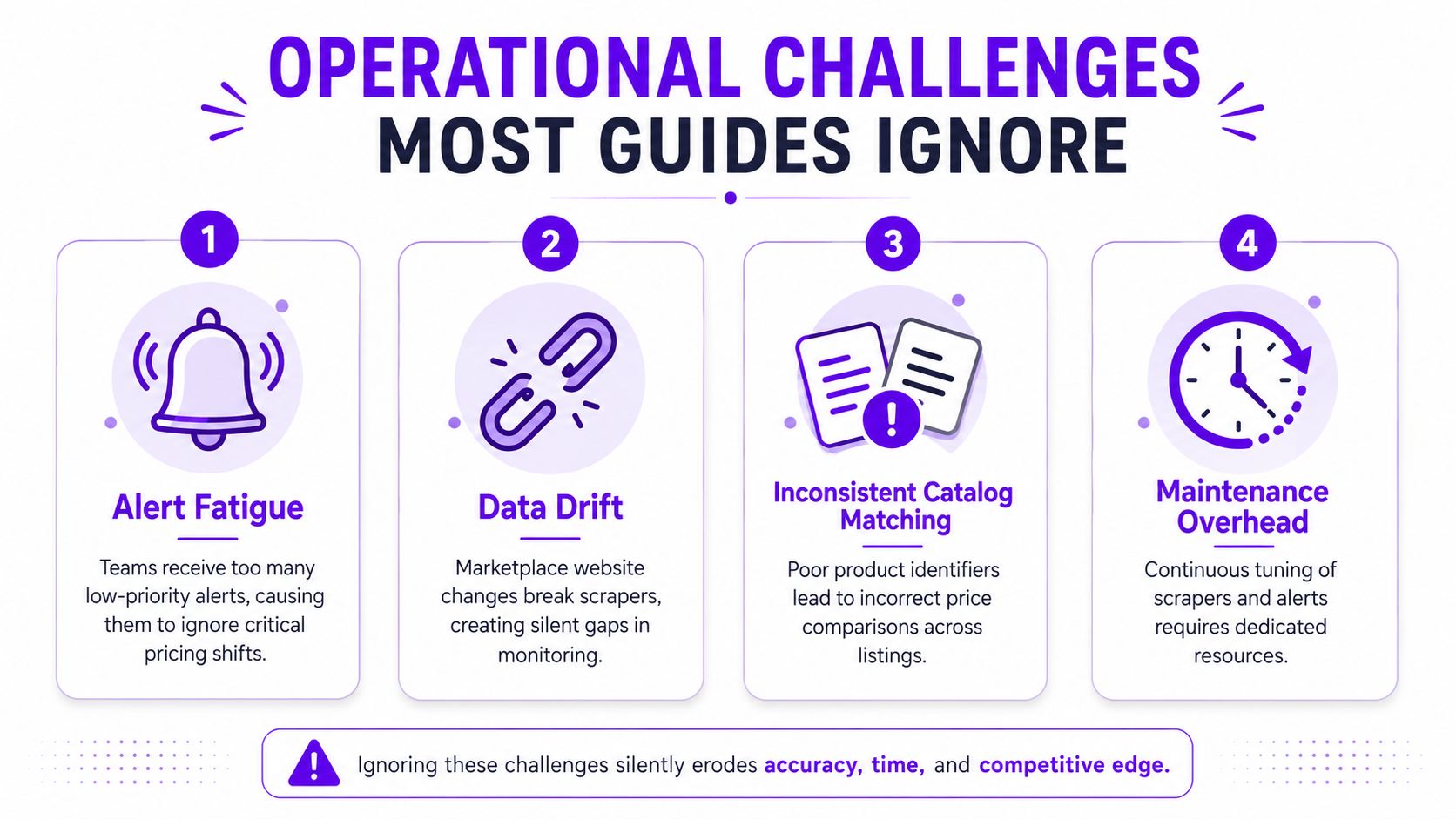
Most monitoring projects don't fail because the dashboard lacks another chart. They fail because the team creates more signals than it can evaluate, trusts matches it hasn't tested, or assigns nobody responsibility for acting on an alert.
Alert fatigue changes team behaviour
If analysts receive an alert for every small price fluctuation, they'll start treating the entire system as background noise. The solution is decision design, not fewer crawls.
Use tiered severity for major undercuts, MAP violations, stock-outs, and strategic products. Add suppression windows for planned promotions and known marketplace events. Send weekly digests for low-priority changes that don't require immediate action. Every alert should answer three questions: what changed, why does it matter, and who owns the next step.
Recent buyer guidance makes the same operational point. High-frequency monitoring can become counterproductive without threshold-based exception routing, audit trails, and rules that connect a signal to approval and action. The Retail Grid guide to choosing price monitoring software frames governance as a practical requirement alongside refresh speed and API-first workflows.
Data drift is usually silent
Marketplace page structures change. Seller information moves. A scraper may continue returning records while missing a critical price field or capturing the wrong offer block. That's more dangerous than a visible outage because the team may act on incomplete data.
Schedule health checks that compare expected fields, capture timestamps, page status, and product counts. When a marketplace changes its layout, pause affected automation until the records are validated. The automating data collection guide is relevant when teams are deciding which collection tasks should be automated and which need human review.
Governance keeps intelligence usable
Assign ownership by alert type. Pricing teams can handle competitive movement. Channel teams can investigate reseller violations. Operations can review stock anomalies. Legal or compliance stakeholders may need to approve escalation language.
Create a match-audit routine that samples difficult products and records corrections. Review bundles, multipacks, variants, refurbished items, and multilingual listings separately. As the catalog or marketplace footprint grows, revisit processing capacity, review queues, and ownership. A setup that works for a small pilot can become unmanageable when more products, sellers, and channels enter the workflow.
Operational test: If a team member can't explain why an alert fired and what action follows, the monitoring program isn't governed well enough.
Your Implementation Checklist and Next Steps
Begin with the catalog, not the software. Clean identifiers such as UPC, EAN, and ASIN improve the starting point for matching, while incomplete product data increases review work and creates avoidable uncertainty.
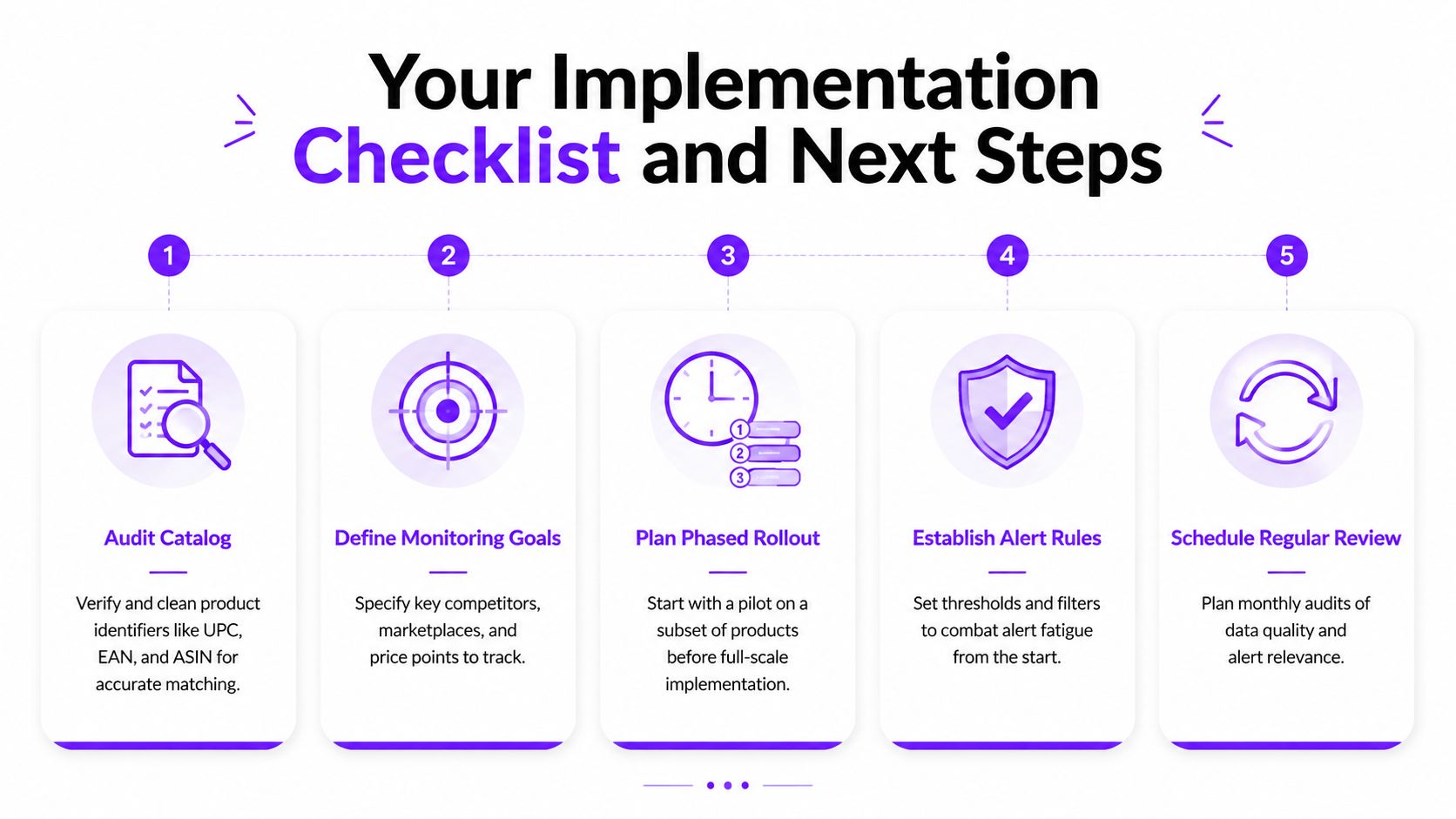
Use this rollout checklist:
- Audit the catalog: Identify missing identifiers, duplicate SKUs, variant relationships, bundle definitions, and condition differences.
- Define the commercial target: Choose the products, competitors, marketplaces, and decisions that matter most. Start with revenue-driving products rather than demanding complete coverage immediately.
- Set the baseline: Record the current margin position, competitive price gaps, Buy Box or marketplace performance where relevant, and MAP compliance process before changing the workflow.
- Configure ownership: Separate competitive price alerts from MAP cases, assign response owners, and document approval and escalation paths.
- Calibrate before scaling: Use a 60-day calibration period to refine matching rules, thresholds, suppression logic, and team confidence. Then schedule quarterly reviews to expand coverage, retire low-value alerts, and adjust priorities.
A phased launch exposes bad matches and noisy rules while the review queue is still manageable. It also gives finance, pricing, sales, and channel teams a shared view of what the data can and can't support.
For teams connecting monitoring with wider process automation, read Lynkro.io's AI automation guide for broader workflow design context. Keep the implementation focused on decisions, not data volume. More listings only help when the business can validate them and act on the resulting signals.
Market Edge helps distributors, manufacturers, importers, and online retailers monitor competitor prices, stock, and marketplace listings for selected SKUs, with product matching, alerts, and MAP evidence workflows. Visit Market Edge to review the platform and assess whether a focused trial fits your catalog, channels, and pricing governance needs.