
Price skimming is a product launch strategy where a business introduces an innovative new product at the highest possible initial price to capture maximum revenue from early adopters. As this initial demand is met, the price is systematically lowered over time to attract more price-sensitive customer segments.
For founders, ecommerce managers, and sales leaders, understanding this strategy is critical. It's not just a pricing tactic; it's a commercial decision designed to maximize profitability and establish market positioning during a product's most crucial phase.
What is a Skimming Pricing Strategy?
Imagine launching a groundbreaking product. Instead of setting a single price for all, a skimming strategy allows you to capture the most value from the outset. You begin by targeting innovators and trendsetters—customers willing to pay a premium to be the first to own a new technology or gain a competitive edge.

Once this top layer of the market has been served, or as competitors begin to emerge, the price is methodically reduced. This gradual reduction opens the product to the next wave of customers, and then the next, allowing you to "skim" revenue from each distinct market segment.
Why Price Skimming Matters Commercially
For B2B decision-makers, price skimming is a strategic tool to achieve several key commercial objectives at launch:
- Accelerated ROI: It enables the rapid recovery of significant research, development (R&D), and initial marketing investments. High initial sales provide a crucial injection of working capital.
- Premium Brand Positioning: A high initial price immediately establishes the product as a high-quality, exclusive offering, building a perception of value from day one.
- Profit Maximization: Instead of settling for a single price, skimming captures the maximum amount each customer segment is willing to pay over the product's early lifecycle.
The strategy creates a sequence of price points that align with the market's evolving demand curve, turning time into a segmentation tool.
Key Characteristics of a Skimming Pricing Strategy
To provide a clear framework, this table summarizes the core components of a price skimming model.
| Attribute | Description |
|---|---|
| Initial Price Point | High, targeting the least price-sensitive customers. |
| Target Audience | Innovators and early adopters at launch. |
| Price Trajectory | Systematically decreases over time. |
| Market Conditions | Best suited for low initial competition and high demand for an innovative product. |
| Core Objective | Maximize early-stage revenue and recoup R&D costs quickly. |
| Brand Perception | Creates an immediate sense of premium quality and exclusivity. |
This illustrates how skimming is a calculated approach that prioritizes profitability and brand positioning when a new product is launched and competitive pressure is at its lowest.
Price skimming is less about the price itself and more about timing. It's a calculated commercial strategy that prioritizes short-term profitability and long-term brand positioning during a product's critical launch window.
By capturing the highest-value customers first, this method sets a strong foundation for broader market penetration later on.
How Price Skimming Maximizes Profitability
The commercial appeal of price skimming is its systematic approach to extracting maximum value from a market. Instead of selecting one price and hoping it fits all, skimming segments the market by timing. You start high to capture revenue from customers willing to pay the most, then gradually lower the price to engage subsequent waves of buyers.

This approach directly targets what economists call consumer surplus—the gap between what a customer is willing to pay and what they actually pay. By starting high, you capture the full amount your most enthusiastic buyers were prepared to spend. A lower, one-size-fits-all launch price would leave significant revenue on the table.
Accelerating Breakeven and Recouping Investment
The upfront investment in R&D and marketing for an innovative product can be substantial. Price skimming directly addresses this by accelerating the path to the breakeven point. A high initial price generates strong cash flow from the start.
This early capital influx is a game-changer for several reasons:
- Faster ROI: You begin recouping your initial investment almost immediately, far quicker than with a lower-priced strategy.
- Funding Future Growth: Profits from early adopters can be reinvested into scaling production, funding the next innovation, or expanding marketing reach.
- Reduced Financial Risk: Covering costs quickly lowers the overall financial risk associated with the product launch.
This front-loaded revenue model provides a powerful financial cushion, offering the stability and resources needed to remain competitive as the product matures and competitors inevitably enter the market.
Anchoring Value and Building Brand Equity
Beyond the immediate financial benefits, the high launch price plays a crucial psychological role. It sets a powerful price anchor, establishing a high perceived value for the product in the minds of customers. This initial impression of quality and exclusivity can deliver dividends for brand equity for years.
A high launch price sends a clear message: this product is premium, innovative, and worth the investment. That perception often persists even after the price is lowered, cementing the brand’s position as a market leader.
Attempting to build a premium image from a low-price launch is an uphill battle. When you start cheap, raising prices later often triggers customer backlash. Skimming sets a high-value precedent from day one, which is a significant long-term brand asset.
Use Case: B2B SaaS Launch and MAP Enforcement
Consider a B2B SaaS company launching a new AI-powered analytics tool for ecommerce brands. The tool helps enforce Minimum Advertised Price (MAP) policies by automatically tracking retailer pricing.
- Initial Price: The company launches a premium tier at $1,500 per month, targeting large enterprises with complex distribution networks. These clients gain immediate ROI by preventing price erosion and are willing to pay for this advantage.
- Early Adopter Value: The high price reinforces the tool's status as a cutting-edge solution for protecting brand value.
- Price Reduction: Six months later, with a solid enterprise client base and R&D costs largely recovered, a mid-tier plan is introduced at $750 per month.
- New Segment: This lower price point attracts mid-market companies and brands that were initially priced out. Their value perception is anchored to the original enterprise price, making the new tier seem highly valuable.
In this scenario, the company skimmed the top of the market before systematically opening access to a wider audience. This is where automated competitor tracking and price monitoring tools become essential. A platform like Market Edge provides the data needed to understand competitor pricing and market saturation, indicating the precise moment for the next strategic price drop.
Real-World Examples of Price Skimming in Action
Observing how price skimming is executed in practice provides a clear blueprint for its application. The strategy is most effective in industries characterized by rapid innovation, strong brand loyalty, and significant R&D budgets, such as consumer electronics. These examples demonstrate the market conditions required for a successful skimming strategy.
Apple and the iPhone Launch
Apple’s product launches are a masterclass in price skimming, building hype and maximizing revenue from a loyal customer base.
The debut of the first iPhone in June 2007 is a textbook example. The device launched with a $599 price tag, aimed squarely at tech enthusiasts and dedicated Apple followers. Just two months later, Apple reduced the price to $399.
This 33% reduction was a calculated strategic move that achieved several key goals:
- Maximized Early Revenue: The initial high price skimmed the most profit possible from the most eager early adopters.
- Established a Premium Anchor: The $599 starting price immediately positioned the iPhone as a high-end, aspirational product.
- Expanded Market Share: The price cut opened the door for the next wave of more price-conscious buyers, accelerating market penetration.
Apple has consistently repeated this strategy with new iPhones, iPads, and other products, proving its sustainability when backed by a powerful brand and continuous innovation. You can explore more competitive pricing strategy examples in our related guide.
Sony and the PlayStation Console Cycle
The video game console market is another ideal environment for price skimming, defined by long product cycles and massive upfront hardware development costs. Sony's PlayStation launches are a prime example.
When a new console like the PlayStation 5 is released, it enters the market at a high price point. This targets dedicated gamers who are willing to pay a premium for the latest technology. At launch, demand typically outstrips supply, reinforcing the console's exclusive status.
Over the console's multi-year lifespan, Sony systematically reduces the price. These reductions are timed to align with specific triggers:
- Slowing Initial Sales: Once early adopters have purchased the console, a price cut is necessary to attract the broader mainstream audience.
- Manufacturing Cost Reductions: As production becomes more efficient, Sony can lower prices without sacrificing profit margins.
- Competitive Pressure: A price drop may be a direct response to a move from a competitor like Microsoft's Xbox.
For B2B companies selling hardware-intensive products, the console model offers a valuable lesson. It demonstrates how to align pricing with both the product lifecycle and evolving production costs to maximize long-term profitability.
This deliberate price reduction strategy allows Sony to skim revenue from every segment of the gaming community over time.
Tesla and the Electric Vehicle Market
Tesla’s launch strategy for new models offers a modern example with powerful lessons for B2B companies manufacturing high-tech industrial equipment. When Tesla introduces a new model, like the Model S or Model 3, it begins with the most expensive, highest-margin versions first.
These initial "Founder Series" or "Long Range" models are fully loaded with premium features and priced accordingly. This approach targets affluent buyers and tech evangelists who desire the best available technology and are less price-sensitive.
By focusing on this top-tier segment first, Tesla achieves several objectives:
- Funds Production Scaling: High initial profit margins generate the cash required to ramp up complex manufacturing lines.
- Manages Demand: Launching premium versions first helps manage initial high demand and long waitlists.
- Builds Brand Prestige: Selling top-of-the-line models reinforces Tesla’s image as a leader in performance and innovation.
Only after this first wave of customers is satisfied does Tesla introduce more affordable, standard-range versions. This tiered launch is a pure form of price skimming, maximizing revenue while managing production and cash flow effectively.
Skimming Pricing Versus Penetration Pricing
To fully grasp the commercial power of price skimming, it is essential to contrast it with its opposite: penetration pricing. While both are product launch strategies, they serve entirely different objectives and are suited for different market conditions. The choice between them can determine the success or failure of a launch.
Price skimming is designed to reach maximum altitude quickly, capturing the most value from those who want to be first. Penetration pricing aims to cover as much ground as possible, capturing maximum market share by making it easy and affordable for everyone to adopt the product.
What’s the Core Difference?
The fundamental distinction lies in the primary objective. Skimming is focused on maximizing short-term profit. It targets early adopters willing to pay a premium for innovation when there is little to no competition.
Penetration pricing is a long-term play focused on maximizing market share. It involves launching at a low price to acquire a large customer base quickly, creating a barrier to entry for competitors.
With skimming, the price starts high and is methodically lowered. With penetration, the price is intentionally low at launch—sometimes at a loss—with the plan to raise it later once a solid market position is established.
When to Use Each Strategy
The ideal market conditions for one strategy are detrimental to the other. Founders and ecommerce managers must conduct a realistic assessment of their product and the competitive landscape before committing.
- Choose Skimming When: You have a genuinely innovative product with a distinct competitive advantage, such as superior technology or design. Strong brand equity and intellectual property protection (e.g., patents) are highly beneficial, creating a temporary monopoly that justifies the premium price.
- Choose Penetration When: You are entering a crowded market with low brand loyalty. If your product is not significantly differentiated, a low price is the most effective tool for persuading customers to switch.
The decision is a strategic bet on what is more critical at launch: immediate profit or rapid market capture. Skimming is a bet on innovation. Penetration is a bet on volume.
The ripple effects are significant, impacting everything from brand perception to financial risk. Skimming builds a premium image but risks slow adoption if the price deters too many potential buyers. Penetration acquires customers quickly but can devalue the brand and attract disloyal, price-driven consumers.
Comparison Skimming vs Penetration Pricing
This table directly contrasts the two pricing strategies across key business dimensions to aid in decision-making.
| Factor | Skimming Pricing | Penetration Pricing |
|---|---|---|
| Primary Objective | Maximize profit, recover R&D costs quickly. | Seize market share, build a large user base fast. |
| Initial Price | High, targeting innovators and early adopters. | Low, often below market rate, to attract mass-market. |
| Ideal Market | New, innovative product with minimal competition. | Saturated market with established competitors. |
| Brand Perception | Creates an image of quality, exclusivity, and prestige. | Can create a perception of being a "discount" or "value" brand. |
| Profit Margin | High initial margins that decrease over time. | Low or negative initial margins, aiming for long-term profit. |
| Risk Profile | Alienating potential customers; attracting competitors. | Price wars; inability to raise prices later; attracting disloyal customers. |
The choice depends on a candid assessment of your product's uniqueness, market position, and risk tolerance.
Practical Application Checklist
Use this checklist to determine which strategy fits your launch:
Skimming Pricing Is a Fit If:
- Your product is highly innovative with a clear, defensible advantage.
- Your brand has strong equity and a loyal customer base.
- You have intellectual property protection (e.g., patents).
- Your primary goal is to maximize short-term profit and ROI.
Penetration Pricing Is a Fit If:
- You are entering a competitive, price-sensitive market.
- Your product is not significantly different from existing alternatives.
- Your business model is built for scale and volume.
- Your primary goal is to capture market share quickly.
In both cases, continuous market monitoring is essential. This is where automated competitor price monitoring tools like Market Edge become useful. For skimming, they signal when it's time to lower the price. For penetration, they help identify the optimal price point—low enough to win customers but not so low as to trigger a price war.
Identifying the Right Conditions for Price Skimming
A skimming pricing strategy is a specialized tool, not a universal solution. Its success depends on a specific combination of market and product conditions. Attempting to skim without these elements in place is a significant risk that can alienate early customers and create opportunities for competitors.
Before setting a premium launch price, conduct a thorough assessment of your position. This pre-launch checklist ensures the conditions are right for this high-reward strategy.
The Innovation and Competition Check
The most critical factor for price skimming is a genuinely innovative product. It must represent a significant leap forward, providing a temporary monopoly at launch.
Your product needs to solve a problem so effectively or offer an experience so unique that early adopters perceive the high price as justified. This is only viable if there is a near-total lack of direct competition. If a customer can find a "good enough" alternative at a lower price, your skimming strategy will fail.
A classic example is the original iPod. When launched in 2001 for around $400, it created the portable digital music player category, giving Apple an open field to skim the market without competitive pressure. You can find more insights on this topic at Wiser.com.
Brand Strength and Audience Receptiveness
A strong brand with a loyal following is an accelerator for a price skimming strategy. When customers already trust your brand and products, they are far more willing to pay a premium for your latest offering. Their belief in your quality standards lowers the barrier to a high-priced purchase.
You also need the right target audience. The launch must appeal to a sizable segment of innovators and early adopters who are less price-sensitive and more motivated by being the first to own something new. Without this initial wave of enthusiastic buyers, the strategy will lack momentum. Analyzing customer data is non-negotiable; our guide on how to conduct market analysis provides a step-by-step process.
A premium price tag requires a premium brand promise. If your market reputation doesn't align with the high price, customers will see a disconnect and turn away.
Barriers to Entry and Justifiable Value
Finally, you must be able to defend your market position. What prevents a competitor from quickly replicating your idea and undercutting your price? Your intellectual property and technological complexity are your primary defenses.
- Patents and IP: Legal protections create a tangible barrier, providing an exclusive window to execute your skimming strategy.
- Complex Technology: If the product is difficult to reverse-engineer, that complexity buys you valuable time before competitors can catch up.
- Clear Value Proposition: The rationale behind the price must be immediately clear. Customers must understand why the product is priced as it is and believe the benefits are worth the cost.
Without these defenses, competitors may flood the market with cheaper alternatives, forcing you into a price war and undermining the entire strategy. This is where automated price monitoring tools like Market Edge are so valuable—they give you the heads-up when threats are emerging so you can adjust your plan before it's too late.
How to Implement Your Price Skimming Strategy
Implementing a price skimming strategy requires a disciplined, step-by-step process built on rigorous analysis and continuous market monitoring. The objective is to maximize revenue from each phase of the product launch.
Step 1: Set the Initial Price
The process begins with determining the highest price the initial target segment—innovators and early adopters—is willing to pay. This price point serves as your anchor and must reflect the unique value and exclusivity of your product. Conduct market research, analyze perceived value, and assess the ROI your product delivers to these first customers.
Step 2: Monitor Triggers for Price Reduction
Once launched, the focus shifts to vigilant market monitoring. The key is to identify the precise moment to execute the first price drop. Moving too soon leaves revenue on the table; waiting too long risks losing momentum.
Key triggers to monitor include:
- Slowing Sales Velocity: A noticeable dip in sales to your initial audience signals saturation of that first market segment.
- Competitor Entry: The appearance of a legitimate competitor erodes the exclusivity that justified the premium price.
- Customer Feedback: Consistent feedback that price is the primary barrier for the next wave of potential buyers is a clear signal to adjust.
- MAP/RRP Violations: For brands selling through retailers, an increase in MAP or RRP violations can indicate that the market perceives the price as too high, prompting unauthorized discounts.
This process is built on foundational conditions: genuine innovation, a strong brand, and some form of protection to hold off competitors.
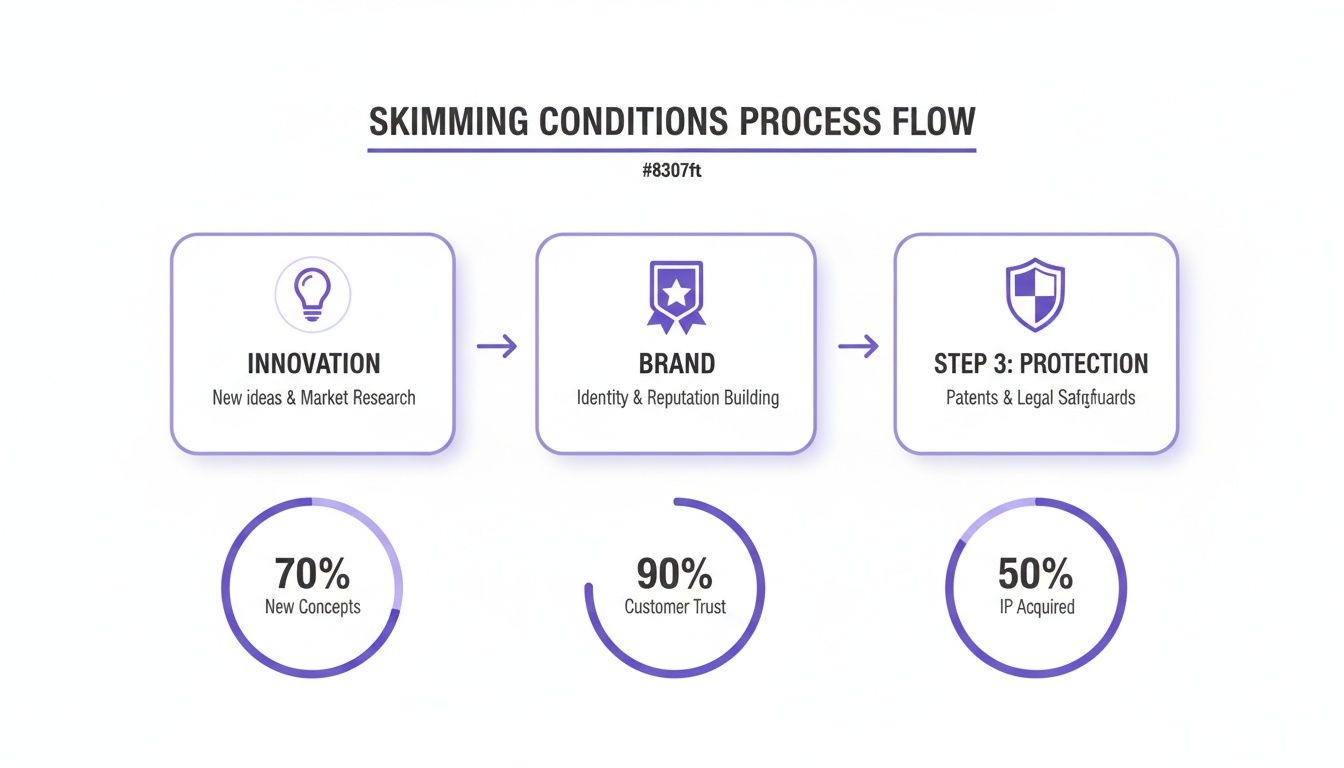
As the flowchart illustrates, these elements create the necessary conditions for a successful high-priced launch.
Step 3: Use Data to Guide Price Reductions
Each price reduction must be a calculated, data-driven decision, not a reactive measure. Manual tracking of competitor prices, stock levels, and promotions is insufficient. You need real-time, comprehensive market intelligence.
A well-executed skimming strategy is proactive, not reactive. You should anticipate market shifts and have your next price point ready before sales begin to plateau, using competitor movements as a key input for your timing.
For instance, continuous competitor tracking helps you understand when a rival is about to launch a similar product, allowing you to preemptively adjust your price to capture the next market segment before they do. Similarly, marketplace monitoring can reveal when third-party sellers are beginning to discount your product, signaling that it may be time for an official price reduction.
This is where automated platforms become indispensable. A solution like Market Edge provides the continuous competitor tracking and marketplace intelligence needed to spot threats and opportunities. Our guide on how to monitor competitor prices breaks down this process in greater detail. With this systematic approach, each price reduction unlocks a new wave of customers, maximizing profitability at every stage.
Got Questions About Price Skimming? We’ve Got Answers.
Price skimming can appear to be a high-stakes strategy. Here are answers to common questions from B2B decision-makers considering this approach.
Can We Really Use Price Skimming for the Long Haul?
Price skimming should be viewed as a powerful launch tactic rather than a permanent strategy. It is designed for the initial window when a product is new and faces minimal competition. The primary goal is to capture maximum revenue from customers who value being first.
The high initial price is the starting point. The long-term plan involves a deliberate and methodical reduction of the price over time. This approach allows you to appeal to successive waves of customers at different price points, eventually settling at a price that is sustainable in a competitive market.
How Will This Affect How Customers See Our Brand?
Initially, price skimming enhances brand image by creating a perception of premium quality and exclusivity. It sends a psychological signal to the market that your product is innovative, high-value, and a worthwhile investment.
The challenge lies in managing subsequent price reductions. If the price is dropped too quickly or steeply, the early adopters who paid the premium may feel alienated. A clear communication plan and a well-timed price reduction schedule are essential to maintain customer trust and protect your brand equity.
What’s the Single Biggest Risk We’re Taking On?
The greatest risk is setting the initial price incorrectly. If the price is too high, it can stifle the launch. Sales will stagnate, momentum will be lost, and it creates an opportunity for a competitor to enter with a more reasonably priced alternative and capture the market.
Another significant risk is that high profit margins attract competition. When rivals see your success, they will be motivated to develop similar products. This increases pressure to lower prices faster than originally planned. This is why continuous competitor tracking is non-negotiable; you cannot operate without clear visibility into your rivals' actions.
This is where automated price monitoring tools like Market Edge become useful. They provide the competitive intelligence needed to set the initial price with confidence and then adjust it strategically as the market evolves.