
Real-time pricing is a pricing approach where product or service prices update on a short cycle using live market, inventory, and demand data. Unlike conventional retail tariffs fixed for months or years, or annual contract price lists, it lets prices respond to changing conditions while those conditions are still commercially relevant.
A category manager may see a competitor cut the price of a popular SKU mid-morning, notice that the competitor is nearly out of stock, and face a familiar decision: reprice immediately, wait for the afternoon review, or hold the current position to protect margin. That decision captures the practical meaning of real-time pricing. It isn't about changing a number quickly. It's about connecting a relevant signal to a defined pricing rule, then deciding whether the expected commercial benefit justifies the operational and governance cost.
The phrase also creates confusion because “real time” sounds binary. In practice, pricing operates on a continuum of refresh frequencies, from continuous capture and short-cycle alerts to hourly, daily, or scheduled repricing. The right choice depends on the market, the product, the data quality, and how quickly customers or competitors can respond.
A Practical Definition of Real-Time Pricing
A useful working definition is simple: real-time pricing adjusts a price using current data and a short, predefined refresh cycle. The inputs might include competitor prices, inventory, demand, material costs, promotions, or wholesale market conditions. The output might be a recommendation, an alert for a human reviewer, or an automated price change.
In electricity, real-time pricing, or RTP, means customers pay prices that vary over short intervals, typically hourly, and are quoted one day or less in advance to reflect contemporaneous marginal supply costs. Major wholesale systems operate at even finer resolution. PJM produces locational marginal price data every five minutes in real time and hourly on a day-ahead basis, while ERCOT maintains historical real-time settlement point prices by 15-minute settlement interval, as documented in Lawrence Berkeley National Laboratory's survey of utility experience with real-time pricing. Conventional retail electricity tariffs usually stay fixed for months or years, so they don't pass through short-term supply changes.
In ecommerce, the same underlying idea applies to a different data environment. A marketplace seller might compare a rival's price, stock status, and promotion, then decide whether to change its own offer. A brand might monitor advertised prices without automatically changing its RRP. Both workflows use live signals, but only one directly changes a selling price.
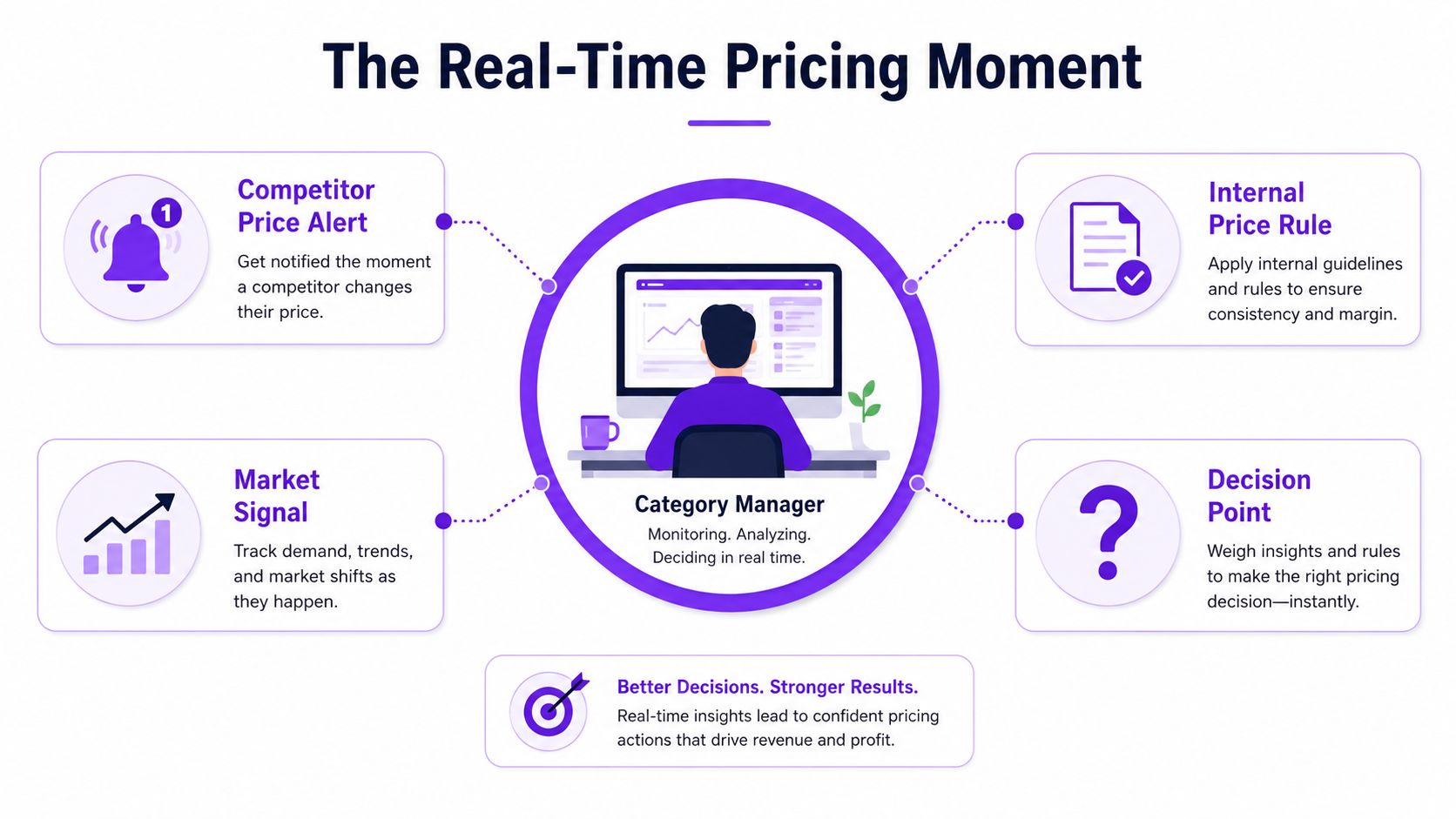
Real-time is a spectrum
| Model | Refresh Frequency | Primary Data Inputs | Typical Use Case |
|---|---|---|---|
| Static | Fixed until manually changed | Cost, contract terms, approved price list | B2B agreements and stable catalog pricing |
| Scheduled dynamic pricing | Defined review cycle | Demand, inventory, competitors, promotions | Daily or periodic ecommerce repricing |
| Real-time pricing | Short cycle based on current signals | Live market, inventory, demand, cost, and competitor data | Volatile marketplaces, constrained supply, and responsive offers |
Dynamic pricing is the broader strategy. It means prices can vary according to changing conditions. Real-time pricing describes a faster, data-connected implementation of that strategy. A business can use dynamic pricing with a scheduled nightly update, while another can use a near-continuous monitoring workflow.
For background on the wider family of approaches, ECORN's guide to pricing strategies for eCommerce provides useful context. Internally, agree on the term before selecting technology. Ask whether your team means live data collection, live recommendations, automatic price publication, or all three.
Data, Frequency, and Algorithms Behind the Price
A real-time pricing system works like a control room. It receives signals, checks their reliability, applies commercial rules, and produces an action. The system doesn't need every input to refresh at the same speed. A stock feed may change frequently, while a cost file or promotional calendar might update only when the business changes it.
The main inputs usually include:
- Competitor prices: Product pages, marketplace offers, reseller listings, and advertised promotions show where comparable offers sit.
- Availability: Stock status helps explain whether a lower price is sustainable or linked to limited supply.
- Demand signals: Orders, searches, conversion patterns, and category activity indicate whether customers are becoming more or less responsive.
- Cost data: Cost of goods, freight, material inputs, and other commercial constraints define the margin boundary.
- Promotional calendars: Campaign dates and planned discounts prevent the engine from treating an intentional promotion as an unexpected market move.
Refresh frequency should follow the decision, not the marketing label. Continuous capture can suit a fast marketplace where a competitor's move matters immediately. A 5-minute or 15-minute cycle may be useful when the underlying market publishes data at that resolution. Hourly or daily updates can be more appropriate for slower categories, negotiated B2B prices, or products where frequent changes would create customer confusion.
The Australian National Electricity Market dashboard reports real-time data at 5-minute intervals, including current dispatch price and historical spot price, while ComEd's hourly program uses PJM real-time hourly market prices calculated as the average of twelve 5-minute prices from the hour. The AEMO National Electricity Market data dashboard illustrates how market infrastructure supports high-frequency pricing. The International Energy Agency's tracker also draws on more than 50 sources with historical, daily, or hourly data, showing that this type of market variable is widely monitored.
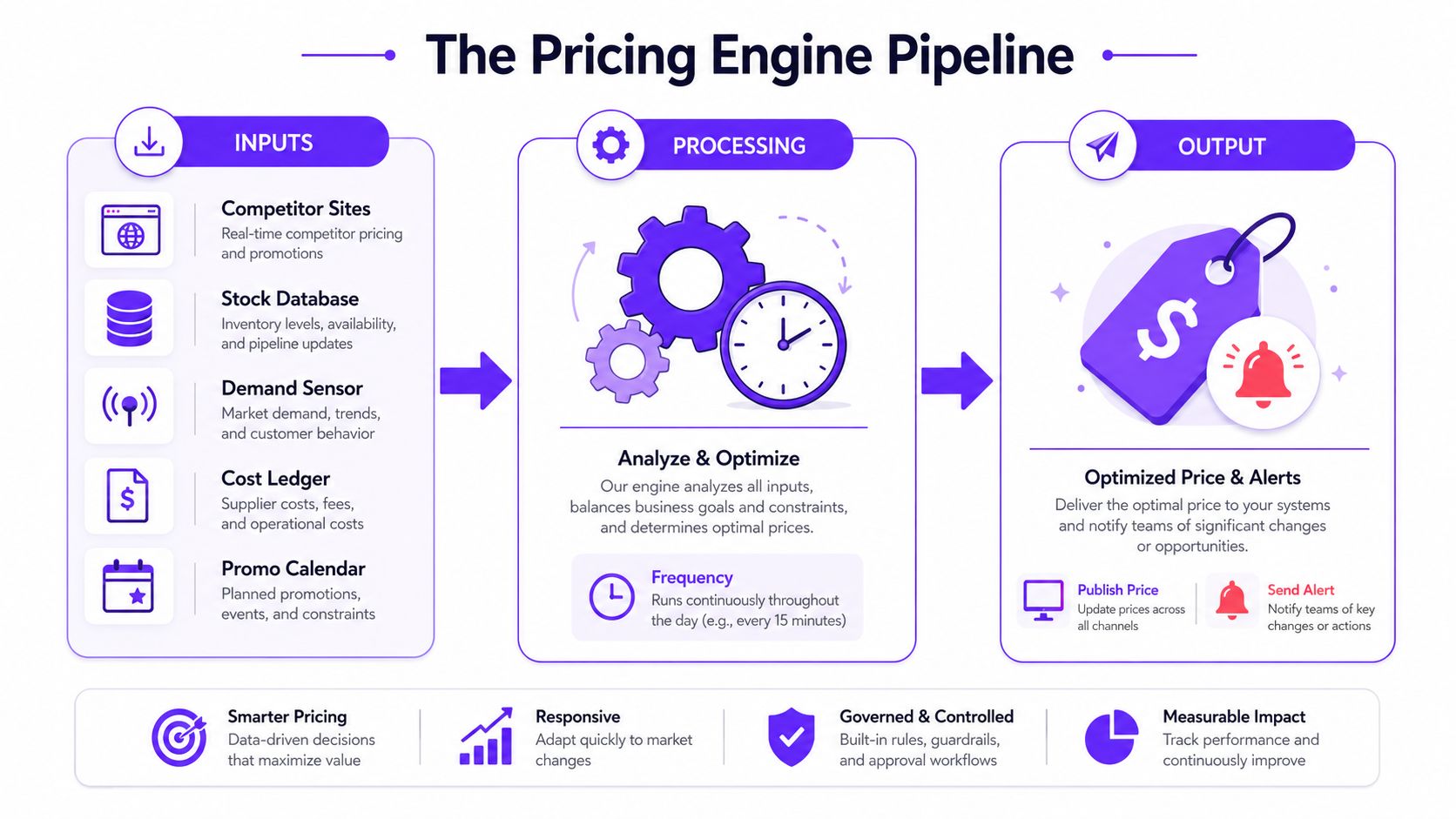
What the decision layer does
The processing layer can be a straightforward rule engine, an optimization model, or an AI-assisted scoring system. Its job is to translate raw observations into a controlled recommendation.
For example, a rule may say: match the lowest comparable offer only when the competitor has stock, never fall below the approved margin floor, and pause repricing when a promotion is active. A more advanced model might weigh availability, expected demand, and competitor movement before recommending a price range rather than one exact number.
That recommendation still needs an audit trail. The reviewer should be able to see the matched product, observed competitor price, stock status, rule applied, timestamp, and resulting action. Teams evaluating marketplace data can also use practical analytics for Amazon sellers to connect price observations with broader seller and catalog decisions.
For the system architecture, real-time data synchronization is the operational foundation. Without consistent timestamps, accurate product matching, and clear handling of missing data, a faster refresh only produces faster uncertainty.
From Energy Markets to Ecommerce and Marketplaces
Electricity markets provide the clearest reference point because RTP was designed to expose customers to changing supply costs. By the early 2000s, utility surveys had already documented real-time pricing as an established approach, reflecting a move away from average-cost retail rates toward prices that more closely tracked marginal operating costs, according to Lawrence Berkeley National Laboratory.
The commercial translation is straightforward. In energy, the live signal is a wholesale market price. In ecommerce, it may be a competitor offer, inventory change, demand shift, or cost update. The central mechanism remains the same: a current signal informs a price decision on a defined cadence.
The differences appear in the data and the governance.
- Energy RTP: The customer's tariff reflects short-interval market conditions. The customer may shift consumption if the price signal is meaningful and visible.
- Distributor benchmarking: The team observes reseller prices, stock, and channel coverage to decide where to source, whom to supply, or whether to adjust its own offer.
- MAP enforcement: The brand doesn't necessarily reprice. It checks whether resellers advertise at or above the approved Minimum Advertised Price, captures evidence, and routes violations for action.
- Marketplace pricing: The seller may respond to offer changes on Amazon, eBay, or eMAG, subject to margin floors, fulfillment costs, inventory, and marketplace rules.
A business should therefore map the commercial problem to the appropriate response. If the problem is an unstable competitor environment, short-cycle monitoring may help. If the problem is a quarterly wholesale review, continuous repricing may add little value. If the problem is unauthorized discounting, evidence and escalation matter more than an automatic price change.
A broader explanation of marketplace structures is available in this guide to what is an online marketplace. The practical lesson is that ecommerce RTP isn't a copy of utility pricing. It's an adaptation of the same signal-response logic to channels where product identity, seller behavior, availability, and policy compliance are central.
Use Cases for Distributors, Brands, and Marketplaces
A distributor usually starts with visibility rather than automation. Suppose a supplier notices that several resellers have raised the price of a product while one seller still shows stock at a lower level. The distributor can compare the offer, confirm that the products are matched, and investigate whether the lower price represents a sourcing opportunity, a stale listing, or a temporary promotion.
The trigger is a price and availability change. The data signal is a matched SKU, seller, channel, observed price, stock status, and timestamp. The action might be to contact a supplier, adjust a reseller recommendation, or hold the current price because the apparent gap isn't commercially comparable.
A brand owner faces a different workflow. The brand's approved MAP or RRP policy may require monitoring across Amazon, Walmart, Google Shopping, and dealer websites. A complete program needs SKU-level tracking, screenshot-backed evidence, violation classification, automated alerts, and an enforcement workflow, as described in this MAP monitoring guide.
Four practical patterns
-
Distributor sourcing window: A tracked competitor goes out of stock while another reseller remains available at a higher offer. The distributor reviews supply, confirms the gap, and considers whether to secure inventory or adjust channel pricing.
-
Brand enforcement queue: A reseller advertises below MAP. The system stores the product match, page evidence, seller identity, timestamp, and violation type. The channel manager decides whether to notify the reseller or escalate the account.
-
Marketplace seller response: A rival changes its offer during an active shopping period. The seller's rule checks stock, fulfillment economics, and the minimum margin before recommending a match, a measured undercut, or no change.
-
Category manager positioning: Several comparable products show reduced availability while demand remains active. The manager uses stock and competitor data together, rather than treating the lowest visible price as the only market truth.
Marketplace monitoring must extend beyond one site. Effective programs cover online marketplaces, retailer sites, and marketplace listings, while some monitoring services describe coverage across 500+ online marketplaces and retailer sites 24/7 with timestamped evidence, as outlined by GrowByData's MAP enforcement resource. That breadth matters because channel conflict can spread across multiple resellers before a team notices it.
Metrics and KPIs That Prove It Works
Leadership doesn't need a report showing that the system changed prices frequently. It needs evidence that the pricing operation made better decisions without damaging margin, customer trust, or channel relationships.
Start with a small scorecard that connects detection to commercial outcomes:
- Price index versus market: Shows whether your offer is generally above, at, or below the relevant comparison set. Define the comparison set carefully so unrelated sellers and bundles don't distort the view.
- Time to detect: Measures the delay between a competitor, stock, or policy change and your system recording it.
- Time to react: Measures how long it takes to approve and publish an action after detection.
- MAP compliance rate: Tracks the share of monitored offers that follow the approved advertised-price policy.
- Stock-out triggered actions: Counts decisions caused by availability changes, such as holding price, raising it within policy, or seeking supply.
- Margin per SKU: Confirms that responsiveness isn't only purchasing visibility at the expense of profitability.
- Avoided revenue loss: Records credible situations where an alert helped prevent prolonged undercutting, missed demand, or an unaddressed channel violation.
Competitor tracking platforms commonly combine automated product-page monitoring, product matching, price-change detection, and evidence-backed alerts. Useful systems also analyze availability and promotions alongside price, because stock changes can explain a price move and reveal sourcing or repricing opportunities, as described in this comparison of competitor price tracking tools.
Design alerts people can trust
An alert should answer four questions quickly: what changed, where it changed, why it matters, and what action is allowed. Set thresholds around meaningful movements, stock transitions, MAP breaches, or repeated changes instead of alerting on every observation.
Separate operational dashboards from leadership reviews. Operators need SKU-level evidence and product-match confidence. Leaders need trends in margin, conversion, compliance, and channel health. Energy teams use price units such as kilowatt-hours, and this guide to per kWh rates provides useful terminology for interpreting those market signals. Ecommerce teams should apply the same discipline to their own units, costs, and comparison rules.
Risks, Governance, and the Trust Question
Faster pricing doesn't automatically create fairer pricing. In energy markets, customers can face volatile bills and must actively shift consumption to benefit from RTP. A 2025 educational assessment of residential RTP found a price elasticity of -4.2%, meaning demand fell as prices rose sharply, which supports a practical point: a live signal helps only when the customer can understand and respond to it. The finding is discussed in CLEAResult's road to real-time pricing.
Ecommerce creates a related trust problem. A brand that changes a public price according to market conditions is using a visible commercial rule. A business that individualizes prices using location, browsing history, or purchase patterns may cross into surveillance pricing. Recent policy attention has included allegations that some grocery prices differed by more than 20% across customers on the same platform, also covered in the CLEAResult discussion linked above.
Practical rule: Use market and product signals first. Treat personal data as a separate governance decision, not an automatic extension of real-time pricing.
The fastest system also creates the largest governance workload. Teams need controls for:
- Price floors and ceilings: Prevent recommendations from exceeding approved commercial boundaries.
- Promotion exclusions: Stop temporary campaigns from triggering inappropriate competitor responses.
- Audit trails: Preserve the input, timestamp, product match, rule, recommendation, and final action.
- Human escalation: Route unusual movements, ambiguous matches, and high-value changes to a reviewer.
- Customer clarity: Explain public pricing logic consistently when customers or partners ask why prices changed.
Alert noise creates its own risk. If the team receives too many false matches or immaterial changes, it will stop trusting the workflow. Real-time pricing should therefore be governed as a controlled operating process, not treated as permission to automate every price decision.
Implementation Checklist and How Market Edge Fits In
A responsible rollout starts with scope. Select the SKUs, channels, competitors, and policies that affect the business most. Don't begin by monitoring every product just because the technology can collect it.
Use this sequence:
- Define the commercial objective. Write one deliverable, such as a priority SKU list tied to margin protection, MAP compliance, sourcing, or marketplace response.
- Choose the refresh cadence. Match frequency to market volatility and decision value. Document why a product needs near-real-time monitoring, hourly review, or a slower schedule.
- Set rules and thresholds. Create a price floor, ceiling, MAP policy, alert threshold, promotion exclusion, and escalation owner.
- Validate product matching. Review matched titles, pack sizes, variants, seller identities, and bundles. The deliverable is a tested exception list, not just a matching score.
- Pilot a small catalog. Compare detected changes with manual checks, record false positives, and measure time to action before expanding.
- Review governance regularly. Keep an audit sample, confirm that personal data isn't being used without approval, and revisit rules when channels or policies change.
A vendor-neutral monitoring platform can collect price and stock data from reseller sites and marketplaces, match comparable products, timestamp observations, and route alerts with evidence. Some systems also support MAP workflows by classifying violations and connecting them to enforcement actions. A useful overview of the broader category is this pricing intelligence platform guide.
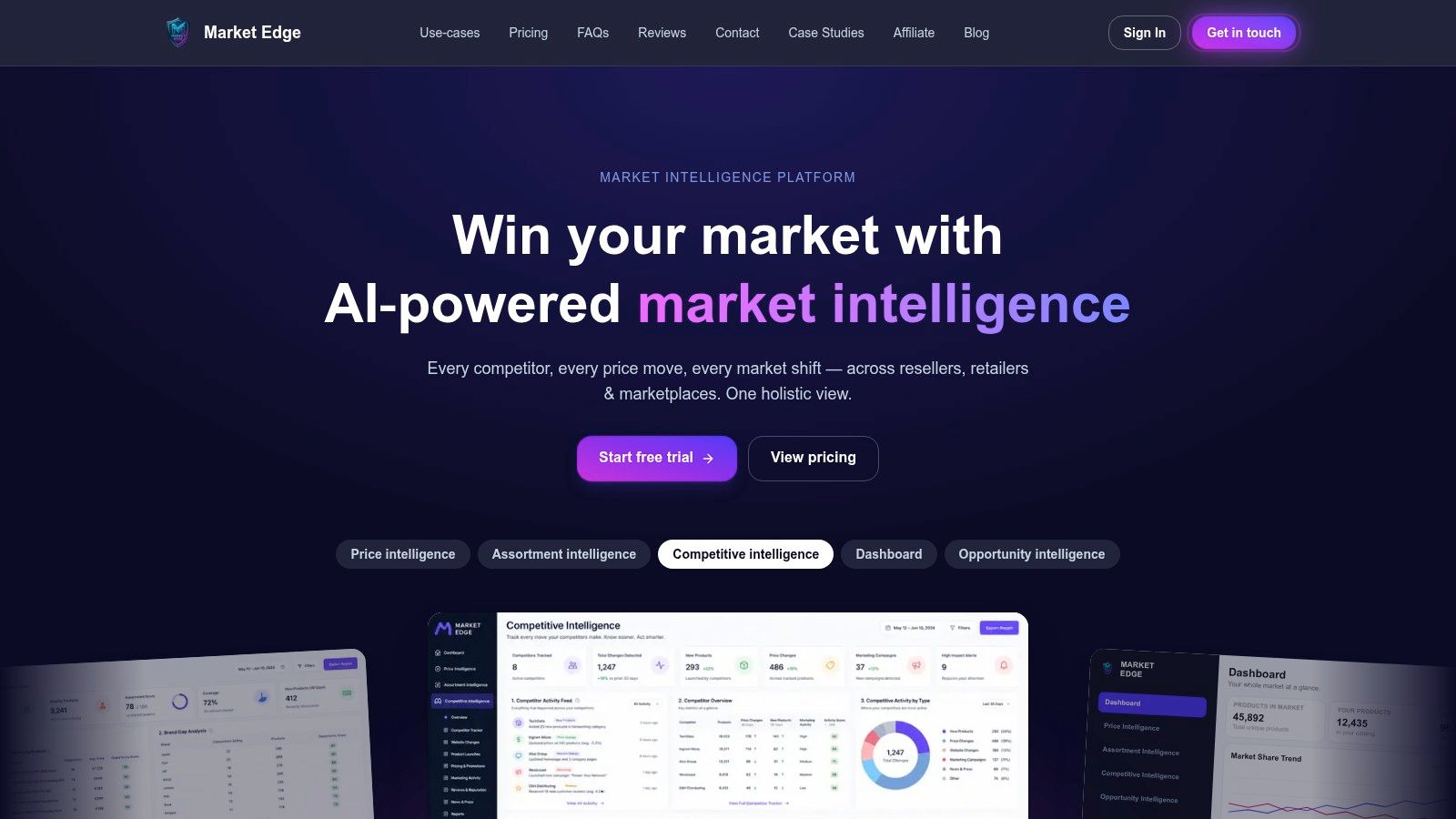
Market Edge is one example of this type of platform. It tracks competitor pricing and stock across resellers, retail sites, and marketplaces, including Amazon, eBay, and eMAG, and uses AI-based product matching to organize SKU-level observations for pricing, MAP, sourcing, and channel decisions. The sensible next action is to define a pilot catalog, nominate the competitors that matter, and agree on the alert rules before expanding coverage.
Market Edge can help distributors, manufacturers, importers, and online retailers monitor competitor prices, stock changes, MAP signals, and marketplace activity in one workflow. Visit Market Edge to review the platform and test whether its near-real-time monitoring fits your pricing operation.