
A pricing manager at a mid-sized distributor sees the same pattern every week. One major rival nudges a key SKU, then three other competitors follow within hours, and the dashboard starts to look less like a market and more like a chain reaction. That's the moment the team asks the right question, not whether prices moved, but whether they moved because one firm set the tone and everyone else followed.
Price leadership is the market pattern behind that reaction. In plain commercial terms, one influential firm changes its regular price, and rivals align instead of starting a fresh round of undercutting. In concentrated markets, that can calm the market and protect margins. In a distributor, manufacturer, or marketplace channel, it can also erase pricing freedom fast if you don't know whether you're seeing leadership, imitation, or just shared cost pressure.
When Competitors Move in Lockstep
A pricing team usually notices price leadership before it can name it. The signs show up in a dashboard first, not in a strategy memo. One supplier changes a distributor-facing SKU, then the same movement appears across several competitors, often without a visible promotion or demand shock.
The pattern that raises the flag
That lockstep motion is why the topic matters commercially. If the market is following one firm's move, then your team isn't just watching prices, it's watching a benchmark form in real time. Standard microeconomics links price leadership to market structures with a small number of firms, restricted entry, homogeneous products, and inelastic demand, which is why it shows up most clearly where rivals have limited room to differentiate on price alone. The mechanism also helps explain why a single announcement can move an entire category and reduce destructive price wars, which is exactly what concentrated markets often try to avoid. Investopedia's overview of price leadership
For B2B teams, the commercial issue is simple. If one seller can reset the reference point, everyone else has to decide whether to match, hold, or risk losing share. That decision directly affects margin, quote competitiveness, and whether your own price becomes the lagging number in the market.
Practical rule: If the same rival keeps moving first on the same SKU family, don't assume it's random. Treat it as a possible benchmark signal until the timing pattern proves otherwise.
A useful way to think about it is this, price leadership is not just a definition. It's a recurring market behavior that either stabilizes a category or compresses your pricing room. Once you start looking at the sequence of moves instead of the move itself, the pattern becomes much easier to spot.
The Mechanics of Price Leadership in Oligopoly Markets
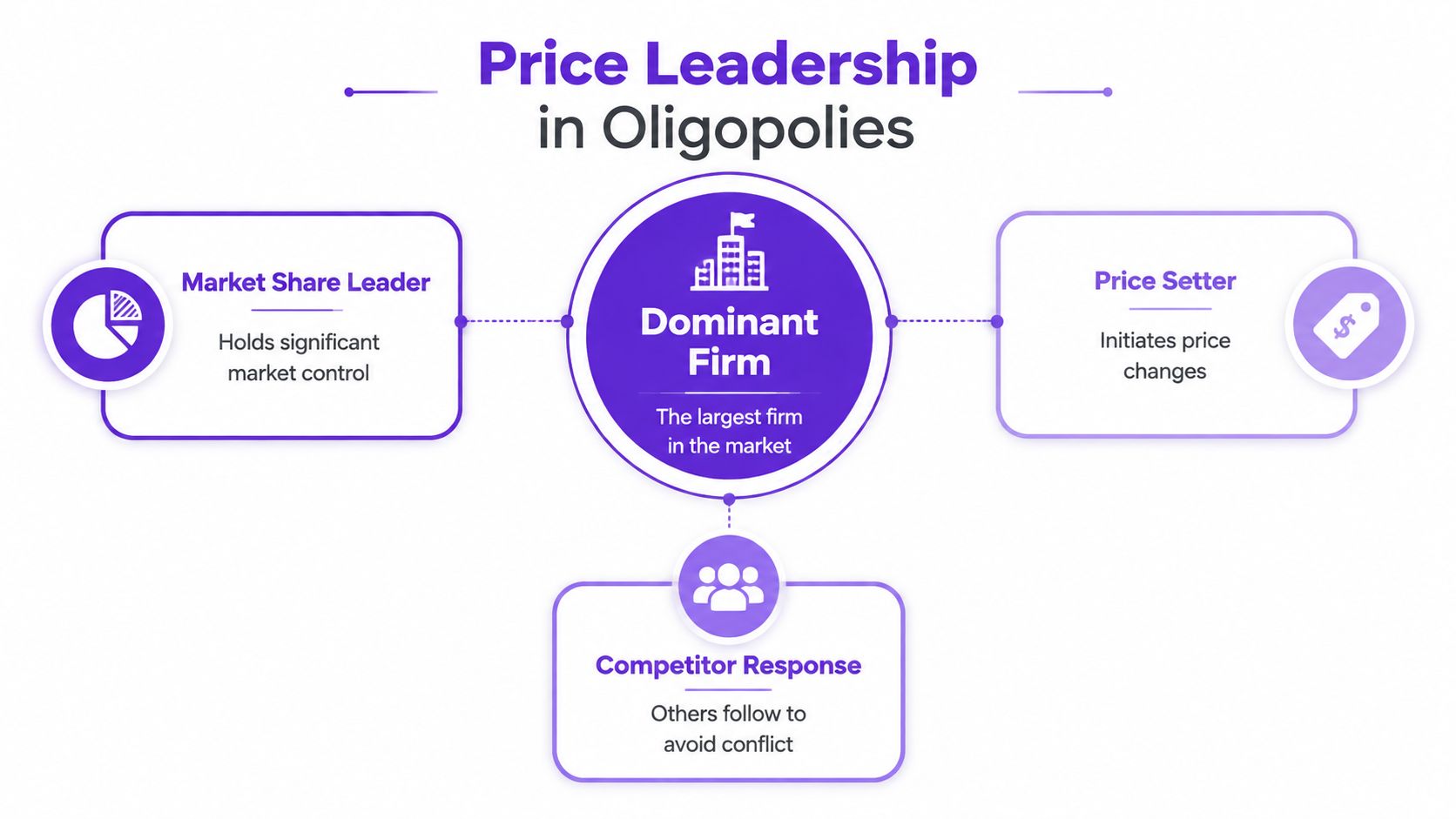
Price leadership tends to emerge where a few firms do most of the selling and everyone can see everyone else's move. In those markets, the leader's price becomes the reference point because rivals would rather follow than trigger a fight they can't easily win. That's why the concept is tied to oligopoly, not to broad competitive markets where no single seller can reliably move the rest.
Why one firm becomes the benchmark
The leader isn't always the biggest seller, but it often is. Academic and practical explanations point to three common leader types, the lowest-cost firm, the largest firm or share leader, and the barometric firm with the best market information. In a B2B setting, those roles can look different by channel. A low-cost manufacturer may establish the floor, a dominant distributor may set the pace, and an information-rich marketplace seller may become the signal everyone else copies.
This is also why leadership can be tacit. In markets where open collusion is illegal in almost every country, firms don't need an explicit agreement for prices to align. They can observe the leader, wait a short lag, and respond. UN ESCWA's glossary entry on price leadership describes the stabilizing role of the leader when markets are coordinated, including the tendency for the leader to set a price high enough that the least efficient firm can still earn an above-competitive return.
A stable market isn't always a healthy one. If everyone follows the same price signal, the category can look orderly while buyers lose leverage.
That's the commercial reality for manufacturers and distributors. The same structure that reduces chaos can also normalize higher prices, especially when entry is limited and products are close substitutes. In ecommerce and marketplace channels, that effect is visible at SKU level. One seller moves, the rest mirror the move, and the market starts treating that number as the new center.
Types of Price Leadership and How They Differ
Not every leader is shaping prices for the same reason. Some firms lead because they're efficient. Others lead because they're better informed. And in some markets, multiple firms move together without saying so explicitly, which makes the pattern feel similar even when the underlying logic is different.
A comparison that pricing teams can actually use
| Leadership Type | Basis of Influence | Typical Market Signal | B2B Example |
|---|---|---|---|
| Dominant firm leadership | Scale, share, or cost advantage | Rivals follow the largest seller's move | A national distributor resets a core SKU and regional resellers align |
| Barometric leadership | Better market information | Others treat the move as a signal about demand or input costs | A well-connected wholesaler adjusts first after freight or supply pressure |
| Tacit coordination | Shared incentives in a concentrated market | Matching prices appear repeatedly without an explicit deal | Several manufacturers converge on the same net price pattern across a category |
The practical difference matters. A dominant firm usually has enough market weight to move the rest. A barometric firm may not be the biggest, but it reads the market well enough that others trust its signal. Tacit coordination is the hardest to prove because the alignment can look like ordinary imitation unless you study timing and repetition carefully.
What the market is telling you
A distributor selling a branded SKU into multiple channels may see all three forms at different times. A low-cost manufacturer can force the floor down. A highly informed marketplace seller can create a short-term reference point. A concentrated category with limited entry can drift into tacit alignment where no one needs to say much at all.
For analysts, the takeaway is not to label the pattern too quickly. First identify who moved first, then ask whether the move came from cost, information, or strategic signaling. That's the difference between a useful benchmark and a misleading one.
Practical takeaway: Don't classify leadership by who is loudest. Classify it by who moves first, who follows, and whether the same relationship repeats across the same SKU set.
How to Detect Price Leadership with Competitive Monitoring
The best signal isn't a single price cut. It's repeated matching. Academic work on identifying price-leadership structures uses a timing-and-matching test, where a follower matches the leader's regular-price change by the same monetary amount and direction within two weeks, which helps separate true leadership from promotions or simultaneous repricing. The Warwick working paper on price-leadership timing gives a useful empirical definition, and recent work on identifying leadership in oligopoly emphasizes the same idea, repeated matched moves within a short window, rather than one-off coincidence. The UEA paper on identifying price leadership structures in oligopoly
What to look for in the data
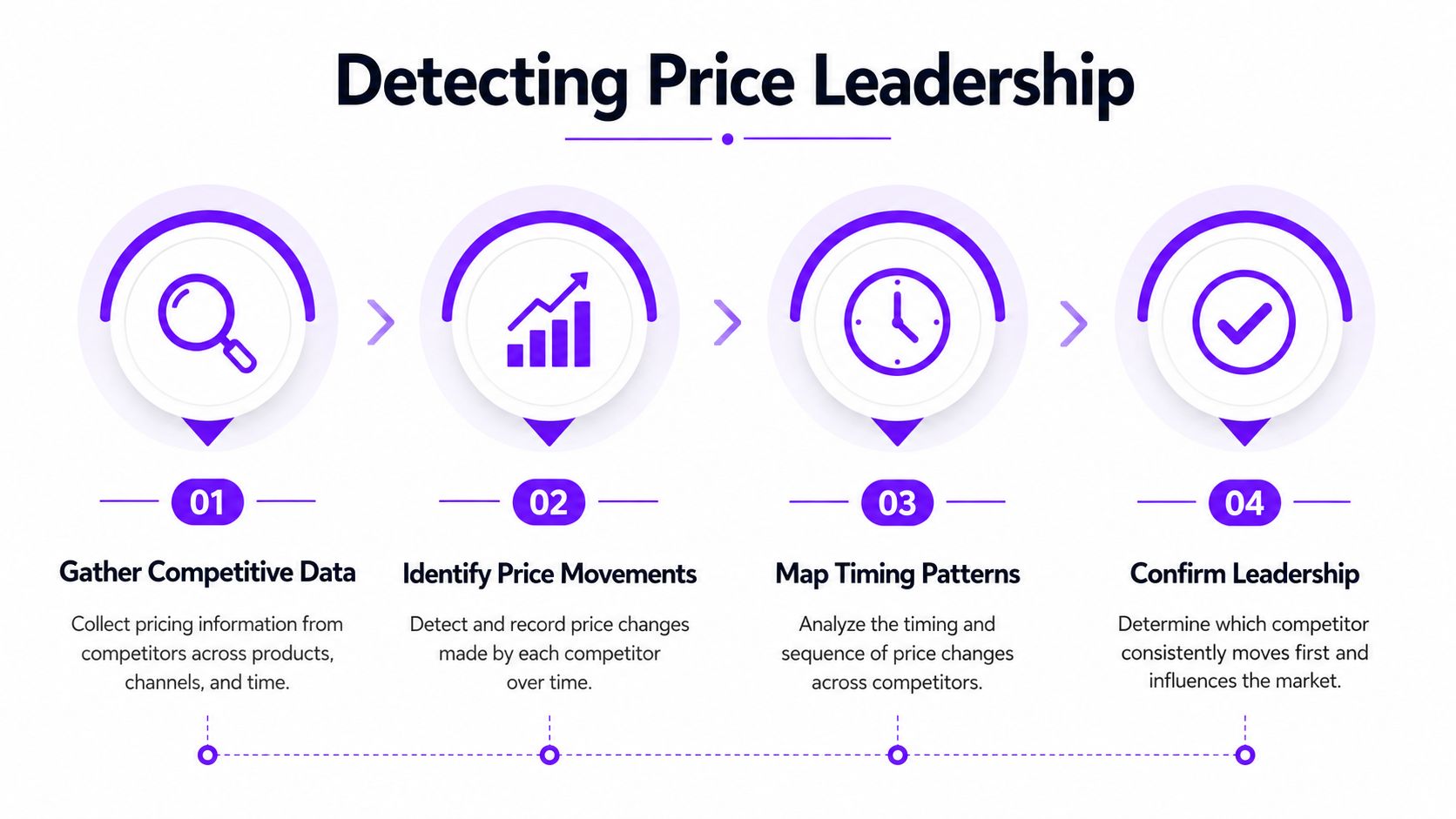
Start with SKU-level history. If one seller moves first on the same item, and the same competitors match that move over and over within a short lag, you have a candidate leadership pattern. If the response shows up across several channels, that's even more useful, because it suggests the market is using one seller as a reference point rather than reacting independently.
The signal becomes stronger when you compare regular pricing, not temporary promotions. That distinction matters because a flash discount can create noise that looks like leadership but isn't. A pricing manager should also separate broad cost-driven repricing from true follower behavior, since a freight or supplier shock can push multiple firms at once without any one firm acting as the benchmark.
A practical monitoring workflow usually looks like this:
- Collect clean SKU matches: Make sure the same product is being compared across sellers, marketplaces, and reseller sites.
- Track timing, not just price levels: Record who moved first and how quickly others reacted.
- Measure repeated matching: Look for the same rivals following the same leader more than once.
- Separate regular prices from promotions: One-off sale activity can hide the underlying structure.
- Review lag patterns by channel: Minutes, hours, or days can matter depending on the market.
For teams already benchmarking against peers, a resource like PageSpeed Plus benchmarking against competitors can help frame competitive comparison discipline, even though the pricing use case is different. The method matters because weak matching logic will make ordinary imitation look like leadership, while strong matching logic will reveal the pattern more clearly.
If you're still defining your monitoring stack, the foundational layer is price collection and product matching. A practical overview is available in this guide on what is price monitoring.
Price Leadership in B2B Ecommerce and Marketplace Environments
In ecommerce, price leadership is often visible before anyone talks about it. One marketplace seller changes a SKU, other sellers realign, and the reference price on the listing shifts almost immediately. On Amazon, eBay, and similar channels, that can happen so fast that a pricing team sees the effect before it understands the cause.
Where the pattern shows up in practice
For manufacturers and brand owners, the commercial risk is erosion through reseller behavior. A reseller lowers a visible offer, the rest of the channel follows, and the SKU starts drifting away from the intended price band. That's why MAP and RRP policies matter, not as paperwork, but as guardrails that help stop one seller from becoming the benchmark for everyone else.
Marketplace data is especially useful because it shows the seller-level structure behind the number. You can see whether the same marketplace operator keeps initiating moves, whether the move spills into reseller networks, and whether the pattern repeats on closely related SKUs. That's a better signal than counting how many offers changed.
A useful operational question is whether you're watching one product or an entire price ecosystem. In direct-to-retailer channels, a single benchmark move can reset conversations with buyers. In reseller-heavy markets, a de facto leader can push the visible market lower even when your own direct pricing hasn't changed.
For teams comparing seller behavior and review surfaces across marketplaces, hosted vs native review platforms compared is a useful adjacent read because the same discipline applies, choose the right data structure before drawing conclusions.
Why monitoring has to be SKU specific
Generic category averages won't help here. Leadership happens at the item level, not at the slogan level. You need to know which seller moved first, which reseller matched, and whether that alignment is persistent enough to matter commercially.
Operational insight: In marketplace monitoring, one seller becoming the benchmark is often more important than the absolute price itself.
That's where tools matter. Vendor-neutral workflows should capture competitor pricing, stock, and timing across channels, then map that back to the same SKU. Market Edge is one example of a platform built for that kind of monitoring across resellers and marketplaces, which makes it easier to see when one actor is effectively setting the pace. For a broader channel context, this overview of what is an online marketplace is worth keeping nearby.

Price Leadership Versus Collusion and Legal Boundaries
A lot of pricing teams worry that tracking follower behavior will blur into collusion. That concern is understandable, but the two are not the same. Price leadership can emerge naturally in concentrated markets, while collusion requires coordination that crosses the legal line.
The line that matters
The key difference is intent and communication. Price leadership can be tacit, which is one reason it's so common in markets where open collusion is illegal. Firms can watch each other, infer the benchmark, and follow without any explicit agreement. That doesn't make every matching pattern legal or harmless, but it does mean the mere existence of alignment isn't proof of misconduct.
The compliance question becomes sharper when firms start exchanging non-public pricing intentions, agreeing on future moves, or using a shared system to coordinate outcomes. Those behaviors are far more sensitive than reacting to visible competitor prices. Pricing teams should document that their decisions are based on independent monitoring, internal margin goals, channel strategy, and customer demand, not on any private arrangement with rivals.
For manufacturers dealing with MAP policies, the legal boundaries are especially practical. A policy framework like minimum advertised price MAP is designed to support brand discipline without turning market observation into improper coordination. That distinction matters because enforcement should protect the brand, not create risk through sloppy process.
Keep the evidence trail clean. If your team can show it used public pricing data, internal rules, and separate approval logic, the compliance posture is much easier to defend.
The safest posture is straightforward. Monitor the market, document your own rationale, avoid private exchanges with competitors, and treat matching behavior as a market signal, not a cue for informal coordination. That approach is legitimate, commercially useful, and much safer than improvising in the gray zone.
Action Plan for Monitoring and Responding to Price Leadership
The response plan should be simple enough to run every week and rigorous enough to hold up under scrutiny. Start by tracking the SKUs where you already suspect follower behavior, then expand to the categories that matter most to margin and volume. If the same rival keeps moving first, your team needs an escalation path, not another spreadsheet.
A checklist pricing teams can use
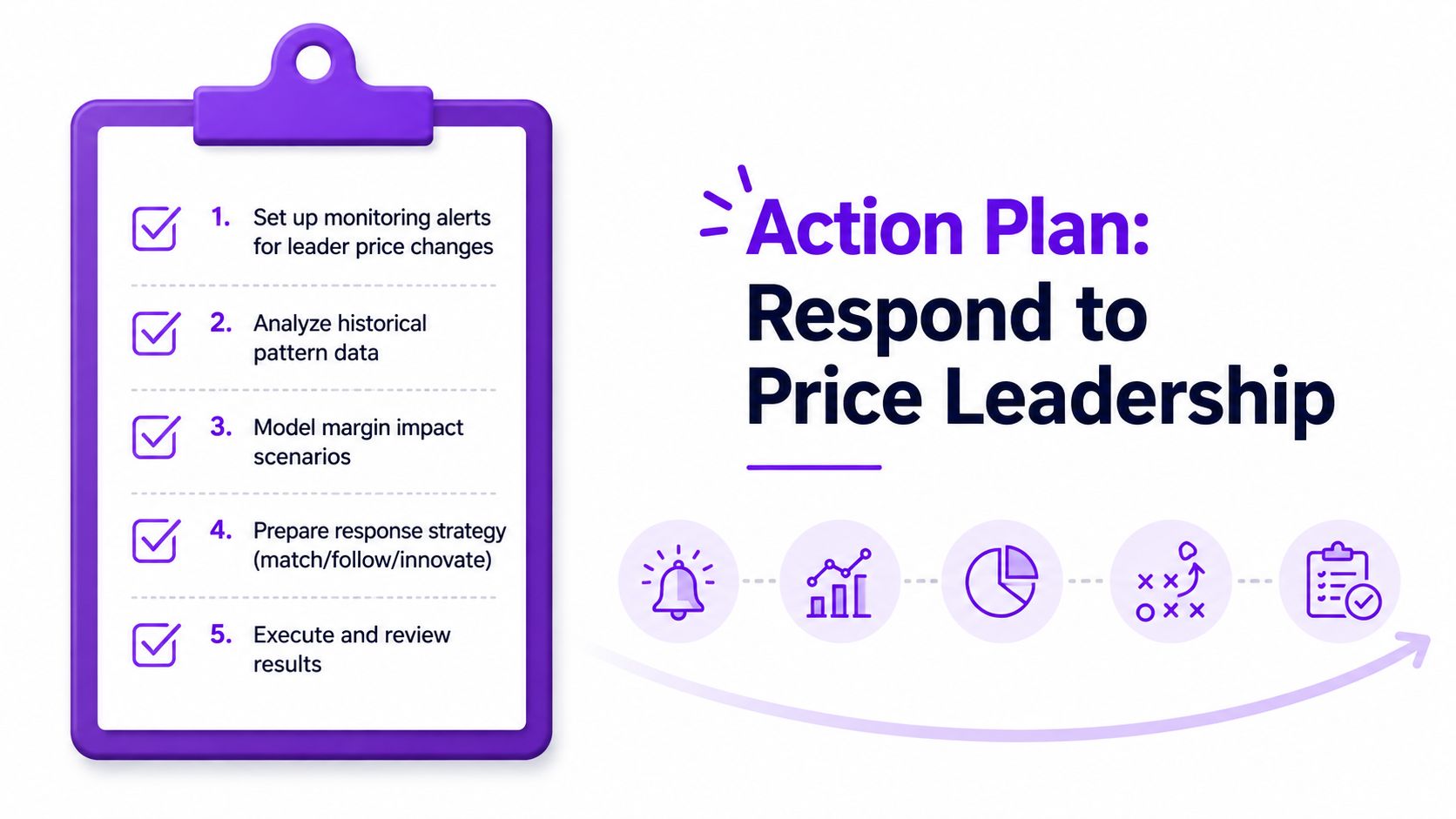
- Set alerts on leader moves: Flag the first visible change on priority SKUs so the team sees the benchmark shift early.
- Review historical matching: Check whether the same rivals have followed the same firm more than once within a short window.
- Test margin scenarios: Model what happens if you match, hold, or reprice in a different channel.
- Define response rules: Decide in advance when to follow, when to hold, and when to protect position through assortment, service, or packaging.
- Audit the result: After each move, compare the expected margin effect with the actual outcome.
What good monitoring actually reveals
The point isn't to react to every competitor change. It's to know which changes matter and which ones are noise. If the same seller keeps becoming the reference point, that's a structural issue, and your pricing governance should reflect it.
That's where automated monitoring earns its place. Market Edge is built to track competitor pricing and stock across resellers and marketplaces in near real time, which helps teams spot follower patterns without relying on manual checks. It won't make the decision for you, but it will show whether the market is following a leader or just changing for unrelated reasons.
If you're trying to separate ordinary competition from true price leadership, start with the timing, the SKU match, and the repeated follower pattern. Then visit Market Edge and see how structured monitoring can give your pricing team the visibility it needs to act with confidence.