
Market intelligence is the continuous collection and analysis of competitor, pricing, customer, and channel data used to guide commercial decisions. One recent estimate valued the global market intelligence market at USD 12.1 billion in 2026 and projects it to reach USD 21.4 billion by 2032, implying an 8.2% CAGR over that period (6Wresearch).
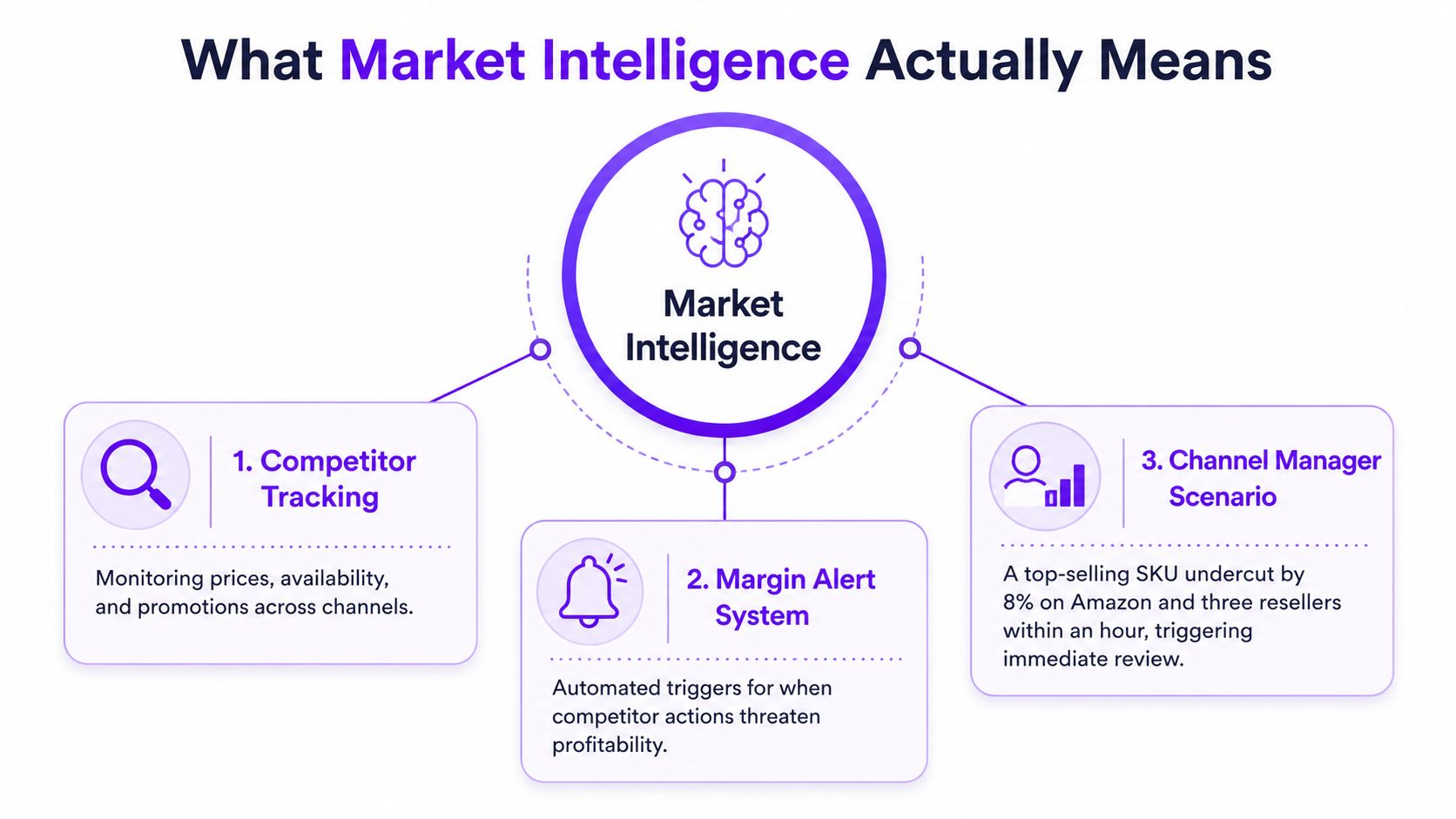
A pricing manager sees a top-selling SKU undercut by 8% on Amazon and three reseller sites within an hour. The finding triggers a margin review before the morning sales call. That's market intelligence in its useful form, not a quarterly report that describes what happened after the commercial window has closed.
What Market Intelligence Actually Means
The practical definition starts with the decision, not the data source. A distributor needs to know whether to reprice, a brand owner needs to know whether to issue a MAP warning, and a category manager needs to know whether a competitor's stockout creates a sourcing opportunity.
Market intelligence provides the evidence for those calls by continuously collecting and analyzing signals such as:
- Competitor pricing: Public prices, discounts, coupons, and price history.
- Product availability: In-stock, out-of-stock, limited-stock, and seller-level availability.
- Assortment coverage: Which competitors carry particular products, variants, or bundles.
- Promotional activity: Sales events, bundle offers, email promotions, and marketplace discounts.
- Customer and channel behavior: Reviews, product-page changes, search movement, and channel-level demand signals.
Market intelligence versus market research
Traditional market research is often project-based and periodic. Teams commission surveys, interview customers, review industry reports, and present findings in a planned briefing. That work remains valuable for understanding attitudes, unmet needs, and broader category direction.
Market intelligence is more operational. It combines structured sources, including reports and filings, with unstructured signals such as web content and customer feedback, then turns them into a decision layer (Contify). The question isn't only “What is happening in the market?” It's “What should our team do today?”
A useful test is whether the output changes an action:
- A price changes because a relevant competitor moved.
- A buyer adjusts a reorder because supply tightened elsewhere.
- A brand manager sends a MAP notice after confirming a public listing violation.
- A sales leader changes a channel promise because assortment or availability shifted.
For a broader look at competitor and market signals, the marketplace insights blog from PuppetVendors offers useful context alongside a more focused explanation of competitive intelligence.
Market intelligence is the continuous process of converting external market, competitor, customer, and channel signals into decisions about price, margin, assortment, sourcing, and growth.
The audiences that benefit most are distributors, brand owners, and retail category managers. Each group may use different thresholds and workflows, but they share the same commercial problem: internal data tells you what your business did, while external intelligence shows what is changing around it.
How Market Intelligence Evolved Into an Always-On Discipline
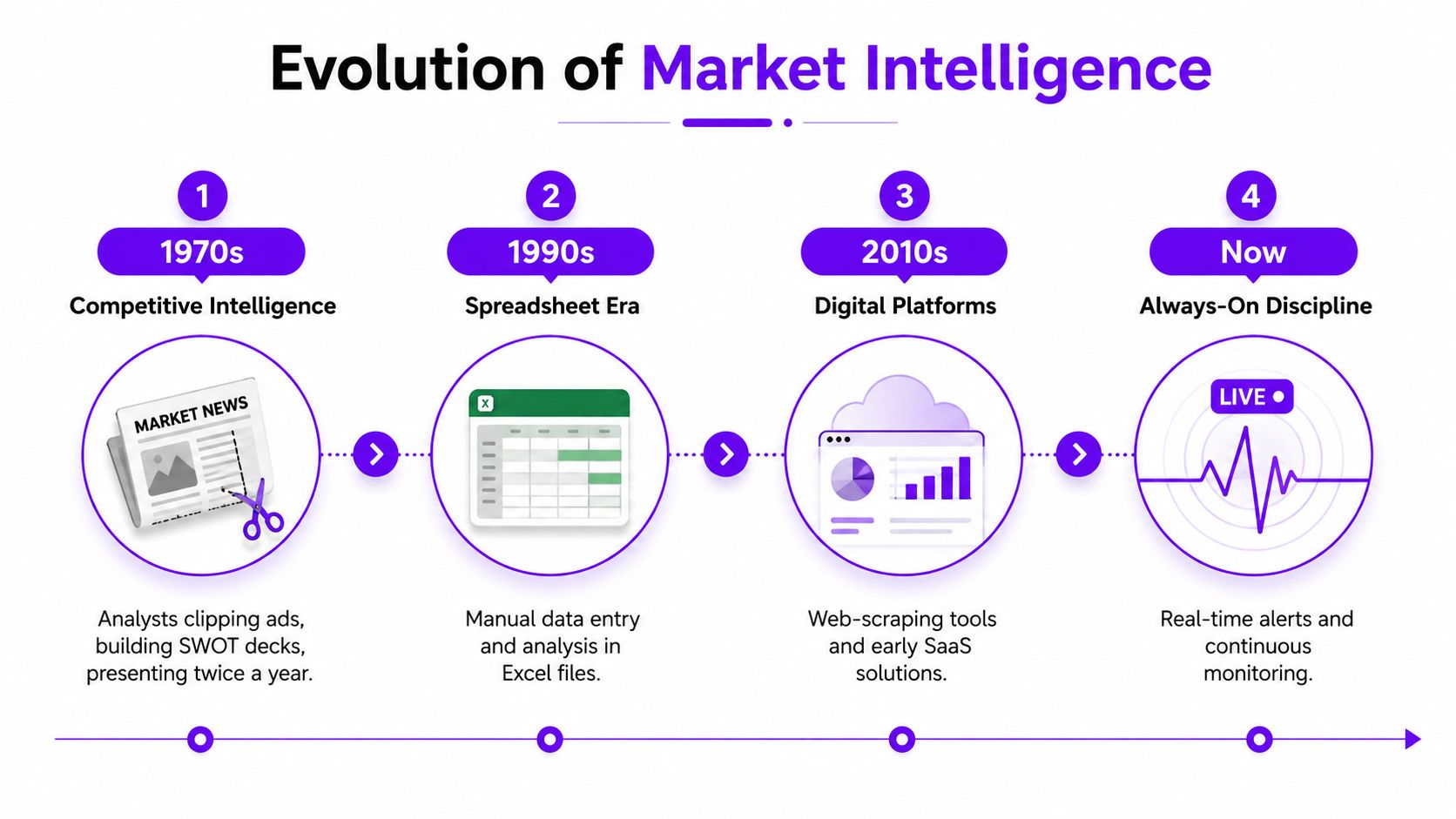
Competitive intelligence started as structured manual research. Analysts clipped newspaper advertisements, tracked rival announcements, prepared SWOT presentations, and briefed executives on a fixed schedule. It was not widely recognized in the United States as a corporate decision-making tool until the 1970s, and Motorola formed one of the first formal corporate competitive-intelligence groups in 1983 (Arab League News).
By 1998, more than 80% of companies with over USD 10 billion in annual revenue reportedly had an organized intelligence system that combined internal teams with outsourced research support, according to 6Wresearch. Intelligence had become an executive capability shaped by globalization, stronger rivalry, and the need to observe competitors systematically.
Why periodic reports lost authority
Spreadsheets improved collection, but manual workflows still left a gap between observation and action. Ecommerce expanded the number of products, sellers, channels, and geographies that teams had to monitor. Web scraping and APIs made daily collection possible, while marketplace repricers shortened the time in which a competitor move remained isolated.
MAP risk added direct margin pressure. A brand could follow its own policy on a direct retailer site while a marketplace seller advertised the same product below the permitted level. A quarterly review could not reliably show which seller changed the listing, when the change happened, or whether the violation had spread across channels.
The modern program works as a commercial control system:
- External data is collected continuously.
- Product and seller records are normalized.
- Rules identify changes that can affect price, margin, MAP, or sourcing.
- Alerts reach the person who can act.
- The response and its commercial effect are reviewed.
That workflow turns market intelligence from a periodic report into an operating discipline. A pricing team can investigate a margin threat while it is still localized, a brand owner can address a MAP breach with seller-level evidence, and a distributor can adjust sourcing or replenishment when availability shifts.
The market intelligence market's projected movement from USD 12.1 billion in 2026 to USD 21.4 billion in 2032 reflects demand for decision-support infrastructure rather than reports alone (6Wresearch).
Core Data Types Every Program Should Track
A serious program doesn't begin by tracking every visible page. It starts with the signals that answer commercial questions. Price tells you how the market is positioned, but availability, assortment, promotion, and seller identity explain why that position exists.
| Data Type | What It Captures | Primary Commercial Decision | Refresh Cadence |
|---|---|---|---|
| Competitor pricing and history | Listed price, discount, coupon, and movement over time | Repricing, MAP review, and promotion benchmarking | Continuous or near real time for priority SKUs |
| Product availability and stock | In-stock status, stock changes, and seller availability | Forecasting, substitution, sourcing, and buy-box decisions | Frequent refresh where availability affects conversion |
| Assortment and catalog coverage | Products, variants, bundles, and channel presence | White-space identification and channel expansion | Daily or according to category volatility |
| Promotional activity | Sales events, bundles, coupons, and stacked offers | Margin protection and promotional response | Event-driven and frequent during campaigns |
| Seller and authorship data | Seller identity, listing ownership, and channel presence | MAP attribution, account escalation, and channel governance | Frequent enough to identify the responsible seller |
Pricing is only the starting point
Price history helps distinguish a sustained repositioning from a temporary error. A single low observation may come from a coupon, a damaged listing, a different pack size, or a seller using an incorrect product match. Without normalization and history, a team can react to noise and damage its own margin.
Availability adds the context that price alone misses. If a competitor is cheaper but out of stock, matching that price may be unnecessary. If several sellers lose stock while your inventory remains healthy, the right move may be to protect price rather than chase a lower market reference.
Assortment data exposes gaps that price reports won't show. A competitor may not be cheaper, but it may carry a pack configuration or accessory set that your channel lacks. That can inform sourcing and product-content decisions.
Promotional monitoring should capture the full offer, not just the headline price. A bundle, coupon, or limited promotion can change the effective value while leaving the standard product price untouched.
Seller identity deserves its own field. A brand manager can't enforce a policy effectively if the system detects a violation but doesn't preserve the seller, page, timestamp, and evidence needed for escalation.
Cross-category sellers matter too. Direct competitors aren't always the first actors to move a price. Marketplace sellers, adjacent categories, and retailers with excess stock can influence the reference price before a conventional competitor appears in a report. Teams exploring trend analysis for ecommerce can use that broader view to connect individual observations with changing category behavior. A practical guide to collecting market data can help teams define source coverage before they select refresh rules.
MAP, RRP, and the Price Rules You Need to Enforce
Price-policy monitoring fails when teams treat every pricing term as interchangeable. MAP governs what a reseller may publicly advertise, while RPM concerns the actual resale price. RRP is generally a recommendation, and UPP, or unilateral pricing policy, needs to be defined carefully in the policy and applied consistently.
MAP doesn't control the final checkout price. A retailer may sell below MAP in a private or checkout-only context, provided the lower price isn't publicly advertised, which means monitoring must cover product pages, listings, email campaigns, and marketplace pages (eBrands).
In the United States, MAP is generally described as lawful when it operates as a unilateral policy limited to advertised pricing. RPM is treated more strictly because it attempts to control the actual sale price (SupplyKick). Legal review should shape the policy, while the monitoring workflow should preserve the distinction.
| Rule | Legal Status | What to Monitor | Monitoring Frequency | Enforcement |
|---|---|---|---|---|
| MAP | Generally a unilateral advertised-price policy, subject to applicable law | Public listing, product page, email, and marketplace price | Frequent for priority items | Verify evidence, identify seller, follow policy escalation |
| RPM | Concerns the actual resale price and carries stricter legal considerations | Checkout price, transaction terms, and supply-chain behavior | Only where legally and commercially appropriate | Legal and supply-chain review |
| RRP | Recommended retail price, not automatically a binding requirement | Public reference price and retailer positioning | Periodic or campaign-based | Commercial discussion, not automatic breach action |
| UPP | Unilateral pricing policy defined by the brand | Advertised-price or other specified policy fields | According to policy risk | Apply documented, consistent channel process |
The operational implication is straightforward. Advertised-price scraping is not checkout monitoring, and a MAP violation shouldn't be treated as proof of RPM. Keep the evidence model aligned with the rule, including the product match, seller, channel, observed price, and time.
Commercial teams sometimes benchmark external service costs while building enforcement operations. A resource such as B2B contact database pricing may help with unrelated vendor comparisons, but it shouldn't be confused with the data and workflow requirements of price-policy monitoring.
Real-World Example of Multi-Channel Price Monitoring
Consider a Tuesday morning at a mid-sized consumer electronics distributor. The category team has a flagship SKU on Amazon, eBay, regional retail sites, and several reseller pages. The team isn't trying to react to every movement. It wants to identify changes that affect margin, channel relationships, or the credibility of its pricing policy.
An hourly monitoring workflow records three different events:
- A competitor drops the flagship SKU by 8% on Amazon.
- A marketplace seller lists the product $12 below MAP on eBay.
- A regional retailer extends a 10% bundle discount around the same product.
Those figures are part of the operating scenario, not a general market statistic. A published retail example describes hourly monitoring across Instacart, Walmart.com, and Target.com, with alerts when a competitor changes a key value item's price by 5% or more (Plott Data).
One detection system, three owners
The Amazon move goes to the category buyer. The buyer checks whether the competitor changed its standard price, introduced a temporary promotion, or is clearing inventory. Matching immediately could reduce margin without addressing the cause.
The eBay violation goes to the brand manager or channel-compliance owner. The workflow preserves the seller identity and listing evidence, allowing the team to follow its MAP process rather than sending a vague complaint about “market pricing.”
The bundle promotion goes to ecommerce. A bundle can change shopper value without appearing as a direct unit-price cut, so the team decides whether to counter with content, a targeted offer, or no response.
Without monitoring, the inbox might contain a forwarded screenshot, an unverified reseller complaint, and a weekly spreadsheet that merges all three events. With monitoring, each alert includes a product match, channel, seller, observed condition, and recommended owner.
Practical rule: A useful alert doesn't merely say that a price changed. It explains what changed, where it changed, who owns the response, and why the change matters.
The commercial benefit comes from routing and context. Price monitoring becomes valuable when it prevents an unnecessary match, accelerates a legitimate MAP escalation, or reveals that a competitor's apparent price advantage is a bundle mechanic.
Turning Competitive Data Into Actionable Decisions
Raw competitive data doesn't protect margin. A team needs a closed loop that moves from observation to response and then checks whether the response produced the intended commercial result.
Start with the SKU, not the platform
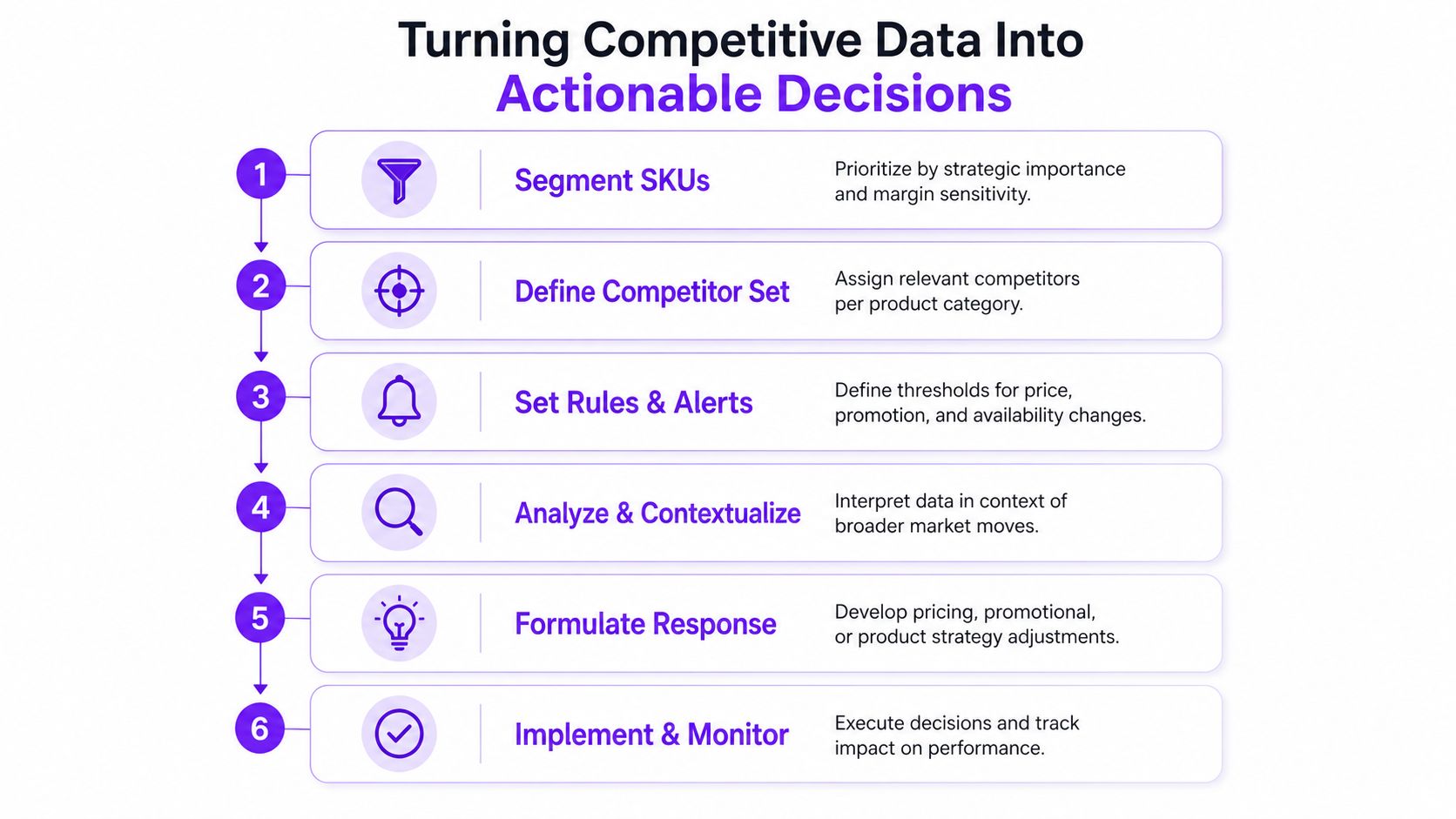
1. Segment SKUs. Separate strategic products, high-margin items, traffic drivers, and low-priority long-tail products. A flagship item may need faster alerts than a slow-moving accessory because the commercial consequence of a visible price move is different.
2. Define the competitor set. Assign relevant competitors by category and channel. Include direct brands, important retailers, marketplaces, and sellers that can influence the reference price. Don't assume one universal competitor list serves every SKU.
3. Set thresholds and rules. Create triggers for meaningful price changes, MAP breaches, stock events, promotions, and product-page changes. A threshold should lead to a decision, not just add another notification.
Add ownership and commercial context
4. Analyze the context. Check pack size, product condition, fulfillment method, seller identity, promotion terms, and stock status before treating an observation as comparable. Product matching errors can turn a legitimate competitor move into a false signal.
5. Formulate the response. The available responses may include repricing, enforcing MAP, changing a source, holding price, adjusting a promotion, or doing nothing. “Do nothing” is a valid response when the competitor is out of stock or the offer isn't comparable.
6. Implement and review. Route the action to a named owner, record the decision, and review margin impact weekly. The team should be able to connect a pricing or sourcing decision back to the observation that caused it.
A pricing decision-making process becomes more reliable when alerts have owners, deadlines, and financial relevance. You can also see how a workflow like this is commonly presented in practice:
The wrong setup produces a dashboard full of movement and no decisions. The right setup gives pricing, sales, sourcing, and brand teams a shared operating view.
Why Some Programs Fail and How to Avoid It
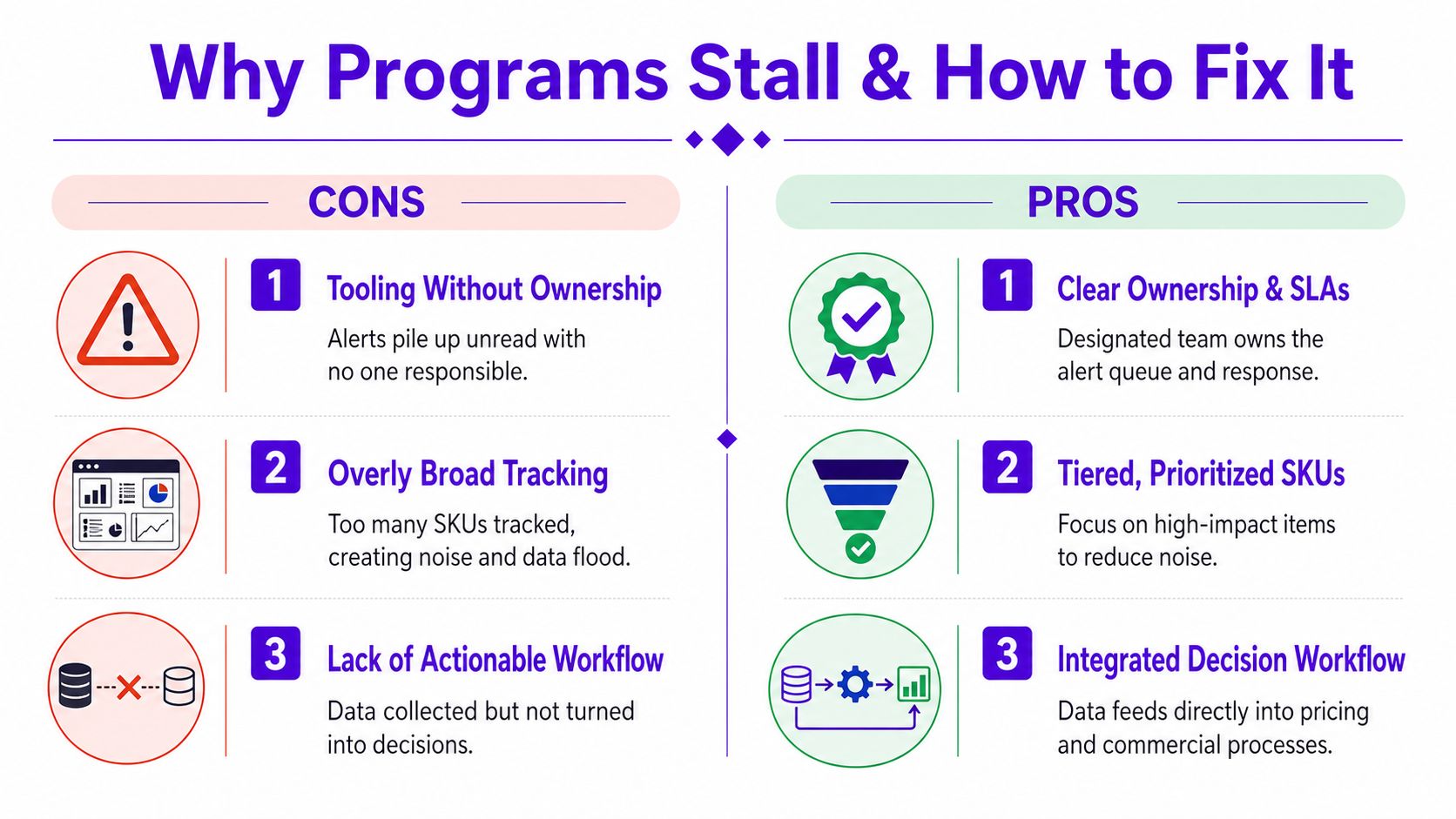
Most stalled programs don't fail because the business lacks data. They fail because nobody has made the data operational.
A company buys a crawler, loads a broad catalog, and creates a dashboard. Then alerts accumulate without a named owner. Pricing managers lose trust when product matching is inconsistent, while executives see licensing cost but not a documented action or recovered opportunity.
The operating fixes that matter
- Assign ownership: Each alert type needs a responsible team and a response SLA. A MAP breach may belong to brand compliance, while a sourcing signal belongs to procurement.
- Narrow the initial scope: Track priority SKUs and high-impact channels first. Broad coverage creates noise before the team has learned which signals deserve action.
- Set financial thresholds: Connect alerts to margin exposure, price floors, stock risk, or strategic importance. A change without a commercial consequence shouldn't interrupt a manager's day.
- Review data quality: Check product matches, seller attribution, pack-size comparability, and source stability. Remove sources that repeatedly generate false positives.
- Secure executive support: Pricing, legal, operations, sales, and category management must agree on policy and escalation paths.
A monitoring program is an operating discipline, not a software installation.
The cost of inaction is often hidden in unnecessary price matching, missed MAP violations, delayed sourcing decisions, and sales conversations based on stale information. A sharper scope and faster feedback loop usually matter more than adding another dashboard feature.
A Practical Checklist for Getting Started
Treat the launch as a focused pilot rather than a platform-wide rollout. The first objective isn't to monitor everything. It's to prove that a defined set of external signals changes a commercial decision.
Build the pilot in four stages
Days 1 to 5, define the jobs to be done. Choose three concrete outcomes: protect MAP, defend margin on priority SKUs, and monitor stock. Write down what counts as a useful result for each outcome before collecting data.
Days 6 to 15, select the coverage. Choose 50 to 100 priority SKUs and 10 to 15 competitor URLs for the pilot. Validate automated collection against manual spot checks, paying close attention to pack sizes, variants, seller identity, and marketplace fulfillment.
Days 16 to 25, create response rules. Define price floors, breach thresholds, promotion triggers, and stock events. Assign every alert to an owner and document the response SLA, including when the correct response is to investigate rather than reprice.
Days 26 to 30, connect the workflow. Send alerts to email or Slack, brief sales and category teams, and hold a weekly review of captured violations against revenue recovered or margin decisions influenced.
Before expanding into more products, regions, or channels, check three signals:
- Alert volume is manageable.
- False positives are below 5%.
- At least one pricing action can be traced back to the data.
These pilot thresholds are operating criteria for implementation, not universal market benchmarks. If the workflow passes them, expand deliberately. Add coverage only when the team can preserve matching quality, ownership, and response speed.
The right vendor-neutral setup combines near-real-time collection, product matching, historical records, seller attribution, configurable rules, and workflow routing. Automated monitoring suites such as Market Edge can centralize those functions for distributors, manufacturers, importers, wholesalers, and online retailers that need visibility across reseller sites and marketplaces.
Market Edge tracks competitor pricing, stock, assortment, and seller activity across websites and marketplaces, helping commercial teams connect external signals with repricing, MAP enforcement, sourcing, and channel decisions. Visit Market Edge to test the workflow on a focused SKU set and see whether automated monitoring fits your pricing operation.