
A pricing manager at a mid-market distributor is comparing two competitive-monitoring vendors. One charges a flat monthly fee. The other charges by tracked URL. Both dashboards appear capable, but the commercial risk is very different. The first model may overcharge a small pilot and undercharge an account monitoring thousands of listings. The second can scale with coverage, but only if the meter is accurate and the contract is clear.
That choice matters to distributors, manufacturers, importers, and online retailers because monitoring workload rarely stays static. Product catalogs expand, marketplaces change, seasonal campaigns create spikes, and MAP enforcement requires a different depth of evidence than a simple price check.
This guide gives you a practical way to decide which usage based pricing model fits your workload, what to meter, how to forecast spend, which terms to negotiate, and where the model breaks. The shift is already commercial rather than theoretical. OpenView-derived reporting showed SaaS adoption rising from 34% in 2020 to 61% in 2022, a 27-point increase in two years, as reported by CFO Dive's coverage of usage-based SaaS pricing.
Why Pricing Model Choice Matters More Than the Tool
The monitoring tool gets most of the attention during procurement. Teams compare dashboards, alert rules, integrations, and product matching. Those features matter, but the pricing model determines whether the platform remains financially sensible when your coverage changes.
A flat retainer gives finance a clean invoice. That predictability is valuable when the number of monitored products and competitors stays stable. It becomes less attractive when one customer runs a light pilot while another tracks every SKU across multiple marketplaces. Both accounts may pay the same fee even though the crawler workload, data volume, and commercial value differ sharply.
A usage based pricing model puts the meter at the center of the buying decision. For monitoring, that meter might be tracked URLs, product records, marketplace listings, crawl frequency, or another observable unit. The right choice depends on whether the unit reflects both customer value and vendor cost.
Commercial rule: Never approve a usage metric just because it's easy to count. Approve it only when the buyer can understand it and the vendor can connect it to delivery cost.
The adoption pattern also favors a practical middle ground. A later summary of the OpenView benchmark reported that 46% of SaaS companies used a hybrid subscription plus usage model, while 15% used a largely pure usage model. Modern usage pricing usually adds consumption charges to a base subscription instead of eliminating the subscription entirely.
Use the rest of the evaluation to answer five questions:
- Workload fit: Does your monitoring volume stay stable, or does coverage expand and contract?
- Meter selection: Is the billable unit close to the work being performed?
- Forecasting: Can procurement estimate a normal month and a peak month?
- Contract protection: Are commits, overages, caps, and reconciliation defined?
- Failure planning: What happens when a crawl spike, catalog change, or meter error creates an unexpected invoice?
The dashboard is only the visible layer. The meter and contract decide whether the tool protects margin or creates a recurring dispute.
How a Usage Based Pricing Model Actually Works
A usage based pricing model charges for consumption rather than access alone. The commercial logic is straightforward. If customer payments scale linearly with consumption, expressed in the cited software-pricing model as β · P_u, the seller can align price more closely with realized value while the buyer pays in proportion to use. The model can also reduce deadweight loss compared with a flat fee, as explained in the software-pricing model on SSRN.
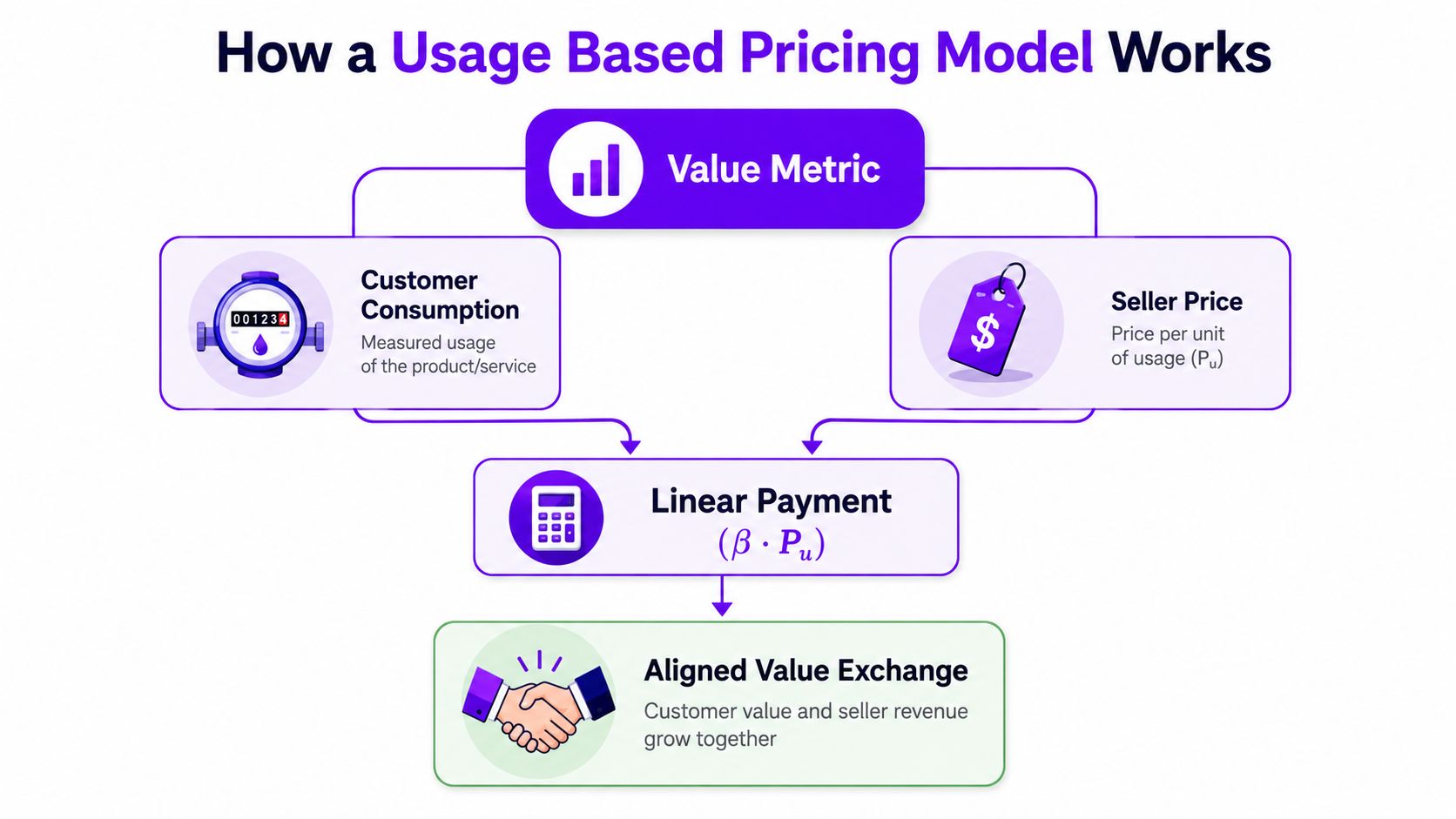
For a monitoring platform, the important question isn't "What did the customer buy?" Ask instead, "What did the platform measure, and what did that measurement cost to deliver?"
The four value-metric categories
Most contracts use one of four broad metric categories:
- Time: Hours of crawler runtime used to scan competitor pages or marketplace listings.
- Transaction: Monitoring events processed, such as a completed price check or stock-status update.
- Volume: Gigabytes of competitor data collected, transferred, or retained.
- Count: Connected product URLs, monitored SKUs, tracked sellers, or active records.
A distributor might pay based on connected product URLs. A manufacturer running MAP enforcement might care about monitored reseller listings and the frequency of checks. An importer benchmarking sourcing may value the number of product records refreshed across selected marketplaces.
The metric should remain customer-observable and controllable. API calls, active users, records processed, gigabytes stored or transferred, agent actions, and tokens are useful examples in software because buyers can see what drives consumption. Monitoring contracts should follow the same principle. A buyer should be able to identify which URLs, products, or checks generated the invoice without relying on an opaque internal calculation.
The margin test
Tie the meter to a measurable cost driver. If a crawler performs more work for each additional URL, the vendor can calculate gross margin per unit as price per unit minus cost per unit, following the operational guidance in this usage-based pricing guide from m3ter.
If the contract bills per account while the actual cost rises with crawl frequency and page complexity, the meter is too distant from the cost driver. Margin will leak. The buyer may also pay for a unit that doesn't map to value.
For a broader explanation of commercial structures, usage based pricing for SaaS provides useful context. Apply the same test to any vendor contract: Can the unit be counted reliably, understood quickly, and reconciled against delivered work?
The Four Variants You Will See in Contracts
The same underlying meter can produce very different commercial outcomes. Don't treat “usage-based” as a complete pricing description. You need to identify the contract variant and understand who carries the risk when consumption changes.
Metered usage
Pure metering charges for actual consumption with little or no commitment. It suits a distributor testing a new competitor set, an importer exploring a market, or a retailer whose coverage changes frequently.
The buyer gets a low entry barrier and pays only for measured activity. The downside is weak budget certainty. A sudden expansion in tracked URLs or crawl frequency can create an invoice that procurement didn't expect.
Per-unit pricing
Per-unit pricing applies a fixed rate to each billable item, such as a tracked URL or SKU. It works well when the unit is clear and coverage is the main driver of value. A price manager can add or remove monitored listings and estimate the effect directly.
This structure backfires when the unit count hides meaningful differences in effort. A simple retailer page and a difficult marketplace listing may not require the same monitoring resources. Ask whether the vendor treats them as equivalent and how it handles failed, duplicate, or temporarily unavailable pages.
Tiered usage
Tiered pricing changes the rate at defined volume breakpoints. It fits a manufacturer monitoring a large catalog across several marketplaces, especially when the vendor can process additional coverage efficiently.
The risk sits in the threshold design. A buyer may reach a new band because of a temporary campaign, then pay a higher rate under an arrangement that doesn't reset cleanly. Confirm whether the rate applies only to incremental units or to the full volume.
Hybrid pricing
Hybrid pricing combines a subscription floor with usage above an included allocation. It suits an online retailer that wants a stable base during ordinary months but needs surge capacity during seasonal promotions.
The base creates predictability for finance. The usage layer prevents the vendor from absorbing unlimited crawler work. Buyers should negotiate an overage rate, alert thresholds, and a clear definition of included usage before signing.
| Variant | Buyer Predictability | Vendor Margin Control | Best Fit |
|---|---|---|---|
| Metered usage | Low | High if metering is accurate | Variable pilots and changing coverage |
| Per-unit pricing | Medium | Strong when unit cost is consistent | URL, SKU, or listing-based monitoring |
| Tiered usage | Medium | Strong at planned scale | Large catalogs and expanding coverage |
| Hybrid | High for the base, variable above it | Strong with defined overage | Stable core workload with seasonal spikes |
For a deeper comparison of volume structures, review volume-based pricing. Choose the variant based on workload behavior, not on the label used in the sales proposal.
Usage Based Pricing Versus Subscription and Flat Rate
B2B buyers should compare three models across four practical dimensions: spend predictability, value alignment, scalability, and contract complexity. No model wins every category.
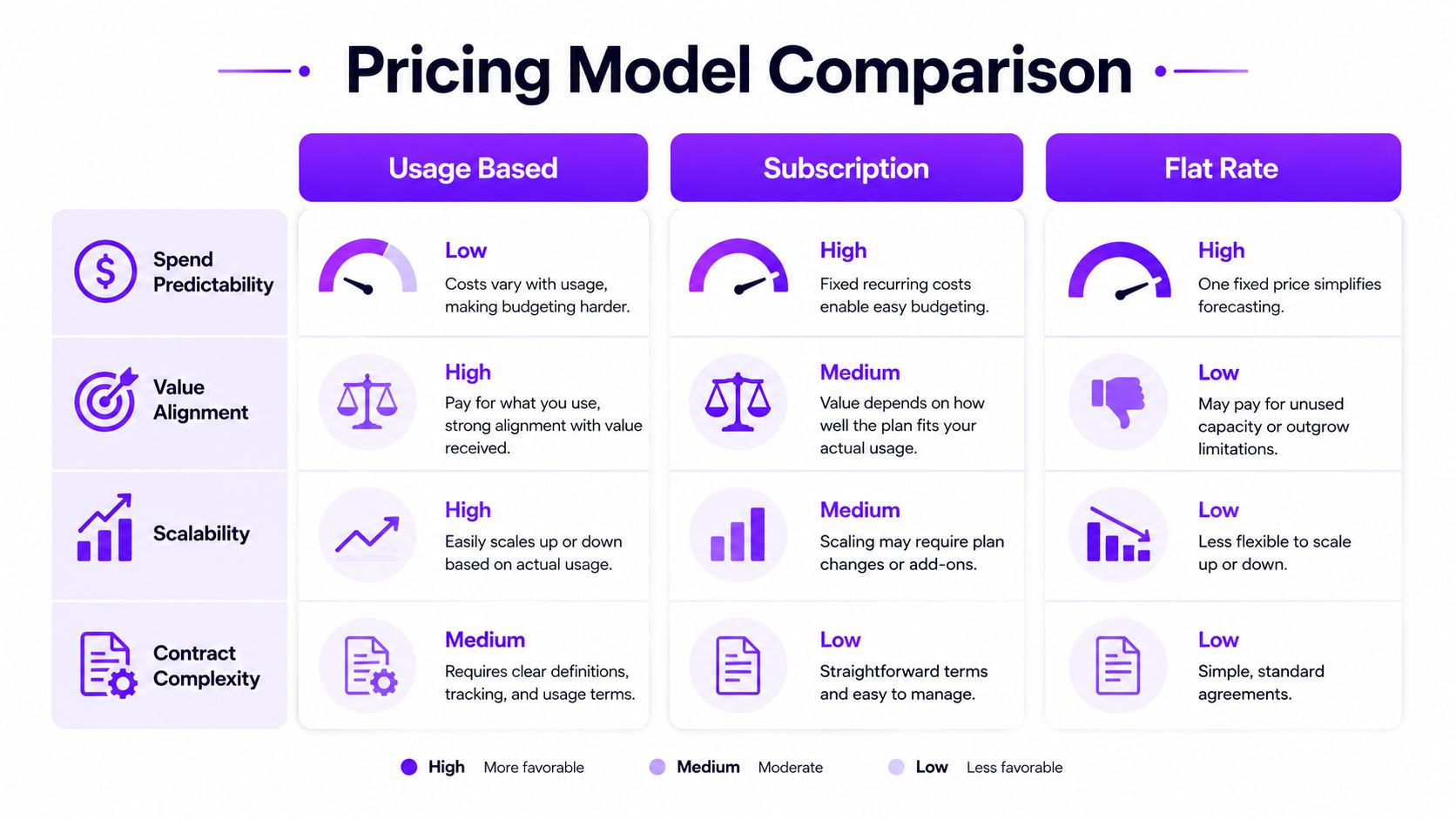
A subscription usually wins on predictability. The buyer pays a recurring fee for a defined plan, whether the team uses every allowance or only part of it. That makes approval and renewal easier, but it can create waste for a light account and underprice intensive coverage.
A flat rate is even simpler. It works when the workload is small and stable, the cost to serve is predictable, and the buyer doesn't expect major changes in products, marketplaces, or crawl frequency. It loses its appeal when accounts differ significantly in coverage.
Usage-based pricing wins when value varies sharply by account. Consider MAP enforcement. A brand owner running a small pilot across a limited reseller set may receive poor economics from a large flat monthly fee. Another brand monitoring thousands of marketplace and retailer listings may receive an excellent deal under that same fee, even though the vendor performs far more work. A usage-based structure allocates spend according to actual monitored coverage.
Who should choose what
- Stable, small workload: Choose a flat rate or simple subscription. Avoid billing machinery that adds complexity without changing the economics.
- Variable coverage: Choose per-unit or metered usage. Make the unit visible and insist on usage reporting.
- Large, growing catalog: Choose tiered usage if the discounts reflect real scale and don't hide a punitive threshold.
- Predictable core plus seasonal demand: Choose hybrid. Set a base allocation, overage band, alerts, and a cap.
- Unclear operational cost: Delay the rollout. You haven't chosen a safe meter yet.
Contract simplicity also has a cost. A flat rate is easy to explain, while usage pricing requires definitions for events, timing, exclusions, resets, disputes, and reconciliation. Buyers should accept that complexity only when the workload varies.
Technical data quality deserves attention as well. Teams building monitoring workflows often need reliable checks and clean event histories, so resources such as analytics QA for dev teams can help clarify how operational accuracy supports trustworthy reporting.
The broader pattern is clear: hybrid structures have become the practical default for many SaaS buyers because they balance a predictable floor with scalable consumption. Pure usage is more exposed to bill volatility, while flat pricing can disconnect spend from coverage.
Implementation Checklist From Metric to Invoice
A successful rollout starts with the meter and ends with an invoice that a customer can audit. Treat these as separate execution steps, not one billing project.
1. Pick the value metric
Start with the customer outcome and the vendor cost driver. In price monitoring, tracked URLs may be appropriate when each URL represents a meaningful coverage decision. If crawl frequency, data retention, or page complexity drives cost more strongly, a URL-only meter may need a usage modifier or a different structure.
What good looks like:
- Visible unit: The customer can see which URLs, SKUs, listings, or checks count.
- Cost connection: The vendor can explain how the unit affects delivery cost.
- Stable meaning: A billable unit doesn't change definition halfway through a contract.
2. Instrument the platform
Capture every billable event with a timestamp and an identifiable customer, product, and source. A monitoring platform should distinguish a successful collection from a retry, duplicate event, or system correction.
Observability matters. A team reviewing infrastructure measurement can use monitor CPU with Fivenines as a practical reference for thinking about resource signals, thresholds, and historical visibility. The billing meter needs the same discipline, even though the measured event is a crawl or record rather than CPU activity.
What good looks like:
- Timestamped records: Every charge can be traced to a time window.
- Deduplication: Retries don't create duplicate billable events.
- Audit trail: Corrections remain visible rather than overwriting history.
3. Forecast consumption and margin
Use historical usage to estimate normal consumption, likely expansion, and peak periods. Project total units, then calculate gross margin per unit as price per unit minus cost per unit. If the forecast relies on a short or unrepresentative baseline, label it as provisional and update it as coverage changes.
A cloud-based billing system can support event ingestion, aggregation, reconciliation, and invoice generation. A 2026 industry summary valued the broader usage-based billing market at $9.4 billion in 2025, projected a 13.2% compound annual growth rate to 2034, and reported that cloud-based billing solutions captured 67.8% of cross-industry usage-based billing revenue in 2025, according to this usage-based billing market summary.
What good looks like:
- Scenario forecast: Finance sees ordinary, expansion, and peak usage.
- Unit economics: Each billable unit has a reviewed cost and price.
- Variance review: Actual usage is compared with the forecast every billing cycle.
For the commercial approval process, document the assumptions in a repeatable pricing decision-making process.
4. Write the contract terms
Define the base commit, included usage, overage rate, true-up process, notice windows, and treatment of disputed records. Don't leave “usage” as a general term. State whether failed pages, retries, paused URLs, and customer-requested refreshes count.
What good looks like:
- Commit clarity: The buyer knows whether unused allocation expires.
- Overage control: The contract defines alerts, caps, and approval rules.
- Reconciliation window: Both parties know how long they have to challenge an invoice.
5. Run billing and reconciliation
The final workflow should ingest events, aggregate usage by billing period, apply the pricing logic, and produce an invoice with supporting detail. Reconcile the invoice against the platform's event history before sending it.
Give customers an exportable usage view. A dashboard that shows only a final amount doesn't provide enough evidence for procurement, finance, or a reseller compliance team. The invoice should answer which products were monitored, when the activity occurred, and how the rate was applied.
Three Real World Scenarios and the ROI Each Buyer Sees
A usage based pricing model creates different returns for different monitoring jobs. The meter should follow the commercial decision the buyer is trying to improve.
A distributor expanding competitor coverage
A distributor starts by tracking competitor SKUs across Amazon, eBay, and eMAG. Per-URL metering lets the team begin with a narrow pilot, then expand coverage to a larger catalog without renegotiating the underlying model. The buyer pays in relation to the monitored set rather than committing to the full future workload on day one.
ROI takeaway: Per-unit pricing reduces the commercial friction of expanding competitive visibility as the catalog grows.
A manufacturer enforcing MAP
A manufacturer needs more than a price alert. The team needs continuous detection across marketplaces and reseller sites, plus evidence that can support an enforcement action. MAP monitoring depends on public advertised prices, not necessarily a lower price revealed only at checkout. A public price below the policy floor on a listing page, promotional email, or paid advertisement can count as a violation, while a checkout-only reduction is treated differently under the U.S. distinction described in this MAP antitrust guidance.
Industry guidance recommends timestamped screenshots and price records as the evidence layer that turns a detected violation into an enforceable case across marketplaces, comparison engines, and reseller sites, as explained by eBrands' MAP monitoring guidance.
ROI takeaway: The value comes from converting detection into documented action, not from collecting another unverified price point.
An online retailer benchmarking importers
An online retailer compares sourcing opportunities across importer and wholesaler catalogs. Volume-based pricing can lower the effective per-URL cost as coverage grows, provided the contract applies the discount transparently and the retailer can identify the URLs included in each tier.
The retailer's return comes from broader sourcing intelligence. More monitored records can reveal price gaps, availability changes, and opportunities to adjust purchasing decisions without paying a fixed fee designed for a much larger operation.
ROI takeaway: A volume structure makes broader benchmarking economically viable when the discount is tied to real scale.
Where Usage Based Pricing Breaks and How to Prevent It
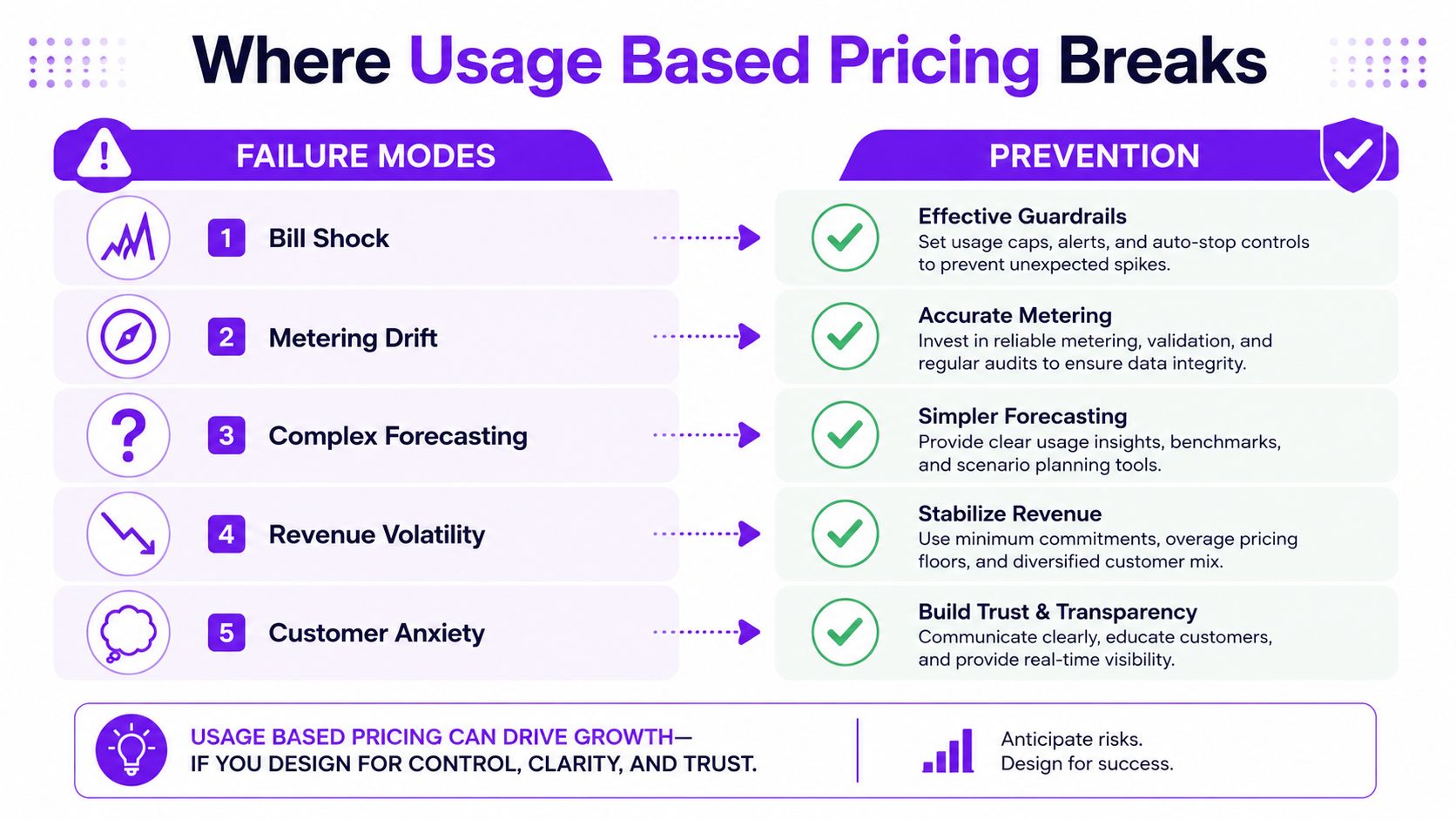
Usage pricing isn't automatically buyer-friendly. It transfers more control to the meter, and a weak meter can create disputes, budget surprises, or silent margin erosion.
Bill shock
A campaign, catalog import, or sudden crawl expansion can push usage beyond the buyer's expectation. Watch for rapid changes in monitored URLs or refresh frequency. Use monthly usage alerts, spending caps, and a defined approval path before large increases take effect.
Metering drift
The billable unit can stop matching the actual cost driver. For example, URL count may remain flat while crawl frequency or page complexity increases. Review the relationship between the meter and delivery cost, and document exclusions for retries, duplicates, and system-generated activity.
Forecasting errors
A short historical baseline can make ordinary seasonality look like unexpected growth. Finance should model consumption from available history, mark uncertain assumptions, and refresh the forecast as the monitored catalog changes.
Contract ambiguity
Overage, true-up, reset, and dispute terms often create more friction than the rate itself. Put each term in writing, including the reconciliation window and the evidence required to challenge a charge.
Margin leakage
A vendor can set a per-unit price below the variable cost of delivering that unit. Review unit economics periodically, especially when data sources, crawl methods, or customer behavior change.
The commercial response is visible in buyer behavior. A 2025 SaaS pricing report found that 73% of companies using usage-based models actively forecast variable revenue, while subscription plus usage users reported the highest median growth rate at 21%, according to Maxio's SaaS pricing trends report. Forecasting isn't an optional finance exercise. It is one of the controls that makes the model usable.
CFO checklist: Require a meter definition, usage export, alert mechanism, cap or approval rule, and reconciliation process before accepting variable billing.
Bringing It Together With a Monitoring Example
A practical monitoring rollout can follow a simple sequence. Choose the URLs that matter, instrument the crawlers, forecast monthly volume, set a commit with an overage band, and bill from reconciled usage. The same workflow supports competitor tracking, MAP enforcement, ecommerce monitoring, and sourcing analysis, provided the meter remains tied to the work delivered.
Market Edge is one example of this approach. It measures usage per tracked URL, supports transparent usage-based pricing, scales from small trials to enterprise deployments, and offers monthly or discounted annual billing. Teams use it to monitor competitor prices and stock across reseller sites, retail sites, Amazon, eBay, and eMAG, with product matching that organizes the collected data around selected SKUs.
Use this decision checklist before signing any usage-based monitoring agreement:
- Metric: Can the buyer explain exactly what counts?
- Coverage: Do URLs, SKUs, sellers, and marketplaces appear in usage reports?
- Accuracy: Are timestamps, retries, duplicates, and corrections handled?
- Forecast: Can finance model ordinary and peak consumption?
- Terms: Are commits, overages, caps, true-ups, and disputes explicit?
- Evidence: Does MAP monitoring preserve records suitable for enforcement?
- Data flow: Can usage be exported and reconciled with invoice data?
For teams that depend on timely updates, review the workflow for real-time data synchronization. The right usage based pricing model isn't the one with the lowest starting fee. It's the one where the meter, cost driver, customer value, and contract terms remain aligned as coverage changes.
Market Edge helps distributors, manufacturers, importers, and online retailers monitor competitor pricing and stock by tracked URL, with transparent usage-based billing and monthly or discounted annual plans. Visit Market Edge to test your own monitoring workload and evaluate whether per-URL pricing fits your coverage, MAP, or sourcing goals.