
A competitor drops the advertised price of a product you sell, sales asks whether you should match it, finance warns about margin, and the channel team reminds everyone that a strategic reseller is already unhappy. The difficult part isn't calculating a new price. It's deciding which objective should dominate this decision, and what evidence justifies the trade-off.
That's why the objectives of pricing work better as a coexisting stack than as a single target. Profitability, volume, competitive position, prestige, strategic growth, customer relationships, channel discipline, and operational efficiency can all matter at once. The pricing manager's job is to rank them by SKU, channel, customer, and period, then connect each priority to a measurable signal and a defined response.
What Pricing Objectives Actually Mean in B2B
Pricing objectives are often presented as a list to memorize. In a B2B business, they're more useful as decision rules. A distributor can protect contribution margin on an imported product, defend share on a high-visibility item, and preserve a reseller relationship during the same trading week. Those aren't contradictory decisions if the business has made the priority by segment clear.
The mistake is choosing “profit” or “market share” as a permanent company-wide answer. A price objective changes the optimization target. Profitability asks whether the price generates an acceptable contribution or return. Volume asks whether a lower price can create enough additional demand to compensate for lower margin. A relationship objective may justify holding a price steady for a strategic account even when a spot transaction could produce more revenue.
The practical starting point is to build an objective stack:
- Set the commercial priority. Decide whether the SKU is a margin anchor, a traffic driver, a share defense item, or a relationship product.
- Name the trigger. Use a competitor move, margin threshold, stock change, renewal event, or customer segment signal.
- Define the response. The response might be a price change, a hold, a sales approval, a promotion, or no action.
- Assign the owner. Pricing, sales, category management, finance, and channel teams need clear decision rights.
- Track the trade-off. A dashboard should show the chosen KPI alongside the cost of pursuing it.
The commercial case for disciplined pricing is covered in this practical explanation of why pricing matters, especially when teams need to connect price decisions to broader business outcomes. For teams comparing software or service options, it's also sensible to compare plans only after defining the workflow and decision problem the tool must support.
Practical rule: An objective that has no trigger, owner, or response is a slogan, not a pricing system.
A useful dashboard doesn't just display the current price. It shows the objective currently dominating, the signal that activated it, the expected trade-off, and whether the result is acceptable. That turns a static strategic statement into an operating rule.
The Core Objectives Every Business Balances
The classic objectives of pricing remain useful, but each one points the pricing engine toward a different outcome.
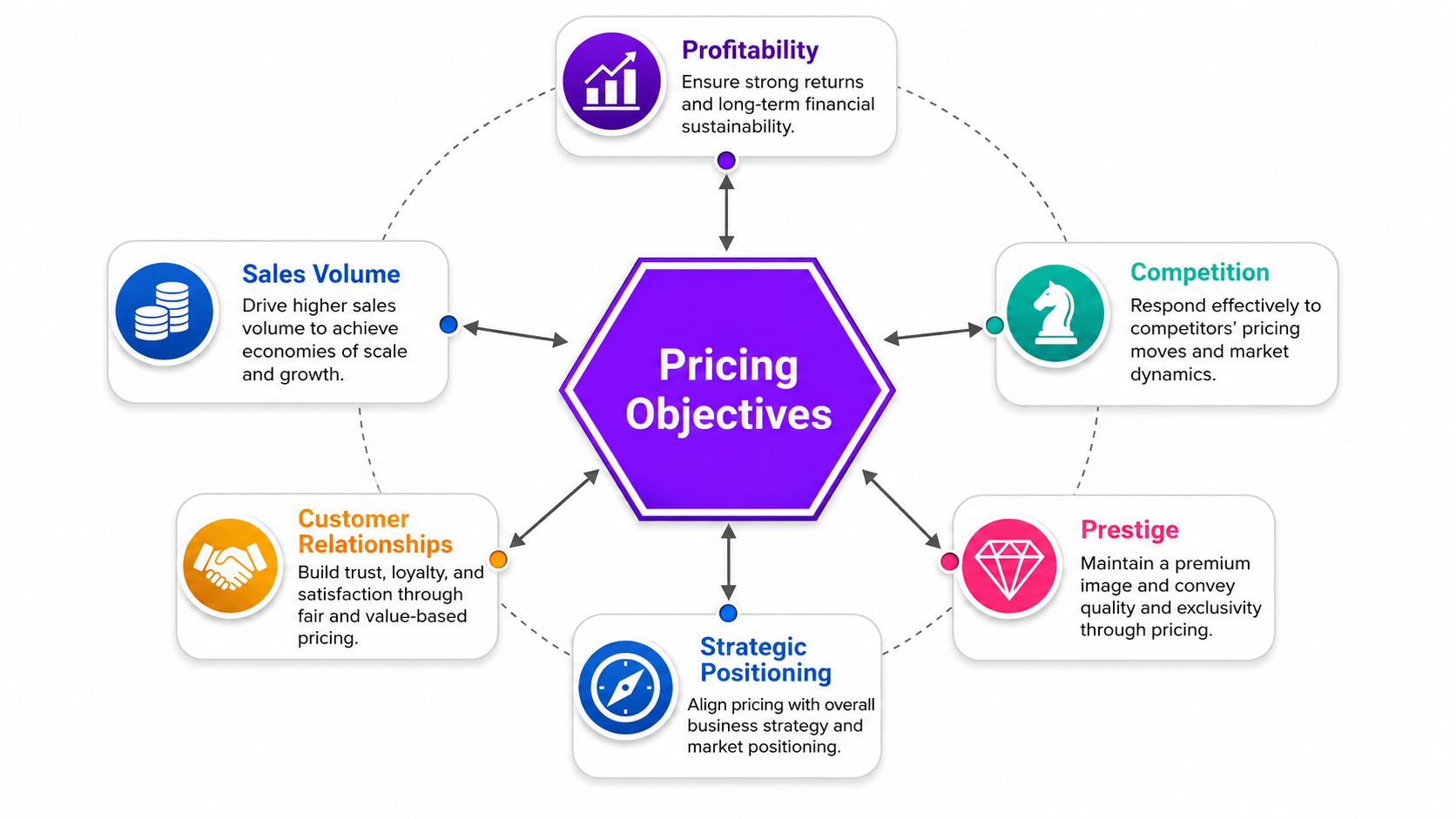
Profitability
A profitability objective targets contribution margin, operating profit, or a target return. The dashboard should therefore emphasize net price, variable cost, contribution, discount leakage, and return by SKU or account. A price that wins volume but destroys contribution isn't a successful decision under this objective.
Sales volume
Volume is a demand response problem, not just a discounting instruction. The key control variable is price elasticity. When demand is elastic, a price increase reduces quantity more than proportionally, so total revenue falls. When demand is inelastic, a price increase can raise total revenue because quantity declines less than price rises, as explained in the FAO pricing discussion.
The right dashboard compares unit movement, revenue, contribution, and estimated elasticity. Lowering price only makes sense when the demand lift is larger than the margin loss.
Competition
A competition objective focuses on relative position. Teams may want to match a reference competitor, maintain a premium, or avoid becoming the visible outlier on a marketplace. The signal is the competitor price gap, but the decision shouldn't rely on sticker price alone. Product match quality, shipping, availability, promotions, and seller status affect the offer buyers see.
Prestige
Prestige pricing protects a premium position. Here, price is part of the brand experience, so automatically matching the lowest listing can damage the very positioning the business is trying to preserve. Relevant KPIs include realized price, premium to a defined reference set, discount frequency, and channel compliance.
Strategic positioning
Strategic pricing supports a longer-term objective, such as entering a segment, building distribution, encouraging adoption, or making a complementary product more attractive. The dashboard should connect price to the strategic measure, such as qualified accounts opened, attach rate, distribution coverage, or adoption quality. A short-term margin result can't be judged in isolation.
Customer relationships
Relationship pricing protects retention, trust, and account economics. Track renewal behavior, repeat purchases, quote conversion, service cost, and account-level contribution. A special price may be rational for a strategic customer, but only when the business understands the total account value and prevents uncontrolled precedent-setting.
A concise operating view looks like this:
| Objective | Primary optimization target | Main signal | Typical KPI |
|---|---|---|---|
| Profitability | Contribution or return | Cost and realized price | Contribution margin |
| Sales volume | Demand and units | Elasticity and unit movement | Units or revenue |
| Competition | Relative market position | Matched competitor offer | Price gap |
| Prestige | Premium perception | Reference-set positioning | Realized premium |
| Strategic | Market or portfolio progress | Segment and channel movement | Strategic milestone |
| Relationships | Account economics and retention | Customer behavior | Repeat or renewal performance |
Teams that want more examples of how these choices appear in different business models can review these pricing strategy examples for startups, then adapt the logic to their own cost structure and channel mix.
Specialized Objectives for Brands and Distributors
Brands and distributors add another layer to the standard objectives. They aren't only deciding what a product should cost. They're managing where prices appear, who can advertise them, how channels interact, and whether pricing work produces enough operational value.
MAP enforcement
A Minimum Advertised Price policy restricts the price a reseller may publicly advertise. It doesn't prohibit the reseller from selling below that level at checkout. That differs from resale price maintenance, which controls the actual resale price, as explained in this overview of MAP policy and antitrust distinctions.
That distinction determines the data source. A brand enforcing MAP should monitor marketplace listings, product pages, shopping feeds, and advertisements. A below-MAP checkout deal isn't automatically a listing breach, while a public product page or feed below the policy floor is directly relevant.
The KPI is MAP compliance rate, supported by breach count, repeat-offender count, correction time, and escalation status. A compliance dashboard should preserve evidence, including the seller, channel, matched product, observed advertised price, timestamp, and policy threshold.
Channel consistency
Channel consistency means reducing unjustified price dispersion across direct ecommerce, distributors, marketplaces, and authorized resellers. It doesn't mean every channel must display an identical price. Freight, service, account terms, promotions, and tax treatment can create legitimate differences.
The KPI is channel price spread, paired with matched-offer coverage and the share of exceptions with an approved commercial reason. Monitoring must distinguish a true product match from a superficially similar listing.
Customer retention
Retention is a pricing objective when a business protects a customer relationship instead of maximizing the margin on every isolated order. Track repeat-buyer rate, renewal behavior, churn signals, service burden, and account contribution. Sales discounts should be reviewed against the full relationship, not treated as free concessions.
Return on pricing operations
Pricing teams also need an objective for the work itself. If analysts spend their time collecting listings manually, they may have little capacity left for decisions. Track pricing-team throughput, exception resolution time, monitored coverage, and the percentage of alerts that lead to an approved action.
| Objective | Primary KPI | Key Data Source |
|---|---|---|
| MAP enforcement | MAP compliance rate | Product pages, marketplace listings, ads, and feeds |
| Channel consistency | Channel price spread | Matched offers across direct and reseller channels |
| Customer retention | Repeat-buyer rate | CRM, order history, renewals, and account profitability |
| Pricing operations ROI | Pricing-team throughput | Alert queue, decisions, and workflow logs |
The objective should determine the evidence standard. A MAP team needs public listing history. A retention team needs customer and account data. A profitability team needs clean cost and discount data.
Why Most Pricing Objectives Fail Without Operational Cadence
A pricing objective can be commercially sound and still fail because the team reviews it too slowly. Persistent inflation changes costs, digital transparency exposes price differences quickly, and competitors can revise offers faster than a quarterly strategy meeting can respond.
Strong pricing outcomes come from governance, execution, and review cadence, not from price increases alone. A team that raises prices without checking demand, competitor behavior, cost movement, and channel enforcement may improve one metric while creating a larger problem elsewhere. The pricing decision-making process should therefore specify not only who approves a price, but when the underlying evidence is refreshed.
Match cadence to the signal
Use a different rhythm for each objective:
- Margin protection: Review landed cost, exchange-rate exposure, and contribution when material cost conditions change. Imported products need special attention because a price that was profitable at one cost basis may become unviable after replenishment.
- Competitive positioning: Check priority competitors on a defined recurring cadence. High-visibility marketplace SKUs need closer observation than low-volume products with limited public competition.
- MAP enforcement: Review new breaches promptly, then escalate repeat violations according to the written policy. Delayed enforcement teaches resellers that the policy has no operational consequence.
- Strategic positioning: Review price ladders and segment performance at a planned strategic interval, while allowing exception reviews when the market changes materially.
- Customer relationships: Review account exceptions around renewal, rebid, and major commercial events, rather than applying a uniform rule to every transaction.
The point isn't to create alerts for everything. It's to connect the review rhythm to the speed and cost of the decision.
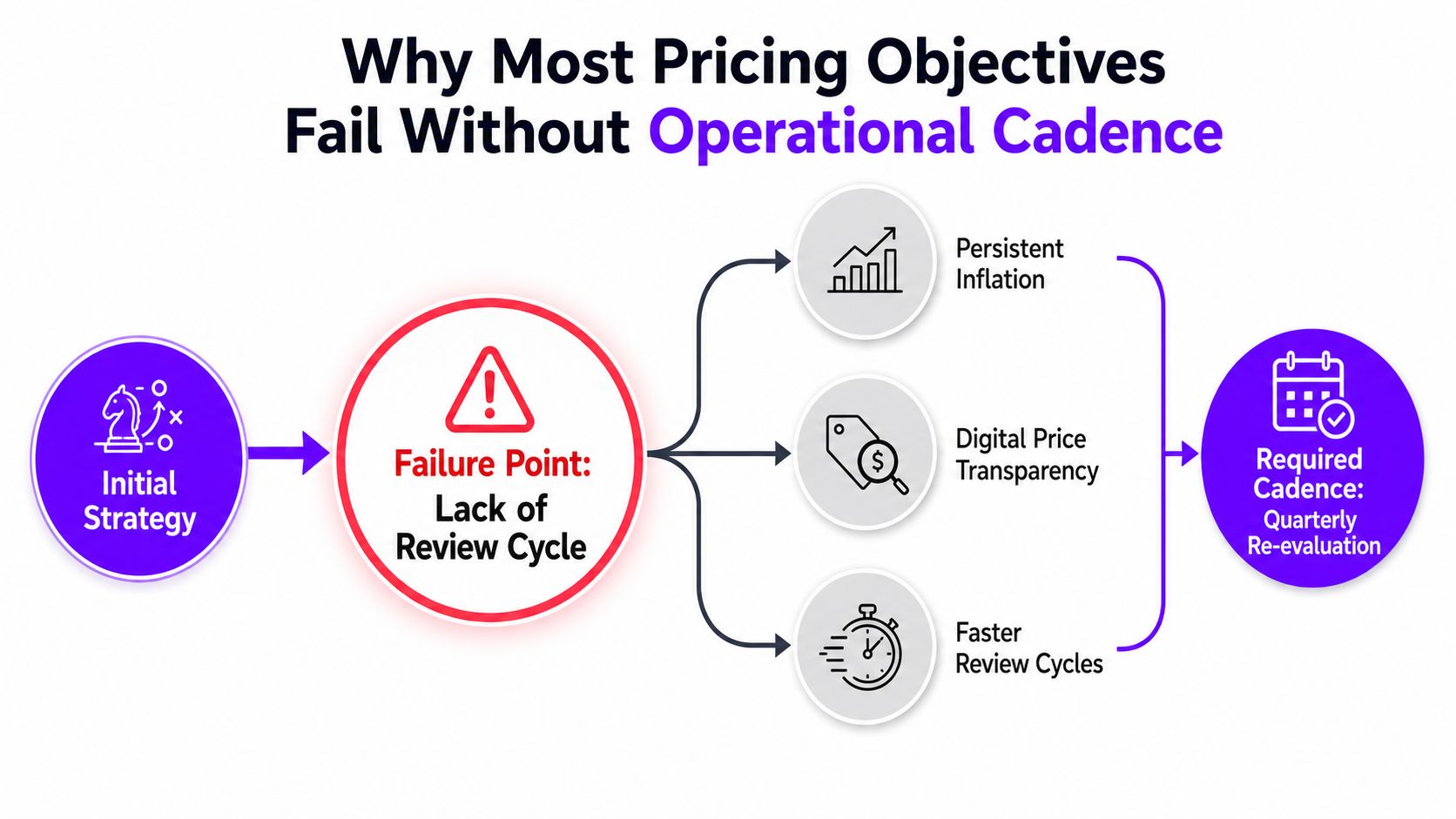
Operating test: If a competitor changes price today, can your team identify the affected SKU, determine the governing objective, and assign an approved response without rebuilding the analysis?
A useful cadence also separates observation from action. The monitoring layer collects price, stock, promotions, assortment, and seller information. The decision layer applies reaction rules. The governance layer reviews whether those rules are producing acceptable margin, volume, channel, and relationship outcomes.
Without that separation, teams either overreact to isolated changes or ignore meaningful trends. An objective becomes useful only when the organization can revisit it at the pace of the market.
Choosing Between Profit, Share, and Survival
Profit maximization, market share growth, and survival often collide when a competitor cuts price. Consider one common scenario: a rival undercuts your matched product by 8%. The fact is the same for every team, but the correct reaction changes with the objective dominating the decision.
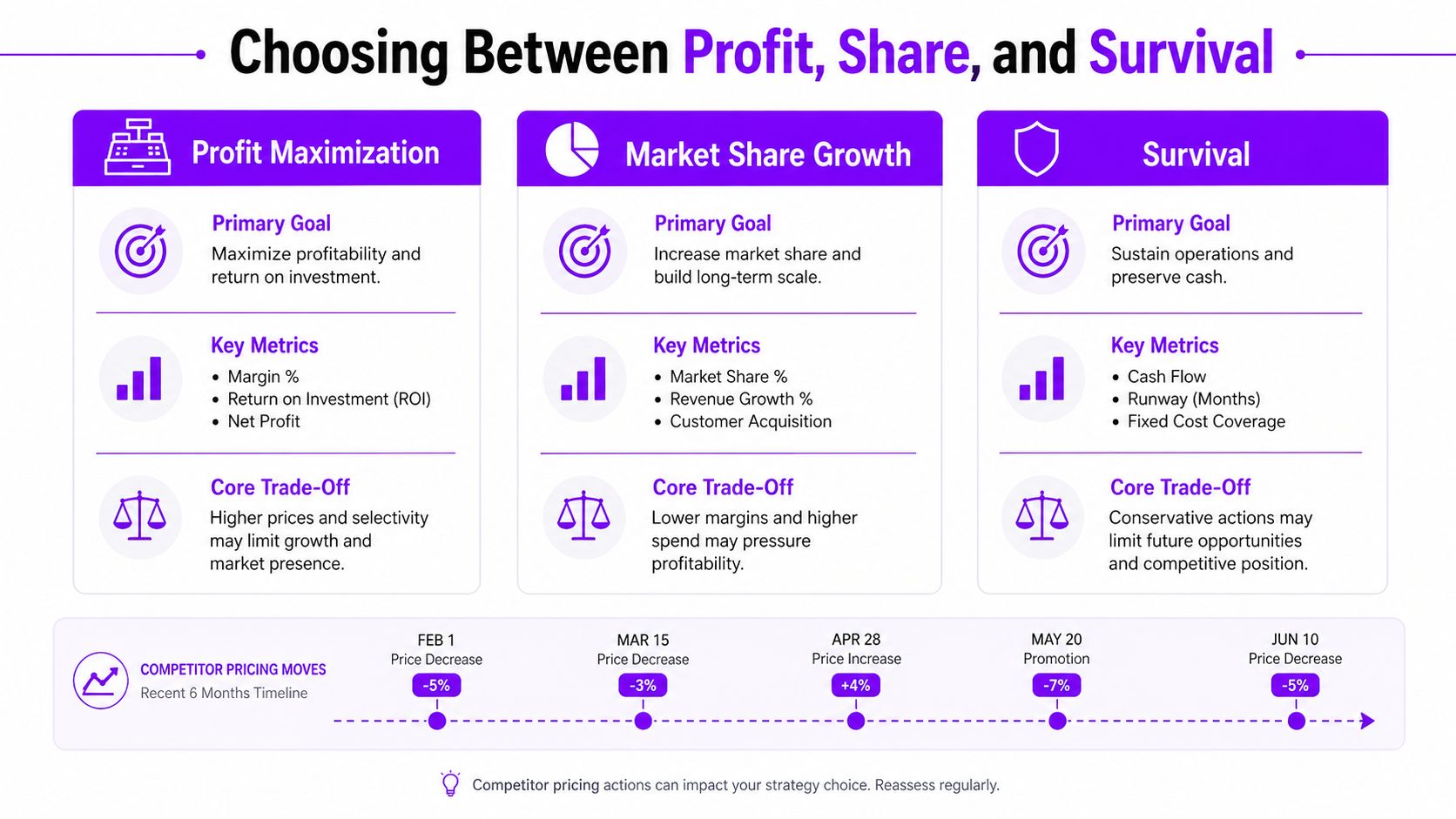
Profit maximization
The profit-oriented team asks whether matching the undercut would destroy contribution. It checks demand elasticity, product cost, customer willingness to pay, inventory position, and the strategic role of the SKU. If buyers are relatively insensitive and the product is a margin anchor, holding price may be better than joining the competitor's move.
Market share growth
The share-oriented team may accept lower contribution to protect visibility, win new accounts, or defend a strategic category. It still needs a boundary. The response could be a selective match for a target segment, a time-limited offer, or a bundle that changes the comparison rather than a permanent price cut.
Survival
A survival objective prioritizes liquidity and continuity. The team may need to clear stock, preserve cash, or keep key accounts active, even when the decision is unattractive on a unit-margin basis. The dashboard shifts toward cash flow, inventory exposure, receivables, and immediate demand.
| Objective Dominating | Reaction to 8% Undercut | Key Question to Ask |
|---|---|---|
| Profit maximization | Hold, match selectively, or adjust only if contribution remains acceptable | Is demand elastic enough to justify the margin sacrifice? |
| Market share growth | Match or create a targeted commercial response | Is this SKU or channel a share engine? |
| Survival | Use the fastest viable action to support liquidity and inventory movement | What price protects cash and continuity? |
Three questions prevent reflexive matching:
- How sensitive are buyers? Identical competitor gaps can produce different revenue and margin outcomes across channels and regions because demand elasticity varies.
- What role does the SKU play? A strategic traffic driver deserves a different rule from a filler product or a margin anchor.
- What does the channel do for the business? A direct channel may fund profit, while a marketplace may support discovery or share.
Competitor benchmarking should therefore be paired with elasticity estimates by SKU and market, not treated as a universal match instruction. Teams evaluating share-oriented decisions can also use this guide to understand market-share pricing without confusing share growth with profitable growth.
How B2B Teams Apply These Objectives in Practice
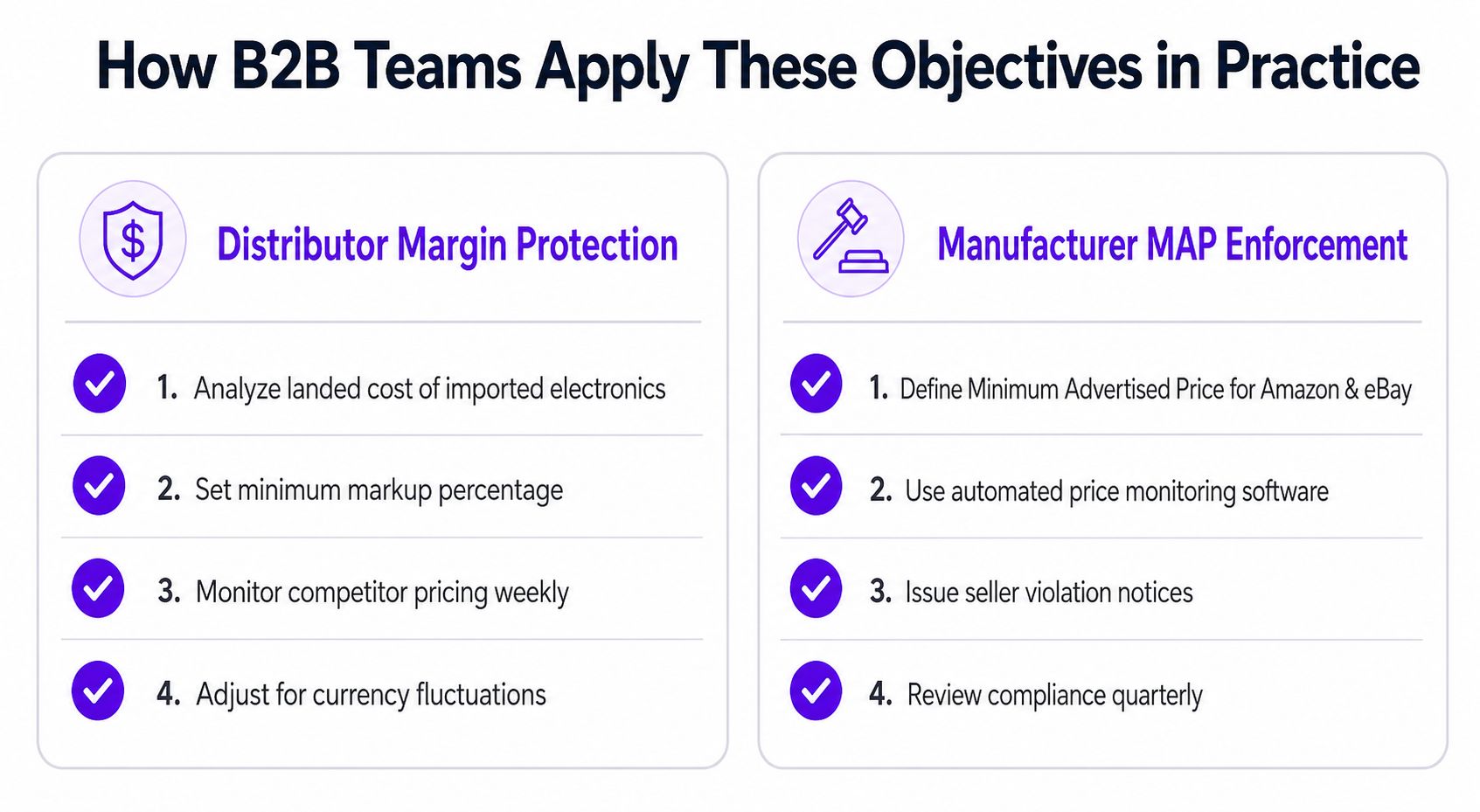
A distributor selling imported electronics may have three simultaneous concerns: landed cost, competitor position, and reseller trust. The team starts by analyzing the landed cost, setting a minimum acceptable markup, monitoring comparable offers, and accounting for currency movement before approving a price change.
For freight-sensitive categories, the cost model should include the relevant logistics inputs. A team reviewing sea freight haulage pricing can use that information as one input to its landed-cost calculation, alongside product cost, duties, handling, and currency exposure.
The manufacturer's workflow is different in emphasis but similar in discipline. It defines a MAP level for Amazon, eBay, and authorized reseller channels, captures public listings and feeds, records violations, sends notices, and reviews recurring compliance issues.
Both teams can run the same six-step monitoring workflow:
- Define competitors. Separate direct rivals, major marketplace sellers, authorized resellers, and irrelevant listings.
- Match products. Confirm model, pack size, specifications, condition, variant, and seller type.
- Set a checking cadence. Assign closer observation to high-visibility or fast-moving items.
- Capture more than the sticker price. Record stock, shipping, promotions, assortment, seller identity, and channel.
- Define reaction rules. State when to match, hold, escalate, approve an exception, or do nothing.
- Review trends, not isolated changes. Look for sustained undercutting, recurring stockouts, assortment shifts, and repeated MAP breaches.
This six-step structure is consistent with the practical approach described in competitor price monitoring guidance. It works manually for a small range and can move into spreadsheets or automated monitoring as the number of products and channels grows.
Stock and assortment data add commercial context. A competitor's out-of-stock period may create temporary pricing power. A new listing may reveal a sourcing opportunity. A promotion may explain a price gap that shouldn't trigger a permanent response.
Prioritizing Your Pricing Objectives and Next Steps
Run this checklist with pricing, finance, sales, category, and channel owners:
- Identify margin anchors. Which SKUs need contribution protection? Monitor cost, realized price, discounts, and margin.
- Mark share engines. Which products or channels justify selective investment? Track matched competitor gaps, units, and account acquisition.
- Name strategic resellers. Which relationships require consistency or retention protection? Review repeat buying, renewal signals, exceptions, and account contribution.
- Rank market-moving competitors. Which sellers influence buyer reference prices? Track their matched offers, stock, promotions, and assortment.
- Set the response rule. For each priority SKU, document the trigger, owner, approval threshold, and permitted action.
- Create a MAP escalation path. A common structure is a written warning and correction window for a first offense, a temporary shipping hold or loss of promotional support for a second offense, and shipment suspension or dealer-status termination for a third offense, as described in this MAP enforcement guide.
The objective stack should appear directly on the dashboard. Every alert needs a business reason, not just a variance. A competitor price change may matter for share, while a stockout may support a margin decision and a public below-MAP listing may require channel action.
Automated price monitoring tools like Market Edge become useful here. They turn recurring collection, product matching, stock visibility, and exception handling into a repeatable operating process rather than an analyst's manual task.
Market Edge helps distributors, manufacturers, importers, and online retailers monitor competitor prices and stock across resellers, retail sites, Amazon, eBay, and other marketplaces. Visit Market Edge to see how a structured monitoring workflow can support margin protection, competitive decisions, and MAP enforcement.