
The core difference between MSRP and MAP is straightforward. MSRP (Manufacturer's Suggested Retail Price) is a non-binding recommendation for a product's selling price. Think of it as a guideline. In contrast, MAP (Minimum Advertised Price) is a formal, legally enforceable policy that dictates the lowest price a retailer can publicly display.
MSRP helps establish a consumer's perception of value, while MAP is a strategic tool for protecting brand equity and preventing price wars among retailers.
Understanding MSRP vs MAP: A Practical Overview
For ecommerce managers, sales leaders, and brand founders, mastering these two pricing concepts is critical for a sound channel management strategy. One offers retail partners flexibility; the other provides brand control. Confusing them can lead to significant commercial issues, including price erosion, channel conflict, and brand devaluation.
This guide clarifies how MSRP and MAP function in a commercial context to support better strategic decisions. The fundamental difference is simple: MSRP is a suggestion, while MAP is a rule with enforceable consequences.
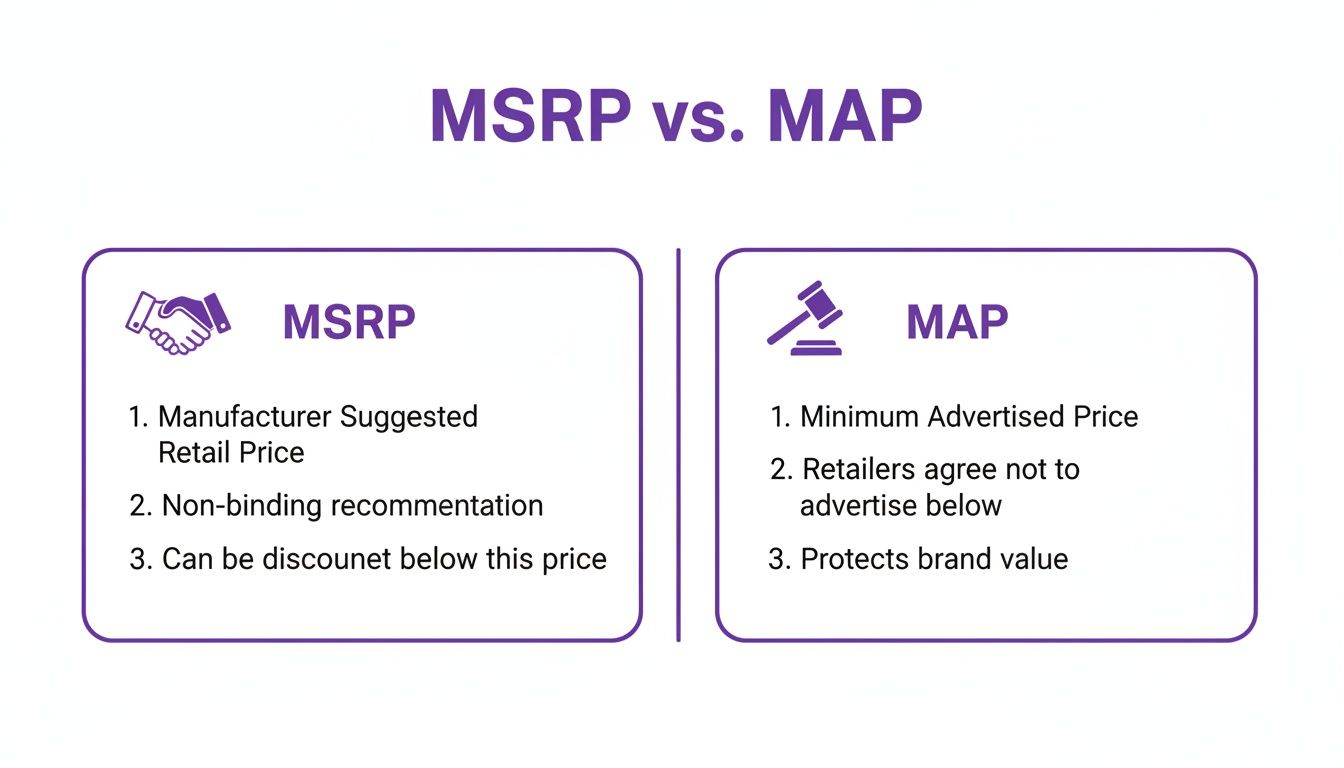
As the visual illustrates, MSRP is a cooperative guideline, whereas MAP is a unilateral directive set by the brand.
Core Functional Differences
While both pricing strategies aim to create market consistency, their operational functions—and legal weight—are vastly different.
MSRP serves primarily as a marketing tool. It helps position a product and anchors its value in a consumer's mind. For example, a new kitchen appliance with a $99 MSRP immediately signals a specific quality and feature tier compared to $49 or $149 alternatives.
MAP, however, is a channel management tool. It prevents a premium electronics brand from being advertised at inconsistent, damagingly low prices across Amazon, major retailers, and independent sellers. This policy is essential for preventing price wars that can squeeze smaller retail partners and degrade a brand's premium perception. Understanding this distinction is a key part of learning how to price products for retail.
Commercial Takeaway: MAP governs the advertised price, not the final selling price. A retailer can still offer discounts in the shopping cart or via private communications and remain compliant, allowing for controlled promotional activity.
The table below further dissects these functional differences.
MSRP vs MAP: Key Differences at a Glance
A side-by-side comparison clarifies how these policies function and their commercial implications. This table provides a direct overview of their fundamental attributes.
| Attribute | MSRP (Manufacturer's Suggested Retail Price) | MAP (Minimum Advertised Price) |
|---|---|---|
| Primary Purpose | To suggest a fair market price to consumers and provide a pricing benchmark for retailers. | To prevent price erosion, protect brand value, and ensure fair margins for all retail partners. |
| Legal Enforceability | Not legally enforceable. It is purely a recommendation; retailers face no penalty for ignoring it. | Legally enforceable. Brands can implement consequences for violations based on a unilateral policy. |
| Retailer Flexibility | Provides maximum flexibility. Retailers can price above, below, or exactly at the MSRP. | Imposes a strict floor on the advertised price, limiting public discounting flexibility. |
| Impact on Brand | Offers weak brand protection; frequent discounting below MSRP can devalue the brand over time. | Provides strong brand protection by maintaining price consistency and perceived value across channels. |
| Typical Use Case | Commodity goods, products in highly competitive markets, or regions where MAP is restricted (e.g., EU). | Premium goods, electronics, health supplements, and products where brand equity is paramount. |
Ultimately, the decision to use MSRP, MAP, or a combination of both depends on the product, market dynamics, and the desired brand experience.
Why Legal Enforceability Is the Deciding Factor
The strategic difference between MSRP and MAP boils down to one critical element: control. While both are pricing tools, only one provides the legal framework to protect a brand's market value. This distinction directly impacts brand equity, retailer relationships, and long-term profitability.
MSRP is a guideline with no legal authority. A retailer can advertise and sell your product at any price, including far below the suggested price, and you have no contractual recourse. In a competitive digital marketplace, this lack of control is a significant liability.

Widespread disregard for MSRP is common; many third-party sellers on major ecommerce platforms ignore it entirely. This behavior creates a price-driven race to the bottom that erodes customer perception of value and squeezes profit margins across all sales channels.
The Power of a Unilateral MAP Policy
A Minimum Advertised Price (MAP) policy fundamentally changes this dynamic. A properly drafted MAP policy is a legally binding unilateral agreement. It is not a suggestion; it is a clear directive that establishes the lowest price a reseller can publicly advertise your product. This protects all partners in your distribution network, from large chains to small independent retailers.
This is the central issue in the msrp vs map debate. If a reseller advertises below your MAP, you have the legal right to enforce predefined consequences. A typical enforcement escalation includes:
- Initial Warning: A formal notification with documented evidence of the violation.
- Temporary Sanctions: A temporary suspension of new product shipments.
- Account Termination: Permanent severance of the commercial relationship.
This framework gives brands the necessary leverage to prevent the price erosion that MSRP cannot. You can find a more detailed explanation of these policies in our guide on what is Minimum Advertised Price.
Commercial Takeaway: A MAP policy transforms a pricing strategy from a suggestion into an enforceable system. It provides the structure required to prevent a race to the bottom, ensuring your brand's value remains consistent across all consumer touchpoints.
Real-World Enforcement Scenario
Consider a premium consumer electronics brand selling high-fidelity headphones with an MSRP of $399 and a MAP of $349.
- Without MAP: A large online retailer advertises the headphones at $299 to capture market share. Smaller retailers are forced to either match the price and destroy their margins or be priced out of the market. The brand's premium positioning is damaged.
- With MAP: The $349 advertised price is the floor. If the same retailer advertises at $299, the brand’s automated price monitoring system flags the violation. The brand issues a warning and, if the violation persists, can halt shipments. This decisive action protects the margins of compliant partners and preserves the product's perceived value.
While MAP is a standard, legally defensible practice in the U.S. (when implemented as a unilateral policy to avoid price-fixing allegations), its legal standing differs internationally. For brand leaders, the choice is clear: to protect brand value and maintain healthy retail partnerships, a MAP policy is the only tool that provides the necessary control. This is where automated price monitoring tools like Market Edge become useful.
Navigating Retailer Flexibility and Market Dynamics
The functional difference between MSRP and MAP directly impacts a retailer’s ability to respond to market conditions. For ecommerce managers and sales leaders, balancing brand policy with the need for promotional agility is key to driving sales and managing inventory effectively.
With MSRP, retailers have complete pricing autonomy. This is advantageous in fast-moving markets, allowing them to adjust prices to clear stock, match competitor promotions, or run flash sales. If a product isn't selling, they can discount it as aggressively as their margins allow.
A MAP policy, conversely, establishes a firm floor for the advertised price. The nuance lies in that specific term: advertised. This distinction creates strategic opportunities for savvy retailers.
The Nuance of Advertised vs. Selling Price
A MAP policy governs the price a customer sees on a product page, in a digital ad, or within a marketing email. It does not dictate the final price paid in the shopping cart. This separation allows for compliant yet competitive pricing. You can learn more about the strategic implications of pricing policies on GrayFalkon.com.
This controlled flexibility benefits both parties. Brands protect their public image and value proposition, while retailers can still compete for conversions without triggering a public price war.
Key Insight: The final in-cart price is sometimes governed by a separate Minimum Resale Price (MRP) policy. While MAP covers advertising, MRP dictates the final sale price. MRP policies are far less common and more complex to enforce legally.
Mini Use Case: In-Cart Discount Strategy
Here is a practical example of how an online retailer can leverage this distinction to gain a competitive advantage while remaining MAP compliant.
- Product: A high-performance camera drone.
- Manufacturer's MAP: $180.
- Retailer's Goal: Increase conversion rates by offering a more attractive price than competitors, all of whom advertise at $180.
Instead of violating the MAP policy by advertising the drone for $170, the retailer implements an automated in-cart discount.
- Public-Facing Price: The product page and all public advertisements display the price as $180, in full compliance with the brand's policy.
- In-Cart Action: When a customer adds the drone to their cart, the system automatically applies a $10 discount or a unique coupon code.
- Final Selling Price: The customer sees the final $170 price only at checkout and completes the purchase.
This strategy achieves key commercial objectives. The retailer gains a competitive edge and improves conversion rates. The manufacturer's brand equity is preserved because the publicly advertised price remains consistent. For brands, this scenario highlights why automated tools like Market Edge are valuable for monitoring advertised prices at scale and identifying true policy violations.
Managing Global and Geographic Compliance Challenges
Expanding a brand internationally introduces significant pricing complexity. A single global pricing strategy is often unfeasible due to divergent legal frameworks governing MSRP and MAP. Different jurisdictions have fundamentally different regulations regarding competition and pricing agreements.
For B2B decision-makers, understanding these geographic distinctions is essential before launching in new markets. A compliant strategy in one region could create legal risks in another. The contrast between the United States and the European Union provides a clear example.
The U.S. vs. E.U. Legal Divide
In the United States, a unilateral MAP policy is a standard and legally defensible tool for brand protection. When structured correctly to avoid price-fixing allegations, it provides an effective means of managing advertised prices and protecting retailer margins.
The regulatory environment in the European Union is entirely different. The legal and geographic differences between MAP and MSRP create significant compliance challenges for multinational brands. While MAP is legal in the U.S. under specific antitrust provisions, it is generally prohibited in the E.U. under their stricter competition laws. MSRP, however, is globally accepted and does not carry the same legal complexities. You can find a deeper analysis of these international rules by reading a detailed analysis on OmniaRetail.com.
This transatlantic divide requires global brands to maintain dual strategies. A North American MAP enforcement program cannot be replicated in Europe; a different, relationship-based model is required.
Key Takeaway: A universal global MAP policy is not viable. Brands must develop region-specific pricing strategies, leveraging enforceable MAP in the U.S. while using MSRP guidance and partner collaboration in the E.U. and other restrictive markets.
A Dual-Strategy Case Study
Consider a global sporting goods company that manufactures high-performance athletic equipment. To protect its premium brand and support its diverse retail network, the company must adopt two distinct strategies tailored to local laws.
- In North America: The brand implements a strict MAP policy, using automated software to monitor online retailers and marketplaces for violations. A reseller advertising below MAP receives an automated warning, followed by penalties such as a temporary hold on shipments for non-compliance. This ensures pricing consistency across thousands of retailers in the U.S. and Canada.
- In Europe: Unable to enforce MAP, the company shifts to a strategy centered on MSRP and strong partner relationships. It provides clear MSRP guidelines and works collaboratively with key distributors and retailers to encourage adherence. Compliance is driven by mutual interest and partnership, not legal enforcement.
Executing a dual strategy requires sophisticated monitoring capabilities. Technology must be configurable to track different policies across different regions. A platform such as Market Edge can be configured to flag MAP violations in the U.S. while simultaneously tracking MSRP alignment and competitor pricing in the E.U., delivering the right intelligence for each market.
How to Implement and Monitor Your Pricing Policy
A documented MAP policy is only effective if it is implemented correctly and monitored consistently. Without a robust system for tracking and enforcement, brand value and retailer margins will inevitably erode. The process requires a clear policy document and disciplined, automated oversight.
The formal pricing policy document serves as the foundation of the entire strategy. It must be unambiguous, clearly defining covered products, the exact MAP for each, and the consequences for violations. This is not a guideline; it is a unilateral policy that establishes the terms for all authorized resellers.
Creating a Clear MAP Policy Document
This document is the single source of truth for your retail partners. It must be distributed to and acknowledged by every reseller before they begin selling your products. Vague or inconsistent language creates loopholes that non-compliant sellers will exploit.
A robust policy document must include:
- A Clear Statement of Policy: Explicitly state that this is a unilateral Minimum Advertised Price policy.
- Covered Products and Prices: A detailed list of all SKUs subject to MAP and their corresponding minimum advertised prices.
- Violation Consequences: An outline of a clear, escalating penalty structure, typically beginning with a formal warning and progressing to shipment holds and eventual partnership termination.
- Scope of Advertising: A precise definition of what constitutes "advertising," including websites, marketplaces, email marketing, and social media.
Commercial Takeaway: A well-documented MAP policy eliminates ambiguity. When a violation occurs, you are not negotiating; you are enforcing a pre-established rule. This approach protects business relationships and maintains a level playing field for all partners.
The Challenge of Manual Monitoring
Once the policy is distributed, monitoring begins. For brands with more than a few resellers or products, manual monitoring is operationally unfeasible. Attempting to spot-check prices across numerous websites and marketplaces is time-consuming, prone to human error, and impossible to scale.
A pricing manager could spend hours daily searching for violations, capturing screenshots, and sending emails, yet still miss countless infractions. This reactive and inconsistent enforcement signals a lack of seriousness to resellers, encouraging further non-compliance.
Shifting to Automated Price Monitoring
Automated price monitoring platforms solve this challenge. These tools act as a constant surveillance system for the digital shelf, scanning the web to detect MAP violations in near real-time. Instead of manually hunting for problems, your team receives automated alerts with the necessary evidence to take immediate action.
For example, a solution like Market Edge can be configured to track your SKUs' advertised prices across hundreds of retailer sites and marketplaces. When a price drops below your MAP, the system flags it, captures a timestamped screenshot as proof, and logs the incident in a central dashboard. This transforms enforcement from a manual chore into a streamlined, data-driven workflow.
Automation ensures your policy is enforced consistently and fairly across all partners, which is critical for maintaining healthy channel relationships. To build a more effective system, review our complete guide to MAP policy monitoring software.
Checklist for Launching Your MAP Monitoring Program
Implementing your policy requires a methodical approach. Follow this checklist to launch your MAP monitoring and enforcement program effectively.
- Finalize and Distribute Your Policy: Have your legal team conduct a final review of your unilateral policy. Distribute the document to all new and existing retail partners and require acknowledgment.
- Configure Your Monitoring Tool: Set up your automated platform to track all relevant SKUs across every authorized (and unauthorized) seller. Input the exact MAP for each product.
- Establish an Internal Workflow: Designate a team member responsible for reviewing violation alerts and communicating with non-compliant resellers. Create a clear, documented process for them to follow.
- Issue Initial Warnings (Grace Period): For the first one to two weeks, focus on education. When a violation is flagged, send a formal warning that references the policy and includes screenshot evidence. This demonstrates seriousness while allowing partners to align.
- Begin Escalation Procedures: After the grace period, adhere strictly to your documented penalty structure without exception. If a reseller ignores a warning, proceed to the next enforcement step. Consistency is what gives your policy authority.
How to Choose Between MSRP and MAP
Deciding between an MSRP or a MAP policy is a strategic business decision that influences brand perception, retailer relationships, and profitability. There is no universally correct answer; the optimal approach depends on your products, market position, and commercial objectives.
An MSRP-only strategy provides maximum flexibility for you and your retailers. A MAP policy, in contrast, delivers control—essential for protecting brand value and ensuring market stability for your retail partners.
When to Prioritize MSRP
For brands competing in crowded, price-sensitive markets, MSRP is often the more practical choice. It gives retailers the latitude to respond to competitor promotions, liquidate aging inventory, and run independent sales without violating a strict policy.
An MSRP-led strategy is appropriate if your business fits these criteria:
- You Sell Commodity Products: For items like basic hardware or generic accessories where price is the primary differentiator, retailers require agility to adjust pricing dynamically.
- You Operate in Legally Restrictive Regions: In jurisdictions like the E.U., where competition laws prohibit MAP enforcement, MSRP is the only viable method for providing pricing guidance.
- Inventory Liquidation is a Priority: If your business model relies on high-volume sales and rapid clearance of seasonal or outdated stock, the flexibility of MSRP is a key operational asset.
Use Case Example: A manufacturer of standard fasteners uses an MSRP. This allows a large home improvement retailer and a small local hardware store to price according to their unique customer bases and inventory needs, ensuring products move efficiently through the channel.

When MAP Is Non-Negotiable
For any brand built on quality, innovation, and a premium identity, a MAP policy is a strategic necessity. It is the primary defense against the brand erosion caused by online price wars. It also protects the profit margins of dedicated retail partners, particularly brick-and-mortar stores that invest in product demonstrations and expert service.
A MAP policy becomes critical in these scenarios:
- You Have a Premium Brand Position: When value is tied to craftsmanship and a superior customer experience, price consistency is paramount. MAP prevents your products from being perceived as "cheap."
- You Need to Protect Retailer Margins: For brands relying on a network of authorized dealers, a MAP policy prevents destructive undercutting, keeping partners profitable and motivated to promote your products.
- Your Distribution Channels Are Complex: The more retailers and marketplaces you utilize, the greater the risk of price instability. MAP creates a level playing field for all channel partners.
Use Case Example: A high-end audio company selling $2,500 studio monitors enforces a strict MAP policy. This ensures that whether a customer is shopping online or at a specialty audio retailer, the advertised price is consistent. This reinforces the product's premium value and protects retailers who invest in knowledgeable staff and demonstration facilities.
Once you determine a MAP strategy is appropriate, enforcement becomes the next critical step. This is where automated monitoring tools like Market Edge become indispensable for tracking prices across the web.
MSRP vs. MAP: Your Questions Answered
When developing pricing policies, several common questions arise. Here are clear answers for business leaders navigating the MSRP vs. MAP landscape.
Can a Retailer Sell Below MAP Price?
Yes, a retailer can sell below the MAP, but they cannot advertise a price below it. This is the most critical distinction. A Minimum Advertised Price policy restricts only the publicly displayed price.
The final transaction price is at the retailer's discretion. They can offer a lower price through in-cart discounts, exclusive email promotions, or in-store specials.
For example, a product has a MAP of $100. The retailer's website must list it at $100 or higher. However, once a customer adds the item to their shopping cart, an automatic $10 discount can be applied, making the final price $90. This tactic respects the MAP policy while still enabling price competition.
Is MAP Pricing Legal?
In the United States, MAP pricing is legal, provided it is implemented as a unilateral policy. This means the brand independently establishes the policy and applies it uniformly to all retailers without negotiation.
The unilateral nature is crucial to avoid any claims of price-fixing, which is illegal and involves agreements between companies to set prices.
It is important to note that this legality is not global. The European Union, for example, has stricter competition laws that generally prohibit resale price maintenance, making most MAP policies unenforceable. Always consult local legal counsel.
How Do You Enforce a MAP Policy?
Effective enforcement is impossible without visibility. Manually checking every retailer's website is inefficient and scalable. A robust enforcement strategy depends on a clear process supported by technology.
A proven enforcement workflow includes:
- Automated Monitoring: A price monitoring platform continuously scans resellers' websites and major marketplaces, identifying any prices below your MAP.
- Violation Documentation: When a violation is detected, the software captures timestamped proof, such as a screenshot, to serve as non-refutable evidence.
- Formal Notification: Using the evidence, an automated yet formal warning is sent to the retailer, referencing the specific violation and your policy.
- Escalation: If the price is not corrected, the policy should dictate the next steps, such as a temporary hold on shipments or, in severe cases, termination of the partnership.
The key to successful enforcement is consistency. Applying the rules fairly to all retailers—regardless of their size—is what gives your policy real authority and protects your brand value.
This is where automated price monitoring tools like Market Edge become useful, turning a manual, reactive task into an efficient, proactive process.
Ready to protect your brand and stabilize your pricing? See how Market Edge can automate your MAP monitoring and enforcement. Learn more at marketedgemonitoring.com.