
When discussing pricing strategy, Minimum Advertised Price (MAP) and Manufacturer’s Suggested Retail Price (MSRP) are often used interchangeably, but they serve fundamentally different commercial purposes. The core distinction is control versus suggestion. A Minimum Advertised Price (MAP) is a unilateral policy from a manufacturer defining the lowest price a retailer can publicly advertise a product for. It is an enforceable rule designed to protect brand equity.
Conversely, a Manufacturer’s Suggested Retail Price (MSRP) is a non-binding recommendation for the final sales price. It provides a guideline but gives retailers complete autonomy to set their own pricing based on market conditions.
Understanding MAP vs MSRP Core Concepts
For any business leader managing a brand—from founders to sales directors—understanding the strategic difference between MAP and MSRP is critical. This choice directly impacts brand perception, retailer relationships, and go-to-market strategy. One acts as a shield for brand integrity; the other is a signpost for market positioning.
MSRP became common in the 20th century as a way to create price stability. However, the rise of ecommerce exposed its limitations. For example, a study of auto parts retailers revealed that 68% sold below MSRP to clear inventory, a practice that quickly erodes a brand's perceived value.
MAP policies were created to solve this exact problem. A MAP policy does not dictate the final sale price; it controls how a product's price is presented to the public, preventing price wars among retailers. For a deeper technical dive, our guide on what is Minimum Advertised Price provides further detail.
MAP vs MSRP At a Glance
For busy decision-makers, this table breaks down the essential differences between MAP and MSRP and their commercial implications.
| Attribute | MAP (Minimum Advertised Price) | MSRP (Manufacturer's Suggested Retail Price) |
|---|---|---|
| Purpose | Protects brand value and retailer margins by setting a floor for advertised prices. | Provides a pricing recommendation to guide retailers and anchor consumer expectations. |
| Enforcement | Legally enforceable through a unilateral policy. Violations can lead to defined penalties, such as withholding inventory. | Not enforceable. Retailers can ignore it without penalty, making it purely a guideline. |
| Legal Standing | A unilateral policy, generally legal in the U.S. under specific antitrust rules (Colgate Doctrine). | A non-binding guideline with no legal weight. Retailers face no penalty for deviating. |
| Retailer Flexibility | Low flexibility on advertised prices, but retailers can still sell for less (e.g., in-cart pricing). | High flexibility. Retailers are free to set any final price they want, above or below the MSRP. |
Ultimately, choosing between these two depends on your brand’s commercial goals. If you need to protect your market position and ensure fair competition among retail partners, MAP is the correct tool. If your objective is to offer a simple pricing guideline without enforcement overhead, MSRP is sufficient.
The Strategic Purpose Behind Each Pricing Model
On the surface, MAP and MSRP seem like simple pricing tactics. However, they serve distinct strategic goals. For B2B leaders, understanding the "why" behind each is key to protecting brand equity, managing channel relationships, and driving sales velocity. These are not interchangeable tactics; they are specific tools for shaping your brand’s market presence.
Think of a MAP policy as your brand's first line of defense. Its primary function is to prevent the erosion of your product's perceived value. When retailers are free to advertise rock-bottom prices, it often triggers a race to the bottom that devalues your brand and conditions consumers to only purchase on discount.
A well-enforced MAP policy levels the playing field for all retail partners. It forces competition to shift from price alone toward value-added services like expert advice, customer support, and a superior buying experience.
This consistency is vital for brands relying on a network of distributors and authorized sellers. It ensures that smaller, service-oriented retailers can compete without being undercut by large-volume online discounters. By stabilizing advertised prices, MAP protects margins for all partners and builds healthier, more loyal channel relationships. The result is stronger brand equity and a more predictable sales channel.
MSRP as a Market Guidance Framework
In contrast, MSRP is a flexible guidepost, not a rigid rule. Its strategic purpose is to anchor consumer price expectations and give retailers a consistent starting point. By establishing a "list price," you help frame the product's value without restricting a retailer's ability to react to local market dynamics or manage inventory.
This flexibility is MSRP’s primary commercial benefit. It empowers retailers to:
- Execute Promotions: Retailers can advertise discounts from the MSRP to attract customers, move aging stock, or create excitement during sales events.
- Adapt to Competitive Pressure: If a local competitor drops prices, a retailer can respond immediately without violating a policy.
- Manage Sales Velocity: Price adjustments relative to MSRP become a tool to accelerate or decelerate sales based on inventory levels and market demand.
MSRP functions as a reference point that supports marketing and sales efforts, guiding your product's market position without the operational overhead required for strict enforcement. To effectively manage either strategy, you must know how your products are being priced in the market. This is where competitor price monitoring software becomes essential for collecting accurate, real-time data.
The choice between MAP and MSRP comes down to your core business objectives. This is where automated price monitoring tools like Market Edge become useful, providing the intelligence needed to ensure your chosen pricing model achieves its intended commercial outcome.
Comparing Legal Frameworks and Operational Demands

The practical difference between MAP and MSRP lies in their legal and operational requirements. A MAP policy is a unilateral agreement. In simple terms, the brand sets the policy, and retailers can choose to comply or not. This one-way structure is the foundation of its legality in the U.S.
This approach is legally supported by the Colgate Doctrine, a long-standing precedent allowing a manufacturer to state its terms and cease business with any retailer who does not adhere to them, provided it is not a conspiracy to fix prices. However, these legal protections vary significantly outside the U.S.
These legal nuances are critical for global brands. In the United States, MAP is a legal advertised price floor. In Europe, EU competition laws often view such policies as restrictive practices, leading to 45% higher enforcement challenges. Conversely, MSRP is globally accepted, but because it is only a suggestion, retailers ignore it an estimated 62% of the time. This presents a clear trade-off between control and operational simplicity. You can explore more on these pricing dynamics to see how they play out globally.
Operational Commitment for MAP Enforcement
Implementing MSRP requires virtually no operational effort. You suggest a price and are finished. Retailers have full autonomy, so there are no violations to track or penalties to enforce.
A MAP policy is the opposite, demanding a significant and ongoing operational commitment. To be effective and legally defensible, it requires a disciplined, consistent process.
A MAP policy is only as strong as its enforcement. Inconsistent application not only undermines your commercial goals but also exposes your brand to legal risks by making the policy appear less like a unilateral decision and more like a collusive price-fixing agreement.
A successful MAP program involves several critical, recurring activities:
- Continuous Monitoring: You must monitor advertised prices across countless websites, marketplaces like Amazon and eBay, and social media channels.
- Violation Identification and Documentation: When a price falls below your MAP floor, you need to capture evidence, including screenshots, timestamps, and the specific retailer.
- Formal Communication: A documented process for sending violation notices is essential, from the first warning to the final notification of penalties.
- Consistent Penalties: Consequences—whether a temporary shipment hold or partnership termination—must be applied evenly to every violator, regardless of their size or sales volume.
Attempting to manage this manually is unsustainable as a brand scales. This is why automated price monitoring tools, such as the platform offered by Market Edge, are essential. They provide the near-real-time data required to identify violations instantly and act decisively.
Impact on Brands, Retailers, and Distributors
The choice between MAP and MSRP has tangible consequences for every entity in the supply chain. For brands, retailers, and distributors, this strategic decision directly shapes brand equity, profit margins, and the health of business relationships.

These pricing models set the rules of engagement for the entire competitive landscape. Here is a breakdown of what this means for each stakeholder.
How Brands Protect Their Value
For a brand, a well-enforced MAP policy is a primary defense of its long-term value. In competitive markets like consumer electronics, unchecked online discounting can quickly turn a premium product into a commodity. A MAP policy prevents this by establishing a clear price floor for advertising, forcing retailers to compete on service and value rather than price alone.
A MAP policy is the commercial equivalent of a brand’s immune system. It defends against the slow infection of price erosion that can degrade perceived value and ultimately harm a brand's market position.
This is especially critical on large marketplaces. For instance, after aggressive discounting eroded its brand value by 25% year-over-year, Sony implemented a strict MAP policy for its audio products. The results were significant: by 2020, the company achieved a 12% increase in average selling prices and an 18% reduction in unauthorized discounting. The move stabilized margins and improved retailer compliance from 62% to 91%. You can explore more on the strategic implications for brands on grayfalkon.com.
The Retailer's Perspective on Margins and Flexibility
When retailers evaluate map vs msrp, the decision comes down to a trade-off: protected margins or promotional freedom?
- MAP Levels the Playing Field: For many retailers, particularly smaller brick-and-mortar stores, a well-enforced MAP policy is beneficial. It prevents large online sellers from driving prices down to unsustainable levels, ensuring all partners have an opportunity to maintain healthy profit margins.
- MSRP Offers Autonomy: Conversely, MSRP gives retailers complete control. They can use price as a strategic lever—cutting prices for a weekend sale to drive traffic, clearing out old inventory, or bundling products to increase average order value. This autonomy is essential for agile inventory management.
A retailer's preference depends on its business model. A business focused on expertise and customer service will likely favor MAP, while a high-volume, promotion-driven model requires the flexibility of MSRP.
Why Distributors Value Stability
Distributors are a critical link in the supply chain, and their success depends on a predictable retail network. MAP policies create this stability. When advertised prices are consistent, it becomes easier to forecast demand and manage inventory. Distributors can cultivate stronger relationships with retail partners because they are not constantly dealing with the fallout of price wars.
With MSRP, the lack of pricing control can create channel conflict and instability. Sudden price wars among retailers can cause erratic ordering patterns, making stock level management difficult for distributors. A stable pricing environment, which MAP helps create, leads to healthier and more sustainable partnerships for everyone.
How to Monitor and Enforce a MAP Policy
A MAP policy is merely a document until it is enforced. To protect brand value and maintain positive retailer relationships, you need a clear, consistent, and scalable process. For ecommerce and pricing managers, this means translating policy into a structured workflow.
This system is built on four critical steps, creating a defensible and commercially effective enforcement program.
1. Draft a Clear and Vetted Policy
The process begins with the policy document. It must be comprehensive, unambiguous, and legally reviewed to ensure it qualifies as a unilateral policy, not a price-fixing agreement.
Your policy must explicitly define:
- Covered Products: List the specific SKUs or product lines subject to the MAP policy.
- The MAP Price: State the exact minimum advertised price for each covered product.
- Definition of "Advertising": Clarify which channels are included, such as websites, marketplaces, social media ads, and email newsletters.
- Enforcement Protocol: Outline the step-by-step consequences for violations, which must be applied equally to all partners.
2. Communicate the Policy to All Partners
Once finalized, distribute the policy to every authorized retailer and distributor. This is not just a legal formality; it is about setting clear expectations and securing buy-in. Frame the policy around its commercial benefits—how it protects margins, prevents price wars, and maintains a level playing field.
A common mistake is treating MAP enforcement as an adversarial "gotcha" game. Position it as a tool for partnership, designed to ensure long-term, profitable growth for everyone.
Ensure every partner receives and acknowledges the policy. Proactive communication at this stage prevents future conflicts.
3. Implement a Scalable Monitoring System
Manually spot-checking prices is not a scalable solution in modern ecommerce. Violations can appear and disappear in minutes across thousands of websites.
Automated monitoring is non-negotiable for an effective MAP program. You need a robust system to continuously track advertised prices across all relevant channels, from large marketplaces to small independent retailer sites. The technology must accurately match products and capture evidence of violations, such as screenshots and timestamps. For more on this technology, our guide to MAP policy monitoring software offers additional insights.
4. Establish a Consistent Enforcement Protocol
Consistency is the bedrock of a legally defensible MAP policy. Enforcement actions must be applied uniformly to every violator, regardless of their size. Favoritism will undermine the entire program.
A tiered enforcement protocol is effective:
- First Violation: An automated notification with documented proof of the violation.
- Second Violation: A formal warning that clearly states the consequences of non-compliance.
- Third Violation: Escalation to a temporary suspension of shipments or an account hold.
- Fourth Violation: Termination of the partnership.
This process must be systematic and impartial. This is where automated tools such as Market Edge demonstrate their value, providing the near-real-time data and documentation needed to enforce your policy consistently without overwhelming your team.
A Practical Checklist for Choosing Your Pricing Strategy
Selecting between MAP and MSRP is a strategic decision that will define your brand's market perception and your retailers' operations. To make an informed choice, this checklist connects your business goals to the appropriate pricing model.
A MAP policy is not a passive guideline; it is an active system requiring establishment, continuous market monitoring, and consistent enforcement.
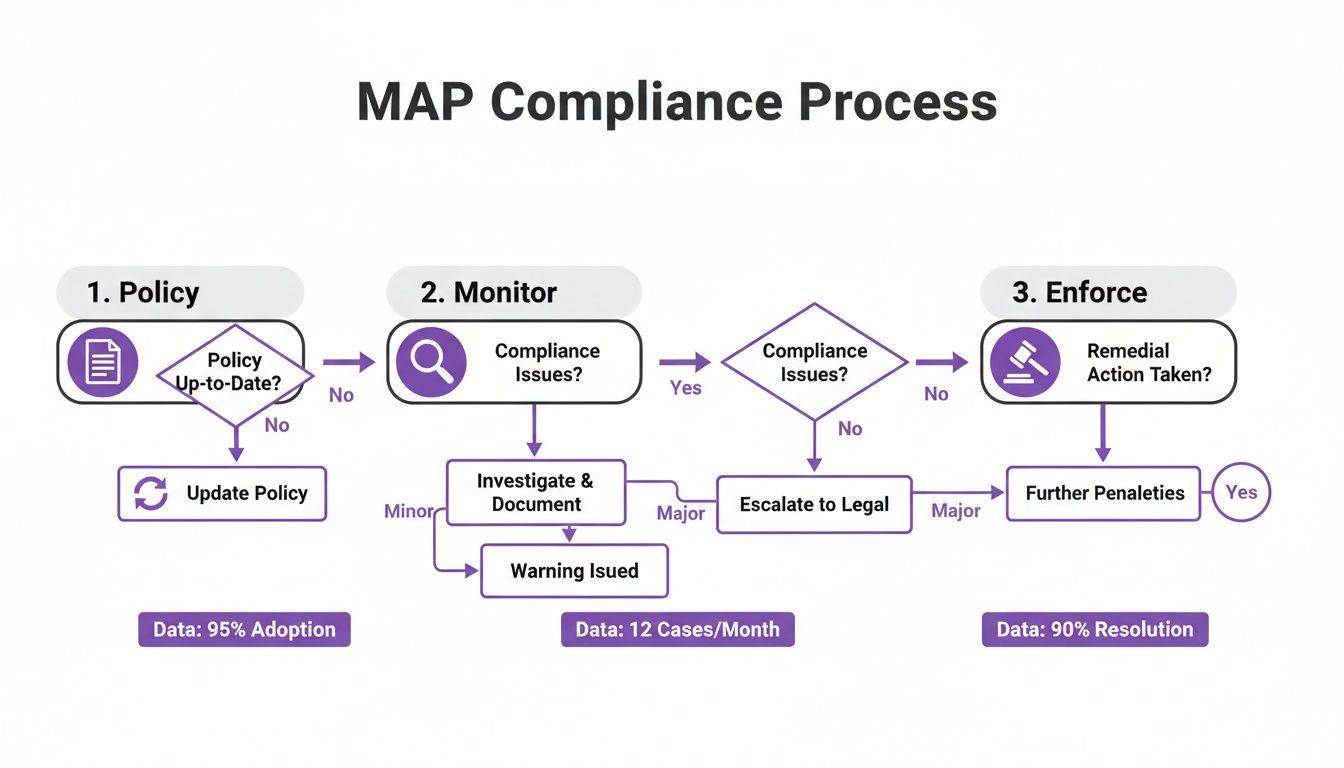
If your organization is not prepared to commit to all three stages, a MAP policy will not be effective.
Guiding Questions for Your Decision
Use these questions to determine whether a MAP policy, an MSRP guideline, or a hybrid approach is the right fit for your business.
1. Is protecting brand perception your top priority? If your brand's reputation is built on a premium image, MAP is the appropriate choice. It prevents price wars that can erode perceived value and ensures consistent positioning across all sellers. A luxury watch brand, for example, would use MAP to prevent its products from being advertised at deep discounts on Amazon, which would devalue the brand.
2. Do your retail channels rely on promotional flexibility? If your partners need the freedom to run flash sales, bundle products, or clear out old inventory, MSRP offers that autonomy. It sets a pricing benchmark but does not restrict a retailer's ability to react to local market conditions. For example, a retailer selling seasonal goods needs the flexibility to discount items at the end of the season without violating a policy.
3. Do you have the capacity for active policy enforcement? A MAP policy without enforcement is ineffective. It requires resources—personnel or technology—to monitor prices, document violations, and communicate with non-compliant sellers. If you lack the capacity for enforcement, MSRP is the more practical option.
The core difference is control versus guidance. MAP provides direct control over your brand's advertised price floor, while MSRP offers guidance. Your choice should reflect your business's primary need.
This is where automated price monitoring tools like Market Edge become useful. They handle the heavy lifting of monitoring and detection, providing your team with the data needed to enforce a MAP policy without being consumed by manual work.
Unpacking the Common Questions: MAP vs. MSRP
Even with a clear strategy, specific questions about MAP and MSRP often arise. Here are answers to two of the most common queries from B2B decision-makers.
Can a Retailer Sell Below MAP?
Yes. This is a common point of confusion. A MAP policy governs the advertised price—what a customer sees on a website, in a digital ad, or on a promotional flyer.
It does not control the final selling price. A retailer can legally sell a product for any price once it is in a customer’s online shopping cart or at a physical checkout counter. The crucial distinction is that the publicly displayed price must not fall below the established MAP.
Is Enforcing a MAP Policy Legal?
In the U.S., it is legal for a brand to establish and enforce a MAP policy, provided it is implemented correctly. The policy must be unilateral—a one-way decision made by the manufacturer—and applied consistently to all retailers.
Legal issues arise if the policy becomes a price-fixing agreement between the brand and its retailers. This can lead to violations of antitrust laws. Maintaining the unilateral nature of the policy is non-negotiable for legal compliance.
Managing these rules and ensuring consistent policy enforcement requires significant effort. This is where automated price monitoring tools like Market Edge come in, providing the visibility required to protect your brand. Find out more at the official Market Edge website.