
You can run a lean warehouse and still get burned by a late shipment. A distributor lands a rush PO, a marketplace listing goes out of stock, pricing starts drifting against a competitor, and suddenly the team is defending a promise it can't physically keep. That's the tension behind just in time inventory, and it's why finance, operations, and commercial teams keep arguing about the same stock position from different angles.
Just in time inventory is a pull-based operating model. You order and receive materials, components, or resale stock close to the moment they're needed, instead of piling up inventory on speculation. In practice, that means less cash tied up, less storage waste, and fewer old assumptions sitting in your warehouse taking up space.
What Just In Time Inventory Really Means for B2B
A B2B team doesn't feel JIT as an abstract theory. It feels like a supplier misses a window, a category manager sees a competitor go out of stock, and the sales team expects you to cover demand that the warehouse never had time to absorb. That's where the discipline matters most, because just in time inventory only works when you treat inventory as a flow problem, not a storage problem.
At its simplest, JIT means materials arrive as close as possible to the moment they're needed in production or fulfillment, which reduces waste and holding costs according to the core definition of the model from Toyota's lean tradition and later business usage (Investopedia). It does not mean “buy nothing” or “hold zero stock.” It means synchronizing supply with demand so tightly that you stop carrying buffers you don't need.
What JIT is and what it isn't
A factory uses JIT to line up raw materials with production starts. A distributor uses it to replenish fast-moving SKUs before they run dry. An ecommerce warehouse uses it to avoid overbuying items that can be tracked in near real time across channels.
Practical rule: if your team can't explain where the next unit comes from, when it arrives, and why that timing is reliable, you don't have JIT. You have hope.
The historical reason this model spread is simple. Toyota used it to cut finished-goods inventory from months of supply to hours in key plants, and that operating discipline became one of the foundations of lean manufacturing globally (Rework). Modern manufacturers with mature JIT and lean programs have reported 20–40% reductions in process lead time within 18 months of sustained adoption (Rework).
For B2B leaders, the takeaway is blunt. JIT is a synchronization strategy, not a storage strategy. If your finance lead thinks it's only about reducing inventory, and your operations lead thinks it's only about avoiding stockouts, both are only half right.
The Core Mechanics Behind a Pull System
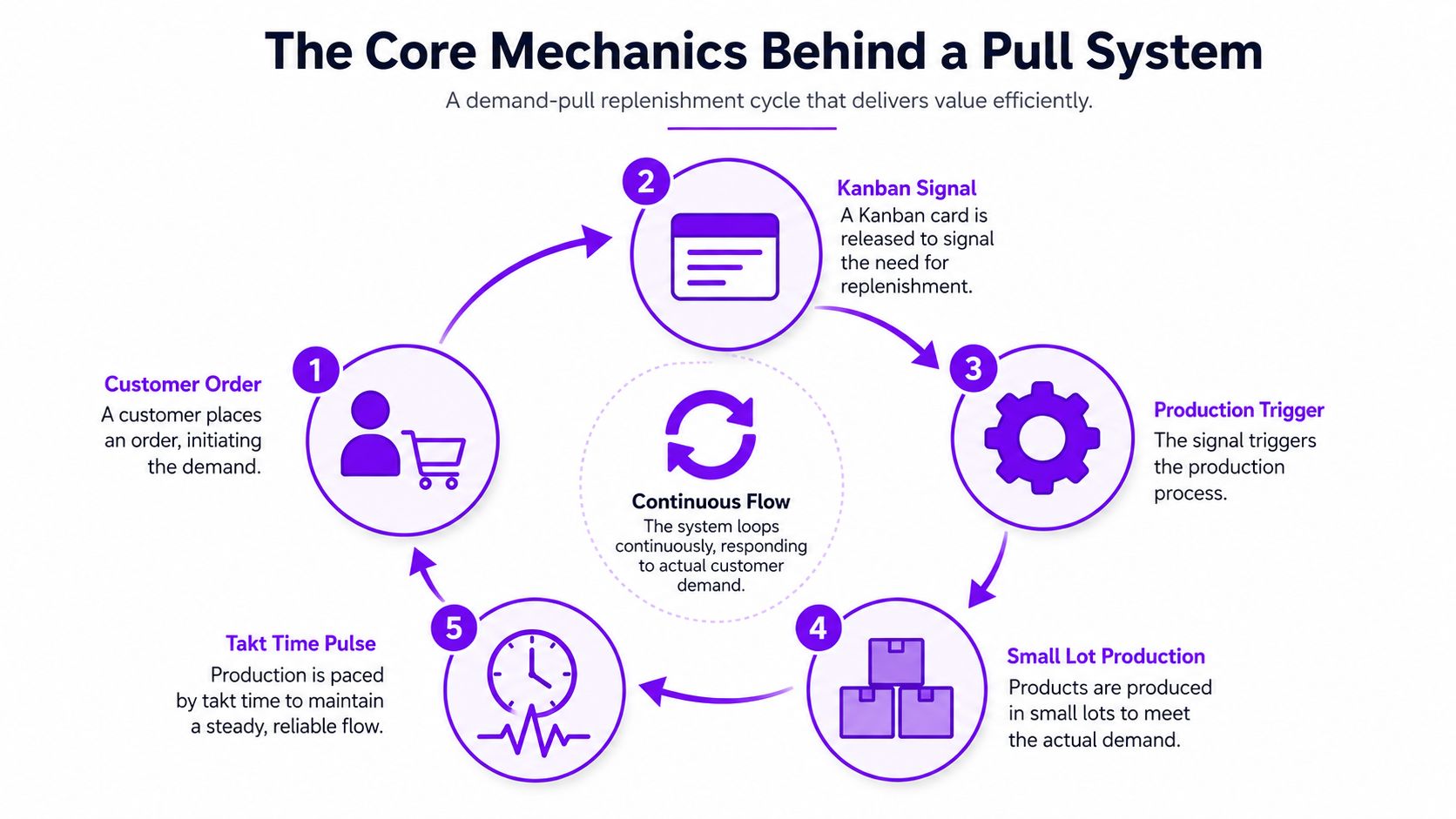
A pull system starts with a real trigger. That trigger can be a kanban card, a two-bin signal, a min-max threshold, or another replenishment rule, but the logic stays the same. Stock moves after demand shows up, then the replenishment cycle responds to that depletion.
The sizing logic is practical. A workable setup uses expected demand rate × replenishment lead time × safety factor, divided by container size, rounded up (Cleverence). That formula shows where the buffer comes from and why the buffer changes. Unstable lead times force more protection. Oversized batches create excess stock. Awkward container sizes make the process harder to run cleanly.
What this looks like in a distribution center
A regional distributor needs replenishment tied to actual depletion, not a fixed month-end buy for a SKU that turns every day. The better move is a small lot sent from the regional node to the forward node as soon as the trigger fires. That keeps the rhythm visible and stops teams from mistaking one large order for control.
Multi-channel demand can break a clean pull setup. Marketplace sales can spike while B2B orders soften, or competitor price cuts can pull demand out of one channel and into another overnight. If you do not separate pure pull SKUs from items that need a buffer, the warehouse will chase noise instead of real consumption. Pure pull belongs on stable, repeatable demand. Buffer stock belongs on volatile items, promotional SKUs, and anything exposed to channel swings.
Takt time sets the pace needed to meet customer demand without overproduction, and pull systems use it to keep production rhythm tied to real orders (Zoho Inventory). If your lines or picking teams cannot hold a steady cadence, the pull signal gets messy fast.
Lead-time reduction is one of the few levers that directly shrinks the buffer JIT needs, so teams trying to cut setup delays and tighten changeovers should cut downtime with this guide. Forecasting also matters, especially when you are dealing with mixed SKU portfolios and uneven demand patterns, so planning teams should use forecasting methods that fit mixed SKU portfolios instead of forcing every item into one average.
Short version. JIT works when signal quality beats stock speculation. If the trigger is sloppy, the system turns into expensive theater.
Where JIT Pays Off in Hard Numbers
The financial case for JIT usually lands faster than the operational one. Inventory carrying costs typically run 20–30% of inventory value per year. A manufacturer holding $10 million in average inventory may spend $2–3 million annually just to carry that stock, and a 50% reduction in inventory can remove $1–1.5 million in carrying costs (Intelycx).
That math matters because cash does not care how tidy the warehouse looks. It cares how much capital is frozen in stock that is not moving. Industry guidance also says organizations adopting JIT can usually cut inventory carrying costs by 30–40%, and some implementations report reductions of up to 75% when supplier discipline and process control are both strong.
What mature programs tend to improve
A 2023 benchmark cited in industry research found mature JIT and lean programs reporting 20–40% reductions in process lead time within 18 months of sustained adoption. The same benchmark set points to common supplier performance thresholds, including supplier on-time delivery above 95%, inventory turnover increases of 20–40%, and Days Inventory Outstanding reductions of 30–50% (Rework).
Those are the numbers that matter in a board pack. Higher turnover means capital cycles faster. Lower DIO means less cash trapped in stock. Better on-time delivery means the system can survive without being padded by excess inventory.
The commercial upside is not limited to factories. An evidence review in healthcare found annual savings of about $3–11 million per hospital, equal to roughly 10–17% in savings (Intelycx). That does not mean every operation gets the same benefit. It means JIT economics are broad enough to matter outside manufacturing, especially where inventory is expensive to hold and easy to measure.
Where the headline ROI gets optimistic
The pitch gets shaky when supplier reliability is weak or demand is erratic. A quoted savings model that assumes perfect replenishment is just a spreadsheet. Real operations need real timing, and timing is where the cost sits.
A JIT business case also has to cover supplier failure, forecast miss, and lead-time drift. If it leaves those out, it is a wish dressed up as finance.
The Risks JIT Articles Tend to Soften
The cleanest JIT story assumes predictable demand, steady suppliers, and stable lead times. That is not how a lot of ecommerce and multi-channel distribution behaves. Demand can swing by channel, by marketplace, and by promotion, and pure JIT gets brittle fast when those signals move at different speeds.
Research on supply chains in turbulent times argues that pure JIT is less reliable when demand and supply become unstable, and practical guidance increasingly points to a split model, use JIT for the most predictable, fast-moving SKUs, then keep buffers on the items that are harder to forecast (City, University of London research). That is the right move. A blanket lean mandate creates fragility when the market is not stable enough to support it.
Which SKUs belong on JIT
Use JIT for items that are all of the following:
- Predictable demand, because the trigger stays dependable.
- Fast-moving volume, because the replenishment rhythm stays active.
- Reliable suppliers, because late inbound stock breaks the model.
- Short, stable lead times, because the buffer can stay small.
Keep buffers for items that are volatile, promotional, multi-channel, or exposed to frequent competitor stock shocks. The more a SKU depends on external availability signals, the less it belongs on pure pull. That includes items that win or lose sales based on marketplace ranking, reseller behavior, or a rival's stockout.
A stockout on a high-visibility marketplace listing hits twice. You lose the sale, then you lose ranking, and your pricing team still has to explain why the item vanished. That is why safety stock calculations matter more than a generic lean rule.
The core mistake is simple. Teams strip out the buffer, then act surprised when a missed inbound shipment stops a line, empties a category page, or forces a price reset that burns margin. JIT should reduce waste, not create avoidable service failures.
Implementing JIT Without Breaking the Operation
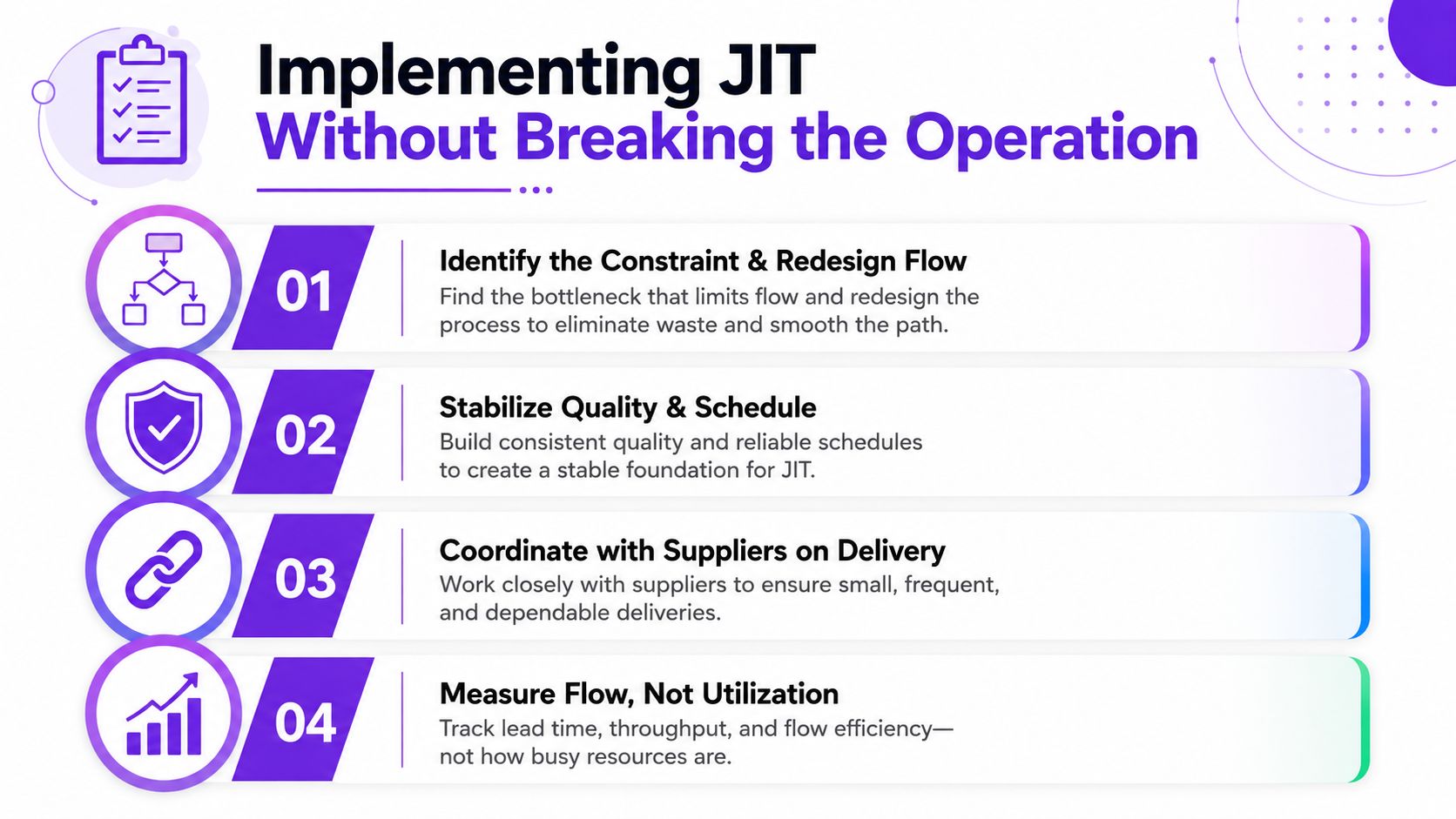
The best JIT rollouts start small and stay specific. I'd rather see one category run well than a full network half-implemented and full of excuses. The practical path is to change how flow is managed, not to reorganize the entire business in one quarter.
Four moves that work in real operations
-
Redesign around the constraint.
Don't rebuild every SKU lane. Start with the constraint that causes the most missed fills, then simplify the path around it. A distributor can do this by rationalizing slow movers out of the JIT pilot and focusing on one repeatable category. -
Stabilize quality and schedule.
Pull signals only work when quality doesn't wobble and schedules don't swing wildly. JIT depends on tight process control, including quality management and schedule stability through TQM and statistical quality control (NetSuite). -
Use real pull triggers.
Kanban, smaller lot sizes, and clean replenishment thresholds keep the system honest (NetSuite). A retailer can pilot this on one fast-moving category, then tighten the rule only after the first cycle proves stable. -
Renegotiate vendor terms.
Tight vendor relationships matter because JIT runs on lead-time commitments and delivery expectations (NetSuite). If a supplier won't commit to timing, that SKU isn't ready for pull.
A useful way to manage the rollout is through mobile workflows that keep receiving, exception handling, and supplier follow-up visible in one place. For teams looking at practical execution patterns, enterprise logistics mobile app examples can help frame how field and warehouse teams keep JIT triggers trustworthy.
A supplier scorecard should be part of the quarter-one plan. Track on-time delivery, defect escapes, and missed window performance. If the scorecard turns red, your JIT pilot should shrink, not expand.
JIT Compared With Other Replenishment Strategies
JIT isn't the right default for every SKU class. That's the point a lot of management decks skip. The decision should be made item by item, based on predictability, lead time, and the commercial cost of a stockout.
| Strategy | Best for SKUs that are | Primary signal | Main trade-off |
|---|---|---|---|
| Just in time inventory | Fast-moving, predictable, supplier-stable | Actual demand and replenishment trigger | Low carrying cost, higher exposure to disruption |
| EOQ reorder points | Repeat demand with stable consumption patterns | Order point and lot economics | Efficient ordering, but still carries buffer inventory |
| Safety stock | Volatile, promotional, or hard-to-source items | Service-level protection | Better continuity, more capital tied up |
| Vendor-managed inventory | High-volume, trusted supplier relationships | Supplier-owned replenishment logic | Less admin work, but dependence shifts upstream |
| Consignment | Strategic items where ownership timing matters | Consumption or usage event | Cash-flow relief, but requires tight controls |
JIT is strongest when the product flow is clean and the supplier base is reliable. Safety stock makes more sense when demand is messy or market exposure is high. VMI can work well when a supplier already sees the demand pattern clearly and can manage replenishment without constant intervention.
For broader operational context, it helps to pair this with best practices for inventory control, because JIT only performs when the basics are already disciplined.
The rule of thumb is simple. Use JIT where timing is predictable, buffer where timing is not. If the SKU is strategic, volatile, or exposed to external shocks, don't force it into pure pull just to satisfy a lean slogan.
Metrics That Tell You if Your JIT Program Is Working
A distributor checks Amazon and sees a listing go dead. The ERP still shows healthy warehouse stock, so the team assumes replenishment is fine. It is not. The right JIT scorecard catches that gap early, before a marketplace stockout turns into lost rank, rushed buying, and price pressure on the rest of the channel.
A JIT dashboard should stay tight and actionable. The control variables that matter are inventory turnover, Days Inventory Outstanding, supplier on-time delivery, stockout rate, and order fulfillment rate because a delay in any one of them can ripple into missed service levels or stalled output (IT Convergence). If the dashboard has twenty widgets, the team is usually hiding a problem, not managing one.
What each metric is telling you
- Inventory turnover. Higher is generally better. If turnover improves and service stays steady, the program is working.
- Days Inventory Outstanding. Lower DIO means less cash trapped in stock and a shorter storage cycle.
- Supplier on-time delivery. This shows whether upstream timing can support pull replenishment.
- Stockout rate. If this rises while supplier delivery stays stable, the issue is usually forecast error, trigger timing, or an overcut buffer.
- Order fulfillment rate. This is the commercial check. It shows whether customers got what was promised.
Read these together, not one at a time. A rise in stockouts with stable supplier delivery points to a planning problem, not a vendor problem. Turnover can look great while service slips, and that usually means the team cut inventory too hard. In ecommerce, that mistake shows up first on marketplace listings and price-sensitive fast movers. In B2B, it shows up as backorders and frustrated account managers.
What a manager should do with the signals
- Pricing manager: If a fast mover keeps stocking out, stop treating price as the only lever. Availability shapes price realization and promo lift.
- Supply manager: If lead-time drift keeps showing up, tighten supplier commitments before you cut buffer again.
- Ecommerce lead: If fulfillment slips on marketplace SKUs, split listing-level availability from warehouse availability and manage them separately.
A good JIT review also needs a hard call on SKU behavior. Pure pull belongs on items with steady demand and reliable supply. Volatile, promoted, marketplace-exposed, or competitor-sensitive items need a buffer, even if that buffer is small. The point is not to chase the lowest inventory line at all costs. The point is to keep the right stock in the right place and stop forcing weak SKUs into a pull system they will break under pressure.
Why External Visibility Is the Missing Piece in Modern JIT
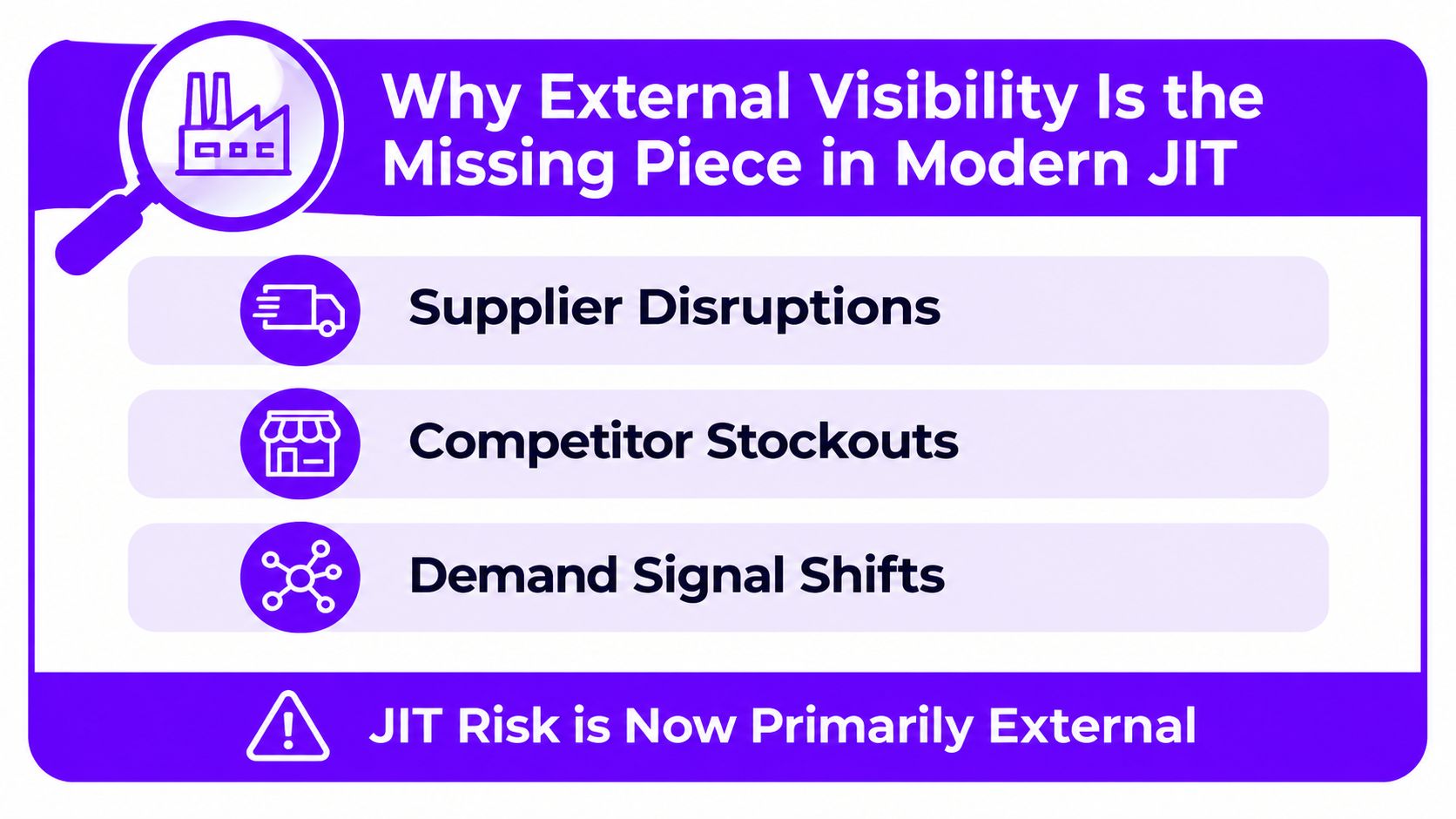
JIT used to be framed as an internal coordination problem. Today, the bigger risk is often outside your four walls. Competitor stockouts, marketplace pricing swings, and reseller channel changes can shift demand before your warehouse data even looks stale.
That's why lean replenishment now needs near-real-time visibility into both internal stock and external market availability. A JIT setup that only watches ERP quantities is blind to the market signals that drive lost sales, pricing pressure, and availability mismatches. If you're managing fast movers across Amazon, eBay, eMAG, reseller sites, or your own storefront, external stock signals are part of the control system, not a separate commercial report.
The practical checklist is simple:
- Track supplier disruptions so late inbound stock doesn't surprise the team.
- Monitor competitor stockouts so you know when demand may swing toward you.
- Watch demand signal shifts across channels before your forecasts drift.
- Separate buffered SKUs from JIT SKUs so the wrong items don't run on the wrong rule.
- Review market availability daily if the category is sensitive to price and stock changes.
For teams building that visibility layer, supply chain visibility guidance is a useful complement to internal planning. This is also where automated price and stock monitoring tools like Market Edge become useful, because they connect competitor pricing and availability monitoring to the replenishment decisions your team already has to make.
If you're trying to decide which SKUs should stay on pull and which ones need buffers, make that call with live stock and price data, not guesswork. Market Edge helps teams track competitor pricing and stock across resellers and marketplaces so JIT doesn't collapse the moment the market shifts.