
High-low pricing is a classic retail strategy where a product debuts at a higher price point, only to be marked down later during a promotion. You’ve seen it a thousand times: a product launches with a certain price tag, and a few weeks later, it’s the star of a "50% Off!" sale.
The effectiveness of this strategy lies in psychology. The initial high price sets a "reference point" or an anchor in the customer's mind. When the discount hits, it doesn't just feel like a sale—it feels like a significant bargain. This creates a powerful sense of urgency that can convert a prospective buyer into a customer. For B2B decision-makers, understanding how to leverage this is key to driving targeted sales growth.
What Is High Low Pricing and Why It Works
At its core, high-low pricing is a calculated play on customer perception. For founders and pricing managers, its commercial power is in shaping buying behavior to drive revenue during specific periods. By setting a high initial price, you are establishing the product's perceived value.
When you eventually lower that price, the discount appears substantial, triggering a fear of missing out (FOMO). This contrasts sharply with an Everyday Low Pricing (EDLP) strategy, which offers steady, predictable prices without promotional peaks. High-low pricing is about creating sales events that energize your customer base and drive volume.
High Low Pricing at a Glance
The table below provides a quick overview of the core components of a high-low pricing strategy.
| Component | Description | Commercial Goal |
|---|---|---|
| Reference Price | The initial, higher price point at which a product is introduced to the market. | Establish a strong perception of value and quality in the consumer's mind. |
| Promotional Price | The temporary, discounted price offered during sales events or special promotions. | Create urgency, drive high sales volume, and attract price-sensitive customers. |
| Sale Frequency | The planned schedule of promotional periods (e.g., seasonal sales, holiday events). | Generate predictable traffic spikes and manage inventory turnover effectively. |
| Customer Segmentation | The ability to appeal to different buyer types at different times. | Capture revenue from both early adopters (at full price) and bargain hunters (during sales). |
As you can see, each piece of the strategy is designed to work together to maximize both perceived value and sales volume, just at different times.
The Commercial Impact of Strategic Discounting
This isn't just about moving last season's inventory. It’s a strategic way to appeal to different segments of your market. Brand loyalists and early adopters are often willing to pay the full premium at launch. Later, more price-conscious buyers can be captured during a sale. This lets you maximize revenue across your entire customer base.
For B2B brands, manufacturers, and distributors, the key benefits are clear:
- Driving Traffic and Demand: Scheduled promotions bring new and existing customers to your site or store, leading to significant spikes in sales volume.
- Efficient Inventory Management: High-low pricing is effective for clearing out seasonal items, overstock, or slow-moving products without constantly degrading baseline margins.
- Creating a Perception of Quality: A higher starting price often signals a higher-quality product. This premium perception can persist, reinforcing your brand's position even when the item is on sale.
The core tradeoff is simple: you sacrifice stable, day-to-day profit margins for the chance to generate massive sales volume during planned promotions. It’s a deliberate choice to prioritize demand generation in concentrated bursts.
This approach is valuable for managing product lifecycles. A manufacturer can launch a new model at a premium price while using promotions to clear out the previous generation's stock. However, successful execution requires careful planning. You need to know your competitors' prices to ensure your "high" price is credible and your "low" price is competitive enough to win the sale.
This is where having real-time market data from a platform like Market Edge becomes essential.
Weighing the Pros and Cons for Your Business
Deciding to use a high-low pricing model is a significant strategic decision. It has clear upsides but also comes with tangible risks. Ecommerce managers, founders, and sales leaders must evaluate this from all angles to ensure it aligns with commercial goals. While the rush of a big sale can bring in traffic, you must consider the long-term health of your brand and profit margins.
The biggest draw of high-low pricing is its ability to kickstart demand and acquire new customers. Promotions create urgency, attracting shoppers who might have otherwise overlooked your brand. It's also an effective way to manage inventory, providing a built-in process for clearing out older collections or slow-moving products without devaluing your entire catalog. Furthermore, this approach naturally segments your customer base, capturing full-margin sales from early adopters and a different, price-conscious crowd during sales events.
The Advantages of a High-Low Pricing Strategy
When executed correctly, the benefits extend beyond a quick revenue bump. It can be a powerful tool for customer acquisition, inventory management, and market perception.
- Drives High-Volume Traffic: Sales events act as magnets, attracting significant attention and clicks. A well-timed promotion can introduce your brand to a new wave of potential customers.
- Keeps Inventory Moving: This model provides a reliable method for liquidating older stock. Instead of sitting on dead inventory, you turn it into an asset that drives traffic and sales.
- Boosts Perceived Value: The initial high price sets a powerful value anchor. When customers see the discount, they feel they are getting a premium product for an excellent price, which enhances their purchase satisfaction.
- Enables Smart Market Segmentation: High-low pricing allows you to cater to two distinct shopper profiles: those who want the newest product immediately and are willing to pay a premium, and bargain-hunters who are willing to wait for a discount.
The Disadvantages and Risks Involved
This strategy is not without its downsides. Leaning too heavily on promotions can train customers to wait for discounts, a cycle that is difficult to break and can cause long-term damage if not managed carefully.
The single biggest risk of high-low pricing is customer conditioning. If you run sales too often, your audience learns to completely ignore the "high" price, because they know a "low" one is just around the corner. This systematically destroys your ability to sell at full margin.
This conditioning leads to other problems that require proactive management.
- Margin Erosion: The most immediate impact is on your gross profit margins. Deep and frequent discounts reduce the profitability of each sale, requiring higher volumes to achieve the same profit.
- Brand Devaluation: Constant sales can make a brand feel less premium. Shoppers may start to perceive the discounted price as the real price, making your regular price seem inflated.
- Operational Headaches: Managing frequent price changes, updating marketing materials, and handling large order spikes is a significant operational lift, especially for businesses with large product catalogs.
- Higher Marketing Costs: Each promotion requires a dedicated marketing push to gain visibility. This means you’re consistently spending more on advertising to announce sales and create urgency.
Ultimately, whether high-low pricing is right for you comes down to a balancing act. It requires a solid understanding of your customers, the operational capacity to execute, and a clear picture of your competitors' activities. This is where automated competitor tracking becomes so important. Knowing when a rival is about to launch a sale helps you time your own for maximum effect. Tools like Market Edge provide that visibility, helping you navigate the complexities of this dynamic pricing model.
Choosing Between High Low Pricing and EDLP
As a brand, retailer, or manufacturer, choosing your pricing philosophy is a fundamental decision. The two dominant models, high low pricing and Everyday Low Pricing (EDLP), represent opposite approaches. They shape your entire strategy for marketing, operations, and how customers perceive your value.
EDLP is the strategy of consistency, famously used by giants like Costco and Walmart. They promise fair, predictable prices every day, so customers don't have to wait for a sale. High low pricing, in contrast, creates excitement and urgency with promotions and sales events. Selecting the right path requires a careful analysis of your brand identity, operational capabilities, and the competitive landscape.
Operational and Financial Implications
These two strategies place vastly different demands on your business. EDLP is operationally simpler. Stable prices make demand forecasting more reliable, leading to cleaner inventory management and a leaner supply chain. Marketing costs are also typically lower because the message is one of consistent value, not constant sales.
High low pricing requires a more dynamic operational engine. To make it work, you need:
- An agile marketing team to plan, launch, and amplify promotional campaigns.
- Flexible inventory systems to handle demand spikes during sales and lulls in between.
- Constant price management across all channels, which is complex for large SKU counts.
The choice is clear: Do you prefer the operational simplicity and predictable margins of EDLP, or are you equipped to manage the complexities of driving large, temporary sales events?
Brand Positioning and Customer Expectations
Your pricing strategy sends a powerful signal to the market. EDLP builds a reputation for trustworthiness and dependability. Customers learn they can rely on you for a fair price anytime, fostering long-term loyalty based on convenience and trust.
High low pricing cultivates a relationship based on the thrill of finding a deal. This model is effective for attracting bargain-seekers and generating buzz. The risk is that you can unintentionally train customers to devalue your products at their regular price. If not managed carefully, your audience will learn to wait for sales, eroding your ability to sell at full margin.
The strategic question isn't just about the numbers; it's about the customer behavior you want to cultivate. EDLP encourages steady, predictable buying habits, while high low pricing trains customers to pounce on promotional triggers.
This decision tree illustrates the trade-offs, showing how the potential for increased traffic comes with the risk of margin erosion.
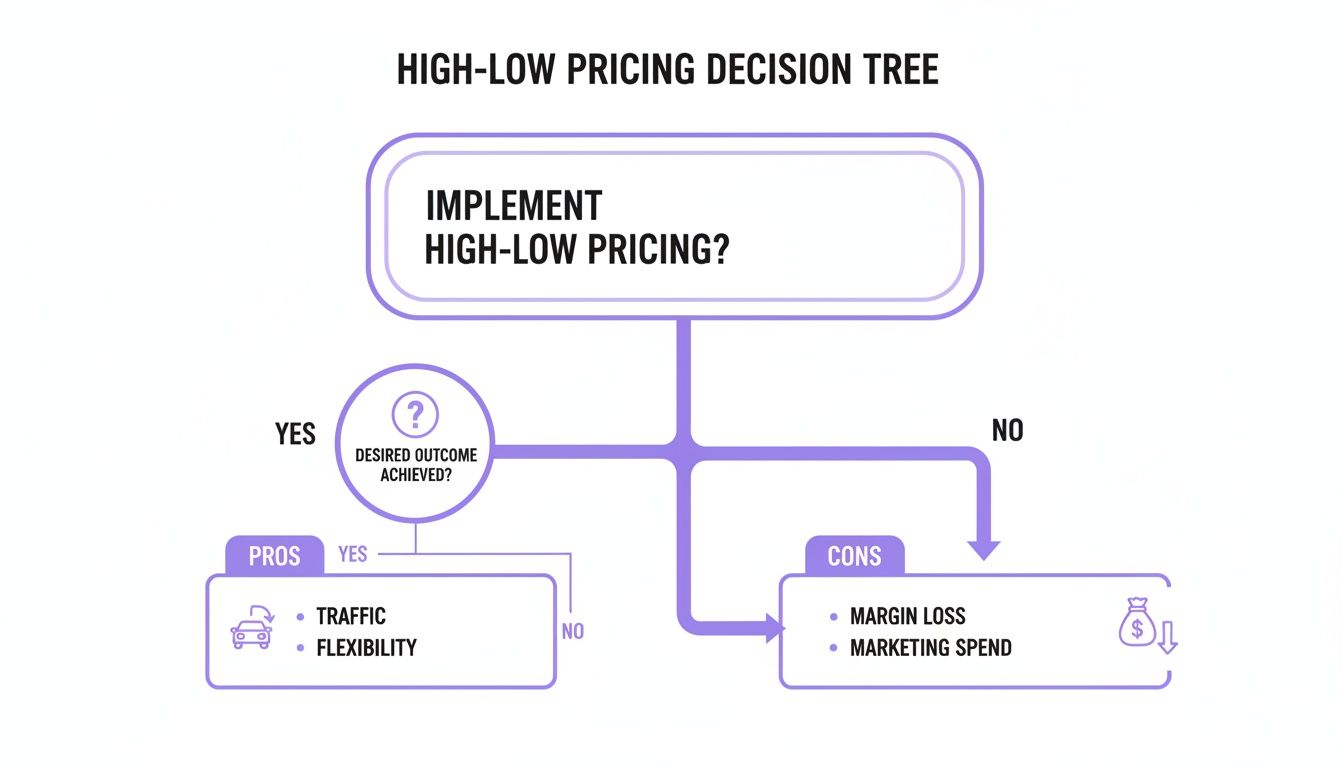
As the visual lays out, the path to more traffic and strategic flexibility is paved with higher marketing costs and thinner margins—a balance that must be carefully managed.
High Low Pricing vs Everyday Low Pricing (EDLP)
This table breaks down the core distinctions between High Low pricing and EDLP.
| Factor | High Low Pricing | Everyday Low Pricing (EDLP) |
|---|---|---|
| Pricing Model | Prices are initially set high and then periodically lowered through promotions and sales. | Prices are consistently kept low, without frequent sales events. |
| Customer Perception | Creates excitement and urgency; attracts bargain hunters. Can erode brand value if overused. | Builds trust and predictability. Attracts customers who value convenience and consistent value. |
| Marketing Strategy | Relies heavily on frequent, high-impact promotional campaigns to drive traffic and sales. | Focuses on brand-level marketing to reinforce the message of consistent, reliable value. |
| Inventory Management | Complex. Must manage unpredictable spikes in demand, leading to higher holding costs. | Simpler and more predictable. Stable demand leads to leaner inventory and a more efficient supply chain. |
| Profit Margins | Margins are higher on full-priced items but significantly lower during sales. Overall margin is variable. | Margins are consistently lower but more stable and predictable on a per-unit basis. |
| Ideal For | Retailers with strong marketing capabilities, seasonal products, and a desire to create buzz. | Businesses focused on operational efficiency, customer loyalty, and a strong value proposition. |
Ultimately, the choice depends on your brand's DNA. High low pricing is about creating moments of high energy, while EDLP is about building a foundation of steady trust.
The grocery sector offers a perfect real-world example of this clash. The shift from high low to EDLP has completely reshaped global grocery, with discounters like Aldi and Lidl surging ahead by sticking to fixed low prices. In the UK grocery market, valued at £220 billion in 2023, legacy players relied on high low tactics where promotions drove 25-35% of sales volume.
But since the 2010s, Aldi’s market share has exploded from 2.5% to 10.2% by 2023. Together, Aldi and Lidl now command 18% of the market, won directly from the high-low incumbents. This EDLP approach resonated deeply, with 55% of consumers saying they prioritize price consistency, especially during times of inflation. You can find more details on how the EDLP strategy is shaking up retail on prgx.com.
This is where automated price monitoring tools like Market Edge become indispensable for brands trying to navigate these complex dynamics.
How to Implement Your High-Low Pricing Strategy

Implementing a high-low pricing strategy requires a methodical, data-driven plan. For managers, success depends on a structured approach that covers everything from setting initial prices and planning promotions to marketing and measuring results. Without a clear plan, you risk setting unrealistic prices, running unprofitable sales, and damaging your brand. This blueprint provides actionable steps for putting a high-low strategy in place.
1. Establish a Credible Reference Price
The entire strategy hinges on the 'high' price, or reference price. Customers must perceive it as fair and legitimate; otherwise, your discounts will appear deceptive.
To establish a solid reference price, analyze three key factors:
- Competitor Benchmarks: Understand what direct competitors are charging for similar products. Your 'high' price should be in a comparable range to be believable. A price that is 30-40% higher than the market average without clear justification will raise suspicion.
- Customer Perceived Value: Consider your brand's reputation, product quality, unique features, and customer service. These intangibles justify a premium and help set a strong price anchor.
- MAP/RRP Adherence: For manufacturers and distributors, your reference price must align with your established Minimum Advertised Price (MAP) or Recommended Retail Price (RRP). Setting a 'high' price that violates these policies creates conflict with retail partners. Using MAP policy monitoring software is crucial for maintaining pricing consistency.
2. Develop a Strategic Promotional Calendar
With reference prices set, map out your promotions. A well-planned promotional calendar dictates the timing, depth, and duration of sales events. It prevents random, margin-eroding discounts that can devalue your brand over time. The goal is to create a rhythm of promotions that builds excitement without training customers to wait for sales.
Your calendar should include different types of events:
- Major Seasonal Sales: Anchor your year with predictable events like Black Friday, end-of-season clearances, or holiday promotions.
- Flash Sales: Use short-term, high-discount events (24-48 hours) to create urgency and clear specific, slow-moving stock.
- Category-Specific Promotions: Run targeted sales on certain product lines to generate interest or respond to competitor actions without discounting your entire catalog.
A classic mistake is making your promotions too frequent or too predictable. If your customers know a 25% off sale is coming on the first Tuesday of every month, they’ll simply hold off on buying. You've just killed your full-margin sales.
3. Execute a Multi-Channel Marketing Plan
A great promotion is ineffective if no one knows about it. A coordinated marketing plan is essential for communicating sales and driving traffic. Your messaging should consistently emphasize the savings against the 'high' reference price to reinforce the value of the deal.
Integrate your plan across multiple channels:
- Email Marketing: Announce sales to your subscriber list, segmenting it to send relevant offers based on past purchases.
- Paid Advertising: Use social media and search ads to attract new audiences, highlighting the discount percentage or final sale price in your ad creative.
- On-Site Merchandising: Update your website with banners, dedicated landing pages, and countdown timers to increase urgency.
- Social Media: Build anticipation before a sale goes live. During the event, share user-generated content to create social proof.
4. Define KPIs and Measure Performance
You can't improve what you don't measure. A successful high-low pricing strategy requires constant analysis and adjustment based on performance data. Before launching any promotion, define the Key Performance Indicators (KPIs) you will use to measure its success.
Your measurement framework should include:
- Sales Lift: The percentage increase in sales volume during a promotion compared to a non-promotional period.
- Gross Margin Impact: The total gross margin dollars generated during the sale. High sales lift is meaningless if you lose money on each unit.
- Inventory Turnover: How quickly the discounted product sold. This is crucial for evaluating the effectiveness of clearance sales.
- Customer Acquisition Cost (CAC): How many new customers the promotion attracted and the cost to acquire them.
Throughout this process, competitive intelligence is critical. Using a platform to automatically monitor competitor pricing and promotions allows you to set more credible reference prices and adjust your calendar in response to market shifts. This is where automated price monitoring tools like Market Edge prove their worth.
Learning from the Real World: Triumphs and Pitfalls
Theory is a good starting point, but actionable lessons come from real-world examples. Examining how other companies have succeeded—and failed—with high-low pricing provides a clear blueprint of what to do and what to avoid. It’s a delicate balance between driving sales and protecting brand value.
The J.C. Penney story is a classic cautionary tale about abandoning a high-low model too abruptly. For decades, their customers were conditioned to expect sales and coupons. This "thrill of the hunt" was integral to the J.C. Penney brand and drove significant traffic and sales.
In 2011, new leadership replaced this model with a 'Fair and Square' strategy, an Everyday Low Pricing (EDLP) approach. They eliminated the sales cycle, and the result was disastrous. Same-store sales dropped by 25% in the first year, and the company lost over $1 billion as its loyal, bargain-hunting customers felt alienated. By early 2013, the company was forced to revert to its high-low strategy. You can read more about the J.C. Penney pricing saga at wallstreetoasis.com.
A Masterclass in Product Lifecycle Pricing
In contrast, the video game industry offers a masterclass in executing high-low pricing correctly. Publishers have perfected the use of this strategy to maximize revenue over a game's entire lifecycle.
A major new game often launches at a premium price, such as $60 or $70, targeting die-hard fans and early adopters. This establishes a high perceived value. After the initial hype subsides, a series of planned discounts begins:
- First Markdown (1-3 months): A modest price drop, perhaps 25% off, attracts the next wave of buyers who were interested but unwilling to pay full price.
- Seasonal Sales (6-12 months): The game receives a deeper discount—50% off or more—during major sales events like the Steam Summer Sale, capturing the mass-market audience.
- Bundles and Subscriptions (12+ months): Eventually, the game is bundled with other titles or added to a subscription service, monetizing the long tail of the market.
This tiered approach effectively segments the market over time, allowing the company to capture revenue from different customer types at various price points. It is a smart execution that keeps a product profitable long after its launch and one of many examples of dynamic pricing where timing is everything.
Common Traps to Avoid in Your Strategy
These examples highlight critical traps that can turn a profitable strategy into a margin-killer.
The biggest danger is losing credibility. If customers feel your "high" price is just a made-up number to make the discount look good, they won't see a genuine deal. They'll see a trick. That kind of damage to your brand's trust can be permanent.
To keep your strategy on track, avoid these common mistakes:
- Setting an Unrealistic "High" Price: Your starting price must be believable and in line with competitors for similar products. Continuously tracking the market is essential to anchor your prices in reality.
- Discounting Too Often: Constant sales train customers to never pay full price. Your discounted price effectively becomes your new regular price, eliminating your ability to sell at full margin.
- Ignoring Competitor Actions: Without monitoring the competition, you can easily be drawn into an unprofitable price war. Data is needed to decide whether to match, ignore, or counter a rival's promotion.
- Creating Channel Conflict: For manufacturers, a high-low strategy must be managed carefully to avoid alienating retail partners. If your direct-to-consumer sales consistently undercut your resellers, you risk damaging critical relationships and violating your own MAP or RRP policies.
Avoiding these traps requires discipline and reliable data. A clear view of the market is necessary to set credible prices and time promotions for maximum impact without compromising your brand's integrity. This is where a platform like Market Edge becomes indispensable.
Fine-Tuning Your Strategy With Competitor Monitoring

An effective high-low pricing strategy is not a "set it and forget it" plan; it must be dynamic and adaptable. Without a constant pulse on competitor activities, you risk setting irrelevant reference prices, timing promotions poorly, and leaving revenue on the table.
Market intelligence allows you to set initial "high" prices that are both ambitious and credible. It also helps you time your sales for maximum impact, preventing you from launching a major promotion at the same time as a competitor, which often leads to a race to the bottom on price.
Protecting Your Pricing Structure
Competitor monitoring is your first line of defense for enforcing MAP or RRP agreements. It helps you identify unauthorized discounting from resellers that can undermine your entire pricing structure and create friction with compliant partners. By monitoring competitor stock levels, you can even adjust your own pricing to capitalize on their logistical issues, turning their out-of-stock problem into your market share gain.
This is where automated competitor price monitoring software proves its worth. It delivers the live data needed to execute a sophisticated high-low strategy based on facts, not guesswork.
A high-low strategy executed in a vacuum is a recipe for margin erosion. True optimization comes from using real-time market data to inform every pricing decision, from setting the initial anchor to timing the final discount.
A Real-World Look at Strategic Discounting
The video game industry offers a prime example of high-low pricing. Publishers use high initial prices followed by a strategic cadence of discounts to maximize profit over a game's lifecycle.
In the global video game market, valued at $184 billion in 2023, a major new title from a publisher like Electronic Arts often debuts at a premium price, such as $59.99 USD. This price targets dedicated fans and early adopters, who can account for 40-60% of launch-week revenue.
Once the initial hype subsides, the high-low strategy continues. Publishers roll out markdowns to attract more price-sensitive gamers. Data shows that around 65% of a game's total sales occur after the launch window, almost always at a discount. This approach can extend a product’s profitable life from a few months to several years. You can find more details on this strategy at retalon.com.
Turning Data Into Action
For any brand or manufacturer, tracking these price drops across the market is essential. It signals opportunities to undercut a rival or flags a MAP violation that requires attention. A smart monitoring plan should include the following actions:
- Set Up Alerts: Create automatic notifications for when a competitor's price on a key product drops below a certain threshold.
- Track Stock Levels: Monitor competitor inventory. An out-of-stock signal can be a strategic opening for you.
- Enforce MAP/RRP: Use monitoring data as concrete evidence when addressing non-compliant resellers.
This is exactly why automated tools like Market Edge are so valuable. They give you the real-time intelligence needed to act fast and protect your brand's position in the market.
Common Questions About High-Low Pricing
How Do You Set a "High" Price Without Alienating Customers?
A successful "high" price is based on perceived value, not arbitrary inflation. Your starting price must feel believable. Begin by benchmarking against competitors to establish a realistic range. Then, clearly communicate why your product is worth that price. High-quality materials, exclusive features, or outstanding customer support can all justify a premium. When customers understand the value, the high price feels fair, and the subsequent discount feels like a genuine bargain.
What's the Right Frequency for Running Promotions?
This requires a careful balance. Too many promotions can train customers to never pay full price, devaluing your brand. Too few can mean missing opportunities to drive sales, acquire new customers, and clear old inventory. A solid approach is to anchor promotions to major retail seasons like Black Friday or Back to School, then supplement with occasional surprise flash sales to create urgency without making your discount schedule predictable.
Does a High-Low Strategy Actually Work for B2B?
Yes, absolutely. While commonly associated with consumer retail, high-low pricing is also a powerful tool in the B2B sector. Volume discounts are a form of high-low pricing, offering promotional rates for larger orders. The strategy is also effective for moving last season's inventory to distributors or offering limited-time introductory rates on service contracts to acquire new clients.
Executing a sophisticated high-low pricing strategy requires constant market visibility. This is where automated price monitoring tools like Market Edge become invaluable, providing the real-time data needed to stay ahead of the market.